TNCS’s Multi-Language Program Embraces the 5 Cs

One of the main questions that came up in last month’s Town Hall meeting was, “How I can continue developing my kids’ multi-language skills at home?”. In fact, this question has been asked since The New Century School‘s inception, and, as multilingualism has become the linchpin of TNCS’s scholastic identity, parent interest has grown apace.

TNCS’s Multi-Language Program—the 5 Cs

TNCS students learn two languages besides English—Mandarin Chinese and Spanish. These particular two will serve them well in our ever-globalizing, internationally collaborative society. Immersion in another language is far and away the proven best method to learn that language, and TNCS incorporates immersion style throughout the grade levels in varying degrees, from offering complete immersion in the pre-primary program to having assistant teachers who speak only in their native languages (Chinese or Spanish) in the primary and elementary classrooms. For the upper grades, however, a bit of academic rigor becomes necessary if the students are to effectively read and write in other languages. Thus, TNCS administration has been steadily refining and tightening the foreign language program to be reproducible each year. Immersion is wonderful to develop the cadence and feel of a language—fluency—but by its very nature, it is not able to be structured, reproduced, or measured.

These two talented, dedicated women overhauled the foreign language curriculum to be exciting for kids, highly educational, and reproducible for staff.

These two talented, dedicated women overhauled the multi-language curriculum to be exciting for kids, highly educational, and reproducible for staff.

So, jumping off from the groundwork laid by former Foreign Language Curriculum Specialist Lisa Warren, Xie Laoshi and Señora Capriles took over the curriculum for the 2013–2014 school year and really brought it to life. They espouse the national standards set by the American Council on Foreign Language Teaching (ACTFL)—the 5 Cs of Language Learning: Communication, Cultures, Connections, Comparisons, and Communities.

Communication

“Communication is at the heart of second language study, whether the communication takes place face-to-face, in writing, or across centuries through the reading of literature.”

Standards for Foreign Language Learning in the 21st Century

Communication, Cultures, Connections, Comparisons, and Communities.

Communication, Cultures, Connections, Comparisons, and Communities.

“Reading is a big part of both classes,” explains Xie Laoshi, “and the kids average about 85% correct comprehension and pronunciation.” Xie Laoshi works very hard to make sure that the students are really learning rather than boring them with nothing but rote exercises. Communication occurs in “real-life” situations to emphasize what students can do with language rather than what they know about a language, such as how many vocabulary words. There is a necessary repetitive component, of course, to learning another language, but Xie Laoshi believes in absorption over memorization. Exercises like creating a pictorial dictionary, in which her students must write a vocabulary word in pinyin (phonetic transcription of Chinese characters into the English alphabet) and in the Chinese character as well as illustrate it, reinforces the understanding of that vocabulary word far more deeply than simply repeating it to oneself several times. “When they connect a word or concept with something personal like objects in their bedroom,” she says, “they absorb better.”

Students even write their own illustrated stories in Mandarin.

Students even write their own illustrated stories in Mandarin.

This is one teacher who knows how to engage her students. She has a natural intuition for what lessons and materials will work and what won’t. In fact, she famously ordered and then rejected an entire semester’s worth of Mandarin workbooks and then made her own, based on her understanding of how kids learn. She makes learning active and interactive. In addition to making pictorial dictionaries, she has students record dialogues of their own creation and play them back for analysis (another means of communication). This kind of commitment is critical to teaching Mandarin, which is among the most difficult languages in the world, not least because it’s tonal. “In order to differentiate meaning, the same syllable can be pronounced with 4 different tones, but then it can have 2–10 different characters and meanings that must be understood in context,” she explains. These meanings are not necessarily related, to intensify the complexity. The word yuè, for example, means “leap,” “moon,” “to cross,” “weapon,” and “months,” depending on how it’s pronounced as well as the context in which it occurs! Then there’s the grammar, the “radicals,” the character-writing—oh, and the fact that some words simply don’t have an English pronunciation equivalent . . . it’s pretty amazing that anyone could learn Mandarin as a second language, given its level of difficulty, but our kids are certainly doing it! “It’s okay if they get frustrated and give up temporarily,” says Xie Laoshi. “I don’t want to stress them out; they’ll come back to it when they are ready!”

Pictured is a third-grade elementary student's Mandarin workbook. She is able to both read and write in Mandarin and, by her own account, loves it!

Pictured is a third-grade elementary student’s Mandarin workbook. She is able to both read and write in Mandarin and, by her own account, loves it!

Besides actually teaching Mandarin to the elementary students, Xie Laoshi also provides Mandarin materials for all levels. The materials are all variations on the same theme, but her expectations for how they are used and what the student will get out of them depends on age and skill level. The younger students focus largely on comprehension and pronunciation, while the older students incorporate reading and writing.

Cultures

“Through the study of other languages, students gain a knowledge and understanding of the cultures that use that language and, in fact, cannot truly master the language until they have also mastered the cultural contexts in which the language occurs.”

Standards for Foreign Language Learning in the 21st Century

Active learning is the goal in Spanish just as in Mandarin, and bringing culture in is a great way to make lessons interactive. “The big issue is how to inspire the child to learn the language,” said Señora Capriles, “so we cook Spanish food, we make piñatas, we sing Spanish songs, and we dance Latin dances.” The students are absorbing the language without realizing that they are learning—because they are so engaged in the classroom excitement.

Lead pre-primary Mandarin teacher Lin Laoshi moonlights in the elementary class to teach the abacus. he is also a member of the prestigious Chinese American Abacus Association.

Lead pre-primary Mandarin teacher Lin Laoshi moonlights in the elementary class to teach the abacus. She is also a member of the prestigious Chinese American Abacus Association.

During Mandarin lessons, students also sing, cook, and experience Chinese customs. Learning the ancient abacus was one such recent cultural element. Parents might wonder why their kids are learning the abacus instead of working on, say, Mandarin vocabulary, but, says Xie Laoshi, “it’s knowledge. It’s not just a cultural event—it’s a connection between the language and another subject.” An upcoming lesson will be calligraphy, which will be another opportunity to deepen language-learning while learning a new skill.

Comparisons

“Through comparisons and contrasts with the language being studied, students develop insight into the nature of language and the concept of culture and realize that there are multiple ways of viewing the world.”

Standards for Foreign Language Learning in the 21st Century

 “Highlighting the differences among our countries, such as that, in Venezuela, there is no Spring, helps us understand each other better,” said Señora Capriles. She put a premium on cultural experiences so the kids begin to see the world through another perspective.

Says Señora Capriles, lessons are tripartite. First, students listen to her describe each item in Spanish. Next they are asked to identify each item according to her repeated Spanish description. Finally, they must reproduce the correct description themselves. Listen, identify, reproduce.

Says Señora Capriles, lessons are tripartite. First, students listen to her describe each item in Spanish. Next they are asked to identify each item according to her repeated Spanish description. Finally, they must reproduce the correct description themselves. Listen, identify, reproduce.

Connections

“Learning languages provides connections to additional bodies of knowledge that may be unavailable to the monolingual English speaker.”

Standards for Foreign Language Learning in the 21st Century

Just as with Mandarin instruction, Spanish is taught slightly differently among levels. Pre-primary is, again, complete immersion, whereas primary and elementary students not only learn Spanish as a language, but they also learn other disciplines in Spanish. “A foreign language is not just learning words, it is itself a tool for learning,” explained Señora Capriles. “That’s why we teach in the language to make the lesson concrete and meaningful. It should be an extension of the [geography or math] lesson but in a different language.” A simple lesson with three pencils teaches vocabulary words for colors and other adjectives as well as math and geometry when the students are asked to add and subtract the number of pencils or rearrange them in various ways.

Communities

“Together, these elements enable the student of languages to participate in multilingual communities at home and around the world in a variety of contexts and in culturally appropriate ways.”

Standards for Foreign Language Learning in the 21st Century

Cultural studies are a part of every student’s day at TNCS, to learn about other places and people inasmuch to begin to understand how our smaller communities fit together as larger, global ones. Parent volunteers present information on their cultural heritage, for example. These lessons serve to expand the student’s knowledge and also remind him or her that we share as much as we differ. Where the 5 Cs intersect is where language-learning takes place.

Just as Xie Laoshi does, Señora Capriles also created materials and modeled how to teach for the assistants during professional development days for staff. Having very recently returned to her native Venezuela, Señora Capriles has turned over the reins of lead Spanish teacher to Señora Medel, who worked alongside Señora Capriles all year to ensure a seamless transition for the students. Señora Medel is originally from Cuba, where she earned her BA in Education and worked many years in the classroom before joining TNCS in 2012. Adiós, Señora Capriles, le deseamos buena suerte!

What To Do at Home

“The key is practice,” said Señora Capriles. “The more opportunity there is for practice, the easier it gets.” One way to open up additional practice opportunities, she says, is for parents to also study the week’s vocabulary and themes. “I encourage parents to bring other languages into the home . . . to bring home books in another language, perhaps, or watch TV in another language.” Also, she reminds us, make sure the kids do their language homework! Xie Laoshi strongly agrees: “Parents sometimes object to the homework, but it is a must in order to learn Chinese,” she says.

TNCS strives to include parents in the ongoing acquisition of other languages, providing multiple ways to access and dovetail with their kids’ lessons. The Mandarin and Spanish “Word of the Week” is posted on TNCS’s home page as well as on Facebook each Monday, for example. “The kids can create dialogues and teach and practice with their parents,” says Xie Laoshi. This blog itself offers a Resources and Links page with several multilingualism articles and is also now updated with a list of language-learning resources.

That list is the product of efforts by TNCS mom Corrine Keet, who generously volunteered her time to collect and compile these resources, and by our resident expert, Xie Laoshi. Ms. Keet says, “Thanks to those who sent in reviews of multi-language resources! It’s a mixture of apps, games, books, cds, etc. meant to be useful for helping the kids with Spanish and Mandarin outside of class.”

Before she departed for Venezuela, Señora Capriles left us with this important insight: “For parents the big question is, ‘how important is a second language for my child?’ If it’s a tool, the child will put more time into learning it and show more interest. A tool leads to progress, which in turn leads to self-realization.” Multilingualism is, indeed, a tool that unlocks amazing learning potential. It’s the heart of TNCS, and TNCS students will reap its staggering benefits.

Happy Birthday, Immersed!

Dear Readers, this is a proud day, marking the end of Year 1 of The New Century School‘s blog. That’s right, 52 posts later, here we are (this is #53). To celebrate, let’s take a look back at what your favorite posts have been—after all, we’re here for you.

Top 10 Most Popular Posts

  1. Preschool Conundrum Solved: Research Demonstrates Benefits of Montessori Education  (224 views so far)
  2. Achieving Balance in Education at TNCS  (215 views so far)
  3. Sustainable School Lunch: Garden Tuck Shop Program Part I  (199 views so far)
  4. Elementary Science Fair!   (175 views so far)
  5. Top 10 Reasons to Attend Montessori Kindergarten  (171 views so far)
  6. Inside the Montessori Classroom  (156 views so far)
  7. Exercising That Mind–Body Connection  (146 views so far)
  8. Elementary Program Merges Montessori and Progressive Education at The New Century School  (130 views so far)
  9. A TNCS Original  (128 views so far)
  10. Language, Math, and Science—Montessori Style!  (125 views so far)

Because a little analysis is just irresistible, let’s draw some conclusions. It’s pretty clear that Montessori and Elementary are the  commonest themes on this list, which is entirely appropriate. TNCS is achieving something entirely unique in education in meshing a progressive, rigorous curriculum with the gentleness and humanity of the Montessori approach. TNCS students learn the standard academics but also get a firm grounding in foreign language and an abundance of the arts, movement, and technology. Perhaps most important and often overlooked in conventional schools is the attention to social relationships and building mutually respectful interactions with peers and with the administration.

So thank you, readers, for your following and your support. What would you like to read more about in future?

TNCS Back-to-School Night

The New Century School‘s annual back-to-school night is a chance for parents to meet teachers, get a peek inside their kids’ school day, and reconnect with and meet other parents. Last night’s was no exception. Teachers report that although the school year has just begun, so far things are going extremely well among the group of mixed returning and new students. True to the Montessori model, the older children have done a beautiful job of welcoming their younger schoolmates and showing them the ropes. TNCS has reached a milestone: it has now existed long enough to have graduated a kindergarten class, meaning there are now half returning and half new students.

During the hour and a half session, teachers explained any changes for the 2013–2014 school year, described a day in the life of a TNCS student, and fielded questions. Specific curriculum points were not handled here; this event was more of an overview. Curriculum discussions will be held during Parent Workshops to take place in October and February (see school calendar here).

Ch-ch-ch-changes

The biggest adaptation so far this year has been with the language program—which is TNCS’s hallmark. Last year, “pull-outs” were implemented, in which students left their home classroom to attend formal language instruction in another classroom. After careful consideration, TNCS administration decided to more fully embrace an immersion style of language learning, school-wide. This move has two huge advantages: 1) research shows that language acquisition happens more organically and therefore more readily and completely via immersion, and 2) this model stays true to Maria Montessori’s conviction that students will learn best if they are given a full morning in their “work zone,” (i.e., their classroom). They develop autonomy, self-confidence, and skill when they can move and work at their own individual paces. So far, this change seems to be having very positive results. Parents report hearing more and more Spanish and Mandarin being casually spoken at home, and one new student who arrived to Mr. Seller’s class speaking neither English, nor Spanish, nor Mandarin is picking up Spanish rapidly enough to be able to adequately communicate his needs.

The immersion is effected by employing native-speaking teaching assistants, Spanish in some classes, Mandarin in others. In Mr. Seller’s class, the assistant, Señora Gonzalez, is a native Spanish speaker, and she speaks exclusively Spanish in class. Students are expected to respond to her in kind and are gently reminded to do so, when necessary. Assistants not only assist the lead teacher, but they also lead certain lessons as well, so that students are learning a given lesson in the foreign language—not just vocabulary, actually learning about a topic in something other than English. Mr. Sellers’ students also get exposure to Mandarin when a Chinese assistant from another class “trades time” with Sra. Gonzalez. Again, the students get the benefit of staying put and not having to interrupt whatever work they are doing to switch gears. The Mandarin teacher comes to them (or the Spanish teacher if they are in a classroom with a Chinese assistant).

Behind the scenes, Xie Laoshi (a.k.a., Jewel) and Señora Capriles orchestrate this “shuffle” of assistants to ensure that all students get sufficient exposure to both foreign languages. They also drive the foreign language curriculum. With their language expertise as well as thorough Montessori training, they are well suited to this role, making class materials and overseeing the framework.

A Day in the Life

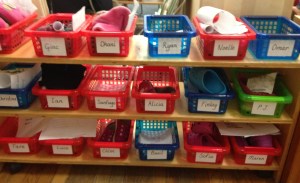
These bins hold students' indoor shoes and any paper work they accumulate throughout the week.

These bins hold students’ indoor shoes and any paper work they accumulate throughout the week. They visit this shelf first thing on entering the classroom.

A typical primary student day starts with exchanging outdoor shoes for slippers to signal to students that it’s time for work to begin. “Circle time” comes next, during which the class sings, greets each other, and goes over daily topics such as the calendar. Circle time might also contain a group lesson on the monthly theme. Currently, primary students are learning about fruits and vegetables, among other topics. Next, teachers invite their students to find some individual work. Mr. Sellers delved a bit into the Montessori concept of work, explaining that “work” in the Montessori classroom is not supposed to be an unpleasant or difficult task. Rather, it’s a desired undertaking, intended to empower the student by offering productive and meaningful activity. “Their work prepares their brains for growth and development,” he said. “Even Practical Life work is preparing them for language and reading, for instance, by instilling that left-to-right progression” (see picture below).

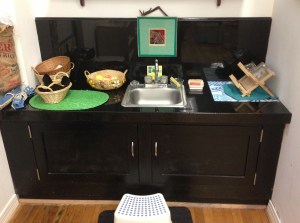
This kid-sized sink represents Mr. Sellers' Practical Life area.

This kid-sized sink represents Mr. Sellers’ Practical Life area.

Parents had lots of questions about how work “works.” At TNCS, there are really only two work rules, say teachers. First is that the students treat all materials with respect, which includes respecting the “work cycle” of choosing an activity, completing it, and putting it away when finished. The second is that students work with only what they are developmentally ready for. So, for instance, 3-year-olds might be naturally drawn to the very pretty bead cabinet, but because they are probably not ready for “skip-counting” (counting by 5s, 10s, 100s, etc.),  they are encouraged to choose something more suitable.

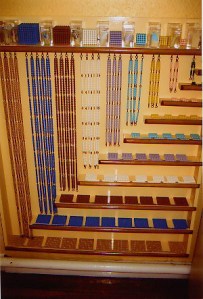
Bead frame

The bead frame is particularly fascinating . . . but hands off until you’re ready :)!

Where does the teacher come in, amidst all of this lovely independent work? When the teacher sees that a student has fully engaged with a particular exploration, the teacher might come along and demonstrate the next step with a material, or introduce a new material altogether. The teacher guides the student to make additional discoveries. The teacher might also guide an older student to mentor a younger one. With a 3-year age range (age ~3 years to age ~5 years) in the primary classroom, many such opportunities arise. The younger kids are eager to please their slightly older peers, and the older kids develop self-confidence by sharing their knowledge. This lovely dynamic pervades school wide, in fact, among classrooms, not just within them.

After a lengthy work period (that will have included snack at some point), primary kids go to lunch, play on the playground, and then enter their afternoon period. For kindergartners, this means instruction with Mrs. Lawson and Mrs. Lazarony. For the 4+-year-olds, otherwise known as the “resters,” this means 20 minutes of quiet time followed by continued work. For the littlest ones, it’s naptime, a legal requirement in the state of Maryland. So-called “specials” also take place in the afternoons and include music, art, and gym.

It was clear that several parents in attendance were recalling their own early education less than fondly and wishing TNCS had been available to them. Mrs. Lawson (also a primary teacher) summed up TNCS’s specialness best: “I love Montessori because children really learn with hands-on materials instead of just by rote. They can tell you why things are the way they are.”

We’re back to school, and the kids are alright.

International Camp at TNCS

For 2 weeks this summer, The New Century School will be hosting five visitors from China to participate in International Camp. From August 5th through 17th, three elementary-age girls and two of their mothers joined TNCS elementary students for an opportunity to be immersed in English. As TNCS moves more fully into its own foreign language immersion style, this pilot camp presents a unique way to reciprocate—to immerse foreign students in English. Let’s meet them!

Mr. Lapreziosa and our Chinese and American friends say cheese!

Mr. Lapreziosa and our Chinese and American friends say cheese!

Alice (Cui Jianing*), Grace (Kuang Juoqui*), and Michelle (Ma Rai*), each age 9 years, came all the way from Guangzhou, China’s second largest city and located in the southeast. During their stay, they will participate in camp activities such as cooking and gardening, they will visit key Baltimore sites such as the aquarium and the Walter’s Art Museum, and they will take daytrips to Philadelphia and Washington, D.C. Michelle, mom Kelly, and Grace are staying at the home of TNCS Executive Director Roberta Faux and her family. Alice and mom Jane are being hosted by another hospitable TNCS family.

As is China’s custom, the girls presented a gift to their American campmates upon arrival. The girls had lots of fun together wearing their beautiful handpainted masks.

Having lots of fun together is more or less the itinerary every day, in fact. They love playing with each other’s toys and games, for example, making the most of that particular cultural exchange. Here are some excerpts from a visit to the classroom:

TNCS: What is the one thing you want to do most while you are here?

Alice: (Thoughtful pause.) Maybe shopping.

TNCS: What would you like to do during your visit to Washington, D.C.?

Grace: Play on the playground!

Michelle: Go shopping for long, pink dresses!

TNCS: What has been your favorite part of being here so far?

Alice: Playing with Michelle and Grace.

Grace: Playing with Kathryn’s toys . . . her weaving set.

Michelle: Playing with kitty Ebony (Kathryn’s cat).

TNCS: What is your favorite thing to eat here in the United States?

Michelle: Blueberries and spaghetti! (Not together.)

TNCS: What flavor of ice cream do you hope to get later at Pitango (the afternoon’s scheduled activity)?

Alice: Chocolate!

Grace: Cookie dough!

Michelle: Chocolate, strawberry, and vanilla!

As you can see, the girls are simply delightful! When asked why they decided to come to International Camp at TNCS, their mothers said, “We want the kids to experience a different culture and to improve their English.” The girls had studied English for 3 years prior to coming here, but there’s nothing like immersion to encourage fluency. The TNCS natives agree. “Our job is to help them learn English and not speak bad grammar,” explained the TNCS gals when asked whether they were taking the chance to practice their Mandarin with their new friends. Moms Kelly and Jane report that by Day 2, they could hear a big difference in their girls’ English, so the no-Mandarin-allowed policy strictly enforced by the TNCS cohort seems to be working!

The camp is being taught by a newcomer to TNCS, and we’re very fortunate to have him and his special expertise. Craig Lapreziosa is a former engineer turned English as Foreign Language instructor, who says, “If you have to communicate in a foreign language, you will.” Of the experience so far, he says that the biggest challenge has been keeping the Chinese and American students integrated during learning activities. They tend to cluster off because it’s more comfortable for them. Socially, it’s a different story, however. “I was worried about how to break the ice among them, but they did it on their own—there’s no shyness among them at all,” laughs Mr. Lapreziosa and points to where the girls were supposed to be having their morning snack. Instead, they were all dancing and singing along to the Beatles playing over the computer, not a drop of inhibition to be seen from anybody! Six 7- to 9-year-old girls will certainly tend to be an exuberant group. “I have new respect for elementary teachers,” jokes Mr. Lapreziosa.

With their daughters having such a nice time, Kelly and Jane have decided to extend their trip a week longer to visit New York City, Boston, Niagara Falls, and (of course!) Disneyworld after leaving Baltimore to take full advantage of being in the United States. Neither Kelly nor Jane has been here before, though Kelly got her M.B.A. in Canada. She now teaches business at Guangdong AIB Polytechnical College, and Jane is a data processing engineer. They describe how different education is at TNCS in contrast to home, where instruction is always lecture style. “Here, they can actually experience things to learn,” says Kelly. She describes Mr. Lapreziosa as being very patient and helpful with the girls. The ladies have some good camp ideas of their own brewing, too. We just may see them back again next year, which would be a real honor. They are most welcome!

Fortunately, our visitors didn't actually have to walk here ;).

Fortunately, our visitors didn’t actually have to walk here ;).

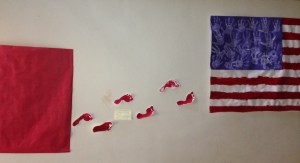
"Walking around the world from China to the United States": This related art project was done during Mandarin Immersion Camp, held earlier this summer.

“Walking around the world from China to the United States”: This related art project was done during Mandarin Immersion Camp, held earlier this summer.

*English spellings helpfully provided by Charlotte Chen—our former and well-loved Chen Laoshi! Thanks Charlotte!

And the Winner Is . . .

Dear readers, you spoke, and we listened. Earning 28% of total votes, the clear winner for this blog’s new name is—dun duh nuh nah—Immersed. Not only is that the name preferred by a majority of readers, but it also reflects The New Century School‘s purpose and values very appropriately. The 2013–2014 school year will renew focus on language learning, as TNCS returns to the immersion model that has served so well in the pre-primary classrooms. Thus, the name accurately conveys that students will be “immersed” in Spanish and Mandarin throughout the school day. Immersed also describes the kids’ full engagement with their scholastic activities. They are fully and enjoyably absorbed by what they are doing and learning, spellbound by the daily quest for new discoveries. As you knew, immersed fits in a number of ways.

Voting results. Thank for your participation :)!

Voting results. Thank you for your participation :)!

New Century News came in second place, by the way, which is also a good name. Many of you came up with your own names, and there were several nice suggestions including The Centurion, The Love of Learning News, and more. This was an altogether delightful exercise for our little community!

Look for the new, enhanced blog to be unveiled next month, just in time to start the school year off on the right note. Until then, blog posts will continue to be on the lighter side as we enjoy summer’s festivities. Also, remember to check the CSA recipes page for weekly additions!

Because it's cute.

Because it’s cute.