“Keeping the Conversation Going”—in Multiple Languages!

Immersed is once again pleased to bring you thoughtful commentary from another perspective. This piece comes to you from The New Century School‘s Head of School Alicia Danyali (bio* at the end), who brings her vast experience to bear on the subject of multiple language learning. Read on!


Alicia Danyali on Bilingualism

Alicia DanyaliIn current-day Baltimore, Maryland, it is apparent that we live in a community where education choices are limitless, philosophies abound, and much of the focus is on the end product (student success). Whether your background is in Montessori or Waldorf or Traditional Public Education, one consistent theme that is agreed upon when registering your child at TNCS is the interest in bilingual language learning.

As language immersion practices become more commonplace, starting during the pre-school years (opposite to the trend of starting in middle or high school) students with these “advantages” are described as “cutting edge” or even “ahead of the game” as learners. Since I have spent the last 20 (or more, um hum) years within dual-language environments, I can agree with much of the research observing student bilingual success when starting at a younger age than middle school. The statistics are out. There is validity that bilingual students are most receptive to a second language from ages 0-7 years.  It has been noted that children exposed to more than one language at a young age are capable of more sophisticated problem solving or demonstrate problem solving in multiple ways.

One of the books that I have recommended over the years is The Bilingual Edge: Why, When and How to Teach Your Child a Second Language, by Kendall, K. & Mackey, A. (2007).  Many of the findings and advice within this book are true to supporting second language learning.  I thought I would share some feedback regarding the publisher’s summary of the book, and invite the educated and dedicated TNCS community to have a think about your own child’s language journey.

For example, as part of the summation of the book, the publisher’s state:

“In The Bilingual Edge, professors and parents King and Mackey wade through the hype and provide clear insights into what actually works. No matter what your language background is—whether you never passed Spanish in high school or you speak Mandarin fluently—King and Mackey will help you:

  • select the language that will give your child the most benefits
  • find materials and programs that will assist your child in achieving fluency
  • identify and use your family’s unique traits to maximize learning

Fancy private schools and expensive materials aren’t needed. Instead, The Bilingual Edge translates the latest research into interactive strategies and quick tips that even the busiest parents can use.”

These are some BIG claims that one book can do all this and support you and your family with second language instruction. Although it is a highly recommended read, please keep in mind, like all published material, one must make the claim that watching your own child absorb the environment offered at TNCS is within a natural setting, encourages curiosity and risk-taking (traits attributed to bilingualism) and includes individualized nurturing, human interaction, and a true understanding/respect of culture.

As the ideas from this book or any other claiming to ensure your child will become bilingual, the ingredients start with your child’s interest and enthusiasm, partnered with an authentic love of learning, parental support along the journey in a truly immersed setting. Please feel free to submit your feedback on other inspirational books read on the subject of bilingual education. “Let’s keep the conversation going.”

*Alicia Danyali: Throughout her professional career as an elementary educator, Mrs. Danyali has been committed to developing pedagogical strategies for a language immersion environment focused on critical thinking and cooperative learning both as a classroom teacher and an administrator. Immediately after graduating from Florida International University with a Bachelor of Science degree in Elementary Education, she moved to The Netherlands to teach in the elementary school at the International School of Amsterdam and then at the Violenschool International School. After 8 years in The Netherlands, Mrs. Danyali moved to Washington, D.C., where she spent 5 years working at the Washington International School (WIS) as both the classroom teacher for 1st and 3rd grades as well as the head teacher and coordinator. She was later appointed School Wide Community Service Coordinator, developing curriculum focusing on service and giving back to the local and world community. In her final year at WIS, she was invited to attend a leadership and curriculum conference in New York City in cooperation with the Museum of Modern Art, Metropolitan Museum of Art, the Guggenheim, and the Whitney Museum. The conference featured connections in the classroom that were shared within the areas of art, history, science, technology, and mathematics. Mrs. Danyali has completed the 90-hour childcare certificate for ages 2–5 years, the 45-hour administrator certificate, and the 45-hour infant/toddler certificate. Mrs. Danyali recently completed graduate school at the Johns Hopkins University School of Education, specializing in Supervision and Administration.

Mrs. Danyali and her husband moved to Baltimore over 8 years ago, when their son was a toddler. During this stay-at-home-mom time with her son, she continued to keep her foot in education by working as a freelance writer for http://www.education.com, teaching Mommy and Me classes as well as classes for home-schooled children at The Painting Workshop, leading 2-year-old classes at Beth Tfiloh, and conducting The Summer Yoga Camp for Kids at The Bryn Mawr School.

Mrs. Danyali is fluent in Dutch, and her personal interests include yoga, swimming, visiting museums, travel, cooking, and spending time with her family. She completed the 200- and 500-hour Advanced Registered Yoga Teacher Certification through Charm City Yoga.
TNCS Parent Workshop: Making the Transition from Pre-Primary to Primary

This week’s Immersed post is a very special one, brought to you by TNCS Primary Teachers Maria Mosby (main author, photographer) and Lisa Reynolds (main photographer), with additional contributions from TNCS Head of School Alicia Danyali and Pre-Primary Teacher Yu Lin.

Their topic? The New Century School‘s Pre-Primary Parent Workshop held January 21, 2016, which was in itself something a little different, focusing on how to make the transition from the pre-primary classroom to the primary classroom a smooth one for our 3-year-old friends. It’s quite a big step for such small children, and many parents experience considerable anxiety about how their child will handle it—a baby in diapers in spring, to a self-possessed student of a multilingual Montessori classroom come fall? Impossible! Yet this is exactly what occurs each year, to the amazement of parents, the delight of the kids themselves, and with knowing smiles by the teachers. And so without further ado, here’s how they do it, as written by Ms. Mosby as well as an excerpt from Lin Laoshi!

The purpose of the Parent Workshop was to give parents an overview of what their child’s experience would be like once they move up to the primary classroom, as well as answer any questions, and perhaps help alleviate any anxiety they might be feeling. It began with Lin Laoshi talking about the difference between the pre-primary and primary classrooms, with the focus being more on independence in primary:

The TNCS pre-primary program is a language immersion program, focusing on foreign language enrichment. Children are exposed to the language 100% of school time. They learn languages through singing fun songs, playing games, doing hands-on activities, and attending cultural presentations. The classroom setting relies mainly on group work with the guidance of the program teacher.

The TNCS primary program is a mixed-age Montessori program, which encourages students to be independent, explore freedom within limits, and learn to establish a sense of order. They are encouraged to choose any activity from within a prescribed range of options and do their work independently most of their school time.

In order to bridge the gap between the two programs, students in the pre-primary program are gradually encouraged to do more things by themselves to enhance their abilities of self-awareness and self-control.”

Mrs. Danyali then gave the parents insight into the placement process and an overview of the primary program, while I walked them through a typical day. From there, it became more of an open discussion and question-and-answer session.

tncs-preprimary-to-primary-transition

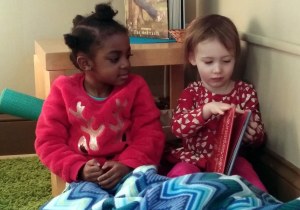
A quiet, cozy moment with a friend in the peace corner goes a long way to making children feel comfortable and at ease.

What particular challenges the children will face was a big part of the discussion. Separation tends to be the biggest issue in my experience. Even though these students have been to school before, they are entering a different environment with new teachers, new friends, and new routines. That’s a lot for a young child at once. We try to make the transition as gentle as possible, and make them feel at home.

Another difficult aspect for the new children can be understanding that not all of the Montessori materials are available for them to use just yet. Everything is so new and enticing—in fact, the Montessori materials are specifically designed to call to the children. However, a new 3-year-old, though very excited by the movable alphabet or bead cabinet, is most likely not quite ready to use these materials. That’s why it’s so important to go over preliminary lessons, or the “ground rules” of the classroom, several times in group and individual situations to kindly but firmly give reminders to all.

tncs-preprimary-to-primary-transition

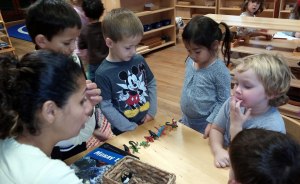
This group Spanish lesson on rainforest animals shows that little kids really can focus . . . even it means keeping their hands otherwise occupied!

Another point to remember is that we make sure each individual child is ready for this transition. Our administrators are very skilled at making sure that children who move up are both physically and emotionally ready. In the rare cases in which a child has shown signs of not being comfortable in the new environment, we worked with the parents to help the child become more independent and develop the skills he or she needed to feel secure in the primary classroom. Consistency and partnership between home and school is, thus, vitally important, as is respect for the child and his or her individual needs.

The photos below (picturing kids who just moved up to primary this school year) erase any doubt that young children are eager to embark on journeys of independence and self-exploration. They learn by doing at this age, and allowing them this opportunity does wonders for their self-esteem, let alone their physical and cognitive development.

The take-away message is, parents should be reassured that this transition needn’t be a scary experience, and there isn’t much special preparation* necessary. We are set up to welcome all children as they are, and the primary classroom is the next step in the work that they’ve already been working so hard at in pre-primary—developing self-help skills, socialization, motor skills, and working within a community.

*Here are some practical tips for parents to familiarize themselves and their children with the exciting changes to come.

  1. It’s great for parents to prepare their children for the transition by talking about it in a positive way, perhaps choosing new items together for the new school year.
  2. Talk about it—but not too much too soon. Constantly discussing the transition, especially when it might be months away, may create anxiety for your child.
  3. Slowly begin introducing more opportunities for independence (allowing your child to dress himself with support, help to pack lunch, etc.). However, I don’t advise rushing toileting or to cause children think there is a “deadline” for them to be ready. This may have the opposite of the desired effect.
  4. Visit the primary classrooms and read up on Montessori theory. A great introduction is A Parents’ Guide to the Montessori Classroom, by Aline Wolf. It’s a quick read and gives an overview of philosophy and materials. Lin Laoshi also recommended the book, Mindful Discipline, by Shauna Shapiro, PhD. Additionally, Mrs. Danyali provided a Reading List that includes these and other very helpful titles.
  5. Come to the “Back-to-School Meet and Greet” with your child at the beginning of the school year. It’s a great opportunity for your child to meet his teachers, new friends (and likely some old friends!), and become acclimated to the new environment.
tncs-preprimary-to-primary-transition

This sweet smile kind of says it all.


Meet the Teachers: Wei Li and Yangyang Li!

20151120_120304

In a true blending of cultures, Li Laoshi and Yangyang Laoshi enjoy some Mexican food . . . with chopsticks!

Although neither Wei (Vivian) Li nor Yangyang Li is exactly new to The New Century School, they have each adopted larger roles within the language department for the 2015–2016 school year. Having first joined the TNCS community in summer 2015 as one of the Lead Teachers on the 2015 STARTALK team, Li Laoshi is now heading up the Mandarin department as Director of the Chinese Language Program and Lead Mandarin Elementary Teacher. Yangyang (first name used to avoid confusion with Wei Li) Laoshi’s first experience at TNCS was as Mandarin Assistant Teacher in the 2013–2014 school year, followed by teaching in the 2014 TNCS STARTALK program. She is now serving as the Primary Mandarin Teacher as well as helping Li Laoshi run the Mandarin department.

universal studio

Li Laoshi is ready to take on the world!

Both teachers are eminently qualified to teach Mandarin. A native of China, Li Laoshi  moved to the United States and dedicated herself to personal development and education after having taught International Business at the Hunan Vocational College of Science and Technology for over 9 years. Interested in enhancing her teaching experience, she earned a Master’s Degree in Education: Teaching Chinese as a Second Language from the University of Maryland, College Park in the spring of 2015 as well as a Maryland State Teaching Certificate. Before coming to TNCS, she completed an internship at the Baltimore International Academy, a full language-immersion elementary school. Li Laoshi is experienced in program design, curriculum development, lesson planning, classroom materials preparation, and assessment.

st

Yangyang Laoshi and her cast of STARTALK characters!

Yangyang Laoshi is from Chengdu in the Chinese southwestern Sichuan province. She has a Master’s degree in teaching Chinese to speakers of other languages from Sichuan University, which is one of the Top Ten universities in China, as well as a Certificate of Accreditation for Teaching Chinese as a Foreign Language. Before she came to TNCS, she worked as a Chinese teacher in the Chengdu American Center for Study Abroad and the Sichuan University Overseas Education College for 1 year, teaching students from New York State University. She also worked as an English Teaching Assistant in a Private English Training School, assisting British teachers with their classes of preschool children ages 3–5 years. Yangyang Laoshi also has the very special distinction of being an accomplished pipa musician.

Qualifications aside, what makes them true educators is their approach to teaching. Seeing them in action is to understand that teaching is their life’s calling, not just a job. They guide, they coax, they laugh—learning is interactive play. They are rarely—if ever—not smiling. No wonder TNCS students respond to them so readily! They have these qualities in common with the other TNCS teachers, and it’s nice to see how disciplines and departments have meshed so well this year. And, to maintain continuity with what and how students have learned in past years, they have regular contact with Xie Laoshi (Jewel), who remains a vital part of the Mandarin program, albeit in a behind-the-scenes capacity.

As such, they have devised a curriculum that is:

  • National standards guided
  • Theme based
  • Age- and language-proficiency appropriate
  • Relevant to daily life
  • Integrated with culture
  • Student centered (what Li Laoshi considers most important)

See examples of some of their past months’ lessons in these links: September, October, and November. As you can see, body parts, family life, and food comprise a large part of these lessons, which makes sense given their criteria in the bullets above. What could be more relevant to kids this age than those three topics? And, see for yourself how easily they connect to these topics, which translates into ready fluency. This video features a Primary student, who had never encountered Mandarin Chinese before enrolling at TNCS this academic year reading Chinese characters aloud about the hours of the day. She is developing her English language skills at the same time. These students are also able to write some of the characters they read.

With only 45 minutes per class, the Chinese teachers nevertheless work in a lot of practice with the language—which is the only way students are really going to be comfortable speaking it. So, they incorporate card games and other games, role-playing, songs, and body movement, based on the proven effectiveness of Total Physical Response (TPR)*. In this video that employs TPR, you can see it in action. (I love my [insert family member.])

Older students additionally take on larger projects, such as “making” and “selling” food. This provides ample opportunity for learning vocabulary related to various foods and cooking as well as working with Chinese currency, the yuan. They “earned” their money by answering questions correctly, a built-in incentive to demonstrate their proficiency.

A similar project was test-run in last summer’s STARTALK, and it was a runaway success. The kids could not stop talking about their “Night Market” and felt excited and proud by what they accomplished. The genius of this kind of project, in which the kids completely lose themselves, is that they are conversing and interacting completely in Mandarin, almost effortlessly. Contrast this with more traditional language classrooms in which students commonly feel self-conscious and struggle to overcome their reticence. “Students feel happy in my class,” said Li Laoshi. “They are enjoying learning; they don’t feel it’s a burden—even the shy ones and those who have never learned Chinese,” she said, even confessing to nearly crying with joy at their achievements. “The Chinese language is totally different from English and Spanish,” she continued. “Because it’s so complicated, the first step is to get the students interested, to motivate them. Then, they really open their hearts.”

Yangyang Laoshi agrees. “I search for games that relate to our lessons,” she said, “but if the kids don’t like them, we find something else instead.” This ability to organize and plan outside of the classroom but adapt and be flexible within the classroom has allowed them to easily meet their goals of cultivating happy, engaged, Mandarin-speaking students. They say their Chinese friends and colleagues are thoroughly impressed by how good the students’ speech is, including some of whom have previously known these children, such as dear Fan Laoshi, who interned at TNCS last year and who remarked on their clarity of pronunciation.

An abiding love for teaching and for their TNCS students is what they attribute their current classroom happiness and success to. “That’s why I came back here from China.” said Yangyang.

Speaking for the TNCS community at large, we are certainly glad to have you both at TNCS!


*Total Physical Response (TPR) was developed in the mid-1960s by Dr. James Asher as a method of learning a second language. Asher noted that the conventional approach to learning second languages differed dramatically from how infants learn their first language. Infants learn to communicate by internalizing language, a process of protracted listening and absorbing. TPR is a technique that replicates that process for learning second languages and beyond by giving a command, modeling the action described in the command, and then having the student imitate that action. Students are not initially asked to speak, but to comprehend and obey the command. Understanding is at the root of language acquisition, according to Asher. This makes a lot of sense when you consider how babies learn to respond to increasingly complex utterances before ever verbalizing a thought.

Research demonstrates unequivocally that brains work more efficiently when the body is also engaged. In fact, neuroimaging shows that during movement, more brain areas are lit up, meaning that more of the brain is active and in use. Language acquisition via TPR takes full advantage of this “powered-up” state.

Excerpts from Exercising that Mind–Body Connection, from the Immersed archives

Meet the Teacher: Manuel Caceres

By now, we are well into the 2015–2016 school year at The New Century School, a period that has been brimming with exciting education-related events so far and has kept the TNCS community very busy, to say the least. But let’s take a moment to catch up with a new-for-this-year educator, who, it’s fair to say, has reinvigorated TNCS’s Spanish-language program and achieved new levels of student engagement. Meet K/1st teacher Manuel E. Caceres—or, as the kids know him, Profesor Manuel.

tncs-spanish-teacher-manuel-caceres

K/1st teacher Profesor Manuel in his classroom.

A native of El Salvador, Central America, Profesor Manuel moved to the United States in March 2004. With a degree in education at the primary and secondary levels, he went on to study education and theology at Pan-American University. He is married with three children, an 8-year-old daughter and boy/girl twins born in spring 2015.

Education is vitally important to him; he believes that “we can accomplish much in this world through educating children as global citizens; citizens who are humane, caring, thinking, and effective.” He strongly believes in “you can do if you really want to.”

tncs-teacher-manuel-caceres

Profesor Manuel donned a Dia de los Muertos costume for Book Character Dress-Up Day on October 31st to go with the K/1st viewing of “The Book of Life” in Spanish.

Up to now he had worked in public schools, including most recently at Baltimore International Academy, an immersion-style International Baccalaureate school, where he taught a variety of subjects. At TNCS, he teaches global studies in the target language of Spanish and is committed to his career in education, to his students, their parents, and TNCS. “I’m very glad to be at this school,” he said, “because private school is very different from what I’m used to. I will use this first year to learn—learn from other teachers, from parents, and from the children.” He values the degree if parent involvement here, especially. Some of his past students have not had the benefit of continual parental interaction, likely due to their life circumstances. In such cases, says Profesor Manuel, the teacher has to become part-time parent, psychologist, etc., leaving insufficient time to teach. “[At TNCS], I can see that children get a lot of support, and it makes an important difference.”

If you are wondering why suddenly your children are speaking more Spanish than ever before, look no further. Although Profesor Manuel might consider himself to be in an adjustment phase, his students would never know it, given the measurable strides they have made already this year in Spanish from his teaching. His deep engagement with his students is at the root. He asks them to set and be ever mindful of their personal goals. He demands—and receives—respect in and for the classroom. Once these important messages have been understood, it’s time to have a little fun while learning.

He also has an innate gift for tapping into kids’ natural proclivities. They like to move around. A lot. So, on field trips, he has been known to take turns sitting with each and every child on the bus and playing piedra, papel, o tijera, which you probably know as the game “rock, paper, scissors.” Not only did keeping them occupied this way reduce the fever-pitch levels of noise and intensity on the bus (by a hair, anyway—any reader who has served as chaperone can relate 😉 ), but it’s also a brilliant method for enhancing language-learning. The actions reinforce the meaning of the Spanish words, and the rhythm aids pronunciation. (By the way, this is the basis of Total Physical Response, a core TNCS teaching approach that “uses physical movement to react to verbal input in order to reduce student inhibitions and lower their affective filter. It allows students to react to language without thinking too much, facilitates long-term retention, and reduces student anxiety and stress.” We’ll explore this fascinating concept further in a future post!)

“I integrate all sorts of things when I teach, like singing, playing, smiling . . . I always try to make connections,” he said. He also makes sure that every child knows that he or she is the “favorite”—in other words, there are no favorites. Each child is special in Profesor Manuel’s class and knows it. They feel secure, and when kids are confident, they are primed for learning.

Watch this video to see him keep a normally pretty rowdy crowd of K/1st students in check as they wait to begin work on a division-wide art project. Some minor delays in getting art materials ready would have otherwise severely taxed the kids’ reserves of patience, but Profesor Manuel and his skeletal assistant came to the rescue, with “Head, Shoulders, Knees, and Toes” in Spanish!

“Let them be,” he said, “teach them the rules, but then let them play.” This approach is clearly working and fits in beautifully at TNCS. We’re glad to have you on board, Profesor! Bienvenida!

TNCS Visits Schools in China!

tncs-chinese-bridge-delegation

2015 Chinese Bridge–American School Principals’ Trip to China Forum

This month, The New Century School was pleased and honored to be part of the 2015 Chinese Bridge Delegation to China. This annual 9-day educational program aims to help K–12 schools strengthen their Chinese programs and partnerships. School visits, cultural activities, and educational workshops comprise the itinerary for this very special opportunity.

The delegation is hosted by Hanban/Confucius Institute Headquarters in China in conjunction with The K–12 College Board. Hanban is the executive body of the Chinese Language Council International, an organization affiliated with the Chinese Ministry of Education of China. Hanban’s mission is to “[make] Chinese language and culture teaching resources and services available to the world, to [meet] the demands of overseas Chinese learners to the utmost, [and] to [contribute] to the formation of a world of cultural diversity and harmony.”

The 250-member delegation comprising school representatives from all across the United States arrived in Beijing on November 10th and from there dispersed into smaller groups to visit respective provinces. TNCS had the good fortune to visit Tianjin, a bustling port city of ~15 million residents in northeastern China. Tianjin’s mix of traditional and modern architecture is quite renowned, perhaps only slightly less famous than its cuisine. In Tianjin, guests are traditionally welcomed with all manner of noodle dishes and bade farewell with an equal variety of dumplings. But the most well-known Tianjin delicacy is “da mahua,” or 麻花.

Despite all of the amazing sights Tianjin had to offer such as Wudadao (Five Great Avenues) and the surrounding historic districts, however, the real purpose of the visit was to tour schools. TNCS was very warmly welcomed by Kunming Road Primary School and Weishan Road High School, with whom friendships were made and future partnerships proposed.

During the school visits, the delegation met with Chinese educators, observed classes, and interacted with students. The graciousness with which Principal Li and Principle Wen welcomed the delegation into their respective schools was wonderful to experience. It was clear that they were striving to impress the delegation in the hopes of establishing meaningful partnerships with U.S. schools.

The Tianjin visit culminated with a very special tour of Tianjin International Chinese College, which hosts students from abroad to learn the Mandarin Chinese language and be immersed in several facets of Chinese culture.

After a few days, the delegation in its entirety regrouped in Beijing to visit one more primary school, network with U.S. colleagues, attend presentations on best practices, and gather resources to build and support Chinese language and culture programs. TNCS will soon reap the benefits of this incredibly productive visit to China from increased idea exchange and resources as well as personal contacts.

Everywhere the delegation went, they received four-star treatment . . . and lots of entertainment in the form of singing, dancing, and more. TNCS students might just recognize this lovely song . . .

感谢您阅读! Gǎnxiè nín yuèdú!