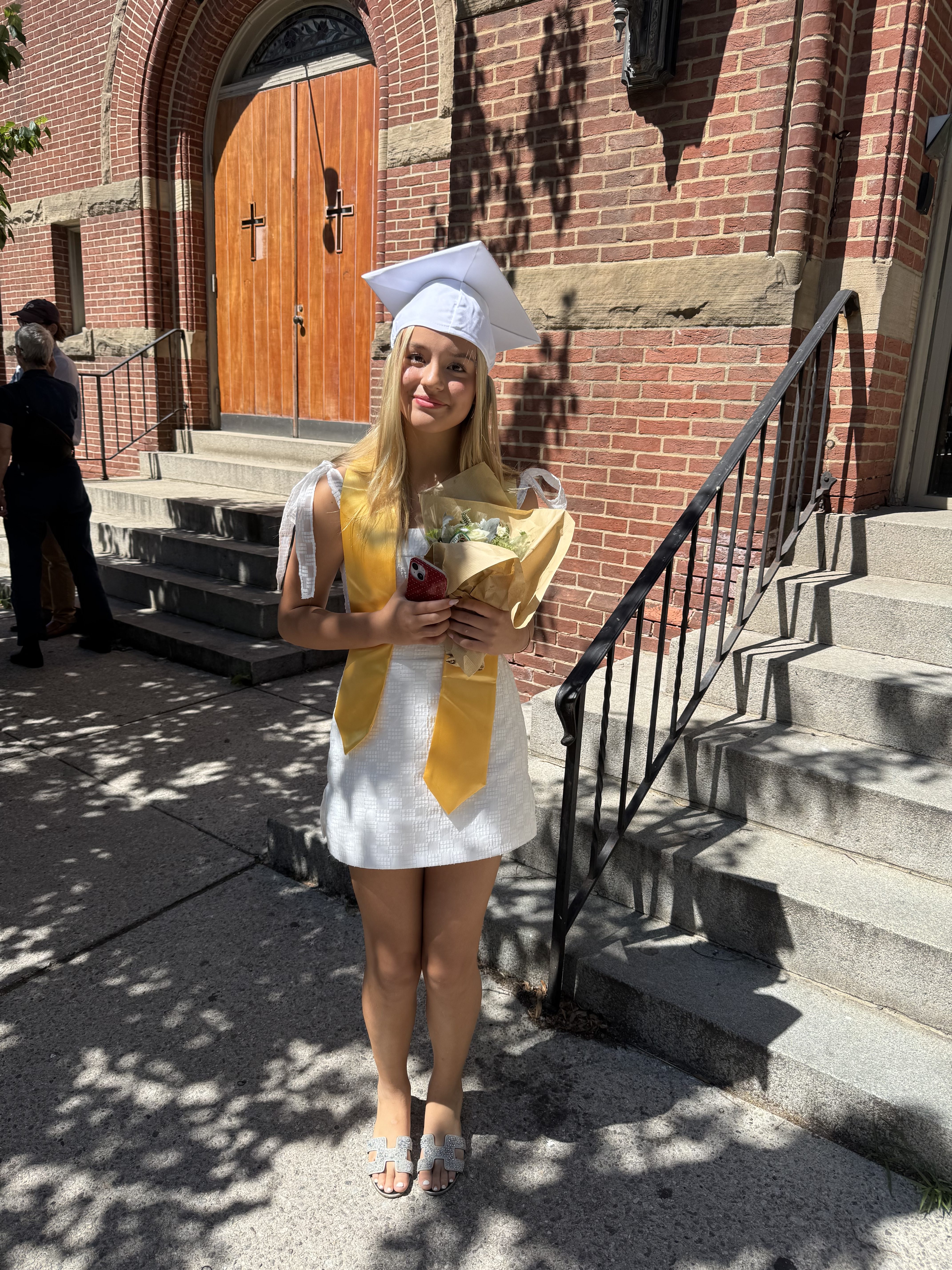
 The New Century School’s graduating class has done it. Five remarkable 8th graders have completed their TNCS journeys and are officially high school bound. Their graduation ceremony was everything longtime TNCS community members have come to expect: heartwarming, bittersweet, funny, and full of the kind of moments that remind you why this school is so special.
Class of 2026: Charge to Graduates
The morning began with the K–7th grade students processing in to “Vitamin C,” a fittingly nostalgic choice, followed by the 8th graders making their entrance to the classic strains of “Pomp and Circumstance.” The atmosphere was celebratory and unhurried, making space for every moment that deserved one.
The ceremony was a full community affair. TNCS Head of School Ann Marie Simonetti and founders Jennifer Lawner and Roberta Faux were recognized for their vision and dedication, without whom, as Mr. Callahan noted in his closing remarks, none of it would be possible. Ms. Simonetti delivered both the welcome and the charge to the graduates, and it was a charge worth remembering.
The K–4 students performed “Unwritten” by Natasha Bedingfield as a gift to the graduates, but what was planned as a tidy performance quickly became something else entirely. An impromptu invitation went out to the whole room, and suddenly everyone was in on it: even teachers were on their feet signing and dancing. One middle schooler who took that as a personal challenge and danced with full commitment for the entire song to the sheer delight of everyone watching. It was exactly the kind of unscripted, joyful chaos that TNCS does better than anywhere.
The song set the stage perfectly for Ms. Simonetti’s charge to the graduates. “The rest is still unwritten,” she reminded them, “and the pen is in your hands.: She drew on Wayne Gretzky’s famous words, “You miss 100% of the shots you don’t take,” to urge the graduates to be brave enough to try, even when success isn’t guaranteed. “Sometimes this means being brave enough to be bad at something, especially in the beginning,” she said. “Remember to give yourself grace and celebrate the small wins along the way.”
She urged them to include others, to seek out perspectives different from their own, and above all, to choose kindness. “If you forget,” she told them with a smile, “just think of the tattoo on my arm: be kind, always.” She called on them to be the person who stands up for what is right, even alone, and to look for ways both big and small to make their communities better. She also reminded them that the hard moments don’t define them. “You will make mistakes. You will experience disappointment. You will occasionally choose the wrong path. But those moments do not define you. What matters most is that you fail forward, taking with you the lessons learned and wisdom gained from each experience.”
She closed with the words every graduate needed to hear: “You leave TNCS with relationships, lessons, values, and memories that have shaped who you are, and will remain part of who you become. Please also take with you the knowledge that we are proud of you, we believe in you, and we cannot wait to see what you will do in your next chapter.”
Mr. Callahan, the 5th–8th grade homeroom teacher, offered his own tribute to the graduates in remarks that were equal parts proud and playful. He spoke about the culture this class brought to TNCS—one of joy, kindness, and hard work, where age-based cliques had no place and kindergarteners were welcomed into basketball games without a second thought. He challenged them, in his final lesson, to always ask why, to never accept the world at face value when better is possible. “Your mind is your greatest tool,” he told them, “and you have an exceptional one.”
Academic Highlights
Before the ceremony’s focus turned to farewells and futures, it paused to honor what this school year actually looked like in the classroom, across every grade.
Ms. Sharma’s 1st through 4th graders had a year full of friendship and discovery. In ELA, they traveled the Yellow Brick Road for a parts-of-speech activity, explored fables and legends to build vocabulary, and wrapped up the year with novel studies of Charlotte’s Web and Freckle Juice. In Global Studies, the class ranged widely from the eras of the Earth to the Ancient Maya to Colonial American trades like butter-making and celebrated Black History Month in February with biography projects.
Math was a particular source of growth. Students strengthened their addition and subtraction foundations, tackled word problems, and were introduced to multiplication, division, fractions, symmetry, bar graphs, and the area and perimeter of rectangles. But perhaps most importantly, as Ms. Sharma noted, every student learned to approach challenges with patience, persistence, and confidence — and that may be the most transferable skill of all.
The 5th through 8th grade cohort logged what Mr. Callahan described as “a long and fruitful year full of analysis, research, and creativity.” In ELA, they read The Hobbit and The Giver, explored World War II through the graphic novel Maus, and wrote their own poems. They also built the mechanics of strong analytical writing: paragraph structure, textual evidence, and deep dives into figurative language, characterization, and story structure.
Global Studies took students from the Mayan, Aztec, and Incan civilizations through the earliest dynasties of Ancient China and all the way to the structure of the U.S. government. The class even wrote letters to their representatives, putting civic knowledge into civic action.
In Math, each grade level had its own arc. Fifth graders built fluency with fractions and decimals. Sixth graders extended that work into percentages and got their first taste of algebra. Seventh graders solved two-step equations and inequalities and explored geometry, probability, and logical reasoning. And eighth graders spent much of the year immersed in algebra, graphing linear equations, solving systems, and analyzing intersecting and parallel lines. As Mr. Callahan put it: “Mathematics is not only about finding answers. It is about learning to think critically, solve problems, and persevere through challenges.”
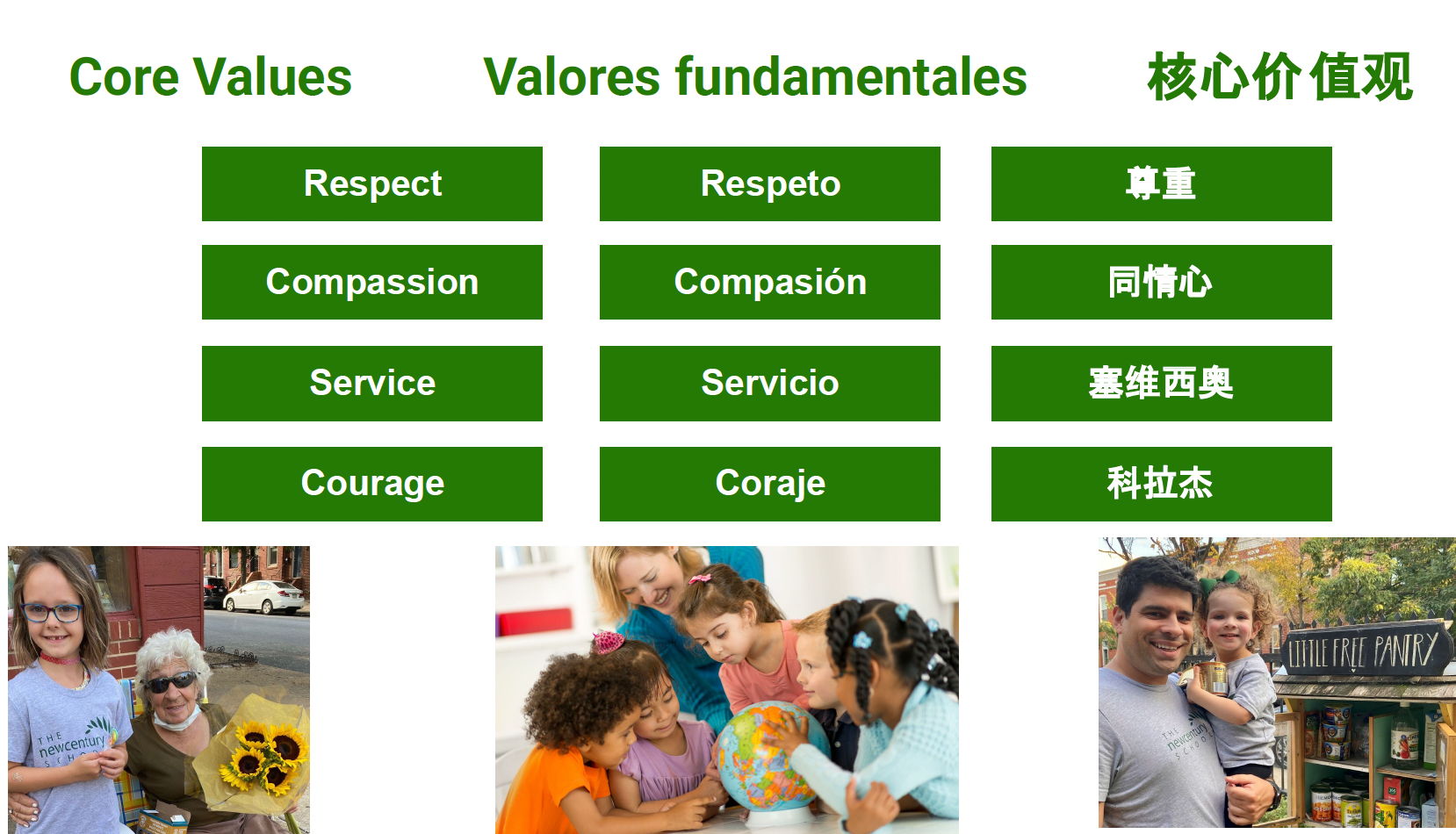
TNCS Core Values
Service is one of TNCS’s four core values, and this year’s graduating class exemplified it in ways both planned and spontaneous. Students across the school completed service opportunities throughout the year: helping at summer camp, assisting with after-school programs, holding the stop sign at dismissal, fundraising, and supporting Baltimore community organizations.
For the 7th and 8th graders, the year’s centerpiece was the biennial Capstone Service Learning trip to Puerto Rico, where students completed environmental and community service projects alongside Spanish-language immersion. The intrepid travelers shared highlights of their experience during the ceremony, a trip that, by all accounts, brought them closer together and to the place they served.
Service awards were presented to students who met or exceeded their grade-level service hour requirements. This year’s Bronze Award recipients were Pia Brown, Jane Lundgren, Zoe Manning, and Arianna Rockwell. The Gold Award for completing double the required hours went to Genesis Fuentes Garcia, Sebastian Lau, Adam Lawner, and Natalia Rojas.
This slideshow requires JavaScript.
Among the 8th graders, two graduates received special Graduation Distinctions that will appear on their transcripts and diplomas: Sebastian Lau graduated cum servitium eximium (“with outstanding service”), and Pia Brown graduated cum servitium fidelis (“with faithful service”).
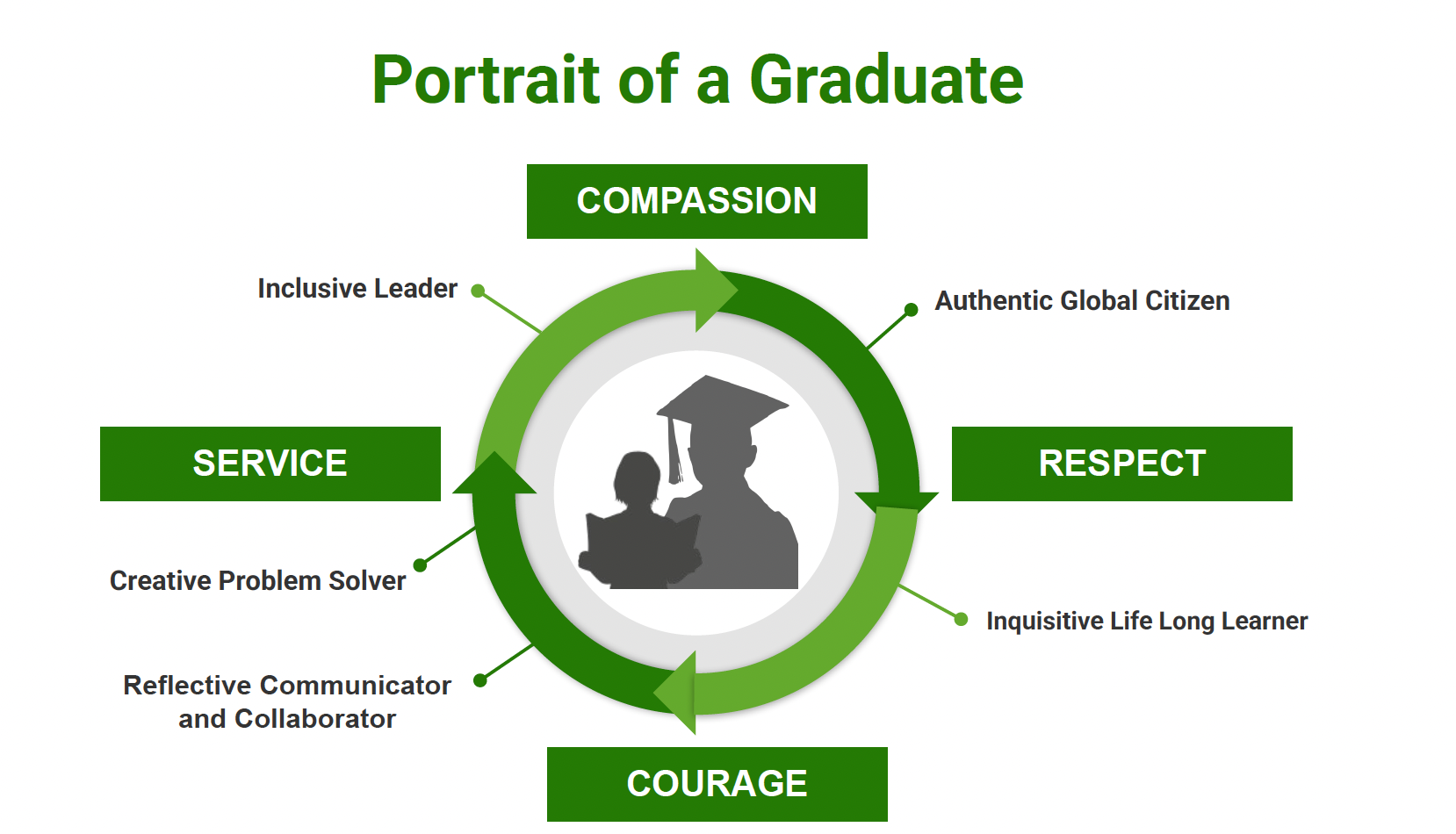
This year, TNCS introduced a brand-new honor: the Core Values Award, presented to the one middle school student who best embodies all four of TNCS’s core values—Compassion, Respect, Courage, and Service—as determined by a committee of middle school teachers. The selection, Mr. Callahan noted, was unanimous and immediate, and the inaugural award went to 7th grader Genesis Fuentes Garcia. When Mr. Callahan first met Genesis, she was quiet and kept to herself, more comfortable with a book than a getting-to-know-you game. Over 2 years, he watched her step out of her comfort zone every single day; taking on difficult work, seeking out service opportunities (and even creating some of her own); and becoming one of the most friendly, outgoing, and confident students he’s taught. “I’m confident that wherever she goes, she will be a leader in her community,” he said.
Genesis accepted the award and then took the microphone to thank her teachers Mr. Callahan, Ms. Sharma, Mr. Federico, Profé J, and Liu Laoshi for their patience, dedication, and belief in their students. “Not only did you teach us knowledge,” she said, “but also valuable life lessons.” She also thanked her classmates for an unforgettable year. It was a gracious, poised moment from a student who has clearly grown into exactly who she is meant to be.
Diploma Presentation and a Final Gift
Then came the main event. Mr. Callahan introduced the five graduates with words that captured each of them with obvious care and cited what high school they would be attending. Each student crossed the stage, shook hands with Ms. Sharma, and paused for a photo, smiles at maximum width.
Then came the moment: tassels moved to the left, and the Class of 2026 was official.
No TNCS graduation would be complete without a touch of humor, and Mr. Callahan delivered. He noted that if there was one thing that united this class all year, it was recess—specifically, the roughly 1.25 balls per week that sailed over fences, collided with pipes and windows, and vanished into the ether. But he also noted, with genuine pride, that by the end of the year, the students had grown: they practiced restraint, held each other accountable, and owned up to lost balls rather than keeping it secret. In honor of all of it, each graduate received their own TNCS soccer ball signed by their classmates and teachers. “Remember your days of fun on the playground and in the parking lot,” Mr. Callahan told them, “and try not to kick this one over any fences.”
The graduates processed out to “Celebration” and joined family and friends for refreshments, and so the Class of 2026 officially began their next chapter. TNCS is so proud of you. We can’t wait to see what you do next. Congratulations! 🎓