TNCS Elementary Information Night Rounds Out a Great 2014!

Refreshments were thoughtfully provided by Chef Emma Novashinski.

Refreshments were thoughtfully provided by Chef Emma Novashinski.

The New Century School‘s fifth year has been undeniably amazing. Rounding out 2014 with yet another breakthrough, Admissions Director Robin Munro announced Thursday that TNCS received a record number of K–5th applications by the 12/17/14 due date. That TNCS’s elementary program has earned its bragging rights—and is attracting hordes of new enrollees—was made clear at the Kindergarten/Elementary Information Night held 12/11/14.

The event was well organized, informative, and fun. Yummy refreshments were provided by Chef Emma Novashinski (who also gave away lovely little jars of homemade pickles), and free childcare including dinner was also offered. Recognizing that parent involvement is vital to student success, TNCS makes it so easy—no, appealing—to participate in school functions.

Elementary Program Overview

Mrs. Munro sent out an agenda before the event to help parents make the most of their time there. The schedule started with her Welcome speech, followed by a program overview by Head of School Alicia Danyali and a brief question-and-answer session. The elementary program—“where traditional and progressive education meet”—provides a solid foundation in the liberal arts by incorporating the following elements:
  • Small class size: Keeping classes to no more than 16 students allows for individualized, differentiated instruction. 
  • Daily language classes in both Mandarin Chinese and Spanish: Younger students begin with conversation and vocabulary building. As their written English language skills progress, they begin to work on reading and writing in Spanish and Mandarin Chinese. Introductory character work in Chinese begins immediately. 
  • Specialty classes: Students have music, art, and physical education classes twice every week. Creativity is encouraged through music and art, while body awareness and health is taught in phys ed class. 
  • Inquiry- and skill-based curricula: We provide a solid foundation in the core subjects of language arts and mathematics, and our teachers develop auxiliary science and global studies lessons based upon student questions and interest. This approach encourages critical thinking and allows children to work to their fullest potential. 
  • Field trips: Teachers take students on weekly trips to our on-site greenhouse and into the school’s extended classroom, lower Fell’s Point. Students take a full-day trip at least once each quarter. Past field trips have included the Baltimore Museum of Industry, the Confucius Institute at University of Maryland College Park, the National Aquarium, and more. 
  • Emphasis on values: Students learn to treat others and themselves with respect. 
  • Mixed-age classrooms: Students to work to their skill level, not just their grade level and benefit both from mentoring and being mentored. 
  • Enhanced learning via technology: Students use children use multiple apps and programs, learn proper keyboarding skills, and begin to learn basic programming.

After the initial gathering, parents were asked to “self-sort” (love that new term coinage!) into three groups and rotate among the three elementary classrooms. In his classroom, Dan McGonigal, the upper elementary mathematics and science teacher, demonstrated a unit on bridge construction in the science curriculum, Engineering is Elementary (scroll below for photos of the students executing this project). Adriana DuPrau, the upper elementary English language arts and social students teacher showcased the English, Chinese, and Spanish curricula. Teresa Jacoby, the K/1st generalist teacher discussed integrating traditional Montessori materials with more progressive curricula and how she differentiates to the various levels in her class. Mrs. Danyali and Mrs. Munro circulated throughout to answer questions.

Elementary Program Philosophy and Approach
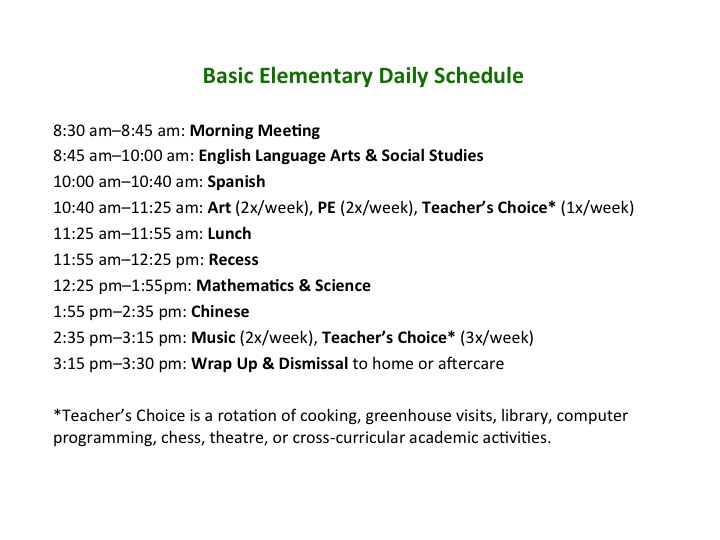
As an independent private school, TNCS does not follow the Common Core standards. Individual grade standards set forth by the Maryland State Department of Education are met—and in most cases surpassed—through the use of carefully selected curricula which best supports our mission to challenge students to realize their richest individual potential through progressive, multilingual education and meaningful participation in the world community.
Students are placed according to their birthday into one of three mixed-age classes: K/1st, 2nd/3rd, and 4th/5th. As the student body matures, upper grades will be added (through 8th) each year, accordingly. Mixing ages is part of the school’s Montessori-inspired vision. Research continues to prove what Maria Montessori observed over 100 years ago, which is that children learn best from their peers. By mixing ages, students can work to their own skill level and not be boxed in by grade-level expectations. TNCS students learn to be friends with everyone and to solve social problems without aggression.
A day in the life of a TNCS elementary student. Looks pretty engaging!

A day in the life of a TNCS elementary student. Looks pretty engaging!

The TNCS format of mixed-age, skill-based classrooms allows our teachers to truly teach and inspire students to reach, or more typically exceed, grade expectations. Through inquiry-based lessons, TNCS teachers can educate the whole child and are not limited by the constraints of a standardized test.

Tools they use to help accomplish these goals include the following.
In Language Arts:
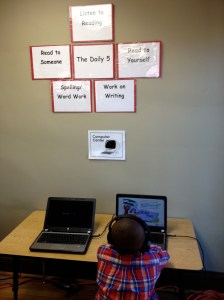
  • The Daily 5 consists of reading to self, reading to someone else, listening to reading, writing, and doing word work.
  • Junior Great Books brings high quality literature and student-centered discussions to the classroom.
  • Wordly Wise 3000 improves student vocabulary.

In Mathematics:

  • Singapore Math is the backbone of the mathematics program.
  • Montessori math materials are used in the K/1st classroom to provide a solid foundation for the transition into Singapore Math in upper elementary.
  • The Daily 3 consists of doing math individually, math writing, and doing math with someone else.

In Science and Technology:

  • Engineering is Elementary allows for learning scientific principles through hands on experiments. The photos below show an example of one project in the bridge design unit.
  • SuccessMaker software is aligned with national grade standards and

Now that’s something to brag about, kids! And keep up the great work, TNCS!

TNCS Elementary Information Night: A School Grows and Flourishes

The New Century School started off 2014 with a bang—on the very first Thursday of the new semester, TNCS held a 1-hour Elementary Information Night followed in a second hour by the first-ever Town Hall. This exciting and important double event was geared toward all current TNCS families regardless of student age and to prospective families interested in joining TNCS’s community. Acknowledging the 2-hour duration, a table of gorgeous appetizers was prepared by Chef Emma Novashinski to see us through, and light beverages were also served. To make attendance even easier, free parking was provided as well as free childcare. The lucky kids got Fell’s Point’s B.O.P. pizza and healthy snacks. This delightful evening, which TNCS administration plans to repeat annually, was a testament to the dedication and commitment of both the TNCS staff for organizing and executing it as well as the families who gladly attended in order to learn more about how TNCS was founded, the current state of the elementary program, and TNCS’s future. These joint efforts ensure that this special school will continue to flourish.

Chef Emma Novashinski provided an array of healthy but delicious hors d'oeuvres to tide over guests arriving just after work.

Chef Emma Novashinski provided an array of healthy but delicious hors d’oeuvres to tide over guests arriving just after work.

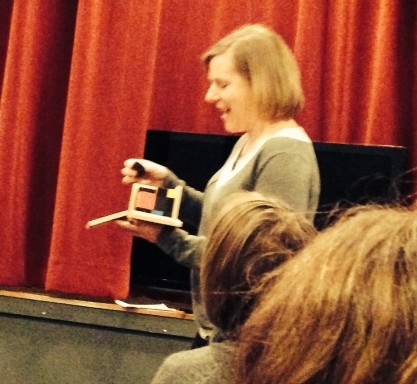
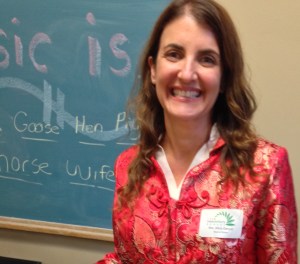
After an introduction to the evening by Admissions Director Robin Munro, Co-Executive Director Roberta Faux gave a heartfelt, enthusiastic, and at times funny speech about TNCS’s rather surprising origins as well as where its heading—“why we got started and how we got here,” as she put it. After attempting to eschew childcare for their daughter born in 2005 and care for her themselves with their “flexible work schedules,” Ms. Faux says that process wore her and her husband down pretty quickly (drawing quite a sympathetic collective chuckle from the audience). She met the other TNCS Co-Executive Director Jennifer Lawner soon thereafter, and together they decided to do something about the lack of stimulating preschool options in Baltimore. They especially identified with the work of education luminaries such as Dr. Maria Montessori and creativity expert Sir Ken Robinson. “In October of 2007, we opened Patterson Park Montessori with five students,” she recalled. That one-room preschool would very quickly prove too small, and TNCS came to be in its current incarnation at 724 S. Ann St. in Fell’s Point in 2010. The Co-Executive Directors felt that the Montessori method “really resonated” with their vision of what early childhood education should be. “Prepared spaces,” said Ms. Faux, set the stage for individual discovery. Within this “freedom within limits that fosters independence,” kids can explore, wonder, touch, and learn about their worlds. They are, moreover, empowered to do so.

Co-Executive Director Roberta Faux speaks fondly of discovering how naturally children learn with Montessori materials and how eye-opening and gratifying an experience that was for her.

Co-Executive Director Roberta Faux speaks fondly of discovering how naturally children learn with Montessori materials and how eye-opening and gratifying an experience that was for her.

This story becomes the more poignant when you consider that both Founders/Co-Executive Directors not only have children attending TNCS in the Elementary and Primary classes, but also that the programs were created very much for those children. And isn’t it very comforting to know that your kids are being taught, nurtured, and cared for every day by a staff hand-picked by these mothers of fellow students? As any new school—or any other kind of establishment for that matter—goes through certain growing pains, that process of becoming can be unsettling. Though TNCS is  still a new school and is still coming into itself, the knowledge that it was born out of the simple desire to provide actual, real children a place to truly thrive preempts any doubt about its integrity, its child-centered approach, and the rosy future it promises itself and its graduates.

After Ms. Faux spoke for about 15 minutes, Head of School Alicia Danyali next took the floor to give an overview of TNCS’s philosophy for elementary education. As the school matures alongside the student body, it’s more and more identifying itself as an elementary school rather than a preschool. A tremendous amount of thought, planning, and resources have gone into the creation of this special elementary program to continue fostering the school’s defining value—whole-child education. Unlike the pre-primary and primary programs, the elementary is not strictly Montessori by any means, which is entirely intentional. With the spirit of independent but guided inquiry very much intact, however, it is certainly “Montessori-inspired.” The commitment to small class sizes as well as the mixed ages within them, says Ms. Danyali, ensures that each student gets individualized instruction and that no one is pigeon-holed according to age but is rather met at his or her skill level. For Ms. Danyali, the emphasis on multilingualism is also a key component of TNCS’s elementary program and one that sets the school truly apart. Elementary students get 45 minutes in each Mandarin and Spanish instruction daily. No other area school can boast this degree of language concentration, even despite the multitude of benefits experts agree that learning other languages confers. (See Top 10 Benefits of Multilingualism.)

Another point Ms. Danyali drove home was that the elementary program is designed to teach kids to learn and be curious about the world around them rather than set up primarily to see them through a test. But she was likewise not about to throw the baby out with the bathwater. Though many curricula are criticized for “teaching to the test,” there is a value to testing when it’s done appropriately. Ms. Danyali wants to implement a test used in other language immersion schools that would give TNCS a yardstick on which to measure overall progress and to give students that practice . . . but not to guide or interfere with the school’s scholastic approach and especially not to assess a teacher’s performance, a criticism that has been leveled at standardized testing in recent news (see the article here). There are also elements of the new Common Core curriculum standards for public schools that she feels are on the right track and could be selectively implemented if appropriate.

And that’s just it. Being a small, independent school offers the freedom to stretch and explore and continue to find ways to really engage students in learning that many schools just cannot have. Another advantage is in the simply amazing educators such an educational model attracts. Speaking of whom, elementary teachers Alisha Roberts and Adriana DuPrau next spoke, each presenting a 10-minute overview of their specialties. Ms. Roberts handles Math and Science (read more here), while Ms. DuPrau teaches English Language Arts, and both teachers mix independent work with small groups. They also create synergies among their disciplines, such that reading and writing is always a component of the science classroom, and discussion and inquiry likewise a component of the reading lesson. Foreign Language Curriculum Director Xie Laoshi spoke last and painted a portrait of how and why teaching foreign language at TNCS is a unique affair. Xie Laoshi creates a dynamic classroom, emphasizing the importance of making the activities relevant for students rather than asking them to complete book lesson after dreary book lesson. In fact, she had the audience in stitches after recounting how she ordered a slew of the best acclaimed books and materials for her curriculum, only to judge them unsuitable and set about making her own from scratch!

An evident degree of preparation and planning went into this evening. Why? Because the elementary program is where it all coalesces—it’s where all of the students are headed and it will define the school in a way that the pre-primary and primary programs do not. Not that those programs aren’t important—they absolutely are! They set the stage for what comes next, and building that solid foundation is critical for development. But making the decision of where to send your child to elementary school carries a lot of additional weight insofar as that education is what will equip him or her for life. The choice to send your child to an environment where his or her whole self is nurtured, not just the academic part, is certainly a lucky choice to have. Again, TNCS is unparalleled in this regard. In addition to their math, science, language arts, and foreign language instruction, elementary students get art, music, and physical education twice weekly to stimulate all areas of development. They also get “Teacher’s Choice” time, which often targets the cultivation of those character qualities a conventional classroom probably lacks the resources for. For instance, Ms. Roberts’s class is learning to crochet, with the help of some parent volunteers, and the scarves they make will be given to Baltimore’s homeless community. Pitching in and helping out is a school-wide value that manifests continually, setting an example to kids to be active, responsible members of their communities (as Dr. Montessori would have utterly sanctioned).

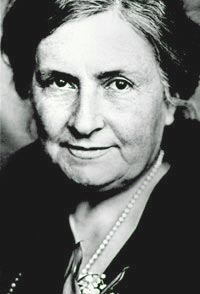
Maria Tecla Artemesia Montessori (August 31, 1870 – May 6, 1952) created the child-centered approach to education that TNCS grounds itself in and grows from.

Maria Tecla Artemesia Montessori (August 31, 1870–May 6, 1952) created the child-centered approach to education that TNCS grounds itself in and grows from.

In one of her very first remarks of the evening, Ms. Faux perhaps best described TNCS’s elementary program trajectory, which has its roots in Montessori but also branches beyond into language immersion and other forms of progressive education and continues to grow. In mentioning that Dr. Montessori, who believed that revolutionizing education would ultimately give rise to a more peaceful society, had been nominated for the Nobel Peace Prize no less than five times, she paused and said, “She would have continued to evolve, just as we are doing.” It was quite a revelatory moment. Of course Dr. Montessori would be exploring new ways to engage children and  embracing new platforms on which to do so—her methodology was built around innovation. TNCS is currently approved to teach through Grade 5 and will continue to add a grade level annually through Grade 8, staying one or two steps ahead of the current “pioneer” elementary student body as well as continuing to find new ways to stimulate and engage them. In the Fall of 2014, a third elementary classroom will be added and a new teacher hired to accommodate that growing elementary student body.

Wait a sec, did you say Grade 8? That’s right. A Middle School comprising Grades 6-8 will open in the Fall of 2016, with new classrooms, new spaces, a science lab, etc. But you’ll have to check back for a follow-up post on what happened during the Town Hall meeting that followed the elementary discussion. Stay tuned!

What Does Kindergarten Look Like at TNCS?

Editor’s Note: For the 2014–2015 school year, TNCS modified the kindergarten program to better accommodate the growing student body. While the primary program still comprises a 3-year cycle, kindergarteners now move up to the elementary floor for a mixed-age K/1st classroom instead of kindergarten taking place within the primary classroom. This adaptation has proven a marvelous success and provides another very important transition mark for students as they broach their elementary years. The gist of the post below, therefore, still very much applies.

The New Century School offers a fresh, progressive approach to educating young children. Kids age 5 years and younger get the nurturing, caring environment provided by the Montessori classroom, and elementary-age kids get a specially designed program that encompasses technology, STEM, the Arts, physical education, language arts, and foreign languages. So what does Kindergarten, that sort of in-between scholastic phase, look like at TNCS?

Appropriately, in some ways it’s a hybrid of the primary Montessori and progressive elementary programs. To say that it’s simply a stepping stone between one phase and the next really doesn’t capture the essence of TNCS Kindergarten, however, nor does it consider the very real importance of this period of development in a child’s life. Says Robin Munro, Director of Admissions, “A lot of parents see Kindergarten as the beginning of ‘big kid school’.” Indeed, in the public school system, Kindergarten is expressly geared toward prepping for first grade. As one mother describes her son’s day in a Baltimore City public charter school, students have a laundry list of skills they must acquire to pass, they work at desks for much of the day just as they will in their elementary years, and the atmosphere is one of strict adherence to the curriculum–it has to be with classrooms of 30 and more children. “It was a huge wake-up call for [my son],” she said, who attended a parochial preschool.

But in all this urgency to get ready for first grade, what actually happened to Kindergarten? Says Ms. Munro, “For TNCS, Kindergarten is more like the conclusion of preschool. Its not a ‘send-off’; we are instituting a radical cultural shift.” Here, the focus is on the child’s development rather than academic achievement. This is a critical point, and one that many of us parents in the fever of making sure our children are “ready,” have a hard time coming to grips with. This begs the question, ready for what, exactly? For TNCS, being “ready” to move on is in some ways a paradox. A child is developmentally where that child is, and it’s the school’s job to meet him or her there, rather than the other way around. (This is the beauty of mixed-age classrooms, which inherently avoid pigeonholing children into certain categories based solely—and rather arbitrarily—on age.) However, it would be naive to pretend that our kids don’t have to measurably progress academically, and TNCS is by no means throwing the baby out with the bathwater. Instead, the answer to “ready for what?” becomes more about the child’s social and emotional skills than about his or her scholastic performance. Says Alicia Danyali, Head of School, “We don’t abandon the child’s development. Their social self needs to be nurtured much more than their academics at this age.”

TNCS’s Kindergarten Information Night this past Thursday provided additional insight into the inner workings of TNCS’s radical approach. Both Ms. Danyali and Ms. Munro were on hand to provide program overviews and answer questions, and primary/Kindergarten teachers Mrs. Catherine Lawson and Mr. Jonathan Sellers presented their Kindergarten curricula. In effect, a primary student’s third year of the 3-year primary cycle becomes his or her Kindergarten year.

A K student’s day starts just like his or her primary classmates’ day. The K student has the range of Montessori materials at hand to independently choose from. Because the student has already spent 2 years in this classroom, he or she is naturally gravitating to the more math and language-oriented materials, as appropriate for his or her age and skill level, rather than Practical Life and Sensorial. However, if he or she prefers the latter sometimes, that’s completely okay, just as it’s fine for the younger kids to want to learn skip-counting with the bead cabinet if they are ready (yikes—that word again) for it. Another part of the Montessori classroom popular with the 5-year-olds and the Ks is the language drawers. These materials designed by a Montessori educator take the tried and true Montessori approach to learning to read and spell but house it in an organized system of cubbies, each containing a set of cards or objects that the student must represent as a word on paper. It’s a very logical extension of the moveable alphabet, and the kids love both the self-guided nature of this activity as well as the immediate gratification and sense of accomplishment they derive from completing each drawer.

The bead cabinet and the language drawers are just two of many materials available to the Ks (and, again, to all primary students no matter what age). As Mr. Sellers put it, “Although there are no specifically K Montessori materials per se, we’re providing the Ks with all the materials they need to set them up for success.” After the morning spent in their respective primary classrooms, lunch, and 30 minutes of quiet time (which can be resting, listening to music, reading a book, etc.), all Ks gather together from all primary classrooms as one group. Thus, says Ms. Danyali,”Ks don’t have to wait until the afternoon to do age-appropriate work, but they come together as a group in the afternoons to do work specific to the K curriculum.” She also points out that a full day in Kindergarten is mandated by the state of Maryland, so TNCS is not able to offer a half-day K program.

Kindergarten is, thus, within the Montessori classroom and stretching a little beyond it. The Kindergarten curriculum is well-rounded and takes into account that the students do need to demonstrate certain abilities by the year’s end. However, Mrs. Lawson is quick to remind us that “Children don’t work for products. Its adults who expect that.” The kids are doing the work for the sheer love of discovery. Important skills are also cultivated, such as good handwriting and computer basics. Each day of the week focuses on a different curricular area, including Global Studies,  Language Arts, Math, and Science. Foreign languages are still taught within the primary morning group, and they get art and music in both environments. The Kindergarten program lets K-age children be kids, be nurtured, and blossom—at their pace—in whatever areas they are ready to bloom in. The atmosphere is that same caring environment they are familiar with and happy in; this encourages them to flourish rather than expend all of their energy adapting to unfamiliar—and  potentially very discomfiting—surroundings.

K students are introduced to the SuccessMaker software they'll use daily in the elementary program.

K students are introduced to the SuccessMaker software they’ll use daily in the elementary program.

Nevertheless, we parents sometimes can’t help letting that doubt creep in that our K-age children will be the oldest in their primary classroom and therefore deriving the least benefit. Research into the benefits for all ages in the mixed-age classroom is unequivocal: the mentor–mentee relationship is mutually beneficial in all sorts of ways. But the real advantage here is that our children are probably doing more advanced work than they would be doing at an other-than-independent school while being able to still be the little kids that they are, getting all the nurturing and special care they still need.

Visit the archives for the Top 10 Reasons to Attend a Montessori Kindergarten.

Open House at TNCS

Our very own Robin Munro, TNCS Admissions Director

Our very own Robin Munro, TNCS Admissions Director

The first Open House of The New Century School‘s 2013–2014 school year got a magnificent turnout of both prospective and current families. Why attend a TNCS Open House? Admissions Director Robin Munro says:

“The easiest way for parents wanting to learn more about the Elementary, Primary, and Pre-primary programs is to attend a weekday Open House. The Head of School, Ms. Danyali, offers a presentation that provides parents a thorough overview of the school. There will also be parents of current students on hand to answer questions and ample opportunity to observe students in their classrooms. If parents like the school, I suggest that they return for a small group tour where they can bring their children for a classroom visit. We also offer a Saturday Open House, which is a perfect event for the entire family. All of our lead teachers invite children into their classrooms to explore and ask questions. Current TNCS parents should also attend to observe their own child in the classroom and to learn about the other programs. As a delicious bonus, all Open House events are catered by our very own Chef Emma and her Kitchen Garden Tuck Shop!”

Main Presentation

Today’s Open House began with a short introduction by Ms. Munro after which Ms. Danyali gave her three-part presentation. Attendees were given take-home information packets as well. Highlights of Ms. Danyali’s talk are broken down into synopses of each program:

Pre-primary: For children ages 2–3 years, the pre-primary classroom offers full immersion in either Spanish or Mandarin Chinese. The children are instructed only in the theme language. This phase of education at TNCS focuses on the children’s social and emotional development. “We want them to begin learning and demonstrating some independence while being able to interact well with others, too,” said Ms. Danyali.

Primary: For children ages 3–5 years, the mixed-age primary classroom offers a more traditional Montessori approach. The lead teacher is trained in Montessori instruction and guides students in correct use of Montessori materials. Language is still a fundamental part of each day, however. Assistants in the primary classrooms are native speakers of either Spanish or Mandarin and come from a variety of countries and cultures. At TNCS, the assistants give specific lessons (e.g., Practical Life and Cultural Studies) in their native language. In other words, students learn a Practical Life skill while simultaneously developing their foreign language skills. The benefits of mixed ages are numerous and include instilling pride and confidence in the older children who serve as leaders for their younger counterparts, developing socially by being able to cooperate with peers as well as children older and younger, and enjoying a sense of nurturing or being nurtured. Kindergarten is included in the primary program; Ks from each primary classroom join together in the afternoons (while the younger children are napping) for some more advanced work.

Daily 5: Read to Self, Work on Writing, Read to Someone, Listen to Reading, Word Work

Daily 5: Read to Self, Work on Writing, Read to Someone, Listen to Reading, Word Work

Elementary: For children in grades “pre-first” through fifth (and adding a grade each year), the elementary classroom emphasizes critical thinking and unit-based discovery. They incorporate the Daily 5, a literacy curriculum that helps students develop the daily habits of reading, writing, and working independently. They read Junior Great Books to encourage critical thinking and deeper understanding. Singapore Math workbooks and SuccessMaker computer software round out the STEM subjects.

Ms. Danyali next spoke passionately about what sets TNCS apart from other private schools. The following list is by no means exhaustive, but here are some perennial favorites.

Head of School, Ms. Danyali gave an overview of TNCS programs for today's Open House.

Head of School, Ms. Danyali gave an overview of TNCS programs for today’s Open House.

What Really Sets TNCS Apart

  • Sustainability: TNCS has initiated Recycling Teams; uses green, non-toxic 7th Generation cleaning and paper products exclusively; and is 100% wind powered by Clean Currents!
  • Kitchen Garden Tuck Shop Program: Run by Executive Chef/Master Gardener Emma Novashinski, this program provides an organic, locally sourced, homemade lunch to participants as part of TNCS’s emphasis on healthful foods for kids. For all TNCS students, the on-premise greenhouse offers chances to explore plant growth from the seed up. Students plant, tend, and harvest produce as well as cook and eat it.
  • The Lingo Leap: The gymnasium/auditorium houses Gerstung equipment and the Imagination playground as well as a stage for our two school-wide annual performances. TLL is also available to host really great kids’ birthday parties!
  • Volunteering: Each TNCS family contributes a minimum of 8 volunteer hours to the school per year. TNCS believes that parents can be better involved in their children’s lives at school this way as well as meet other TNCS families. The volunteer coordinator makes it easy to match your particular skill set to specific volunteer tasks.
  • Lecture Series: New this year, TNCS will be inaugurating this initiative with Dr. Bonnie Zucker on November 13th, 9 am–10 am. Come hear Dr. Zucker’s presentation on how to raise Anxiety-Free Kids.
  • Extended Campus: Because TNCS believes strongly in community, we want students to become very familiar with the school’s environs. They take walks to nearby parks, the post office, or to special Fell’s Point happenings. In learning about their broader community, they will better participate in and contribute to it.
  • Multilingualism: Learning foreign languages increases brain elasticity, executive function, and critical-thinking capacity. How you learn a language is key. Research shows time and again that rote learning is far less effective than immersion. Throughout each phase of TNCS education, full or partial immersion is implemented.
  • Differentiation: Each child is an individual, with strengths, preferences, and traits particular to him or her. TNCS is unique in being able to individualize instruction to each child. “We can accommodate whatever level your children need in terms of education. We will meet them were they are,” says Ms. Danyali. This is possible both because of mixed-age classes and small class sizes.
  • Immersed: TNCS publishes this blog weekly to keep you informed about school events, initiatives, and relevant topics. we invite your participation and feedback!
  • Specials: TNCS emphasizes The Arts. Our art, music, and movement classes are truly special and cultivate your child’s creativity and humanity.
  • Staff: TNCS staff are truly dedicated, loving people. Our children are nurtured—cherished, even—as they are guided through their school day, learning, absorbing, and discovering the while.

Again, the list goes on and on . . . TNCS is a very special place.

Q&A and Classroom Observation

The Open House presentation ended with a Q&A series during which parents asked a lot of great questions about school particulars. A particularly incisive one asked of the currently enrolled families was, “What’s it like to have bilingual kids if you don’t speak the language?” Answers ranged from getting additional support from apps to learn with the child to the child intuitively understanding the correct context for speaking in Spanish or Chinese (i.e., to another speaker of that language). TNCS is also making more opportunities available to parents to learn these languages. The Word of the Week appears on TNCS’s home page, and an upcoming blog post will offer tips for practice at home from our two resident language curriculum experts Senora Capriles and Xie Laoshi.

Finally, parents were free to roam about the school and observe students in classrooms in real time, which is where TNCS really shines.

If you missed this first Open House, not to worry! Two more are offered in November and a third in January. Visit the website to register, because, as Ms. Munro says, Open Houses are the best way to learn more about TNCS’s programs—first hand!

A TNCS Original

Interview with Grace Addison Lintz

With The New Century School’s 2013–2014 school year starting back up this past week, we thought we’d get an insider’s perspective on how things are going. Miss Grace Addison Lintz is one of the original children to start at TNCS’s forerunner, Patterson Park Montessori, and has been a member of the student body from the ground up, as it were. As you will see, Grace, a.k.a., “Gracie,” is a true original, in all senses of that word. Read on to learn all about TNCS through Gracie’s eyes.

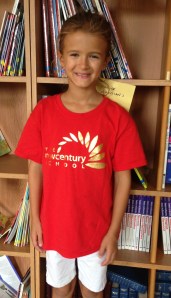
Wearing her TNCS shirt, Grace represents the school beautifully!

Wearing her TNCS shirt, Grace represents the school beautifully!

In TNCS’s library:

TNCS: Can we begin by you telling me a little about yourself?

Gracie: I’m Grace Addison Lintz, and I’m turning 8 years old on September 30th. And I’m going to Costa Rica in October to meet my baby brother Lucas.

TNCS: How exciting! How long have you been attending TNCS?

Gracie: I think 6 or 7 years . . . I was either 2 or 3 when I started, and now I’m in the third grade.

TNCS: Wow! You must really like TNCS, huh?

Gracie: I love it! It’s my favorite school! Wait—it’s my only school! (Ba dump bump)

TNCS: Do you remember who your very first teacher was?

Gracie: (Pointing to a spot slightly below her shoulders) She had black hair to here. I don’t remember her name. I only remember Mrs. DuPrau; I’ve been with her since I was 3 or 4.

TNCS: What’s it like to be one of the oldest students here at school? You must feel very special to be a third grader!

Gracie: (Unmoved) I thought I was still in 2nd until I saw the list. (Pause) Mrs. Roberts is the new elementary teacher, and I have homeroom with her.

TNCS: You have homeroom this year? What’s that like?

Gracie: (Thoughtfully) You know how you go home? Mrs. DuPrau is my reading and global studies teacher, and Mrs. Roberts does math, science, teacher’s choice, and snack—and a few other things—and that’s a homeroom teacher.

TNCS: Got it. What is “teacher’s choice”? That sounds kind of exciting!

Gracie: Okay, teacher’s choice is like the teacher can choose. It can be anything, like music. (Here we were interrupted by a knock at the door. Gracie ran to answer it and saw Señor “Freddie” there, who was just checking on why the library door was closed. Grace scampers on back, having been reminded of something important to tell me by his brief appearance.) And aftercare is really fun!

TNCS: Ahh. What makes aftercare so fun?

Gracie: Well, you get to play outside, and you have to join clubs. Last night on the computer, Mommy signed me up for some clubs . . . story club, origami club, and another one but I don’t know what it is. (Pause) Your breath smells like gum.

TNCS: (Giggle) Thanks. I think. So what are your favorite subjects in school?

Gracie: Weeeeell, I love to read—it’s really fun. And I like art because I get to paint. And music because we do a lot of plays. And math. And science. (Pause; coyly) Why are you asking me these questions?

TNCS: (Amused) For the TNCS blog. Do you know it?

Gracie: Yeah, well, my mommy gives it to me to read sometimes.

TNCS: (Throwing caution to the wind) Do you like it? (Long silence) I bet you’re going to read the next one, because it’s going to be about you!

Gracie: Do people read the blog?

TNCS: (About to crack up) I hope so! (Regaining composure) Do you have a favorite book?

Gracie: Yes!!! I do! I have two: Diary of a Wimpy Kid and The Babysitting War.

TNCS: (Seeing a preferred line of questioning) Are those chapter books?

Gracie: Mm hmm. I love chapter books. I don’t really read picture books anymore . . . now I’m onto chapter books without pictures because I like to just imagine the pictures.

TNCS: Can you tell me what your favorite thing about TNCS is?

Gracie: (Perplexed) What do you mean?

TNCS: Imagine you met someone who had never heard of TNCS and didn’t know anything about the school—what would you tell that person to give him or her an idea of what TNCS is like?

Gracie: (Promptly) It’s on South Ann St.

TNCS: So it is!

Gracie: Wait—wait! It’s very good because it has a lot of fun things.

TNCS: Like what, for example?

Gracie: Music, art, aftercare . . .

TNCS: (Trying to trigger more details) Do you like the stability balls you sit on?

Gracie: The what? Oh, the bouncy balls? Yeah, because it’s more comfortable. (Switching subjects and tracing a finger from the bottom of her foot to the to the top of her head) A thought starts here and comes all the way up here where I keep five at a time.

TNCS:  That will come in handy at test time.

Gracie: Yeah, but sometimes I just have to pick one. Can I get water? (Returning) I love to talk. Can I see your notebook? I’m going to see how many pages we wrote. (Counts 9, which would ultimately become 12)

Grace was very impressed by the number of pages we generated during our interview. We could have chatted for hours!

Grace was very impressed by the number of pages we generated during our interview. We could have chatted for hours!

TNCS: So, as an elementary student, do you get homework?

Gracie: No, we only have to read every day. Mrs. DuPrau says 15–20 minutes, but I like to read for an hour. Mommy says I should talk about reading because I love it. Sometimes we get a few math problems.

TNCS: (In closing) So, Grace, what final thing would you like to tell me about TNCS?

Gracie: Um, like what?

TNCS: (Coaxingly) Think about it this way: you kind of know TNCS the best because you have been here since the very beginning—

Gracie: Kathryn and Fiona and I know it the best because we were the first ones to walk in here. Our little sisters weren’t born yet. (Returning her attention back to the question) Like what?

TNCS: Anything at all from your point of view. (Mischievously) Try bringing a thought up from your foot.

Gracie: We have a lot of classes in our school . . . Let me think for a minute—is that okay?

TNCS: (Really struggling to suppress laughter) Of course—whatever you need.

Gracie: Okay, I’m going to go check on something, and I’ll come back with an answer.

TNCS: (Only able to nod at this point but utterly charmed by her gravitas) Okay—try to think about what makes TNCS special.

Gracie: (Bursting back into the room after about 30 seconds) Spanish and Chinese languages in our school!!!!!! A lot of people from TNCS speak lots of different languages. How could I forget about that?! In Spanish class we learn lots of new things . . . And this year we have new teachers! And the lunch program is yummy!

TNCS: Well done, Gracie! I think you hit some of the most important things about TNCS. By the way, the foreign languages and the lunch program are two of my favorite things about TNCS, too. So, that’s it! I want to thank you very much for your time and for answering all of these questions. I enjoyed this very much.

Gracie: Wait—I want to talk about something else! It’s SuccessMaker. SuccessMaker has reading and math. There’s a cool game in math; you have to use your brain a lot to solve the problem before time runs out. There’s a board that has all our names on it, and we put a sticker on each time we do a reading or math game. (Gush over, she sits back with a satisfied smile.)

TNCS: I can’t wait to learn about SucessMaker firsthand. Thanks again, Gracie. You did great!

. . . And there you have it, readers—TNCS through the eyes of one very clever, charming, special (and sweet!) little girl!

Talking to Grace is both informative and really entertaining!

Talking to Grace is both informative and really entertaining!