TNCS Celebrates Chinese New Year!

The Chinese Lunar New Year is always a big event at The New Century School, a time to reflect on all that has happened during the prior year, connect with family and friends, and eat delicious foods, all to start the new year off in a positive way. This year is Year of The Fire Monkey, and it starts Monday, February 8th. To gear up for this special occasion, TNCS elementary students attended a presentation on China on Friday morning.

Given by a TNCS parent volunteer, the presentation was intended to not only celebrate Chinese culture and customs, but also to invite the elementary attendees to compare and contrast what primary and secondary education looks like in China to their own experiences here as U.S. students. Please excuse generalizations (of both schooling styles), which were made simply for the purposes of the exercise and not to pass judgment on either.

Although at first glance, Chinese and U.S. schools looked pretty similar to the audience, with lots of smiling faces and a happy sort of hubbub going on around campus, the differences became more evident once inside the classroom. Discipline and respect are highly prized in the Chinese classroom, meaning that kids are not permitted to fidget and must sit quietly—on their hands, in point of fact—until called on by the teacher. TNCS students, by contrast, are given the license to sit, stand, or recline where and how they wish at many points during the day so long as they demonstrate that they can handle this freedom and attend to their scholastic pursuits.

Advantages and disadvantages are evident in both approaches. TNCS students get to relax a little as well as not have to constantly fight their very natural instincts to move around, but the Chinese way allows up to 50 students per class to attend to a lesson without potential distractions from surrounding students.

Another point that TNCS students were asked to consider involved what are called “specials” at TNCS and include The Arts and physical education. In China, students are asked to replicate crafts and artwork from a model as well as exercise in perfect unison, and they are held to a very high standard of performance. This can mean that they are not given much opportunity to be creative or exhibit individuality in a given school day, although the skills they master are certainly impressive. U.S. students, by contrast, are frequently encouraged to find their unique identity and then express the heck out of it. However, they may not develop technical mastery of what inspires them at as young an age as do their Chinese counterparts. So, again, one approach might work for some, another for others.

The outcomes of these different approaches are, in some ways, “worlds apart.” While it’s certainly true that Chinese students command a large body of information and demonstrate their capacity for retention at test time, some of their teachers commented on their inability to think for themselves in non-academic environments. Many Western students experience nearly the exact opposite, following their individual paths of inquiry wherever they might lead and employing critical thinking and creative problem-solving to get them down the road. However, the United States ranks far below China (and 20 or so other countries) in measurable scholastic skills like math. This might matter a lot to some, less so to others, but once more the point is in exploring the two styles. Ultimately, it’s probably true that neither educational approach is perfectly ideal across all settings or contexts.

Nevertheless, TNCS students enjoyed teasing out both the differences and the parallels, and it was gratifying to see them imagining themselves in the shoes of a Chinese student. Their observations were insightful and even sometimes incisive. It’s a good bet that many of them would like to visit China for themselves in the near future.

In the meantime, they can content themselves with the video below of the slides presented today in addition to turning their thoughts to the approaching lunar new year, which Li Laoshi and Yangyang Laoshi are sure to help them celebrate with a bang! We hope that this Monkey Year brings you and yours health and happiness!

TNCS Middle School: Opening the Window of Awakening

As we approach the end of 2015, our thoughts naturally turn to what lies ahead in the coming year. For The New Century School, one thrilling near-future event looms very large: the opening of the TNCS middle school in fall 2016.

One of the more unfortunate American societal trends is that middle school–age kids are in a slump. Forgotten in the interstices between elementary school and high school, these kids are victims of what has been termed the “lost years.” Multiple factors contribute to this problem, but a key issue is that kids are still maturing yet are confronted with the many pressures and challenges of young adulthood. Many do not yet have the tools they need to face down these challenges and become confused and overwhelmed, which all too often leads to poor decision-making with potentially life-altering consequences, such as teen pregnancy or drug abuse. Another unfortunate consequence is that kids show less interest in learning, with correspondingly lower academic performance.

The good news is, these problems are preventable, and TNCS is leading the charge to revolutionize middle school education. Rather than view the middle school years as inevitably unproductive, TNCS sees them as a Window of Awakening—flipping the entrenched notion that kids at this age are a lost cause on its head. Middle school becomes an opportunity, not a wasteland. A juncture, not a dead zone.

So how will TNCS make middle school a positive experience for students? Of course, the scholastic piece will maintain continuity with TNCS’s core identity as a progressive, inquiry-based learning institution that emphasizes global citizenship and community spirit. TNCS administration is in talks with a middle school curriculum expert to ensure that the curriculum will be rigorous and engaging, meets or exceeds state standards, and is relevant and therefore meaningful for students ages 10–14 years. Mixed-age classrooms, individualized instruction, and language acquisition will remain vital components in effecting this specialized middle school curriculum.

Screen Shot 2015-12-24 at 9.55.23 AM

The real difference will be in embracing the oft-squandered opportunity that these years present to keep them invested in their learning. It’s an opportunity to really set them up for success in high school and beyond with the explicit practical skills they will need. These include physical and mental organizational skills (e.g., keeping track of materials; time management) and developing the habits of successful students (to study smarter, not harder). And, more than that, it’s an opportunity to guide them in their search for their identity to who they really are—to help them actualize their innate potential and goodness.

Akin to the preschool years in some ways, during the middle school years, kids need parents more, not less. Despite their kids’ outward physical growth and the biological changes that seem to propel them to adulthood, parents retain more influence over kids at this age than they might realize. Although kids test out rebellion and throw up opposition every chance they get, these might be requests for attention and help. They are navigating a huge new world, and sometimes they want their hands held along the way.

TNCS is a small, close-knit school. Many among the student body have known each other since toddlerhood. While many preteens and teens are crumbling under peer pressure, pressure to conform, and the pressure to make good choices about huge decisions with their as-yet limited knowledge and experience, TNCS middle school students will benefit from being a part of this protective community where they will be free take things at their own pace.

At the same time, an integral school value is the courage to take risks—not to be confused with condoning risky behavior. This risk-taking is about creativity. Problem-solving, conflict resolution, trying new things, innovating . . . all of these are hallmarks of happy, successful, self-possessed individuals. TNCS middle school will create frameworks for possibility, in the words of The Art of Possibility, a groundbreaking book comprising 12 practices for bringing creativity into any endeavor.

True to TNCS’s mission, fostering compassion and its logical consequence, altruism, the middle school will broaden and deepen the mentorships begun in the younger divisions such as elementary students reading to the pre-primary and primary students. Here, these mentorships might take the form of actual instruction, which will benefit both groups, the younger  kids by the content of the instruction and the older kids by the act of instructing. The “Learning Pyramid” posits that we retain 90% of what we learn when we teach it to someone else. Leadership skills will be further cultivated through proposed formation of a student government.

They will reach out to the larger community as well with targeted “service learning.” In the words of the National Service Learning Clearinghouse, service learning is “a teaching and learning strategy that integrates meaningful community service with instruction and reflection to enrich the learning experience, teach civic responsibility, and strengthen communities.” The possibilities for specific programs are endless, but partnering with Habitat for Humanity is one example of ways TNCS middle school students might participate. Maryland, by the way, was the first state to require service-learning hours as a condition of graduation from high school. (Click here to read some of the many academic, personal, and social student benefits of community engagement.)

Field trips will also take on a service-oriented hue. The upper elementary students are already taking excursions with teachers Kiley Stasch and Dan McGonigal that are connected to their in-class study. By applying what they have learned to the real world, they are then invited to reflect on their experience to reinforce the link between their service and their learning. Given their status as ever-maturing young people, these trips may take them farther afield than where they have so far gone, in keeping with TNCS’s global vision.

Why a middle school? TNCS Co-Founder/Executive Director said it best: “At the end of the day, what we want for our kids is for them to be happy with who they are and what they are doing.” And that’s what TNCS middle school will be all about.

Happy Holidays, TNCS Community! See you next year!


Happy Birthday, Immersed!

Dear Readers, this is a proud day, marking the end of Year 1 of The New Century School‘s blog. That’s right, 52 posts later, here we are (this is #53). To celebrate, let’s take a look back at what your favorite posts have been—after all, we’re here for you.

Top 10 Most Popular Posts

  1. Preschool Conundrum Solved: Research Demonstrates Benefits of Montessori Education  (224 views so far)
  2. Achieving Balance in Education at TNCS  (215 views so far)
  3. Sustainable School Lunch: Garden Tuck Shop Program Part I  (199 views so far)
  4. Elementary Science Fair!   (175 views so far)
  5. Top 10 Reasons to Attend Montessori Kindergarten  (171 views so far)
  6. Inside the Montessori Classroom  (156 views so far)
  7. Exercising That Mind–Body Connection  (146 views so far)
  8. Elementary Program Merges Montessori and Progressive Education at The New Century School  (130 views so far)
  9. A TNCS Original  (128 views so far)
  10. Language, Math, and Science—Montessori Style!  (125 views so far)

Because a little analysis is just irresistible, let’s draw some conclusions. It’s pretty clear that Montessori and Elementary are the  commonest themes on this list, which is entirely appropriate. TNCS is achieving something entirely unique in education in meshing a progressive, rigorous curriculum with the gentleness and humanity of the Montessori approach. TNCS students learn the standard academics but also get a firm grounding in foreign language and an abundance of the arts, movement, and technology. Perhaps most important and often overlooked in conventional schools is the attention to social relationships and building mutually respectful interactions with peers and with the administration.

So thank you, readers, for your following and your support. What would you like to read more about in future?

Standardized Testing: It’s Time to Talk About It

The heartbreaking paradox exists in U.S. public education that conscientious teachers want students to think and to learn during the time they spend together, yet those same teachers must produce a sufficient proportion of students who can pass standardized tests. As the ill-starred students graduate without having learned much beyond how to choose A, B, C, or D, it’s becoming increasingly evident that real learning and overemphasis on test-taking are mutually exclusive. In “Warnings from the Trenches”, originally published in Academe, the journal of the American Association of University Professors, former Maryland public school Social Studies teacher Kenneth Bernstein describes it like this:

“We entered teaching because we wanted to make a difference in the lives of the students who passed through our classrooms. Many of us are leaving sooner than we had planned because the policies already in effect and those now being implemented mean that we are increasingly restricted in how and what we teach.”
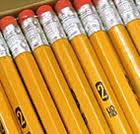
Remember the dread that this box of pencils could inspire?

Remember the dread that this box of pencils could inspire?

Federal policies such as 2001’s No Child Left Behind and 2009’s Race to the Top squeeze teachers into ever narrower pigeonholes while the students languish uninspired before seas of multiple choice bubbles waiting to be filled in (No. 2 pencil, please). NCLB mandated that states implement reading and math standards then measure student progress in those areas with annual testing in grades 3 through 8. Schools, moreover, are also measured against each other and “graded” on number of students meeting the standards. Due to the rigors imposed by these well-meant (insofar as originally intended to help disadvantaged students by leveling the academic playing field) but ultimately disastrous policies, teachers often face no choice but to “teach to the test.” If it’s not on a standardized test, it will probably fall to the wayside. Goodbye, foreign languages. So long, art. See ya later, music.

Those three things just listed have other important common characteristics besides being unlikely to show up on standardized tests: first, they are emphasized at The New Century School; second, they are noted for cultivating higher-order creative and critical thinking skills. Standardized tests, by contrast, are widely criticized as setting impossibly high stakes, creating a climate of cheating, and being of such poor quality and design that they don’t allow students to demonstrate what they may have actually learned. Some say these tests threaten to turn kids into a generation of mindless drones rather than intellectually curious, well-adjusted people who can think on their feet—you know, human beings.

Standardized Testing’s Negative Effects

Stemming from such adversity, “Warnings from the Trenches” was written as an address to college-level educators. Bernstein says to them,

“The structure of [elementary] testing has led to students arriving at [high] school without what previously would have been considered requisite background knowledge . . . Now you are seeing the results in the students arriving at your institutions. They may be very bright. But we have not been able to prepare them for the kind of intellectual work that you have every right to expect of them. It is for this that I apologize, even as I know in my heart that there was little more I could have done. Which is one reason I am no longer in the classroom.”

Reading this lament is unsettling enough, but the distress only grows when you consider the clear implication that the problem originates in elementary school but impacts a student’s entire academic career. When Bernstein’s article was reprinted in the Washington Post‘s The Answer Sheet last month, comments poured in from instructors who had similar experiences. One college professor writes:

” . . .Within the first two weeks of each semester, I can identify students who were home-schooled or who attended private high schools. Why? Because they participate in class discussions. Because they can apply theory in meaningful ways. Because they can find examples that exemplify those theories in the world at large. Because they can write a proper sentence and a proper paragraph. Publicly schooled kids, for the most part, can’t do any of those things.”  

It’s clear: uncritical use of standardized testing has deleterious effects on both teacher and student. A pilot study compiled by the UCLA Center for Research on Evaluation, Standards, and Student Testing reported that at their worst, standardized tests:

  • Narrow and trivialize the curriculum. The focus of instruction shifts to easily assessed fragments of topics and away from significant or broad knowledge acquisition.
  • Exclude topics and skills not likely to appear on the test. Computer skills, long-term or collaborative projects, and even science at the lower grades get pushed out of curricula. (Notably, this finding was specifically from Maryland schools.)
  • Reduce learning to rote memorization of basic facts. Higher-order thinking skills get short shrift insofar as multiple-choice formats don’t require organization and composition of ideas or words to be answered.
  • Demand too much classroom time for test preparation. One study found that test prep occupied 10% of overall elementary class time.
  • Restrict how teachers teach. To prepare students for the testing environment, teachers often evaluate in-class work with a test-like, worksheet-like format—drilling.
  • Reduce time spent with individual students as well as instructional differentiation. One size fits all. It’s standardized, after all.
  • Exclude the student’s say in his or her own education. Gone is choice, guided exploration, and intellectual curiosity. Kids (and teachers) have to “stick to the program.”

And that’s not even taking into consideration the mental and physical health problems brought on by the stress of high-stakes testing. Kids exhibit gastrointestinal upset and regressive behavior, while teachers fight stress headaches in the days and hours leading up to the dreaded Test Time. NCLB also precipitated a rather ironic outcome: 19 states lowered their academic standards in order to show better test scores. No wonder, then, that in 2012 the United States ranked only 17th out of 49 countries in education. Worse, most other countries were showing improvements in academic matrices, whereas the United States’ performance was described as “hardly remarkable.” Ouch!
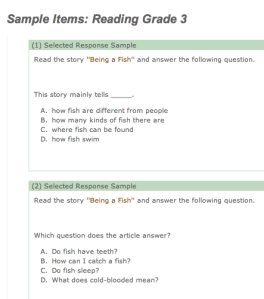
An example of Maryland's 3rd-grade standardized reading test.

An example of Maryland’s 3rd-grade standardized reading test.

An example of Maryland's 3rd-grade standardized math test.

An example of Maryland’s 3rd-grade standardized math test.

TNCS’s Approach to Standardized Testing

At TNCS, as the elementary program grows, standardized testing looms in the near future. The 2013–2014 school year will accommodate students through 4th grade. Public schools starting at 3rd grade in our state are subject to the Maryland School Assessment (MSA) to comply with the federal NCLB act. Being an independent school affords much more flexibility as well as choice in this matter, fortunately for TNCS.

Lest we throw the baby out with the bath water, it’s important to remember that schools need a means of assessing their curricula and the implementors of those curricula as well as student performance. The above criticisms apply to the worst-case scenario. What a carefully considered assessment situation can offer is a reliable way to evaluate academic achievement and to maintain school accountability without sacrificing core values. So, although we’re probably stuck with standardized testing in some form, rest assured parents—school administrators vow that TNCS elementary instruction will never deteriorate to teaching to the test. Though the standards are certainly covered, “[We are] committed to providing each child the opportunity to become an independent, secure, and balanced human being. Each child cultivates his or her natural intellectual curiosity while developing leadership skills and the ability to think critically. We embrace the individual and design developmentally appropriate activities and lessons to engage and enrich.” Many such engaging and enriching activities have been profiled in this blog, such as learning Mandarin and Spanish. Learning foreign languages is key to developing the problem-solving skills that so many students currently lack (see Multilingualism at TNCS: Optimizing Your Child’s Executive Function). Providing art instruction is another way TNCS cultivates those character skills that some public school curricula sadly can’t begin to address (see The Importance of Being Artistic).

Hope for the Future

It’s also possible that the the current federal administration will continue taking steps to reverse some of the harm to public education done by NCLB. In 2010, the blueprint for reforming the Elementary and Secondary Education Act (of which NCLB is an offshoot) was released but stalled in Congress. The Obama administration countered by giving 34 eligible states plus D.C. the flexibility to expand academic performance measures, such as writing and social studies proficiency. Maryland is one of the states no longer suffocating under the restrictive NCLB measures. We can hope, right?

In the meantime, an “A+” goes to schools like TNCS, committed to providing a well-rounded, progressive education that benefits the whole child, not just the test score.

What do you have to say about this important subject? Please contribute thoughts, questions, and comments. Your participation in this discussion will help TNCS forge the way to a brighter future for elementary education in Baltimore. Our thanks once again to TNCS Enrollment Coordinator Robin Munro for suggesting this worthwhile and very relevant topic.

Charmed by TNCS’s Year of the Snake Performance

February 10th, 2013 marked the beginning of The Year of the Snake (蛇 Shé) in the Chinese Lunar New Year, also known as the Spring Festival.  Although in Chinese lore the snake year is commonly considered less propitious than its predecessor (Year of the Dragon), The New Century School rang in the new year in high style. The meteor strikes, nightmare cruises, and olympic athlete scandals that the lunar year commenced with notwithstanding, TNCS honored the snake with weeklong festivities (such as making and eating dumplings, or 饺 jiǎo), culminating with a special performance at Port Discovery on Saturday, February 16th.

This was TNCS’s second annual Port Discovery performance in honor of Chinese New Year, and the primary and elementary students just loved it! The Chinese teachers spent weeks teaching them the songs and poems that made up the program. Chen Laoshi (a.k.a. Charlotte) and Xue Laoshi (a.k.a Cici, or 薛雪) presided over the actual performance, keeping their little red-and-gold-garbed snakes, mice, roosters, dragons, etc. on task. Xue Laoshi  says, “I am so proud of all the students. They all did a good job.”

The performance comprised two songs and a poem. Xue Laoshi explains that the first song was the Happy New Year song, sung by the primary students. Next, the primary and elementary students together sang the Chinese Zodiac Song and acted out the characters they were describing. Lastly, the elementary students recited a famous Chinese poem about a snowy landscape. Because the poem is quite long, they read in unison from placards printed with both English phonetic and Chinese characters. The students are clearly making remarkable progress—not only can they speak Mandarin beautifully, but they can also read and write it!

Xue Laoshi isn’t prepared to stop there, however. She says, “For the Year of Snake, I plan to help the students make even more progress. Maybe they will even tell you a story in Chinese not just read it!”

Sounds like this Year of the Snake might not be so bad after all!