Meet the Teacher: Vianyely Loveras Brings Heart to a Preprimary Spanish Classroom!

One of The New Century School‘s hallmarks is its commitment to language immersion. Having remained steadfast in this commitment throughout its 15+ year history, TNCS welcomes teachers who are native speakers of Spanish (and Mandarin Chinese and English) from all over the world. This cultural enrichment is another jewel in TNCS’s crown. To optimize the attainment of true language proficiency, TNCS starts immersing students in Spanish (or Chinese) at age 2 in the preprimary classrooms. The three preprimary classrooms are so essential to TNCS’s mission—they start students off on a pathway of lifelong joyful learning by helping them become self-motivated and through careful cultivation of cognitive and emotional development. This is precisely where educating the “whole child” begins.

This school year, Vianyely Loveras took over as lead in one of the preprimary Spanish classrooms, and she brings a wealth of heart and passion to her new role (she even has love in her name!). Walking into her bright, sunny classroom, visitors see smiles all around, including Sra. Loveras’s own.

Meet Vianyely Loveras!

Originally from the Dominican Republic, Sra. Loveras’s journey to becoming an educator began with her early childhood education degree after moving to New York City in 2010. She attended high school there before pursuing higher education at Borough of Manhattan Community College (BMCC). “I went to college for early childhood education,” Vianyely notes, explaining that her career choice was influenced by family members who were teachers. “They always talked about how much they loved their jobs, and I too wanted to choose a career that I would actually enjoy. I have always liked kids, so I decided to give it a try, and I love it.”

Beyond her teaching career, Sra. Loveras is an esthetician specializing in waxing and eyelashes. She also enjoys art, particularly embroidery and macramé. “I learned macramé when I was in the Dominican Republic,” she explains, noting that school days there were shorter, running from 8:00 to 12:45, which allowed time for additional activities in the afternoon.

Sra. Loveras came to the United States in 2010, living in New York City for 8 years before moving to Baltimore in 2018. One thing she misses about New York is its authentic Dominican food, which Baltimore has so far fallen short on. In fact, Sra. Loveras’s Dominican heritage shines through in her love for her native cuisine. When discussing traditional Dominican food, she lights up, explaining a cultural touchstone known as “the flag.” “The rice, beans, and meat—we call it ‘the flag,'” Vianyely explains. “The white lines are the rice, the beans are the blue squares, and the red squares are the meat.” The cultural connection between food and national identity remains an important link to her homeland, which she tries to visit every summer to reconnect with family.

Sra. Loveras in the Classroom!

Although her early childhood education degree provided the foundation for her teaching career, she credits her hands-on experience at TNCS with deepening her understanding of Montessori principles and child development.

“I had not worked in a classroom until starting at TNCS,” Sra. Loveras shares. “This was my first job working with kids besides babysitting with my family.” She first joined TNCS in January 2020, just before COVID hit. After a 2-year hiatus, she returned in 2023, initially serving as Miss Garcia’s assistant before stepping into her current lead teacher role.

For Sra. Loveras, the transition to lead teacher came with both challenges and growth. “I worried that I wasn’t ready, but Miss Lane motivated me. She would say, ‘Yes you can do it, and I’m sure you’re going to love it.’ And I did. She was right!”
Sra. Loveras quickly embraced Montessori principles. “I am so impressed with how beautiful it is . . . how the children learn to do so many things on their own, how they become so independent. I also learn a lot by watching the other lead teachers in their classrooms. This philosophy just got in my heart.”

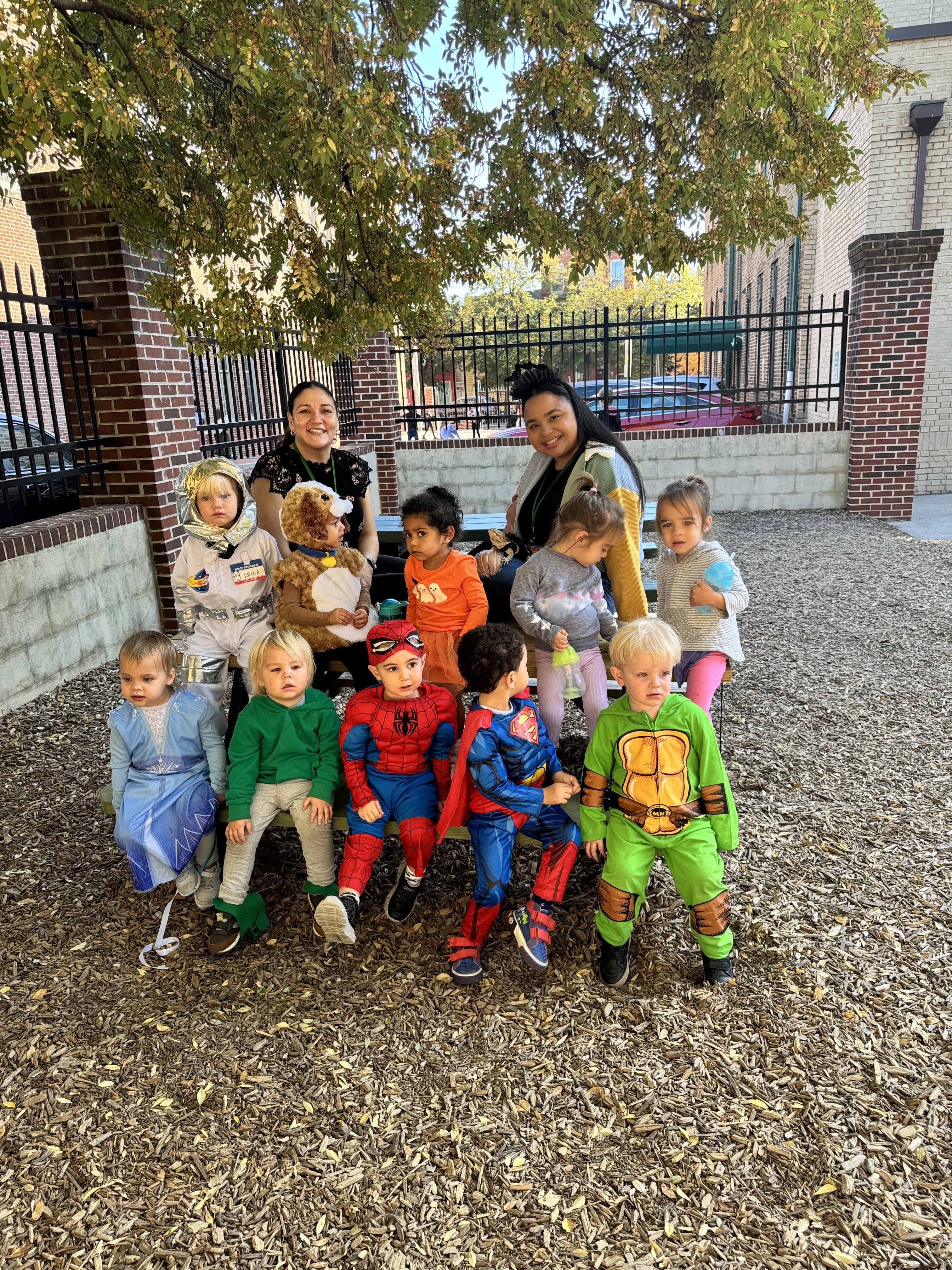
Currently, Sra. Loveras leads a classroom of 11 students, most of whom started as 2-year-olds. She and her assistant teacher primarily speak Spanish in the classroom, and her students are thriving. “They understand perfectly what we say. They tend to respond in English, except for those whose parents speak Spanish to them at home, but they are clearly learning.”

A typical day in Sra. Loveras’s classroom begins with the morning cycle from 8:45 to 10:00. “The second students take off their jackets and change their shoes, they start doing their work cycle. We always have food available for them in the kitchen, so if they’re hungry, they can have a quick snack and then return to their work cycle.”

At 10:00, the class gathers for circle time. “We sing songs, read books, and sometimes I show them a lesson from the shelf as a big group.” Following circle time, the students head outside for about an hour before returning for lunch, which they help set up themselves. Naptime runs from 12:30 to 2:30 PM, and dismissal is at 3:15.

Sra. Loveras takes pride in incorporating cooking and planting activities into her curriculum. “Today we made a banana shake. I love to cook, so that’s what we do much of the time.” Recently, her class joined with the other preprimary classes to plant sunflowers and milkweed for monarch butterflies.

While such daily activities certainly sound engaging and fun—not to mention a delight for all of the senses—Sra. Loveras is clear about the deeper importance of her work, and it informs every choice she makes regarding her students. She reflects:

Our role in the classroom goes far beyond caring for the children—though that’s a very important part. We are here to guide them, to create a safe and supportive environment where they can explore, learn, and grow independently.

We lead them gently in the right direction and give them the tools to discover things on their own. Even something as simple as tidying up becomes a meaningful learning experience. What may seem like a routine chore to us as adults becomes a powerful way for children to develop responsibility, independence, and important practical life skills.

Beyond the academic and practical learning, we also build deep, trusting relationships with the children. We are the familiar faces they see every day—the ones they feel safe with, turn to for comfort, and grow to trust. This emotional connection is just as important as the learning itself, and it’s something truly special to witness each day.

What brings Sra. Loveras the most joy as an educator is witnessing her students’ growth. “My favorite part is seeing how I teach them something today, and then tomorrow they come and they already know how to do it all by themselves. Sometimes they hear me and Miss Susanna, my assistant, say something to them in Spanish, and they come in the next day saying it. That’s the best part—to see their progress and how they enjoy what we do.”


Art and Education: Brenda Lane Blends Her Dual Passions at TNCS!

At The New Century School, students in the primary program are fortunate to work with an educator who brings a unique creative perspective to the classroom. Brenda Lane, a visual development artist, seamlessly balances her role as a teaching assistant with an emerging career in animation. If that surname is ringing a bell, it should—Miss Brenda is the daughter of none other than TNCS Preschool Coordinator Terriann Lane!

Miss Brenda Gets Animated!

Born in Honolulu, Hawaii, Miss Brenda (and family) moved to Columbia, MD when she was in high school. But it wasn’t until college that her passion for the arts began to bloom. She majored in fine arts at Virginia Commonwealth University, where she discovered her true calling in her final year. “I knew I didn’t want to be a gallery artist. Then, in my last year, I suddenly realized I want to work on movies and TV shows. That was my ‘it-all-came-together’ moment,” she reflects.

Unfortunately, the pandemic curtailed networking opportunities, so she sought other fulfilling post-graduation employment in the interim:

I really wanted something while I was waiting for that big job opportunity that would be helpful to the community. I didn’t want to work in customer service anymore, which I did all through college. I definitely wanted to do something that was more impactful, so I started at my mom’s last school as an aftercare teacher, and they soon pulled me in to be a floating assistant.

The interim turned out to be more than a temporary stopgap, as we’ll see. But, back to the early 2020s, Miss Brenda saw an opportunity and seized it. She traveled to Los Angeles to attend an animation industry conference, sensing that the animation industry on the East Coast was not very robust. This decision proved pivotal, leading to her current role as Creative Production Director at Black-n-Animated, a nonprofit organization dedicated to helping Black artists and animators enter and thrive in the industry. “Everything kind of fit into place,” she says of the serendipitous connection.

Two years on, her artistic career continues to flourish. She’s currently working on “Assassinista,” a 3D animated short film through a Pixar co-op slated for release on Disney+ in 2027. “It’s comparable to the ‘Spider-Verse’ kind of animation style,” she explains. “It’s only 7 minutes, but we’re going to get it there.” In this project, she serves as both assistant producer and color key artist (as part of her visual development expertise), marking her first official credit in the animation industry.

“I’m really into concept art, such as what Pixar and other studios do, which shows the process of how you get to a design,” explains Miss Brenda. “Concept art and visual development are really one and the same. So, basically, if someone needs a shelf or a window in a scene, for example, I can design that.”

Bringing Art to the Classroom

Miss Brenda’s exciting work in The Arts has not dampened her enthusiasm for educating. At TNCS, she is Ms. Pozo’s assistant in one of the primary Montessori classrooms for children ages 3 to 6. In addition to her main responsibilities of “supporting teachers, supporting students, and maintaining an optimal classroom environment where students can grow their learning,” she collaborates with Montessori teachers to create educational materials, putting her digital art skills to practical use. “If you need something with Photoshop or Illustrator, I’m able to make it,” she says. “I helped make illustrated step-by-step instructional materials to help children learn how to read, for example.”

Her complementary roles have even deepened her appreciation for children’s content. “being in the classroom has exposed me to so many things that I now enjoy,” she reflects. “I really do love doing it, and it also pushes me more toward children’s content and animation . . . and maybe I’ll consider pursuing children’s books.”

Looking to the Future

Despite the animation industry’s current uncertainties following recent strikes, Miss Brenda maintains a balanced perspective. She appreciates the stability her teaching role provides while pursuing her animation career through remote work. Her days are long—she spends all day in the classroom then goes home to join remote meetings in L.A. and work on her art—“but this is where I enjoy being,” she says of her position at TNCS.

Miss Brenda’s passion for both education and art is evident in her interactions with students. “I’m passionate about what I do, and it brings me joy to be around the students. I hope that I can bring them some joy as well,” she shares. She particularly enjoys encouraging young artists, loving it when her budding student artists ask her for drawing and painting advice.

Making an Impact

Beyond her roles at TNCS and in animation, Miss Brenda continues her work with Black-n-Animated, which recently achieved nonprofit status. “We just had our first career summit in L.A. with really big industry names coming to talk to all of our people trying to break in,” she said. “I’m really excited about the new year!”

Whether she’s supporting young learners in the classroom or pushing creative boundaries in animation, Miss Brenda exemplifies how diverse passions can enrich both personal fulfillment and professional impact. Her presence in the primary Montessori program reflects TNCS’s commitment to nurturing creativity and bringing real-world artistic expertise into the classroom, enriching students’ early educational experiences.

TNCS’s Preschool Division Flourishes Under Terriann Lane’s Leadership!

The New Century School‘s preschool division exemplifies the profound impact of authentic Montessori education under the guidance of Preschool Coordinator Terriann Lane. Now in her second year, Ms. Lane has orchestrated significant enhancements to both the physical environment and educational approach, creating spaces where young minds can truly thrive.

One of Ms. Lane’s primary achievements has been establishing consistency across classrooms while maintaining each teacher’s unique perspective. “When I joined the TNCS community, each preschool classroom was in their own bubble,” she reflects. “Now they’re visiting each other’s classrooms to observe how systems work. They’re collaborating and asking each other questions. There’s now a sense of community while striving to understand and implement the curriculum.”


“The environment must be rich in motives which lend interest to activity and invite the child to conduct his own experiences.” Dr. Maria Montessori


This cohesion extends to the physical environment, where Ms. Lane has implemented substantial improvements. She explains:

One of the requests was to make sure that each classroom had furniture that matched. When you go into either classroom, they have the same types of shelves, same types of chairs, same types of tables, and that creates order, which is important in Montessori. Dr. Maria Montessori wrote that ‘…everything about a child should not only be in order, but that it should be proportioned to the child’s use, and that interest and concentration arise specifically from the elimination of what is confusing and superfluous.’

The preschool division currently encompasses three primary (ages 3–5 years) and three preprimary (starting at age 2) classrooms, each thoughtfully—and beautifully—equipped with materials that support the Montessori curriculum. Ms. Lane has ensured that “all of the curriculum areas are covered in every classroom,” with special attention paid to Practical Life activities—a cornerstone of Montessori early childhood education. “Practical Life work prepares the children to excel in other areas of curriculum, including Sensorial, Math, and Language by growing their sense of coordination, concentration, order, and independence,” she said.

This slideshow requires JavaScript.

Innovation meets tradition in these spaces. A particularly creative solution was found for the second-floor classrooms that lacked working sinks. Ms. Lane introduced “Mighty Sinks,” a portable solution that enables essential Practical Life activities. “It has a working faucet, and you just fill it with water, dump the water, clean it, fill with water, and repeat,” she explains. “The children are now able to do their dishwashing and hand washing, cleaning up after art projects… they can use it for any work requiring water right in the classroom.”

The classrooms buzz with purposeful activity, particularly during mealtimes. Students actively participate in preparing for lunch, setting their own places, and engaging in what Ms. Lane calls “social learning.” Food preparation has become an integral part of the curriculum, with children learning practical skills like peeling oranges or cutting bananas—activities that build independence and fine motor skills.


For how to support your Montessori student at home, see the PowerPoint presentations from the TNCS Preprimary and Primary Workshop events held earlier this month:


This slideshow requires JavaScript.

Most importantly, Ms. Lane notes signs of true Montessori “normalization,” in which children naturally follow classroom procedures and engage in work independently. The focus on community building is evident as students demonstrate care for their environment and each other. “If you walk into a classroom and see something on the floor, you pick it up. Or, someone falls down and bumps their knee on the table and you go over and ask how they’re doing and can I help you. Those moments reflect true community.”

Looking ahead, Ms. Lane envisions expanding the so-called “Cosmic curriculum”—Montessori’s integrated approach to cultural and political geography, life sciences, botany, and zoology. She emphasizes the importance of scientific observation in tracking student progress: “The Lead Teachers scientifically observe what the children are doing and then plan lessons for them to move forward through the curriculum.”

The teaching staff’s dedication to Montessori principles has been particularly noteworthy. “I’m proud of them for hearing me, trying it all, and now asking questions to strengthen their practice,” Ms. Lane shares. “In the beginning, they were just asking questions, and now they’re implementing what they’ve learned and are learning.”

Through careful attention to both the physical environment and pedagogical approach, TNCS’s preschool division continues to provide an authentic Montessori experience where children develop independence, community awareness, and a love for learning. Under Ms. Lane’s guidance, the school maintains its commitment to Dr. Montessori’s vision while adapting to meet the needs of today’s young learners.

TNCS 2nd- and 3rd-Graders Go Places with Teacher Sarah Weiskopf!

The New Century School values what each individual member of the community brings to the beautiful whole. This is no less true for TNCS teachers, who are, after all, helping introduce young humans to the world and what it offers. Their unique perspectives incrementally broaden students’ horizons and ignite the passion for exploration.

For TNCS grades 2 and 3 English Language Arts and Global Studies teacher Sarah Weiskopf, this is a deeply held tenet.

I really believe in guiding the student toward self-construction, showing them where the tools are, so they can kind of teach themselves. In the Montessori way, you put things out, you give a lesson, and you inspire students toward learning. In that inspiration toward learning, they actually are making themselves into whole human beings. So I like to just be the guide and kind of step back and allow that knowledge and exploration to unfold.

How Sarah Weiskopf Came to TNCS

Ms. Weiskopf started teaching at TNCS in the 2021–2022 school year. She is about to commence her third year at TNCS and is even helping out with summer camp in the meantime.

But she traveled a few dozen thousands of miles to get here. To start this journey from the beginning, Ms. Weiskopf attended Skidmore College, a liberal arts college in Saratoga Springs, NY, for her undergraduate degree. After an on-campus job in the dining hall taught her that food service was definitely not her thing, she began working in a preschool and loves that experience.

She bookmarked that for a bit, not yet certain that teaching children was her avocation, and moved to Prague in the Czech Republic in 2013. There, while teaching English as a second language to adults, she realized that she preferred teaching younger students after all. So, she interviewed at the International Montessori School of Prague as an ELA support teacher and was hired. “Then someone in the 1st, 2nd, 3rd classroom was leaving temporarily, and I took over in that classroom as the assistant,” she explains. “I fell in love with the theory behind Montessori, and watching it in practice was really inspiring.”

She lived in Prague for 3 more years, then made a pit stop in Southeast Asia to do some teaching-subsidized travel there. When she returned to the United States, she had a goal: earning a Master’s degree in Montessori Education. So, instead of going home to her native town of Pittsburgh, PA, she arrived in Baltimore to enroll at Loyola University Maryland. She took a slight detour back to food service to support herself through graduate school, waiting tables and bartending.

With her Master’s degree in hand, Ms. Weiskopf has been teaching for several years. She decided to remain in Baltimore, which is close enough to Pittsburgh to see her family regularly, and bought a house here last year. She taught in Baltimore City and Baltimore County private schools for a bit, but, when the pandemic hit, some of her students’ parents approached her about leading an at-home school in Monkton. She had a cohort of 13 students in grades 1st through 7 and taught all subjects (with the help of an employees she brought on to help out with the upper-level math. They did most teaching and learning outdoors. “In the winter, we had a little garage space that we worked in with space heaters,” she recounts. “We did a lot of hands-on learning. For instance, the kids were really into biking, so I taught the 7th-graders how to use power tools, and they  built bike ramps and little bridges on the property. That was a blast!”

Ms. Weiskopf at TNCS

When in-person school was about to start back up, Ms. Weiskopf got the call to interview at TNCS, having been recommended as a candidate by a teacher friend. Although she misses teaching all subjects and having her students all day long (à la Montessori and her pandemic pod experiences), she is enjoying her time here and especially appreciates her co-teacher Swati Mehta. “She and I are really able to share ideas back and forth and collaborate,” said Ms. Weiskopf. “We are so in sync at this point that it’s just second nature working with her. So I really love the ability to have a co-teacher in that capacity.”

And for you, TNCS parents, she wants you to know that your involvement is most welcome.

The part of the job that I love the most, actually, is parent/teacher relationships. I really see teaching as a partnership between me and the students’ parents or  family members. I can’t do my work without their involvement; they can’t do their work as parents without my involvement. So I really do think that we are a team. I’m an open book, and I really want parents and family members to come and ask questions, see lessons, and really be involved.

Outside of TNCS

Although teaching requires a monumental amount of energy, commitment, and care, Ms. Weiskopf finds plenty of latitude for extracurricular activities: “I like to spend time with my fiancé hiking, biking, and walking our dog Phoebe. We love to travel and go camping as often as we are able! We have a workshop in our basement for home renovation and DIY projects. We most recently built a coffee table.”

Wait—fiancé? You read that correctly; besides starting her third year at TNCS, Ms. Weiskopf has another big event to look forward to: she is getting married in December! As the seasoned traveler you are, we know you will fare very well on that upcoming journey!

Introducing Stephen Billhardt, TNCS’s New Interim Director of Preschool!

Since its inception 10 years ago, The New Century School has certainly grown into more than a preschool, having expanded to comprise both Lower and Upper School divisions. But in many ways, TNCS’s youngest students are still at its heart, and the lower school requires specialized guidance.

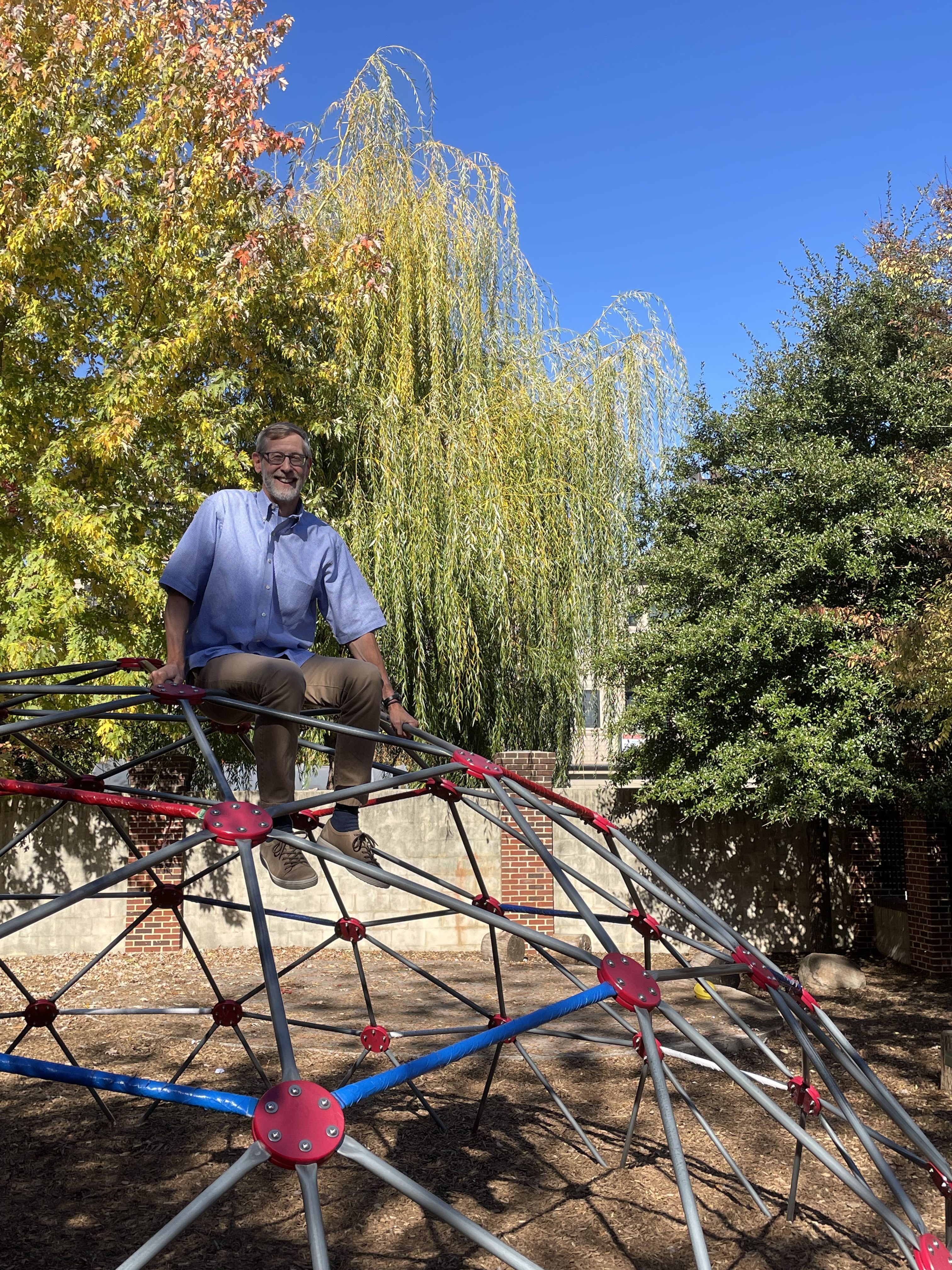
Meet Stephen Billhardt!

That’s why Stephen Billhardt has become TNCS’s new Interim Director of Preschool. He came to TNCS in sort of a roundabout fashion . . . but you’ll soon see how clear the path actually was! He and his wife were living and working outside of Boston when, in early 2021, she took a job with Baltimore City public schools. They did what Mr. Billhardt calls a “commuter marriage” for a year while he stayed in Massachusetts temporarily to complete his commitment working at an integrated preschool and kindergarten (and, over the summer, help his elderly father recover from a recent health incident). With both their son and daughter in their respective colleges, and the now 28-year married couple missing each other, he says it was the right move to also relocate to Baltimore. He joined his wife in mid-September and remembered TNCS from previous visits to Baltimore on walkabouts with his wife through Fell’s Point. “Any small school is of interest to me, so I had researched it to find out more about it. After 2 weeks of settling in, I reached out.” After speaking with both Co-Founder/Co-Executive Director Roberta Faux and Head of School Erika Johnson, he was hooked. Part of the appeal, he says, was the Montessori primary program, which he was familiar with because his own children went to Montessori school through 3rd and 4th grades.

Although—spoiler alert—Mr. Billhardt has been in education for more than 30 years, that’s not how his professional life began. “I didn’t know I was going to be an educator,” he recounts, “I thought I was going into business. My dad was in business, my brother was in business, so I just thought that’s what I would do. I actually sold car phones, fax machines, and antitheft devices for a summer.”

Background

Originally from southern Connecticut, he attended Dickinson College in Carlisle, PA, earning an undergraduate degree in Economics and Political Science. “My first experience working with children was as a Big Brother in college. I had the same little brother for 3 years, and that got me interested in early childhood education.” He then ended up in Boston, where a couple of his friends were living who thought he’d make a great teacher and suggested he give it a try. While student teaching, he got a Master’s in Education, then a second Master’s in Educational Leadership from the Harvard Graduate School of Education. It was there that he met his wife, joking that that was the “best part of the program.”

After Boston, he moved to Vermont for his first full-time teaching job. “I just love Vermont. I taught at a small elementary school called Moretown Elementary—it’s just a great little school, and it’s right on the river.” What drew him to early childhood education? “It’s a great age. Early childhood is a wonderful learning opportunity for the children, for the teachers, for the parents. (As parents, we’re all still learning.) The developmental stage is so great—I appreciate all the smiles and the ready-to-learn attitudes,” he said.

And that sealed the deal! Since then, he has always worked in elementary school or preschool divisions. Next, he and his wife relocated to Michigan. She taught in Detroit public schools, and he went to Grosse Pointe to lead a grade 1 through 5 lower school. After a couple of years in Michigan, they relocated to Cambridge, MA, across the river from Boston. For the next 14 years, he assumed the principalship of schools in the Southborough and Watertown Public Schools.

“I’ve had the opportunity to be in independent and public schools for 33 or 34 years, 27 of those in educational leadership, and I like having that experience.” His most recent independent school experience was as Lower School Head at a pre-K through 4th-grade all-boy’s school called The Fessenden School in Newton, MA. “Once every 10 days he gathered all the students together and marveled at the range of learners and the developmental span. “Although that was challenging, it allowed me to really develop my skill set to engage children. They need some sort of activity; they’re attention spans are only so long, so you have to have little snippets of things and visuals. I would always have music at these assemblies.” Like TNCS, Fessenden “wears a lot of hats” being both a pre-K through grade 4 school but also having an upper school for 5th- through 9th-graders with a boarding option for domestic and international students. Mr. Billhardt was there from 2012 through 2020.

“Finally, over the last 2 years, I had a wonderful experience at the Willett Early Childhood Center, a public integrated preschool for children with and without disabilities. From age 3 there, students have the opportunity to get an individual education plan (IEP), and the public school is required to support them with the hope that they would learn strategies to overcome some of the disabilities or help support them with their disability. We had about 75 children on IEPs with another group of typically developing children as peer role models. All public schools have that opportunity, but I find it very effective. That was one building. Then there was also a stand-alone kindergarten building with 275 kindergarteners.”

Stephen Billhardt at TNCS!

His initial impressions of TNCS will surprise no one. “It’s a very nice community,” he said. “And there’s a lot going—a lot of exciting things. For me, it’s fun learning about such a language-rich immersion experience with the children. I’ve had Spanish in my schools in the past, but nothing to the level of what you see in the classrooms here.” He’s also excited to be back in the Montessori atmosphere. “Montessori is the greatest approach education has to offer for that age group.” He appreciates the multiage component of Montessori and the work ethic it inspires. “I love the open-ended work, the communication, and the collaboration,” he said. “I appreciate the methodical approach to the materials: how they’re laid out, how children access them, when they access them, and how long they access them. So, walking into classrooms and seeing that really gels with me.”

After this long in education, Mr. Billhardt says, he wants to be at a school that excites him. He also wants his role to work for everyone involved. “Let’s see if what I bring works for everybody and for the institution first,” he said of his new position.

With 33 years in the public and private sectors, Mr. Billhardt is excited to help contribute to TNCS. “I’ve had a unique opportunity to see and work with children and families in those sectors. I think all schools offer different opportunities for educators and school leaders to learn. Independent school leaders have a lot to learn from public school leaders and vice versa. I think finding what works best for children, how we communicate with families, how we support and develop educators—each school does it differently. But there are some very good practices out there, and being able to pick the best from the different schools I’ve been at and the experiences that I’ve had, I hope to bring those to this school.”

As for how he’s settling into his new city, he picked the perfect fall to do it, as he greatly enjoys being outside. With these warmer-than-normal fall temperatures, he’s getting plenty of opportunities to walk around and get to know Baltimore: “I like the water; I walk along the harbor in the morning and watch the sunrise, or I take the water taxi. I’ve climbed the Washington monument, but I haven’t yet made it to the art museums.” He particularly wants to get to the American Visionary Art Museum, and we all know what a treat he’s in for. He’s also excited to start sampling some of Charm City’s food. Then there’s the Enoch Pratt Free Library—he has been to four branches so far. Reading and listening to audio books are a favorite pastime. “I like spending time on my own to recharge,” he said. “I love being around people, but at the end of the day I like to get some alone time to rejuvenate.”

When he’s not in Baltimore, he likes road biking and boogie boarding. With our nation’s capital so close by, he and his wife are also looking forward to visits there. They also travel to their daughter’s music performances; she plays the upright bass. “I love spending time with my kids who are 21 and 20. I love seeing how they’ve developed as students and now young people/young adults. As parents, even if you’re an educator, you look back and at some point, you have to say, ‘I did a pretty good job’. I think it’s important as parents and guardians to celebrate our children’s successes and be there to support and nurture them as they grow up. They still need us. That’s our role; our role doesn’t go away.”