Meet the Teacher: Andrew Callahan Joins TNCS’s Middle School Program!

The New Century School occupies an elite niche in education, providing instruction and learning opportunities for students ages 2 all the way up through 8th grade. To accomplish this mighty task, TNCS uses both programmatic and physical divisions to optimally serve the spectrum of needs all these students will have at their very different developmental levels. Importantly, the same amount of care and resources pour into each division.

Now in its 15th year, TNCS began as just a preschool. As the years went by and the student body got older, TNCS sequentially added grades—and physical spaces—to keep up with its students and to be able to continue flourishing, serving an expanded enrollment with its mission.

TNCS’s middle school (grades 6–8) is special for all these reasons, but it also stands out in other ways. It represents a double turning point: it’s the culmination of an 11-year educational journey for many TNCS students, and it’s also the safe place where TNCS students prepare to join a much larger world. As the middle school has matured, other opportunities inherently aligned with TNCS’s mission and identity have emerged—namely, scholarships. TNCS offers these scholarships to Baltimore students in underserved populations who have demonstrated academic excellence. The middle school years are critical in so many ways, and TNCS makes sure its middle school students are advantageously equipped.

Welcome, Andrew Callahan!

Its teachers are the key. Enter Andrew Callahan, who joined TNCS in the 2024–2025 school year as the middle school homeroom teacher. He also serves as both English and Global Studies teacher for grades 6–8, along with the additional role of Student Engagement Coordinator. “In that capacity, I run the social-emotional learning program, help out with the service-learning program, and try to provide additional supports to our students who need it the most,” he explains. He also helps out after school during after care.

Background

Born and raised in Taunton, Massachusetts (“about halfway between Boston and Providence, Rhode Island”), Mr. Callahan’s path to teaching—and to Baltimore—was anything but direct. His educational background includes studying film and psychology at Wesleyan University, with significant experience in leadership training through the Boy Scouts of America. On graduating in 2020, he initially found himself, like many others during that pandemic-dominated time, isolated from the world and not by choice.

His first post-college position was as a work-from-home paralegal, which meant clicking away on a computer all day with no real human interaction. He asked himself, “How can I get out of this and become a more social person again?” The answer: “There are very few more social places in the world than a school.”

So, in 2021, once vaccines became available, Callahan made a dramatic change. “I was getting tired of living so isolated and just kind of wanted the opposite,” he explains. He moved to New York City, where he taught at Brooklyn Ascend High School, a charter school in Brownsville, one of Brooklyn’s poorest neighborhoods. “I’ve always really been interested in how people learn and the way you communicate to get things to stick in the long-term memory,” he shares. “Film felt like an analog into English. A lot of the thinking work is the same, and so it really has gelled really nicely.”

While teaching the students at Ascend (he managed four classes of 30 students each) was often very rewarding, other aspects that can plague any school, like teacher apathy and burnout, had a dampening effect. Fortunately, this did not extend to his newfound passion for teaching in general.

Mr. Callahan at TNCS

When his girlfriend was accepted into a Ph.D. program in clinical psychology at Loyola University Maryland, they moved to Baltimore in August 2024. After becoming interested in TNCS through an online job search, he was further drawn by its smaller size as well as its focus on service learning, which he was well versed in through the Boy Scouts. Also, he says:

The move from high school to middle school was appealing to me because when I was teaching freshman at Ascend, I was struck by how underprepared a lot of them were, and there were so many foundational things that I didn’t have the time to work on with them because we had to keep moving through the curriculum. It’s heartbreaking to have 9th grade students who literally can’t read—and it wasn’t because of intellectual disabilities, it was because no one had given them a shot. I realized I would love the chance to lay these foundations to set students up for success in high school.

Mr. Callahan initially spoke to Head of School Ann Marie Simonetti about coming to work at TNCS, and he said he immediately felt welcomed, a feeling that has persisted. “It really does feel like a place where I’ve gotten to meet so many different types of people,” he said. “My coworkers here are incredibly diverse, and I get to learn from all of them and build relationships with people who I otherwise might not meet.” Mr. Callahan also appreciates the intimate scale of his current position. He can spend one-on-one time with each of his students, a luxury he could not afford with his former larger caseload.

The significant educational challenges he witnessed early in his teacher career have made him particularly appreciative of TNCS’s approach: “Being here is a lot more uplifting. Everyone here cares so much, and no one’s going to get through 8th grade at TNCS not knowing how to read. I’m 100% confident in that.”

In his English classes, Mr. Callahan is currently teaching memoirs. “We’re reading ‘Born a Crime’ by Trevor Noah and another memoir called ‘How Dare the Sun Rise.’ It’s a great story about a woman who was raised in the Democratic Republic of Congo during wartime and then she and her family moved as refugees to the United States when she was middle school age. It’s really exciting for the middle schoolers to be able to read about this completely different middle school experience.”

In Global Studies, he’s connecting this work to ancient African history. “We started the school year at the very beginning of time. We talked about how life formed on the earth, the Cambrian explosion, then moved into the Jurassic period, and then got to humans just before winter break. Now we’re on civilizations.” Although teaching Global Studies is new to him, an uncle taught history (Mr. Callahan was actually also his student at one point), and Mr. Callahan reached out to him for insight. “[My uncle] has this great passion for what it means to be a human, what it means to be a society, and so I used that in class. We jumped way back in time to the hominids and Homo erectus then looked at how we got to today. It’s been really fun to go on this journey with the students,” he said.

Regarding his teaching philosophy, Callahan emphasizes the importance of critical thinking and of meaningful challenge:

I think that’s what education is when it comes down to it—it’s making connections and pathways. One of the things you’re teaching is media literacy and understanding the world, but you’re also teaching students how to think. Math is great and really important for understanding things that you do in your day-to-day life. People don’t think that novels and literature come up in your day-to-day life as much, but when you’re teaching people how to think critically, that’s the skill.

I want students to feel comfortable in my classroom, but I don’t want them to feel too comfortable. Growing does not happen without a little discomfort and a little frustration. Students appreciate being taken seriously, and that means holding them accountable a lot, and that’s what I hope to bring to my classroom and to everything I do here at the school.

Regarding TNCS’s multilingual curriculum, Mr. Callahan says he’s very glad to see it. Although he currently speaks only English (with a dabble of high school Latin), he studied abroad in Sweden, where he encountered jokes like:

What do you call someone who knows two languages? Bilingual.
What do you call someone who knows three languages? Trilingual.
What do you call someone who knows one language? American.

Unless they attend TNCS, that is!

Mr. Callahan is also enjoying his new city and exploring its quirky character with his girlfriend. Coming from New York City, they are surprised by all the fun, free community events happening all over. He also maintains a range of hobbies. “I love to go on hikes, which is something that I’ve been able to do a lot more in Maryland than in New York City.” He also enjoys video games, Dungeons & Dragons, basketball, and comics—a connection that runs deep: “My dad raised me on superhero comics. That’s how I learned how to read, with the first issues of The Amazing Spider-Man from the 1960s.”

These personal interests often help him connect with his students. “My video game hobby is something I’m able to relate to students with. We’re able to talk about what games we’re playing, and it really is nice to be able to talk to each other in this way.”

Mr. Callahan has obviously settled in beautifully at TNCS, and TNCS is grateful to have him on board. He looks forward to what spring at TNCS holds in store . . . and more fun around Baltimore!


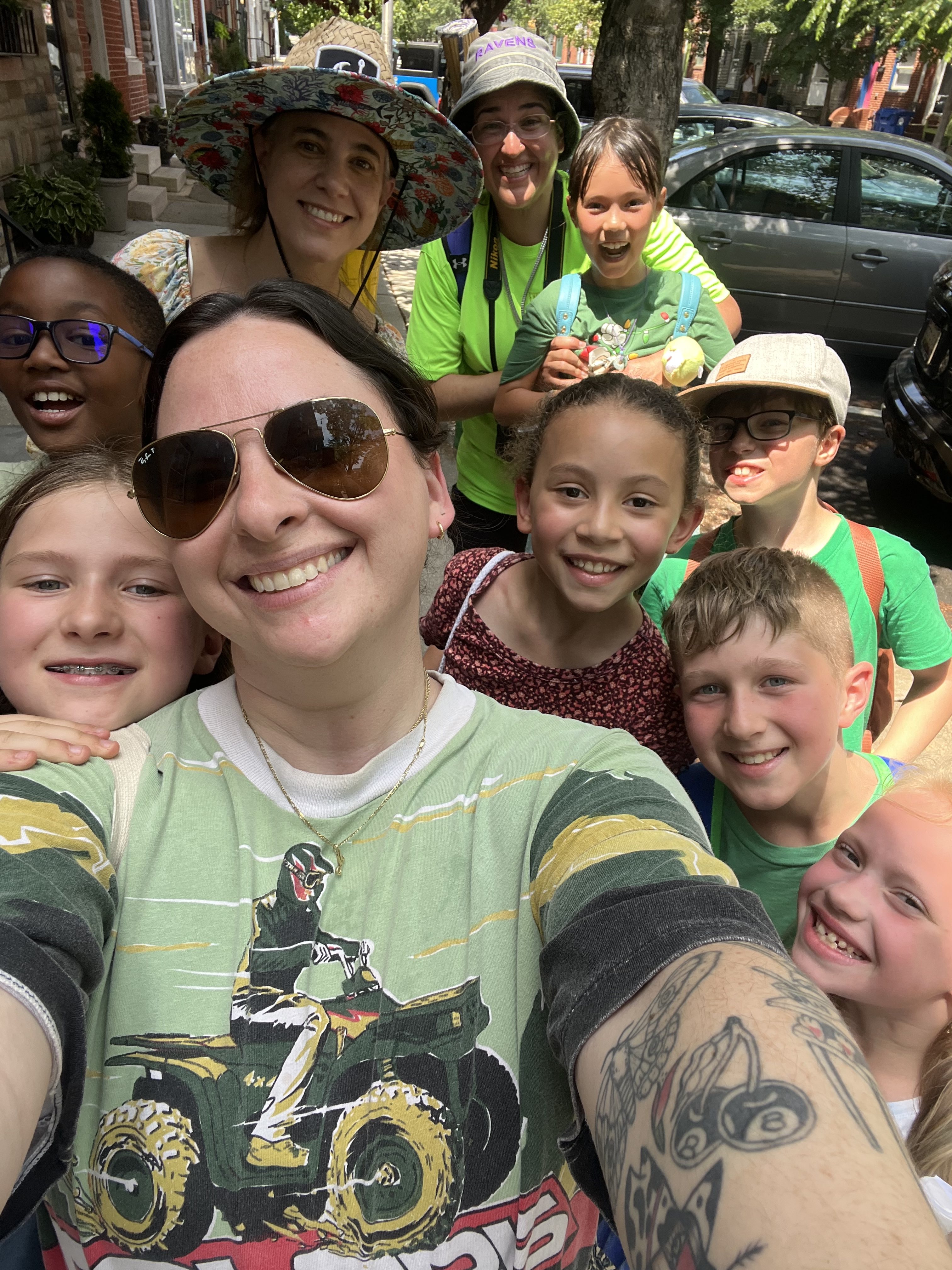
Pictured is Mr. Callahan giving an English lesson. (Just kidding—he officiated his brother’s wedding last summer!)

TNCS 2nd- and 3rd-Graders Go Places with Teacher Sarah Weiskopf!

The New Century School values what each individual member of the community brings to the beautiful whole. This is no less true for TNCS teachers, who are, after all, helping introduce young humans to the world and what it offers. Their unique perspectives incrementally broaden students’ horizons and ignite the passion for exploration.

For TNCS grades 2 and 3 English Language Arts and Global Studies teacher Sarah Weiskopf, this is a deeply held tenet.

I really believe in guiding the student toward self-construction, showing them where the tools are, so they can kind of teach themselves. In the Montessori way, you put things out, you give a lesson, and you inspire students toward learning. In that inspiration toward learning, they actually are making themselves into whole human beings. So I like to just be the guide and kind of step back and allow that knowledge and exploration to unfold.

How Sarah Weiskopf Came to TNCS

Ms. Weiskopf started teaching at TNCS in the 2021–2022 school year. She is about to commence her third year at TNCS and is even helping out with summer camp in the meantime.

But she traveled a few dozen thousands of miles to get here. To start this journey from the beginning, Ms. Weiskopf attended Skidmore College, a liberal arts college in Saratoga Springs, NY, for her undergraduate degree. After an on-campus job in the dining hall taught her that food service was definitely not her thing, she began working in a preschool and loves that experience.

She bookmarked that for a bit, not yet certain that teaching children was her avocation, and moved to Prague in the Czech Republic in 2013. There, while teaching English as a second language to adults, she realized that she preferred teaching younger students after all. So, she interviewed at the International Montessori School of Prague as an ELA support teacher and was hired. “Then someone in the 1st, 2nd, 3rd classroom was leaving temporarily, and I took over in that classroom as the assistant,” she explains. “I fell in love with the theory behind Montessori, and watching it in practice was really inspiring.”

She lived in Prague for 3 more years, then made a pit stop in Southeast Asia to do some teaching-subsidized travel there. When she returned to the United States, she had a goal: earning a Master’s degree in Montessori Education. So, instead of going home to her native town of Pittsburgh, PA, she arrived in Baltimore to enroll at Loyola University Maryland. She took a slight detour back to food service to support herself through graduate school, waiting tables and bartending.

With her Master’s degree in hand, Ms. Weiskopf has been teaching for several years. She decided to remain in Baltimore, which is close enough to Pittsburgh to see her family regularly, and bought a house here last year. She taught in Baltimore City and Baltimore County private schools for a bit, but, when the pandemic hit, some of her students’ parents approached her about leading an at-home school in Monkton. She had a cohort of 13 students in grades 1st through 7 and taught all subjects (with the help of an employees she brought on to help out with the upper-level math. They did most teaching and learning outdoors. “In the winter, we had a little garage space that we worked in with space heaters,” she recounts. “We did a lot of hands-on learning. For instance, the kids were really into biking, so I taught the 7th-graders how to use power tools, and they  built bike ramps and little bridges on the property. That was a blast!”

Ms. Weiskopf at TNCS

When in-person school was about to start back up, Ms. Weiskopf got the call to interview at TNCS, having been recommended as a candidate by a teacher friend. Although she misses teaching all subjects and having her students all day long (à la Montessori and her pandemic pod experiences), she is enjoying her time here and especially appreciates her co-teacher Swati Mehta. “She and I are really able to share ideas back and forth and collaborate,” said Ms. Weiskopf. “We are so in sync at this point that it’s just second nature working with her. So I really love the ability to have a co-teacher in that capacity.”

And for you, TNCS parents, she wants you to know that your involvement is most welcome.

The part of the job that I love the most, actually, is parent/teacher relationships. I really see teaching as a partnership between me and the students’ parents or  family members. I can’t do my work without their involvement; they can’t do their work as parents without my involvement. So I really do think that we are a team. I’m an open book, and I really want parents and family members to come and ask questions, see lessons, and really be involved.

Outside of TNCS

Although teaching requires a monumental amount of energy, commitment, and care, Ms. Weiskopf finds plenty of latitude for extracurricular activities: “I like to spend time with my fiancé hiking, biking, and walking our dog Phoebe. We love to travel and go camping as often as we are able! We have a workshop in our basement for home renovation and DIY projects. We most recently built a coffee table.”

Wait—fiancé? You read that correctly; besides starting her third year at TNCS, Ms. Weiskopf has another big event to look forward to: she is getting married in December! As the seasoned traveler you are, we know you will fare very well on that upcoming journey!

Global Studies at TNCS Gets to the Heart of Ancient Civilizations!

For post #333, it’s high time to cover Global Studies in The New Century School elementary and middle school programs. (Immersed has looked at GS in the Montessori classrooms, and, to be sure, those early lessons in this essential discipline pave the way for future analytical thinking about GS topics.) So, buckle up—we’re boarding a time machine back to 2000 BC and forward to visit the three most advanced American civilizations prior to the arrival of the Europeans: the Aztecs, the Maya, and the Inca.

But first, why are Global Studies so important? They are foundational to cultivating global citizens, a tenet of TNCS’s educational approach. According to the National Council for the Social Studies, by studying other cultures, students:

  • [gain] knowledge of world cultures and
  • [understand] the historical, geographic, economic, political, cultural, and environment relationships among world regions and peoples.

As their critical skills develop, older students are asked to:

  • [examine] the nature of cultural differences and national or regional conflicts and problems and
  • [act] to influence public policy and private behavior on behalf of international understanding, tolerance, and empathy.

So, pretty important. Accordingly, in Quarter 1, TNCS 5th- through 8th-graders dug deep into their unit on Ancient World Cultures. Global Studies at TNCS is not studying historical facts and committing them to memory. To ensure that material is truly learned, GS is integrative, incorporating art, writing, and even performance. GS teacher Daphnée Hope explained that, for each of the three civilizations, students created an art project that celebrated one aspect of the given culture. They could build a 3D model of a village, draw maps of the various regions like the Yucatán peninsula where many Mayan structures remain today, or even build pyramids or citadels such as reproductions of Machu Picchu, for example.

The unit culminated with a large project intended to demonstrate that students have absorbed the material and could reproduce it in their own (very) unique way. They were graded in two-part fashion: In one prong, they were assessed on how they presented, in terms of engaging the audience, and, in the other prong, they were assessed on being a good audience and being respectful, attentive, and polite. As you’ll see from their presentations, one theme captivated them all. (If you guessed human sacrifice, you’d be correct!)

 . . . Nothing could beat the way the Aztecs performed their sacrifices. The Aztecs had a very unique way of performing their sacrifices: They would lay people down, stab them with an obsidian blade, and pull out their hearts. Most people would think it is gruesome, but it is a way of signaling their opponents defeat . . .

One thing is for sure—the ancient civilizations unit will really stick with these students! Other interesting tidbits that captured their attention were the Mayan belief that humans were created from maize, that the Mayans understood the concept of zero, and that the Mayan calendar is never wrong . . . except in predicting that the world was to have ended on December 21, 2012. Minor detail.


Q2 will explore World Cultures and Geography, followed by Civics in America in Q3 and American History in Q4. Although these units involve no bloody religious rituals, there will be plenty to keep TNCS students engaged and their perspectives broadened!


“Machu Picchu is still here,
Machu Picchu is still there!
Standin’ up!”

Get a Glimmer of TNCS Middle School: Meet Daphnée Hope!

The Middle School program at The New Century School got a whole new look for the 2019–2020 school year. Daphnée Hope not only took over as the 7th- and 8th-grade homeroom teacher, but she also transformed the classroom into a place of beauty, inspiration, and motivation. You can’t walk into her class without feeling uplifted! Even her name sparks positivity!

IMG_3353

With Hope for the Future . . .

IMG-2831 copy

Home from first deployment!

Ms. Hope came to TNCS from San Antonio, Texas, and she and her husband moved to Baltimore almost 2 years ago for his work as a fighter pilot with the U.S. military. They now live in the Hampden neighborhood. She taught for a year and a half at other schools in the city before joining TNCS and is in her fifth year of teaching overall. We’ll delve into how her first year at TNCS is going, but first let’s backtrack to how she found teaching—or maybe it’s more accurate to say that it found her!

Ms. Hope earned a bachelor’s degree in English with a concentration in Creative Writing from Texas A&M University. Her teaching degree came later and not in a completely conventional manner. Having so many creative writing credits meant that she could take additional related classes and then be “adopted” by a school that would mentor her as a teacher. “During my first year of teaching I wasn’t technically a teacher,” she explained. “I walked in on the first day of school and thought, ‘the students and I are going to learn together!’ It was really scary but it was the most rewarding growing experience.”

IMG_3010

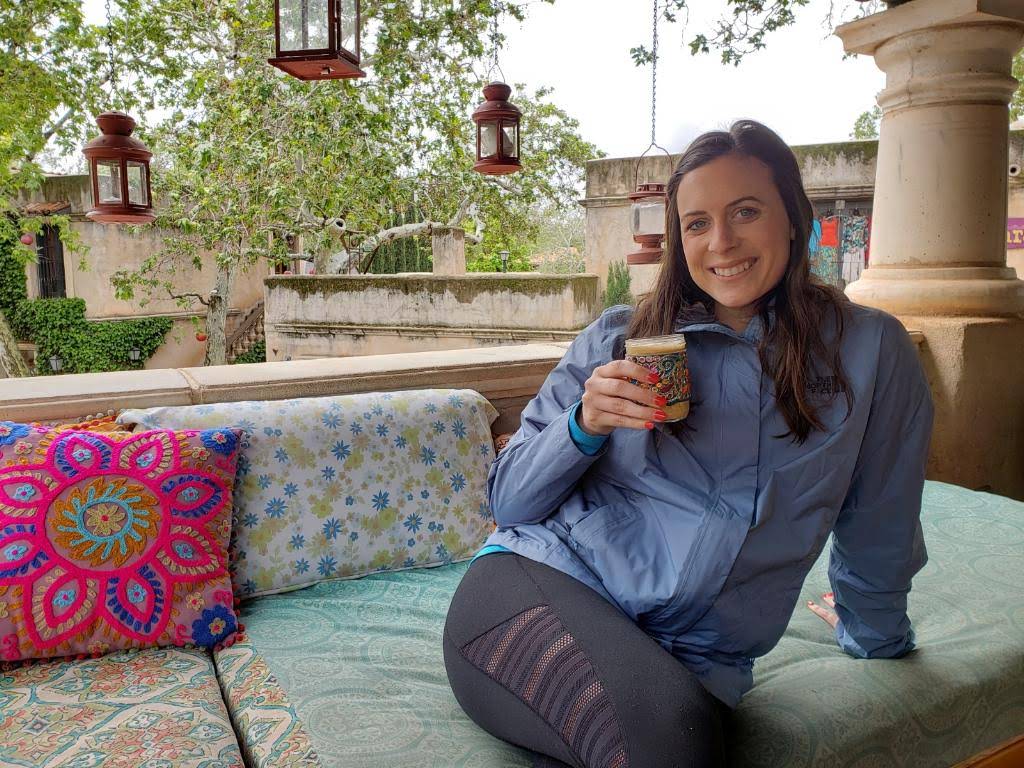
Hiking in Sedona, AZ

This last insight came from a bit of reflection—she wasn’t immediately aware that deciding to teach was the right thing to have done: “I didn’t actually set out to be a teacher. I became a teacher. I’ve always loved kids, but I had never thought about teaching.” She recalls her father telling her and her sister that they could choose whatever degree they wanted to pursue, so long as they could find employment in their chosen fields. Ms. Hope had a job set up in France after college, but, much to her dismay, that fell through.

So, upon graduating, she started sending out résumés, thinking that she would teach for a year while figuring out what career she really wanted. She went for an interview for a teaching position in west Texas that somehow did not feel right to her. On the drive home, she confided her feelings to her mother who had accompanied her. “I really don’t want to teach there,” she told her mother, who responded that it was sort of the only available option. Then, in a stroke of maternal genius, she suggested stopping in a cute little town for lunch to cheer her daughter up. What happened next can only be described as “destined.”

We stopped in, and this feeling came over both of us. My mom said, ‘You can work here for a year.’ So, we go to the middle school, and I basically knock on the door and introduce myself to the principal. I said something like, ‘I know this might seem random, but I was wondering if you had any English positions open.’ She actually replied, ‘We have been praying for a teacher to walk through our doors for almost 4 years now!’ They hadn’t had a teacher, and there I was, just like they had wished for. Also, like me, she was a graduate of Texas A&M and an English major. Just like that, they hired me! I couldn’t believe it—it was so unexpected, but it was the best 2 years of teaching I had ever had. It was a godsend. The only reason I left is that my husband and I got engaged and had to move.

IMG_1399That was Ozona Middle School, and Ms. Hope clearly benefited from that near-miraculous experience. Her career path was set—she was a teacher through and through, after all!

. . . And Hope for the Present!

Mere weeks into her first year at TNCS, Ms. Hope seems to embrace everything about the school, and her positivity is infectious. Upper elementary and middle school students are working hard in her ELA and Global Studies classes and loving every minute of it.

IMG_3260

She came to TNCS because she was actively seeking an independent school, her experiences in city public schools having been somewhat discouraging. When she met with Head of School Señora Duncan, she felt excited about the school and the prospect of teaching here. “I could see myself fitting in well here. I remember going home and telling my husband that the kids are just so happy, and they want to learn.”

Ms. Hope’s ELA class initially comprised a Daily 4 Rotation of independent reading with daily reading log, mini writing lesson with her, word work station (5th grade) or ISEE test prep (6th through 8th grades), and iReady (see TNCS BTS Night for more information). However, as time has gone on, she has adapted the Daily 4 to better fit the needs of her students and to incorporate real-world learning. Depending on the day of the week, the Daily 4+ might consist of novel study through a literature circle station, a TED talk station, iReady reading comprehension lessons, a vocabulary/word work station, a social-emotional journaling station, and a news article analysis and conversation station.

Teaching writing is one of her passions, and she especially loves teaching writing to middle schoolers. Their first writing assignment for the year was a personal narrative, and quarter 2 started off with creative writing—a Halloween-inspired short story. “I really enjoy building relationships through writing. I use writing and journaling to help my students make sense of their feelings and have an outlet—a creative space to call their own,” she said. Middle schoolers, after all, are going through profound physical and emotional changes, so having tools like creative expression to forge them into something manageable is highly important for this age group. Her classroom is a space where they can be themselves, maybe even their best selves.

“My favorite thing about working here is that the kids are so happy to learn. You just don’t find that everywhere,” said Ms. Hope. It’s also true that not every school is fortunate enough to have such enthusiastic educators. Ms. Hope infuses her classes with rigor and fun. Her standards are high, and TNCS students are thoroughly enjoying rising to the challenge! Welcome to TNCS, Ms. Hope, and here’s hoping the rest of your school year gets even better!

tncs-middle-school-teacher-daphnee-hope