TNCS Elementary Information Night Rounds Out a Great 2014!

Refreshments were thoughtfully provided by Chef Emma Novashinski.

Refreshments were thoughtfully provided by Chef Emma Novashinski.

The New Century School‘s fifth year has been undeniably amazing. Rounding out 2014 with yet another breakthrough, Admissions Director Robin Munro announced Thursday that TNCS received a record number of K–5th applications by the 12/17/14 due date. That TNCS’s elementary program has earned its bragging rights—and is attracting hordes of new enrollees—was made clear at the Kindergarten/Elementary Information Night held 12/11/14.

The event was well organized, informative, and fun. Yummy refreshments were provided by Chef Emma Novashinski (who also gave away lovely little jars of homemade pickles), and free childcare including dinner was also offered. Recognizing that parent involvement is vital to student success, TNCS makes it so easy—no, appealing—to participate in school functions.

Elementary Program Overview

Mrs. Munro sent out an agenda before the event to help parents make the most of their time there. The schedule started with her Welcome speech, followed by a program overview by Head of School Alicia Danyali and a brief question-and-answer session. The elementary program—“where traditional and progressive education meet”—provides a solid foundation in the liberal arts by incorporating the following elements:
  • Small class size: Keeping classes to no more than 16 students allows for individualized, differentiated instruction. 
  • Daily language classes in both Mandarin Chinese and Spanish: Younger students begin with conversation and vocabulary building. As their written English language skills progress, they begin to work on reading and writing in Spanish and Mandarin Chinese. Introductory character work in Chinese begins immediately. 
  • Specialty classes: Students have music, art, and physical education classes twice every week. Creativity is encouraged through music and art, while body awareness and health is taught in phys ed class. 
  • Inquiry- and skill-based curricula: We provide a solid foundation in the core subjects of language arts and mathematics, and our teachers develop auxiliary science and global studies lessons based upon student questions and interest. This approach encourages critical thinking and allows children to work to their fullest potential. 
  • Field trips: Teachers take students on weekly trips to our on-site greenhouse and into the school’s extended classroom, lower Fell’s Point. Students take a full-day trip at least once each quarter. Past field trips have included the Baltimore Museum of Industry, the Confucius Institute at University of Maryland College Park, the National Aquarium, and more. 
  • Emphasis on values: Students learn to treat others and themselves with respect. 
  • Mixed-age classrooms: Students to work to their skill level, not just their grade level and benefit both from mentoring and being mentored. 
  • Enhanced learning via technology: Students use children use multiple apps and programs, learn proper keyboarding skills, and begin to learn basic programming.

After the initial gathering, parents were asked to “self-sort” (love that new term coinage!) into three groups and rotate among the three elementary classrooms. In his classroom, Dan McGonigal, the upper elementary mathematics and science teacher, demonstrated a unit on bridge construction in the science curriculum, Engineering is Elementary (scroll below for photos of the students executing this project). Adriana DuPrau, the upper elementary English language arts and social students teacher showcased the English, Chinese, and Spanish curricula. Teresa Jacoby, the K/1st generalist teacher discussed integrating traditional Montessori materials with more progressive curricula and how she differentiates to the various levels in her class. Mrs. Danyali and Mrs. Munro circulated throughout to answer questions.

Elementary Program Philosophy and Approach
As an independent private school, TNCS does not follow the Common Core standards. Individual grade standards set forth by the Maryland State Department of Education are met—and in most cases surpassed—through the use of carefully selected curricula which best supports our mission to challenge students to realize their richest individual potential through progressive, multilingual education and meaningful participation in the world community.
Students are placed according to their birthday into one of three mixed-age classes: K/1st, 2nd/3rd, and 4th/5th. As the student body matures, upper grades will be added (through 8th) each year, accordingly. Mixing ages is part of the school’s Montessori-inspired vision. Research continues to prove what Maria Montessori observed over 100 years ago, which is that children learn best from their peers. By mixing ages, students can work to their own skill level and not be boxed in by grade-level expectations. TNCS students learn to be friends with everyone and to solve social problems without aggression.
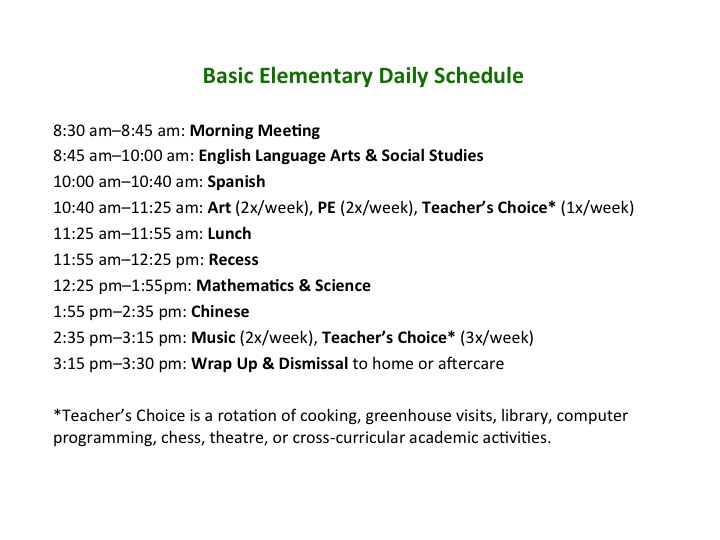
A day in the life of a TNCS elementary student. Looks pretty engaging!

A day in the life of a TNCS elementary student. Looks pretty engaging!

The TNCS format of mixed-age, skill-based classrooms allows our teachers to truly teach and inspire students to reach, or more typically exceed, grade expectations. Through inquiry-based lessons, TNCS teachers can educate the whole child and are not limited by the constraints of a standardized test.

Tools they use to help accomplish these goals include the following.
In Language Arts:
  • The Daily 5 consists of reading to self, reading to someone else, listening to reading, writing, and doing word work.
  • Junior Great Books brings high quality literature and student-centered discussions to the classroom.
  • Wordly Wise 3000 improves student vocabulary.

In Mathematics:

  • Singapore Math is the backbone of the mathematics program.
  • Montessori math materials are used in the K/1st classroom to provide a solid foundation for the transition into Singapore Math in upper elementary.
  • The Daily 3 consists of doing math individually, math writing, and doing math with someone else.

In Science and Technology:

  • Engineering is Elementary allows for learning scientific principles through hands on experiments. The photos below show an example of one project in the bridge design unit.
  • SuccessMaker software is aligned with national grade standards and

Now that’s something to brag about, kids! And keep up the great work, TNCS!
Happy Birthday, Immersed!

Dear Readers, this is a proud day, marking the end of Year 1 of The New Century School‘s blog. That’s right, 52 posts later, here we are (this is #53). To celebrate, let’s take a look back at what your favorite posts have been—after all, we’re here for you.

Top 10 Most Popular Posts

  1. Preschool Conundrum Solved: Research Demonstrates Benefits of Montessori Education  (224 views so far)
  2. Achieving Balance in Education at TNCS  (215 views so far)
  3. Sustainable School Lunch: Garden Tuck Shop Program Part I  (199 views so far)
  4. Elementary Science Fair!   (175 views so far)
  5. Top 10 Reasons to Attend Montessori Kindergarten  (171 views so far)
  6. Inside the Montessori Classroom  (156 views so far)
  7. Exercising That Mind–Body Connection  (146 views so far)
  8. Elementary Program Merges Montessori and Progressive Education at The New Century School  (130 views so far)
  9. A TNCS Original  (128 views so far)
  10. Language, Math, and Science—Montessori Style!  (125 views so far)

Because a little analysis is just irresistible, let’s draw some conclusions. It’s pretty clear that Montessori and Elementary are the  commonest themes on this list, which is entirely appropriate. TNCS is achieving something entirely unique in education in meshing a progressive, rigorous curriculum with the gentleness and humanity of the Montessori approach. TNCS students learn the standard academics but also get a firm grounding in foreign language and an abundance of the arts, movement, and technology. Perhaps most important and often overlooked in conventional schools is the attention to social relationships and building mutually respectful interactions with peers and with the administration.

So thank you, readers, for your following and your support. What would you like to read more about in future?

TNCS Back-to-School Night

The New Century School‘s annual back-to-school night is a chance for parents to meet teachers, get a peek inside their kids’ school day, and reconnect with and meet other parents. Last night’s was no exception. Teachers report that although the school year has just begun, so far things are going extremely well among the group of mixed returning and new students. True to the Montessori model, the older children have done a beautiful job of welcoming their younger schoolmates and showing them the ropes. TNCS has reached a milestone: it has now existed long enough to have graduated a kindergarten class, meaning there are now half returning and half new students.

During the hour and a half session, teachers explained any changes for the 2013–2014 school year, described a day in the life of a TNCS student, and fielded questions. Specific curriculum points were not handled here; this event was more of an overview. Curriculum discussions will be held during Parent Workshops to take place in October and February (see school calendar here).

Ch-ch-ch-changes

The biggest adaptation so far this year has been with the language program—which is TNCS’s hallmark. Last year, “pull-outs” were implemented, in which students left their home classroom to attend formal language instruction in another classroom. After careful consideration, TNCS administration decided to more fully embrace an immersion style of language learning, school-wide. This move has two huge advantages: 1) research shows that language acquisition happens more organically and therefore more readily and completely via immersion, and 2) this model stays true to Maria Montessori’s conviction that students will learn best if they are given a full morning in their “work zone,” (i.e., their classroom). They develop autonomy, self-confidence, and skill when they can move and work at their own individual paces. So far, this change seems to be having very positive results. Parents report hearing more and more Spanish and Mandarin being casually spoken at home, and one new student who arrived to Mr. Seller’s class speaking neither English, nor Spanish, nor Mandarin is picking up Spanish rapidly enough to be able to adequately communicate his needs.

The immersion is effected by employing native-speaking teaching assistants, Spanish in some classes, Mandarin in others. In Mr. Seller’s class, the assistant, Señora Gonzalez, is a native Spanish speaker, and she speaks exclusively Spanish in class. Students are expected to respond to her in kind and are gently reminded to do so, when necessary. Assistants not only assist the lead teacher, but they also lead certain lessons as well, so that students are learning a given lesson in the foreign language—not just vocabulary, actually learning about a topic in something other than English. Mr. Sellers’ students also get exposure to Mandarin when a Chinese assistant from another class “trades time” with Sra. Gonzalez. Again, the students get the benefit of staying put and not having to interrupt whatever work they are doing to switch gears. The Mandarin teacher comes to them (or the Spanish teacher if they are in a classroom with a Chinese assistant).

Behind the scenes, Xie Laoshi (a.k.a., Jewel) and Señora Capriles orchestrate this “shuffle” of assistants to ensure that all students get sufficient exposure to both foreign languages. They also drive the foreign language curriculum. With their language expertise as well as thorough Montessori training, they are well suited to this role, making class materials and overseeing the framework.

A Day in the Life

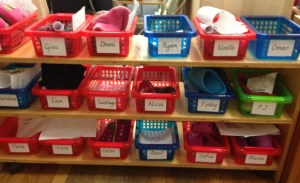
These bins hold students' indoor shoes and any paper work they accumulate throughout the week.

These bins hold students’ indoor shoes and any paper work they accumulate throughout the week. They visit this shelf first thing on entering the classroom.

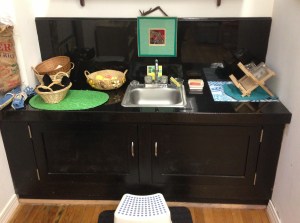
A typical primary student day starts with exchanging outdoor shoes for slippers to signal to students that it’s time for work to begin. “Circle time” comes next, during which the class sings, greets each other, and goes over daily topics such as the calendar. Circle time might also contain a group lesson on the monthly theme. Currently, primary students are learning about fruits and vegetables, among other topics. Next, teachers invite their students to find some individual work. Mr. Sellers delved a bit into the Montessori concept of work, explaining that “work” in the Montessori classroom is not supposed to be an unpleasant or difficult task. Rather, it’s a desired undertaking, intended to empower the student by offering productive and meaningful activity. “Their work prepares their brains for growth and development,” he said. “Even Practical Life work is preparing them for language and reading, for instance, by instilling that left-to-right progression” (see picture below).

This kid-sized sink represents Mr. Sellers' Practical Life area.

This kid-sized sink represents Mr. Sellers’ Practical Life area.

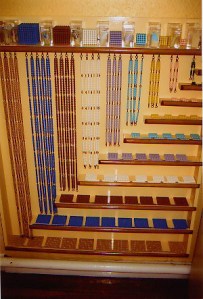
Parents had lots of questions about how work “works.” At TNCS, there are really only two work rules, say teachers. First is that the students treat all materials with respect, which includes respecting the “work cycle” of choosing an activity, completing it, and putting it away when finished. The second is that students work with only what they are developmentally ready for. So, for instance, 3-year-olds might be naturally drawn to the very pretty bead cabinet, but because they are probably not ready for “skip-counting” (counting by 5s, 10s, 100s, etc.),  they are encouraged to choose something more suitable.

Bead frame

The bead frame is particularly fascinating . . . but hands off until you’re ready :)!

Where does the teacher come in, amidst all of this lovely independent work? When the teacher sees that a student has fully engaged with a particular exploration, the teacher might come along and demonstrate the next step with a material, or introduce a new material altogether. The teacher guides the student to make additional discoveries. The teacher might also guide an older student to mentor a younger one. With a 3-year age range (age ~3 years to age ~5 years) in the primary classroom, many such opportunities arise. The younger kids are eager to please their slightly older peers, and the older kids develop self-confidence by sharing their knowledge. This lovely dynamic pervades school wide, in fact, among classrooms, not just within them.

After a lengthy work period (that will have included snack at some point), primary kids go to lunch, play on the playground, and then enter their afternoon period. For kindergartners, this means instruction with Mrs. Lawson and Mrs. Lazarony. For the 4+-year-olds, otherwise known as the “resters,” this means 20 minutes of quiet time followed by continued work. For the littlest ones, it’s naptime, a legal requirement in the state of Maryland. So-called “specials” also take place in the afternoons and include music, art, and gym.

It was clear that several parents in attendance were recalling their own early education less than fondly and wishing TNCS had been available to them. Mrs. Lawson (also a primary teacher) summed up TNCS’s specialness best: “I love Montessori because children really learn with hands-on materials instead of just by rote. They can tell you why things are the way they are.”

We’re back to school, and the kids are alright.

Inside the Montessori Classroom

Many of us have at least a vague idea of what Montessori education is about and that Maria Montessori was an expert in child development and education, but some of us—even parents of Montessori-educated kids—still have questions. Or, maybe you have tried to explain Montessori education to curious friends and family members and have been met with blank stares or frank puzzlement in return.

colorful materials and inviting tableaux comprise a TNCS class layout

The Montessori classroom invites and inspires

In this post, we’ll compare a Montessori classroom to a traditional one to characterize The New Century School educational experience and gain some insight into how the classroom works, why Montessori students love learning, and why the Montessori method is so wonderful for our kids. In fact, despite obstacles (e.g., budgetary, legislative), the U.S. public educational system has begun to show the Montessori influence here and there, as educators wake up to the fact that students graduate from school and are at loose ends for how to live enriched, fulfilling lives. The traditional model has certain shortcomings that the Montessori education inherently prevents. (However, this discussion is not intended to belittle traditional education, only to investigate how Montessori can enhance learning for many by virtue of a radically different approach.)

children work independently and in groups in the smoothly functioning primary Montessori classroom

Children working independently and in groups in the smoothly functioning Montessori classroom

At TNCS, pre-primary classes (ages 2–3 years) follow the classic Montessori model; primary and elementary classrooms (ages 3–5 years and 5 years and up, respectively) use a Montessori-based approach. Classes comprise mixed age groups quite deliberately, and this is the first big difference between Montessori and traditional classrooms, in which each grade level corresponds to a single age. A vital element in Montessori education is that older children assist younger ones and that younger children not only learn from their mentors but also develop better social skills through this interaction. The older children also benefit greatly; another key element in Montessori education is consideration for others. Practicing compassion and kindness for their younger classmates teaches the older children how to conduct themselves graciously in any social milieu. Yet another advantage to mixing ages in this way is that students remain with the same teacher and many of the same children for 3 years, developing trusting, long-term bonds. The teacher also comes to know each child very well and gains an intimate knowledge of how each child best learns.

practical life materials teach kids everything from proper handwashing to garment buttoning

Practical Life materials

Another difference an observer would note immediately on entering a Montessori classroom is the room itself. Students are not seated in rows facing a teacher who is lecturing at a chalkboard as in a traditional classroom. Rather, individuals or small groups either completely independently or with the aid of the teacher are each engaged in separate activities that they have voluntarily chosen. They might be seated at small work tables or kneeling on rugs as they go about their tasks, which vary from sensorial (such as tracing sandpaper letters with their fingers) and practical-life activities (such as practicing folding towels) in the pre-primary and primary classrooms to working at computer stations at the elementary level. The point here is that students be inspired to learn by engaging in what draws them instead of required to sit passively and be lectured to. Not only will the consequent learning be deeper and richer, but the student will look forward to learning as the natural extension of his or her innate curiosity. School should not be something our kids dread, after all!

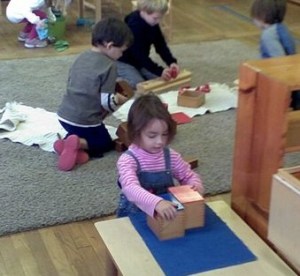
having completed work with the number rods, this child surveys his work before putting away the materials

A child in the Primary classroom works intently on the number rods

More importantly, this room for individual concentration and focus is the hallmark of Montessori education. It fulfills the child and allows him or her to become the person who intrinsically wants to help others and to make a difference in the world. Although it’s easy to imagine that a classroom full of kids each doing what he or she individually wants would be chaotic and noisy (a very common misconception), the complete opposite is true. TNCS classrooms are warm and peaceful places. The children are engaged in their work, and the atmosphere is one of pleasant, purposeful exploration. It goes without saying that passive, rote memorization–based learning has no place here. Learning is a dynamic, absorbing experience. It’s truly a marvel to see the self-discipline TNCS kids exhibit as they go about their daily work.

Yet another difference is the breadth of the classroom. TNCS extends the classroom to encompass the surrounding neighborhoods, fostering a sense of community and instilling the importance of community involvement—“our extended campus is the city.” And, for that matter, the world. TNCS has a very diverse student body, and students are encouraged to share their culture, promoting mutual respect and a broad, global perspective. Getting outside and seeing what’s going on around the school is a regular part of TNCS curriculum.

A final difference to be discussed here (though there are many more) is in the approach to “success.” AT TNCS, the product of the work done is not the focus; rather, the doing of the work is what’s important. Making mistakes and having another try is all part of the process. Students learn to relish the endeavor, of trying over and over, instead of being afraid to make those mistakes: “They welcome a challenge, and they do the work that’s required to meet that challenge. They are willing to take risks because they understand that often the most valuable learning comes when you try, fall, get up, and try again.” (This hearkens back to an earlier post on “grit”; see “Getting the Education Nitty Gritty” in Recent Posts, top right.) This also touches on another concept fundamental to the Montessori classroom—work cycles. Although Montessori methods are often criticized for not allowing imaginative “play” and focusing all on “work,” children do not make this distinction. If they are doing what they themselves have chosen to be doing, it follows that they will be enjoying it. The work cycle, though, by having a beginning (choose work), a middle (do the work), and an end (put away the work), additionally teaches them commitment, focus, and persistence. The rhythm of the work cycle has applications in all areas of daily life, not just in the classroom.

In The Absorbent Mind, Dr. Montessori wrote, “The child is endowed with unknown powers, which can guide us to a radiant future. If what we really want is a new world, then education must take as its aim the development of these hidden possibilities.” And this sums up the difference between a Montessori and a traditional classroom best. All too commonly, the traditional classroom, even at its pinnacle, can do no better than produce test-takers, albeit skillful ones; the Montessori classroom, by contrast, yields happy, inquisitive, well-rounded citizens of humanity.*

playing on the geodome on a beautiful, sunny fall dayplaying on the geodome on a beautiful, sunny fall dayplaying on the geodome on a beautiful, sunny fall day

For more information, including articles and videos, visit The Montessori Foundation’s website. And, find some hard data on the learning experience delivered by traditional versus Montessori approaches here.

*You want proof, you say? Consider this illustrious list of well-known folks, from silicon valley entrepreneurs to great chefs to princes, who were either Montessori educated or educators, and see for yourself!