Kids and Internet Safety: Start the Conversation!

At The New Century School, technology is an important component of the curriculum. But, with technology, comes cyber activity—at least a little anyway. Though the practice is kept to a minimum, sometimes TNCS students go online to research a project, participate in interactive learning games, or enter a learning portal such as SuccessMaker. Parents should know that TNCS has oversight, internet restrictions, and firewalls in place—students are not given independent time to surf the ‘net. Activities are overseen by teachers and correspond to a classroom lesson. TNCS has integrated some very high-tech systems that are regularly updated.

Home Agreement on Internet Usage

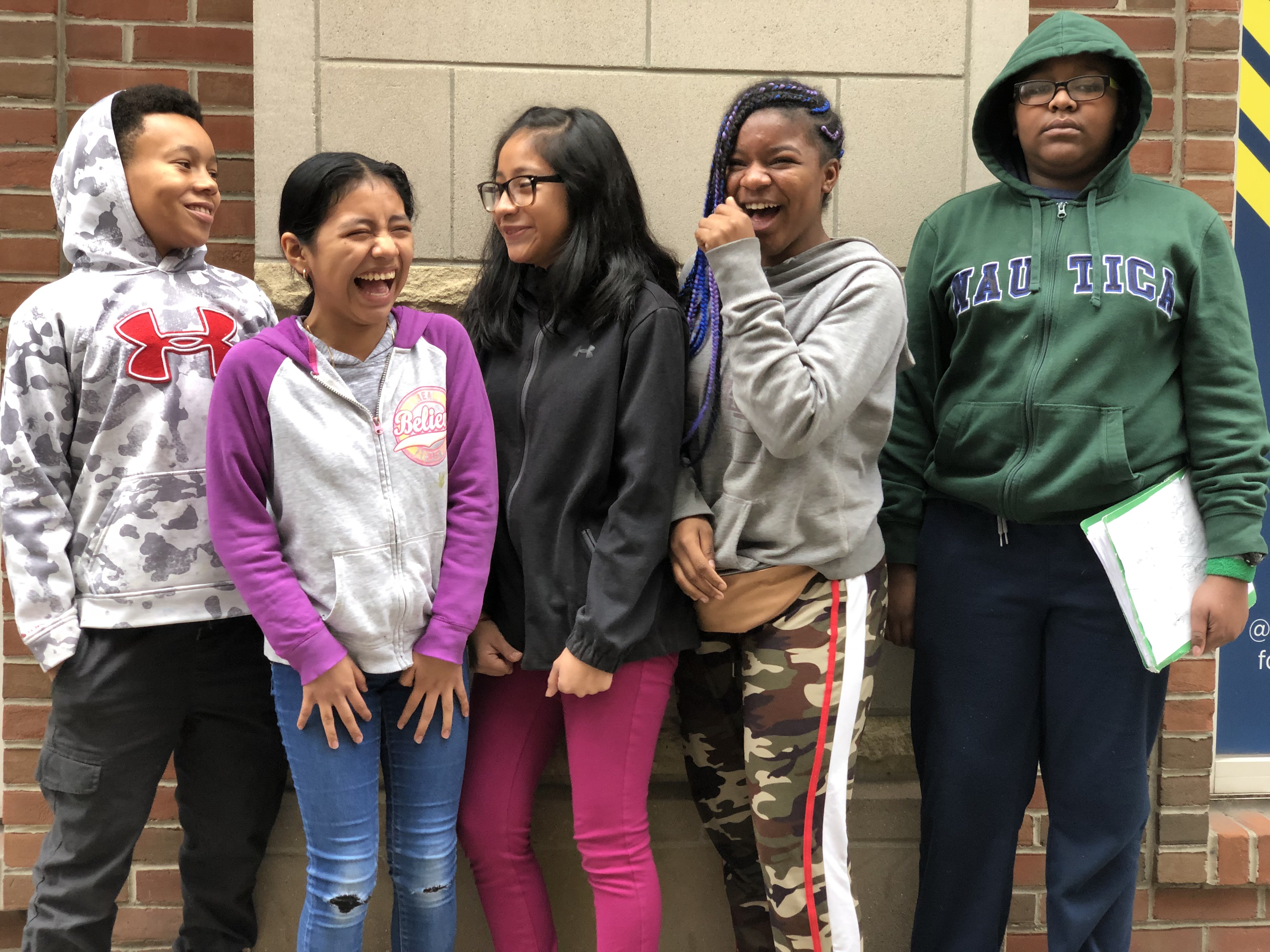
School probably isn’t the only place where children probably spend some time online, though. To tie together home and school usage, an email from TNCS homeroom teachers to parents went out on Friday, April 5th providing an overview of a very important topic that upper elementary and middle school students have been exploring with Dean of Students Alicia Danyali during Quarter 3. Students in grades 4–8 reviewed their online habits, learned what constitutes cyber-bullying in various scenarios, and were encouraged to broach the topic at home with the adults in their lives.

The email also included this suggested template for a “home agreement” on internet usage. “By no means is TNCS navigating or superseding rules currently in place at home, but if you are seeking some guidance regarding talking points that ensure everyone in your home is aware of expectations, you may consider this document as a “jumping off point,” explained Mrs. Danyali. “It’s not limited to what is shown here, but this is a good place to start.”
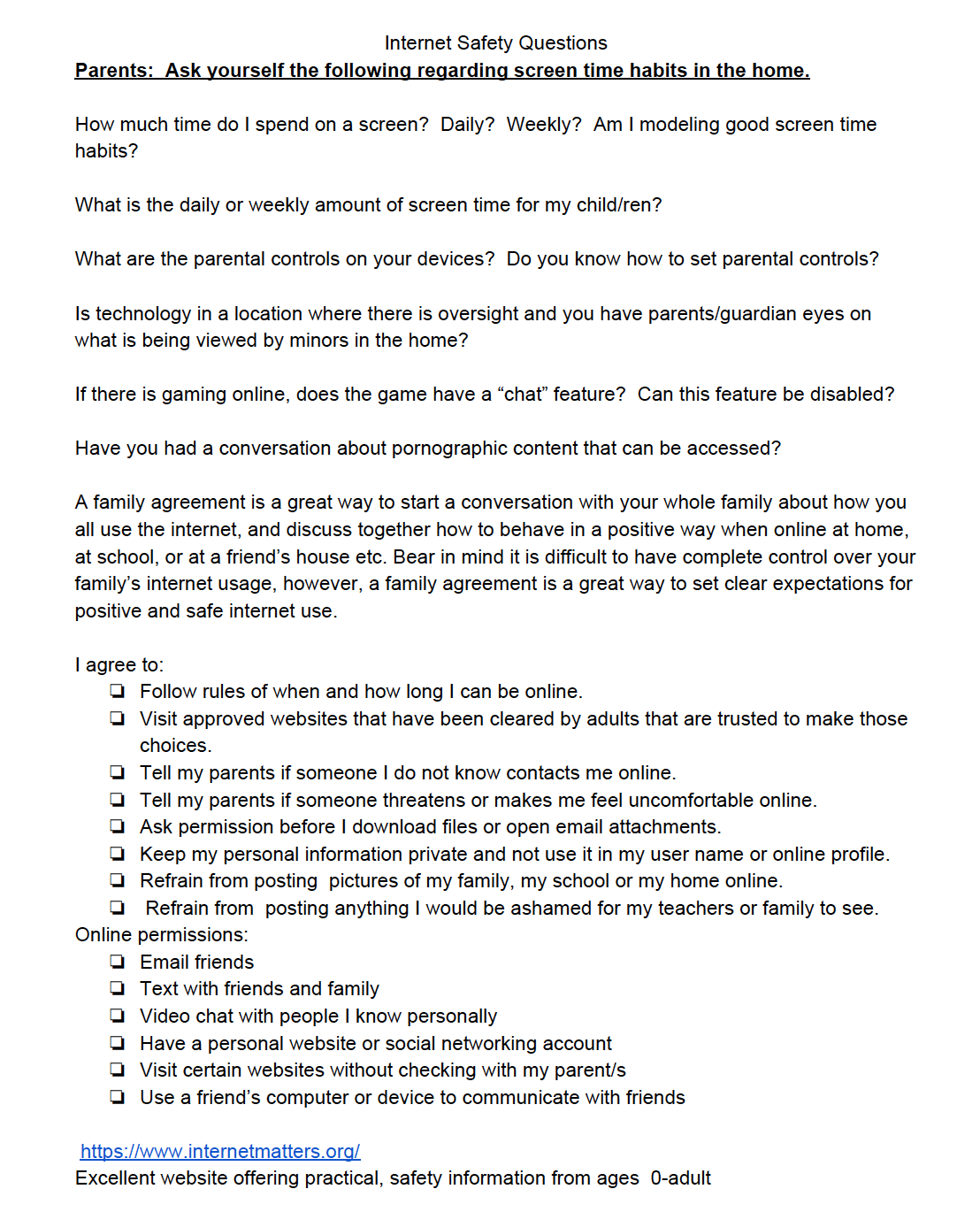
Screen Shot 2019-04-08 at 2.21.22 PM

School and Home Partnerships for Safe, Healthy, Happy Children

This Immersed post will delve a little deeper to explain how and why the discussion arose and why TNCS feels the conversation should be ongoing. We’ll walk through the document to provide a little commentary on each part. First, here is Mrs. Danyali’s rationale for this initiative:

Señora Duncan and I worked together to create this message. It’s a big topic that we feel should have a spotlight, especially for the 4th- through 8th-graders. It’s about having those bigger conversations of technology oversight in the school house and what that looks like in your house. It’s not a judgement of what people are doing—there’s no right or wrong. We’re just saying that we strongly encourage having the conversation. Maybe there are things parents haven’t thought of before because they might think their children are still too young for the conversation to be relevant. We want students to have an open line of communication with their parents at home, that they know they can to go to them with questions and concerns.

It’s hard to believe, but even at the age of 9, what a child does online is creating a permanent footprint. We all need to better understand what that means, and they need to know that there’s a safe place with the adults in their lives to go to.

What they are suggesting is a family agreement. This starts with reflecting on internet usage in your home. “Some of the reflection questions are meant to get parents thinking about their own online usage—again, not as a judgement—but because we are partners in the students’ education, safety, and well-being,” said Mrs. Danyali. Having studied the topic in school, it makes sense to also have a complementary or supplemental conversation at home. Questions such as, What is the amount of time we agree on? What are the boundaries? What are parental controls on your children’s devices? Do you know how to set parental controls? can really deepen awareness and even expose some areas that might need tightening up. “I have a tracker that tells me how much time I’m spending on my phone, which I really like, because it helps me avoid mindless use,” she explained.

As is likely the case at most schools, TNCS students run the gamut regarding home usage, from students who do not go online at all to students who are managing their own SnapChat and Instagram accounts. “Maybe their parents don’t always know what they are putting on these sites,” mused Mrs. Danyali. “Even though it sounds like everyone is being safe, the reality is, having that parent oversight is vital.”

Something some parents may not be aware of is that even some online video games have a chat feature, and home gaming systems can have an online chat feature. Do you know how to disable that, if necessary?

Once parents have reviewed their own usage habits and that of their children, the agreement part comes in, and this is where you are building trust. In effect, you are saying to your children: “I trust you to be on here for our agreed-on time period and to conduct yourself safely.” You are also telling them that you want to make sure they are protected: “If someone asks you for your address, come and tell me so we can block that person.”

“This is well worth investigating,” said Mrs. Danyali. “You are preventing predators from being able to come in that are savvier than we might realize. Even if your child does not go online at all at home and is not allowed to play video games, it’s important for this to be on you radar because it will become part of their world at some point.”

More on this in future, but sex ed expert Debbie Rothman recommends having a conversation about online pornography starting as early as age 8. Some parents may find that shocking, but children need to know how to distinguish fact from fiction when it comes to what constitutes a healthy intimate relationship. “It’s important to have the conversation and get out ahead of the issue—there’s probably not many children who haven’t been exposed to some form of pornography by the time they hit high school, whether they sought it out or not. We are not having that conversation in school because that one is more appropriate at home, but we do have resources to support parents if they need it,” said Mrs. Danyali.

Social and Emotional Learning at TNCS

As Dean, Mrs. Danyali has always been deeply invested in the “invisible curriculum” at TNCS and on the values of the school and its students—social and emotional learning (SEL), basically. She became aware that social media apps led to problems in relationships among students, some of whom may have misinterpreted what was actually being conveyed, and this was stressful for students. “When that face-to-face component is missing, you can’t pick up on facial cues,” she explained. “That has led to misunderstandings.” To address this as part of the unit wrap-up activity, she divided the whole cohort into two groups so they could engage in some role-playing to explore how to effectively communicate. They very quickly saw how face-to-face communication provides information that a text cannot convey . . . no matter how many emojis are included.

“I also worked with a TNCS family who has helped in this area in the past, and they shared an FBI site called Safe Online Surfing that has links to online safety curricula, formatted as games tailored to grade so it’s appealing to students,” said Mrs. Danyali. This screen shot of the 4th-grade portal takes users in an interactive journey through 1. Safe Surfing, 2. Personal Information, 3. Crossing to Safety, 4. Computer Health, 5. Treasure Hunt, 6. Word Search, and 7. Marine Matching.

Screen Shot 2019-04-08 at 3.05.11 PM.png

Each TNCS student had to answer a set of questions about internet safety to assess their level of background knowledge. They then did the game itself independently.

Where Do We Go from Here?

And where did this idea spring from in the first place? Mrs. Danyali has long been incorporating best practices that she has gathered from a multitude of articles and from researching dozens of websites recommended by other educators. “I keep a file of these recommendations to draw from, and they are all different based on individual preferences,” she explained.

One recommended website is InternetMatters.org, which even offers this downloadable poster on Internet Manners.
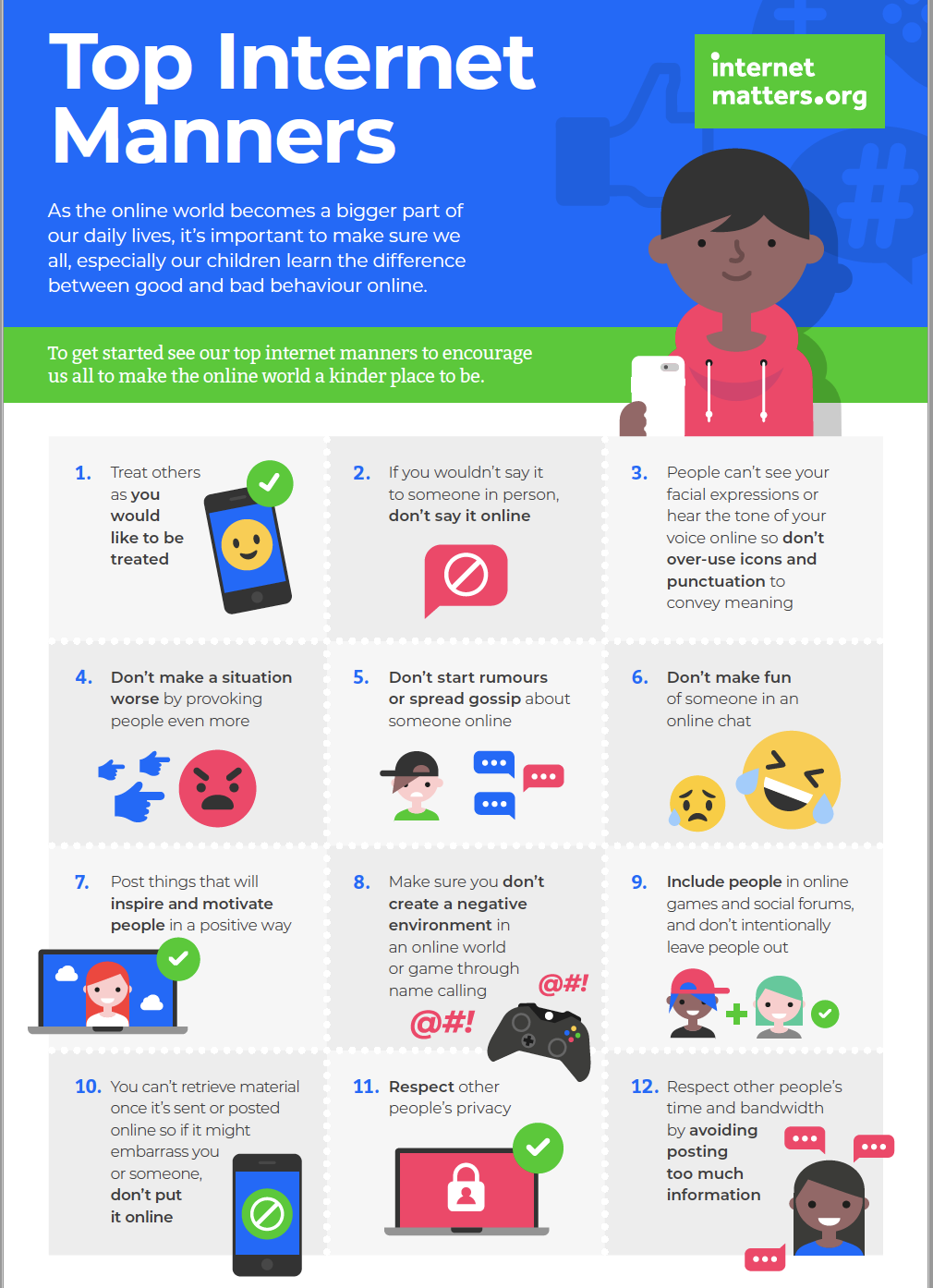
Screen Shot 2019-04-08 at 2.35.10 PM.png

Consider printing this and posting it near a home computer or by your child’s desk. Positive habits encouraged in your children today may lead to a less dystopian cyberspace for all to enjoy safely participating in.

Cooperative Learning at TNCS: Reading Buddies, Budding Readers

Peer mentoring is a built-in, powerful tool at The New Century School, arising as a very natural consequence of its philosophy and mission. Classes comprise mixed-age groups quite deliberately, a big difference between TNCS and traditional classrooms, in which each grade level corresponds to a single age. A vital element in TNCS’s approach to education is that older children assist younger ones, and younger children not only learn from their mentors but also develop better social skills through this interaction. The older children also benefit greatly; another key element of TNCS’s approach is consideration for others. Practicing compassion and kindness for their younger classmates teaches the older children how to conduct themselves graciously in any social milieu. Yet another advantage to mixing ages in this way is that students remain with the same teacher and many of the same children for more than just a year, developing trusting, long-term bonds.

Incidentally, the teacher also comes to know each child very well and gains an intimate knowledge of how each child best learns.

Not only does social and emotional learning (SEL) increase from the mentor–mentee relationship, but academic gains are also made. Furthermore, there is scientific evidence to back up the suggestion that mentoring and being mentored provide cognitive advantages that conventional teaching does not. A 2017 study from the Journal of Educational Psychology demonstrates that partnering with higher-achieving peers can have a positive influence on a student’s learning, and students who are older, more capable readers can be these peers for young students.

Reading Buddies at TNCS

That’s where Reading Buddies comes in. This practice pairs different grade-level classrooms for community reading time—an upper-grade homeroom connects with a lower-grade one, and students pair up for time with books.

This cooperative learning method happens all over the campus, in all divisions. In a check-in post from earlier this school year, TNCS Dean of Students/Head of Lower School Alicia Danyali enumerated many of the initiatives she was undertaking for the 2018–2019 school year, including establishing various class partnerships for service learning purposes—read more on that here. And the roots of the school community deepen as classes across campus work and share together. Because of the success of Reading Buddies, in particular, we’re revisiting this lovely tradition in more detail.

“Every second Wednesday, my 4th- and 5th-grade homeroom students go to Ge Laoshi’s K/1st class to participate in service learning by reading to their young friends,” explained TNCS teacher Nameeta Sharma. When asked what he liked about the Reading Buddies program, one of her 4th-grade students replied, “Everything!” “It’s fun to read to the little kids, and they really listen to me while I’m reading,” he continued. “Sometimes the teachers pair us up, and other times we just go read to whoever we want to. We all like to read Dr. Seuss books while we’re there.”

Benefits Abound

Reading Buddies also promotes reading. It allows younger readers to see what being a fluent reader looks like, as they have a peer model demonstrating reading skills. Older students become positive role models as well as develop patience and empathy as they work with their younger buddies. As the year progresses and the skills of the younger readers increase, students take turns reading to each other. In some cases, the mentee goes on to become the mentor of an even younger student. The relationship is thus bidirectional and enormously enriching.

The benefits are profound. Both sets of students get excited about Reading Buddies time because it’s a chance to do something different, visit another classroom, have fun, and make new friends. Even the Middle Schoolers love it!

Strengthening Community

Cooperative learning is also a great way to build community in the school, a primary part of TNCS’s mission. Another benefit of cooperative learning is simply that the Upper Elementary and Middle School students would not have another opportunity to get to know their younger schoolmates without this special time together. The upper and lower classrooms are situated in different buildings, and even lunch and play spaces are kept separate, as appropriate. Thanks to Reading Buddies, though, younger students recognize their role models around campus and can wave hello. It’s so nice to see, and these relationships can extend beyond the reading partnership. They can even have a positive impact on disruptive behavior. Younger children yearn for the respect of their older heroes and tend to comport themselves with more self-awareness in their presence. Older children develop a sense of protectiveness and want to nurture their adorable young friends. It’s easy to imagine how these SEL moments take root and flourish in a child’s character.


The practice of sharing a book is a delightful gift in and of itself; Reading Buddies deepens the enrichment exponentially. Now that’s a happy ending!

TNCS Dean Attends Progressive Education Summit!

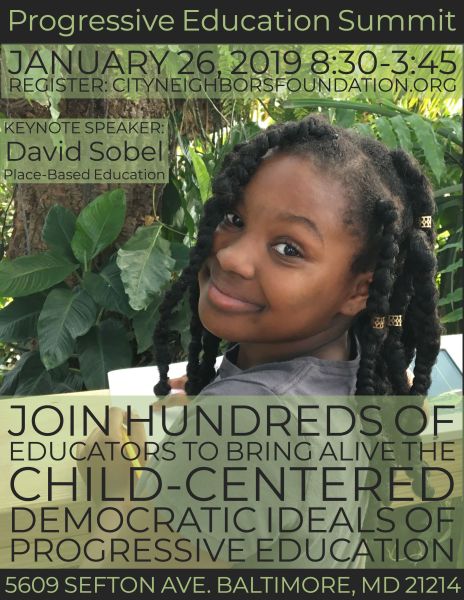
As a key part of its identity, The New Century School embraces progressive education. It was a natural fit, then for TNCS Dean of Students and Head of Lower School Alicia Danyali to attend City Neighbors Progressive Education Summit here in Baltimore at the end of January. According to its website, “The Progressive Education Summit brings together hundreds of educators from around the region and the country to share best practices, work with great educational thinkers and practitioners, connect with other educators, and work to bring alive the child-centered, democratic ideals of progressive education.” Attendant schools were an equal mix of public and independent, and about 550 educators from across the country participated.
summit-flyer-2019

The 2019 summit, the eighth annual, featured master classes, the first summit storytelling event by 10 to 15 storytellers, over 30 workshops, a Baltimore resource fair, and abundant networking opportunities. In addition, this year, David Sobel was the Keynote Speaker. The author of Place-Based Education: Connecting Classrooms and Community, Sobel is a leading national voice in place-based education. He was recognized as one of the Daring Dozen educational leaders in the United States in 2007 by Edutopia magazine.

Mrs. Danyali had much to say about her experience at the summit, all glowingly affirmative. “I loved everything about it,” she said. “There were a lot of opportunities to attend workshops and hear speakers throughout the day—more than any single person could actually attend.” The conference was divided into categories: Educator Reflection and Care, Arts Integration, Place-Based Education, Leadership, Learning Disabilities, Health, Trauma, Cultural Relevance, Development, Social Justice, and Progressive Education. “When I heard that David Sobel was the Keynote, I was really excited. I am a big fan of his.” She absorbed quite a lot from the presentations and will bring her perspectives to bear at TNCS. She started by describing the overall spirit of the conference then discussed the presentations that stood out most to her.

Progressive Education Talks

“The conference started off with some Baltimore high school students speaking, and I thought that set the tone so beautifully. The speeches were very uplifting,” said Mrs. Danyali. One was from City Neighbors and spoke about how a teacher changed his life, believed in him and supported him, despite the odds being very heavily stacked against this student just because of growing up in what is considered quite a dangerous part of the city. Another, from Digital Harbor, immigrated here 2 years ago speaking no English and is now fully English proficient. She spoke about all of the opportunities the school has afforded her in pursuing her dream of becoming a pilot. “Both of these demonstrated right from the start of the conference that educators should not label students. Even when we feel defeated by a set of circumstances, there are a lot of resources that we can solicit. We can network with other schools, for example. No matter how well funded a school is, there will always be social challenges to deal with. So just knowing that support is out there is helpful,” explained Mrs. Danyali.

The purpose of the conference was about how progressive education looks in different settings. One of the main themes was storytelling, and how an educator’s story can shape how he or she guides students. “What I really was interested in was how there can be different takes on various philosophies, like civic engagement or helping people with trauma, and how that can be embedded in the curriculum and not so stand alone,” said Mrs. Danyali.

Place-Based Education

Although place-based education was one of the categories/presentations of the conference, it informed everything. Said Mrs. Danyali:

The philosophy is very much in line with TNCS’s approach. You use what’s in your neighborhood, and you use what’s in your surroundings as part of developing curiosity and an open-ended inquiry-based curriculum. For me, it was great because [Sobel] had so many inspiring, real-life examples in his presentation from not only high school but also all the way down to preschool, where this should start. I was really impressed with the examples he shared from around the country of students exemplifying place-based learning in all age groups. Creative City, right here in Baltimore, is one school implementing the approach.

This slideshow requires JavaScript.

Mrs. Danyali explains that all three preprimary classes this spring will follow Sobel’s teaching prescriptively, which is essentially student driven. “All of the preprimary students seem to be really interested right now in fire trucks and the fire brigade, so we’re looking to connect with a local fire department to get them to come and do a presentation. This will also help to take away that fear of hearing the siren by knowing they are here to help,” she said. “We’ll make that connection right here in their own community and do more investigation.”

As noted, place-based education is for all age levels; in fact, it is inherently a developmentally appropriate approach because it is authentically student driven. “As I drive to work in the morning, I’m always thinking about what Baltimore offers for place-based education,” said Mrs. Danyali. “This happens to be Black History month, and we have Frederick Douglass, the Underground Railroad, and so on. We make connections with local businesses, such as Greedy Reads Bookstore. We’ll get to know the Post Office around the corner. This gives students a sense of identity in the community and less fear, because Baltimore sometimes gets a bad rap. Also, understanding the cultures that make up the community is vital—inclusivity and diversity.”

Importantly, place-based education integrates all subject areas, including service into the unit of focus. Students learn all of the other disciplines as well, but rather than having the idea that doing math, for example, is all drudgery, they develop the mindset that they can use math to find answers to something they have gotten curious about in their community surroundings. They start to grasp that learning is not for learning’s sake but is useful and meaningful and a way of navigating the world. They are empowered—they see that their intellects make an impact on that world; they become problem-solvers. “It’s a concept called ‘firsthandness,’ explained Mrs. Danyali.” Firsthandness sort of speaks for itself, but, essentially, it’s experiencing the world as it is, where it is, rather than how it’s packaged and presented inside a classroom.

Service Learning

Another important value at TNCS is Service, and TNCS students in all divisions pursue regular service-oriented activities around the campus (e.g., taking out the trash, helping escort younger students into the building at morning drop-off, beautifying the grounds) and in the wider community (e.g., blanket-making, stenciling storm drains with environmental awareness messages—the list is too long to reproduce here!).

So, sitting in on a service-learning talk appealed very much to Mrs. Danyali.

With my role in service for the school, I learned about service-related programs for students going into high school that are happening right here in Baltimore. One is a 5-week community garden project that they apply for that happens once a week starting in April in a community that is currently a food desert. I shared this with Mrs. DuPrau as a possible area to explore for some of our students to help them get that experience, because they will have a service commitment in high school to fulfill in order to graduate. So, this could be a jumping-off point if they’re interested in being outside and meeting other students. It’s almost like a camp in that way. This volunteering might even lead to part-time paid work. The programs also have a lot of community support.

Positive Schools

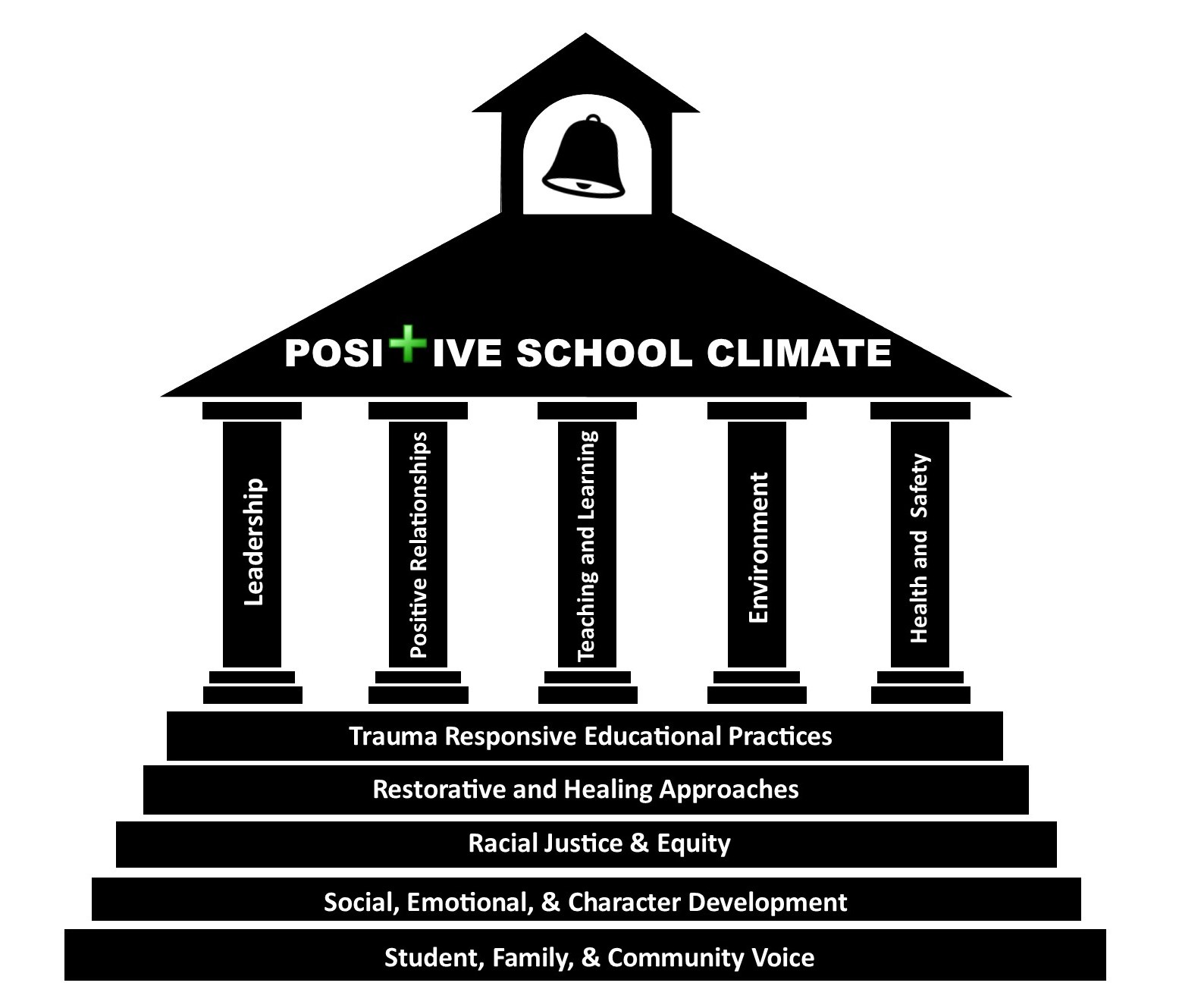
Mrs. Danyali was also very moved by a presentation by Shantay M. McKinily, Director of the Positive Schools Center, University of Maryland School of Social Work.

Pillars-and-Tenet-infographic-without-school-logo--6-01-17.jpg

The presentation was on the Maryland Commission on the School-to-Prison Pipeline and Restorative Practices, a statewide campaign on training teachers on how to implement and teach restorative practices, which is a passion of Mrs. Danyali’s. Ms. McKinily covered new and emerging research out of Harvard on cutting the “school-to-prison pipeline,” the unfortunate trend of so-called “problem students” coming out of schools and going right into the criminal justice system. “Something that is really shocking to me and has been occupying my thoughts is that, as prisons are privatized, they are somehow able to get data from schools on detentions and other disciplinary measures taking place in 4th grade and using that information to project where to build prisons and where prisons will be needed,” said Mrs. Danyali.

tncs-head-of-school-attends-progressive-education-summitThis idea leads her right back to a truth she holds dear—that we need to attend to the social and emotional needs of our youngest students:

This is game-changing in the sense that, although we put a lot of thought and energy and time into the middle and high school years about where our children will end up, in reality, our society has allowed the prison system to get information on percentages of younger children who are chronically absent or chronic behavior problems and use those numbers. It defeats the purpose of all of these research-based grass roots efforts. As hard as people are working to tell their real story, the narrative already in place—that if they are in this position by 4th grade, they’re doomed—comes from a much bigger system working against them.

Ms. Mckinily gave lots of examples, some from personal experience, such as the need to build more schools and have smaller class sizes so that teachers are not having to contend with such large numbers of students, upward of 30 a class. She explained that the prevailing classroom management principle at her school was to divide the class into three groups. Imagine a hypothetical top group, who is more or less left to their own because they can work independently. and score well. The hypothetical middle group might show promise but needs help, and, although it can be difficult to determine exactly what they need, they will likely get tutoring and other support. The lower group needs lots of catching up and are treated almost like a lost cause.

Ms. McKinily felt that she may have contributed to the prison pipeline when she was an educator because that hypothetical lower group never got what they needed. This is partly because her school was counting on her to get as many students as possible to that high group so the school would receive better government funding. In addition to being academically behind, the lower group might have many other social challenges to contend with, and so their host of problems was just too overwhelming to deal with, and school resources would go to students who had a chance to make it to the higher-achieving group. The lower group, of course, became the group identified as a problem—fodder for the prison pipeline. Ms. McKinily felt strongly that she needed to get the word out there: That lower group needs the biggest focus to avoid the devastating and lifelong repercussions of being identified as a societal problem and put away.

“Her goal was to change the narrative, to get the support that they need for student wholeness, for literacy, and for staff leadership,” explained Mrs. Danyali. “The Positive Schools Center works with schools in Baltimore City, such as Wolfe Street Academy and Benjamin Franklin High School. These are ‘big small steps’ for change, but the success stories are amazing.”

Onward and Upward

“It was a great experience and definitely relative to many aspects of the mission at TNCS,” concluded Mrs. Danyali, about the summit. As a result of her attendance, Mrs. Danyali will have the chance to take her expertise into the wider educational sphere. She was asked to join two D.C. groups geared toward early childhood education—one is on progressive education and another is for more specifically preschool immersion educators who are also doing place-based curricula. “We network through workshops, emails, and newsletters and focus on developmentally appropriate curriculum and how to bring school out into the community . . . being flexible and more student-driven. You can cultivate that in preschool and build on it.”

TNCS Elementary & Middle Visit the Frederick Douglass–Isaac Meyers Maritime Park!

February marked Black History Month, also known as National African American History Month, the annual celebration of notable achievements by African Americans as well as a time to reflect on their critical role in the history of the United States. This period of recognition dates back to 1915, 50 years post-emancipation, when historian Carter G. Woodson and minister Jesse E. Moorland founded the Association for the Study of African American Life and History (ASALH), formerly the ASNLH. This organization went on to sponsor a week dedicated to Americans of African descent during the second week of February, which coincides with the birthdays of two of the most important figures in all of U.S. history, Abraham Lincoln and Frederick Douglass.

Since 1976, that week has expanded to embrace the whole month of February, and each year the sitting ASALH has established a different theme for Black History Month. For 2019, that theme was “Black Migration.” According to their website:

The theme Black Migrations equally lends itself to the exploration of the century’s later decades from spatial and social perspectives, with attention to “new” African Americans because of the burgeoning African and Caribbean population in the United States; Northern African Americans’ return to the South; racial suburbanization; inner-city hyperghettoization; health and environment; civil rights and protest activism; electoral politics; mass incarceration; and dynamic cultural production.

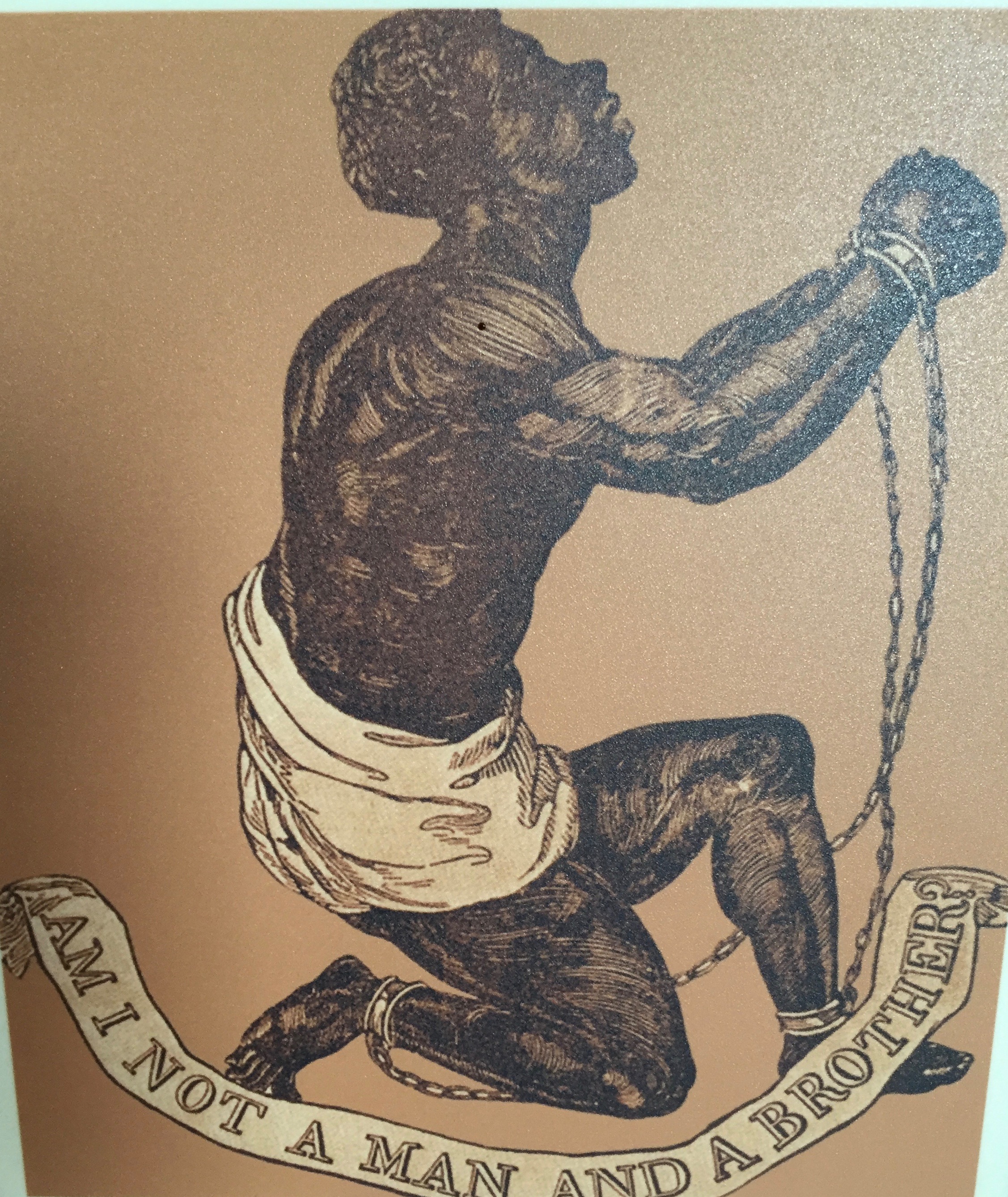
Elementary and middle school students at The New Century School learned last month just how Baltimore figures into this theme in very important ways. Although Maryland upheld the constitutionality of slave-holding from 1715 through 1864, the city of Baltimore was a hybrid of northern and southern proclivities. Being so close to the Mason-Dixon line, it was a stopover point for escaping slaves headed north to abolitionist states or Canada. It was also home to many freed former slaves, one of whom was Frederick Douglass himself.

tncs-visits-frederick-douglass-museum

TNCS Head of School Alicia first gave some preparatory social/emotional learning lessons tailored to first one cohort of 4th- through 8th-graders and, later, a second cohort of 2nd- and 3rd-graders.

After, they walked through Fell’s Point to the Frederick Douglass | Isaac Myers Maritime Park & Museum overlooking the harbor on Thames St. and now under the aegis of Living Classrooms.

TNCS students would explore some big questions prior, during, and after their visit: “How can one man own another?” for example. They would also consider the Underground Railroad and how so much of a runaway slave’s chance of successful escape was completely out of their own control— how much uncertainty and difficulty a slave would likely encounter.

The students were completely captivated by the interactive exhibits. They will not soon forget their encounter with Frederick Douglass or with what it was like to follow the North Star with the fervent hope of reaching a better place.

tncs-visits-frederick-douglass-museum

Check-In with TNCS Curriculum Coordinator Adriana DuPrau!

The New Century School‘s Curriculum Coordinator Adriana DuPrau has been very busy heading into the third quarter of the school year. That’s due, of course, to the fact that she oversees the curricula of both elementary and middle school divisions, which is no small task, but there’s another aspect making this particular year rather special—in 2019, TNCS will graduate its first 8th-grade class!

So, let’s just get this out of the way. In Baltimore, it’s not where you went to college, it’s where you went to high school. It’s a thing.

High School Readiness

The implications of graduating the first 8th-grade class are huge. First, it’s important to get it right and pay close attention to the process to be able to replicate it seamlessly in subsequent years as well as to avoid pitfalls. Most importantly, however, the students must be ready for high school, and that readiness entails a lot, especially here in Baltimore City, where high schools are not zoned; rather, students choose the school they want to attend and then apply to get in. This is true for both public and private high schools. Many city high schools have unique identities, so students can match up their individual strengths and interests to the particular school that is going to meet their needs. Ultimately, they are embarking on a path that should prepare them for future success, whether that’s in college, career, or whatever else they envision.

This process takes planning: School choice starts by exploring available options to learn what each school offers; where it’s located; and, importantly, what special academic (e.g., results on a standardized assessment) or admissions requirements (e.g., audition or portfolio) must be met to be accepted. Attending school Open Houses and doing Shadow Days are also typically part of the process.

So, Mrs. DuPrau has been supporting this effort in many ways, starting with testing. “We learned that some of our 8th-graders had not taken many tests, and so we need to provide more test-taking opportunities. Next year, practicing for tests will take the place of teacher’s choice time for middle school students. Let’s learn how to take a test. It’s also important to have a test for students coming in to TNCS to see where they’re at,” she explained.

Wait—TNCS doesn’t do standardized testing, does it? Although the TNCS approach is the antithesis to “teaching to the test,” as mentioned above, the results of a standardized assessment are probably going to be necessary for any student bent on getting into the school of choice.

Oh, I See!

That’s where the Independent School Entrance Exam—the ISEE—comes into play. This test comprises Reading Computation, Essay, Quantitative Reasoning, Mathematical Computation, and Analogies. Dean of School Alicia Danyali began implementing test-taking skills instruction as well as practice time during the 2017–2018 school year.

“Most private school students need to take the ISEE, and then their score is what the majority of private schools will look at. That’s the big standardized test,” explained Mrs. DuPrau. She signed up TNCS to be an Education Records Bureau (ERB) member so that the ISEE could be administered on site. (“ERB is a not-for-profit member organization providing admission and achievement assessment as well as instructional services for PreK–Grade 12,” according to the ERB website.)

Said Mrs. DuPrau: “We opened the ISEE up to 6th–8th graders. It was optional for 6th and 7th grade and mandatory for the 8th grade because they need that score.” The 3-hour test took place on November 14th and was proctored by TNCS Language Arts teacher Ilia Madrazo. “It ran all morning,” said Mrs. DuPrau, “and was the first time our students had taken a real test.” (A practice run took place last May.) “To prep the 8th graders for this test, [TNCS Co-Executive Director/Co-Founder Roberta Faux] worked with them weekly, especially in math,” she said. How did the students fare? “They said it was super hard,” said Mrs. Duprau. “The ISEE is hard. Out of all the high school testing they have been doing, they said the ISEE was by far the hardest.” (But they scored highest in math!)

It’s important to note that the ISEE is required for applications to private schools.

And Are They Ready?

For public schools, on the other hand, the i-Ready is a required test, which, unlike the pencil-and-paper ISEE, is administered online and took place a month after the ISEE, on December 14th. “From my understanding,” explained Mrs. DuPrau, “the computerized test will first assess ‘where the student is’ and either build on questions if the student keeps getting everything right, or it will go back. In this way, it’s similar to how SuccessMaker works.” Thus, i-Ready is both intuitive and differentiated.

After students had taken the test, Mrs. DuPrau escorted them to Taco Fiesta for lunch!

tncs-middle-schoolers-take-the-i-ready-test

Having taken both the ISEE and the i-Ready, TNCS 8th graders now have the option of applying to both public and private schools. They also took both tests early enough that they could retake one or both if desired.

Students applying to Institute of Notre Dame additionally had to take the High School Placement Test (HSPT), which was administered at Cristo Rey Jesuit High School.

High School Applications

While all this testing fervor was happening, students had to begin completing their high school applications, which were due December 14th for most private schools and approximately a month later for public schools. Some other schools they are applying to include Baltimore Leadership School for Young Women and Western High School—for those of you true Baltimoreans sure to inquire!

Mrs. DuPrau was instrumental here as well. She worked with TNCS scholarship students during the school day as needed to help them navigate the less-than-straightforward application process. She got the students accordion binders so they could organize materials by school—one tab per school. “For each school they applied to, we made checklists, put in our applications, made copies, and made sure we scheduled a shadow day and an interview,” said Mrs DuPrau. With binders in hand, they attended the Baltimore City Schools Choice Fair at the Convention Center on December 9th. Explains Mrs. DuPrau: “All the high schools from Baltimore City go there and have their own booth. A few representatives from the school man the booth and share about the school. There were also a lot of performances—singing and dancing and things like that. The girls would visit the booth and ask questions, and there were also students from the school on hand whom they could talk to.”

“The girls had so much fun with it,” recounts Mrs. DuPrau, “and I also taught them how to research information on their own. They’re binders are still growing, and they keep adding tabs!”

tncs-curriculum -coordinator-adriana-duprau-helps-apply-to-high-school

Mrs. DuPrau also had the good fortune to meet a representative of the i-Ready test whose job is specifically getting 8th graders into high school. She invited Mrs. DuPrau to join a committee on how to prepare 8th graders, follow up with them, make at least two visits throughout each high school year, and later help them apply to colleges.

Other Areas

As busy as she was with the 8th-graders, Mrs. DuPrau still made time for all of the other TNCS students, for tutoring, for setting up programs around campus, for doing dismissals (always with a big smile) as well as for teachers and faculty.

Self-Defense Class

For students in grades 4 through 8, Mrs. DuPrau arranged a self-defense/self-empowerment workshop on December 18th with author and mindfulness guru Jillian Amodio. The class focused more on promoting self-confidence and respect rather than combat techniques and was divided into boys and girls sessions, with slightly different curricula. Tips for online safety and other common-sense habits were also encouraged.

This video gives an idea of what her workshops might cover; however, they are tailored to context and age.

Finally, Ms. Amodio gave the following mantras for the students to reflect on.

Mantra for Respectful Males
I respect myself, my body, my mind, and my emotions.
I respect the bodies, minds, and emotions of others.
I respect that others feel differently and value our differences.
I am allowed to express sadness and hurt without being seen as weak.
I offer to help others when I see they are in need.
I will not place myself above anyone else. We are all equal and worthy.
There is no place for unnecessary aggression in my life.
Gentleness is a something I value.
Sensitivity towards others is something I take pride in.
There is no reason to be rude.

Mantras for Strong Girls
I respect myself, my body, my mind, and my emotions.
I respect the bodies, minds, and emotions of others.
I respect that others feel differently and value our differences.
I am allowed to express sadness and hurt without being seen as weak.
I offer to help others when I see they are in need.
I am in control! I am Strong! I am worthy!
Bold is beautiful!
I will never settle for less than I deserve!
I will not apologize for others! I will not apologize unnecessarily!
Every great woman has encountered fierce battles. Wear your battle scars with pride and rejoice in all you have conquered!

Learn more about Ms. Amodio at jillianamodio.com.

Staff Support

Although her official title is “Curriculum Coordinator,” Mrs. DuPrau’s responsibilities stretch beyond the classroom. She works closely with TNCS Head of School Shara Khon Duncan, for example, and also meets regularly with teachers. “[Señora Duncan and I] work together on how we can help with or improve the curriculum. I also help her observe teachers as well as with applying for federal grants (e.g., Title II and Title IV). We are also trying to figure out how our school can be recognized on school choice applications.”

tncs-curriculum-coordinator-adriana-duprau-and-teachers

She notes that morale among teachers has been especially high this year, which makes her job more fun—as well as trickles down to happier students. Part of this, she reasons, is the wonderful teachers themselves and another part of it is how valued they feel by the administration. In general, a spirit of collaboration and positivity pervades.

Coordinating the International Trip

Another first for TNCS this year is the international service trip middle schoolers will take this spring. They are planning to go to Puerto Rico, where passports are not required. “That is a big project,” said Mrs. DuPrau. “Figuring out all the details and coming up with fundraising ideas has been challenging.”

But, never fear! It will happen, and Immersed will fill you in on all the fun! In the meantime, thanks for all you have done to make the 2018–2019 school year such a huge success, Mrs. DuPrau!