TNCS’s Second Annual Town Hall

town-hall

TNCS will host a Town Hall annually to provide a forum for communication of ideas and news to the TNCS community.

On Tuesday, March 10th, The New Century School held its 2015 Town Hall meeting for an auditorium full of eager participants. Admissions Director and Town Hall Moderator Robin Munro said, “We are a young and very ambitious school, so yearly meetings like this are critical. We will provide an annual state of the school update, specifically the K–8th program, and a forum for families to ask questions.” Childcare with dinner and wine and hors’ d’oeuvres were offered, and questions were solicited ahead of time to allow the event speakers to shape the discussion accordingly.

There was an evident unifying thread to this event: collaboration. Mrs. Munro remarked by way of introduction that “the map hasn’t been written to exactly where the school’s destination is and what the steps are along the way.” The implication is clearly that TNCS community input is not only valued and taken seriously but is also helping navigate to the destination. We are writing this map together.

tncs-town-hall-audience

TNCS parents chat amongst themselves while having a little nosh prior to the start of the event.

Some notable differences from last year’s Town Hall bear pointing out. The biggest is the growth and maturation that the past year has afforded TNCS. Now in its 5th year, TNCS has emerged from the growing-pains phase faced by any new school as a secure, comfortable-in-its-own skin swan. It is owning its unique identity, and that feels good. Another key difference was in the nature of the interaction between the audience of parents and the event speakers (school administrators and executive directors). Parents were encouraged to share any concerns, but criticism was given in an overwhelmingly constructive way. Parents explained their problems but helpfully offered potential solutions to these problems in the same breath. The result was a very positive and productive evening. It felt like we were all in this together, collaborating to help keep the school flourishing and moving forward. Oh, right—that is the essence of the TNCS community!
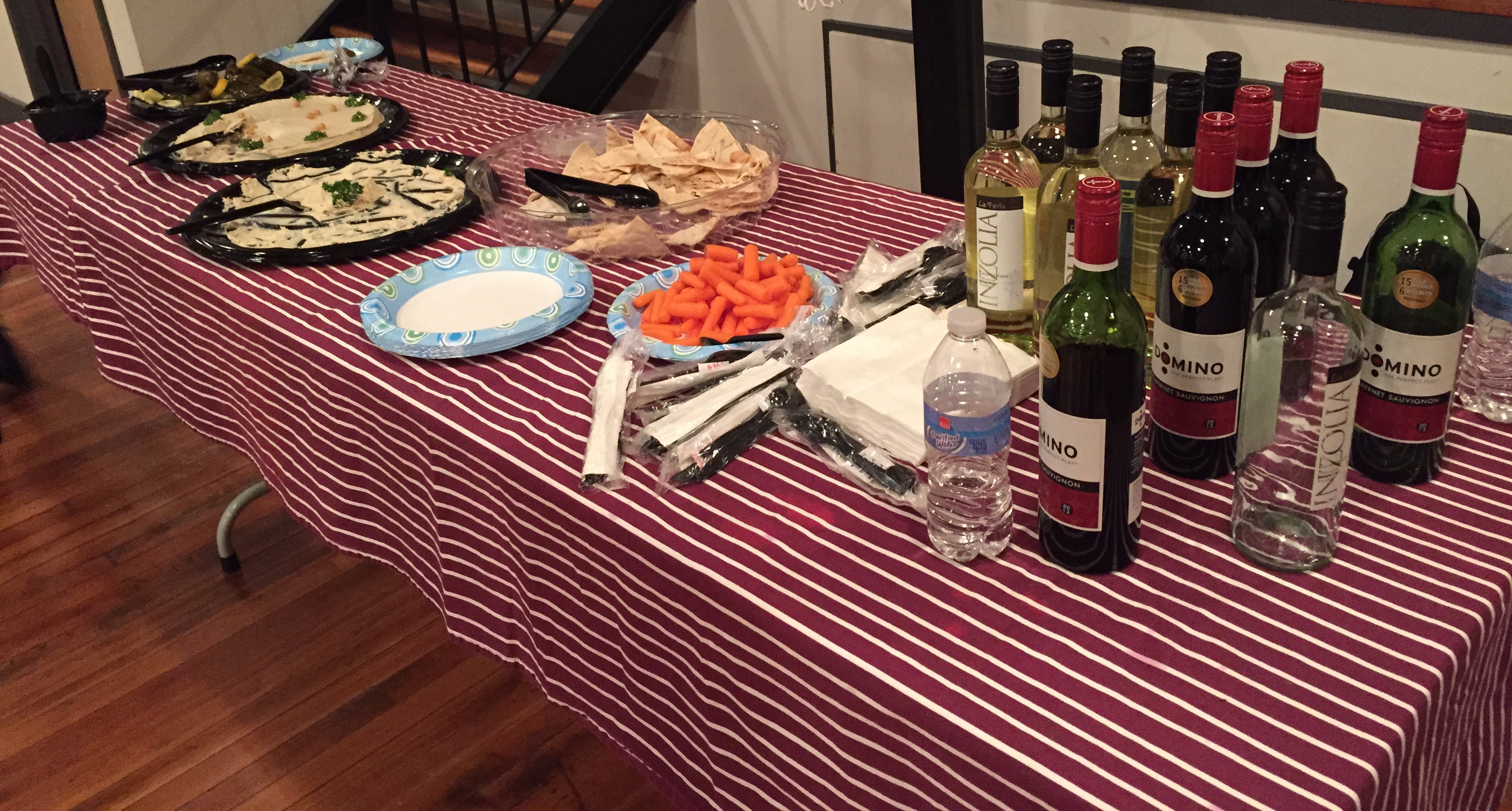
happy-hour-light-fare-provided

Hors d’oeuvres gave attendees time to arrive at a leisurely pace, mingle, and recharge before getting down to business.

Speaker Presentations

In Public Health, the concept of “patient activation” measures an individual’s capacity to manage his or her own health and health care. Does she eat right and get plenty of sleep to maintain health? If he falls ill, does he have the skills to communicate effectively with a physician and to follow doctor’s orders? A correlation can be drawn in the education domain: “parent activation.” The Town Hall audience of parents was highly activated. They participate competently in the education their children are receiving at TNCS, they are knowledgeable about every aspect of their child’s school day, they purposefully sought out the school that best aligned with their own values. Their kids are so much the better off for it. This is not a way to say that TNCS students are simply academically superior. Although that is often the case, academic performance is not the key measure of “success” at TNCS; it’s so much more.

Co-Founder and Executive Director Roberta Faux calls the TNCS community “like-minded,” and she expressed our shared vision beautifully in a couple of personal vignettes. She retold the story of the school’s origins (much of the audience had not heard it last year) and how quickly the 1-room Patterson Park Montessori grew into TNCS today. Then she described a lovely interaction she recently had with one of her daughters, in which her daughter asked her what gifts would she (mom) prefer had been bestowed on her daughter as a baby by a fairy godmother, a là Princess Aurora in the story of Sleeping Beauty. First of all, what an insightful and touching question from such a young child. Both this question and the answer Mrs. Faux ultimately gave exemplify what TNCS is, how it works, and why it is such a phenomenal school. “I took a step back,” she said, “and I asked myself, “as parents and educators, what do we want for our kids?” In the meantime, of course, she had answered her daughter by telling her that she likes the gifts that her daughter already exhibits, such as her kind spirit and enumerating her many other attributes.

“It’s not just about achievement,” she continued. “It’s about being able to find our own happiness, overcome stress, engage in healthy give-and-take human relationships. These are the real-life training skills that we hope our children grow up learning and take with them.” She explained that in the United States, “giftedness” and high IQ are perhaps overvalued. “All children are capable of great things,” she said. But what’s wrong with working hard to achieve goals rather than being able to effortlessly master something? “Grit” is what will allow a person to attain mastery of something otherwise outside of his or her given wheelhouse. At TNCS, students are encouraged to try new things, to explore and to inquire their way into making self-guided discoveries. This takes perseverance, and this stick-to-itiveness will be a resource they can draw on in any circumstance for life. (Please see below for links to the TED talk she mentioned as well as Immersed‘s own handling of this topic.) “Education should not be just about achievement,” concluded Mrs. Faux. “It’s about cultivating the strength to work hard enough to find what you love. For my kids and for the kids here, if they can find that, then we’ve given them so much.”

Co-Founder and Executive Director Jennifer Lawner spoke next to express appreciation of and gratitude for TNCS staff and families, second the ideas expressed by Mrs. Faux, and to share a charming anecdote of her own: “Thinking back to 2007, I remembered how Roberta and I would sit on the sofa in her sunroom and discuss the crazy idea of opening a preschool. Finally, I knew I had to make a decision, so I said, ‘I’ll only do it if we can do language immersion,” and without any hesitation whatsoever she said, ‘well, okay’.”

Based on the topics submitted by attendees, Ms. Munro organized the overall discussion into nine umbrella categories: Space, Curriculum, Staffing, Standardized Testing, Accreditations, Parent–Administration Organization, Scholarship Fund, Short-Term and Long-Term Plans, and Open Q&A. Although not every topic got exhaustive coverage and not necessarily in this order, the following synopsis provides a comprehensive overview of the school and its future direction.

Space: Indoor and Outdoor

The Middle School opens in fall of 2016 and will most likely be housed in the existing Union Box space of Building North. The Co-Founders are in talks with architects and engineers to develop it as a multi-classroom space, which, if all goes planned, will be secured by August. Fall 2015 will see a mixed-age grade 4/5 classroom, mixed-age grade 2/3 classroom, and either two mixed-age K/1st classrooms or a straight K class plus one mixed-age K/1st class.

Last year’s playground redesign experienced some environmental setbacks but is still going to happen in order to create a space that can work for preschool, elementary, and future middle school students. A new geo dome will be erected, and the greenhouse will be moved. Other aspects are less certain, but ideas for improvement flew about the room. Also, Head of School Alicia Danyali just announced that Friday that TNCS mom Tracey Browning has organized another High Five fundraiser at Camden Yards. Funds will go to the playground overhaul.

Staffing and Curriculum

Mrs. Danyali fielded these topics and was visibly thrilled to announce that she will be joined by an Assistant Head of School in August. This will free up much of her time to focus on exploring new approaches to inspire kids to learn and be excited about that learning. The International Baccalaureate is one such program on the horizon. “The International Baccalaureate aims to develop inquiring, knowledgeable and caring young people who help to create a better and more peaceful world through intercultural understanding and respect,” through challenging and rigorous education programs.

Regarding the curriculum, questions here were very specific. Being fans already of the school day scholastic content, parents wanted to know if there will be additional after-school enrichment, sports, and musical instrument instruction. The administration heard them loud and clear—this was perhaps the primary issue of the evening. Proposed solutions will probably involve community partnerships, and this is a good thing on many levels. TNCS is committed to being a responsible and active member of the external community; partaking of community offerings is one way to honor this commitment. Discussions were already underway to expand the relationship with Coppermine Fieldhouse at DuBurns Arena, so giving more opportunities for team sports instruction and participation is a likely outgrowth. The Patterson Park pool could be used for swimming lessons, and the ice skating rink could also be used in an athletic program. Musical instrument instruction will have to be given some more thought, but some creative workarounds thrown out included inquiring about the services of Laura Norris, Director of the Baltimore Chapter of Mando for Kids, a free program that teaches Baltimore City kids ages 6 and up to play the mandolin. Mrs. Norris just happens to live down the block from TNCS and is a frequent guest performer. This video clip features all age groups she currently teaches. Developing a special offshoot for TNCS students is a distinct possibility.

Standardized Testing

“Will TNCS be implementing standardized testing?” was another popular question. “To be in line with the other private schools, it makes sense,” said Ms. Danyali. “We are leaning toward the ERB, but it’s not set in stone yet. We want something that would match this independent, dual-language learning environment.” According to the ERB–Lighting the Pathways to Learning website (ERB stands for Education Resources Bureau), “ERB is the only not-for-profit member educational services organization offering assessments for both admission and achievement for independent and public schools PreK–grade 12. . . With the diverse needs and requirements in today’s academic landscape, ERB takes a customized approach to our services.” Ms. Danyali says she is grateful that TNCS isn’t forced to implement standardized testing, “but students also need to know how to take a test—it’s important to have that exposure.”

Such testing, albeit less pressurized than it would be in a public school setting, will also prepare students for matriculation into secondary school and beyond. Regardless, teachers are never asked to simply “teach to the test.” They have freedom to accomplish their goals how they deem suitable, based on and tailored specifically to the individuals they teach.

Parent–Administration Organization 

Parents were very vocal about their willingness to help tackle existing obstacles to progress. A  suggestion was made was to formalize a PTA-esque parent committee, and another to create an oversight committee to help tie individual committee threads together to more effectively communicate school changes and news. “We are open,” said Mrs. Munro. “If what you want is a formal quarterly meeting, we’ll make that happen.” Thus, again the collaborative nature of this group was felt.

Short- and Long-Term Plans and Q&A

Though we didn’t get the chance to address this one head on, a theme throughout the discussion emerged that could serve to answer questions about how well students will be prepared for the next steps (whatever those might be) in their academic careers and lives. With the attention to whole-child development, the carefully differentiated instruction, the administration policies that ensure that TNCS doesn’t exist in a vacuum but is part of the city and state educational corps, etc. all combine to guarantee not just preparedness but that the TNCS-educated student will thrive in his or her future environs.

The Q&A gave TNCS administrators a clear idea of what parents feel could be done better. These issues were addressed with seriousness and respect and are of immense value to the moving the school forward. Many parents took this opportunity to praise the school and administrators for the zillion things they get right on a daily basis.

Finally . . .

For more information on Professor Angela Duckworth and grit, please visit the following links:

See you next year, TNCS community! In the meantime, keep that valuable and much-appreciated feedback coming!
Phys Ed Is Going Strong at TNCS!

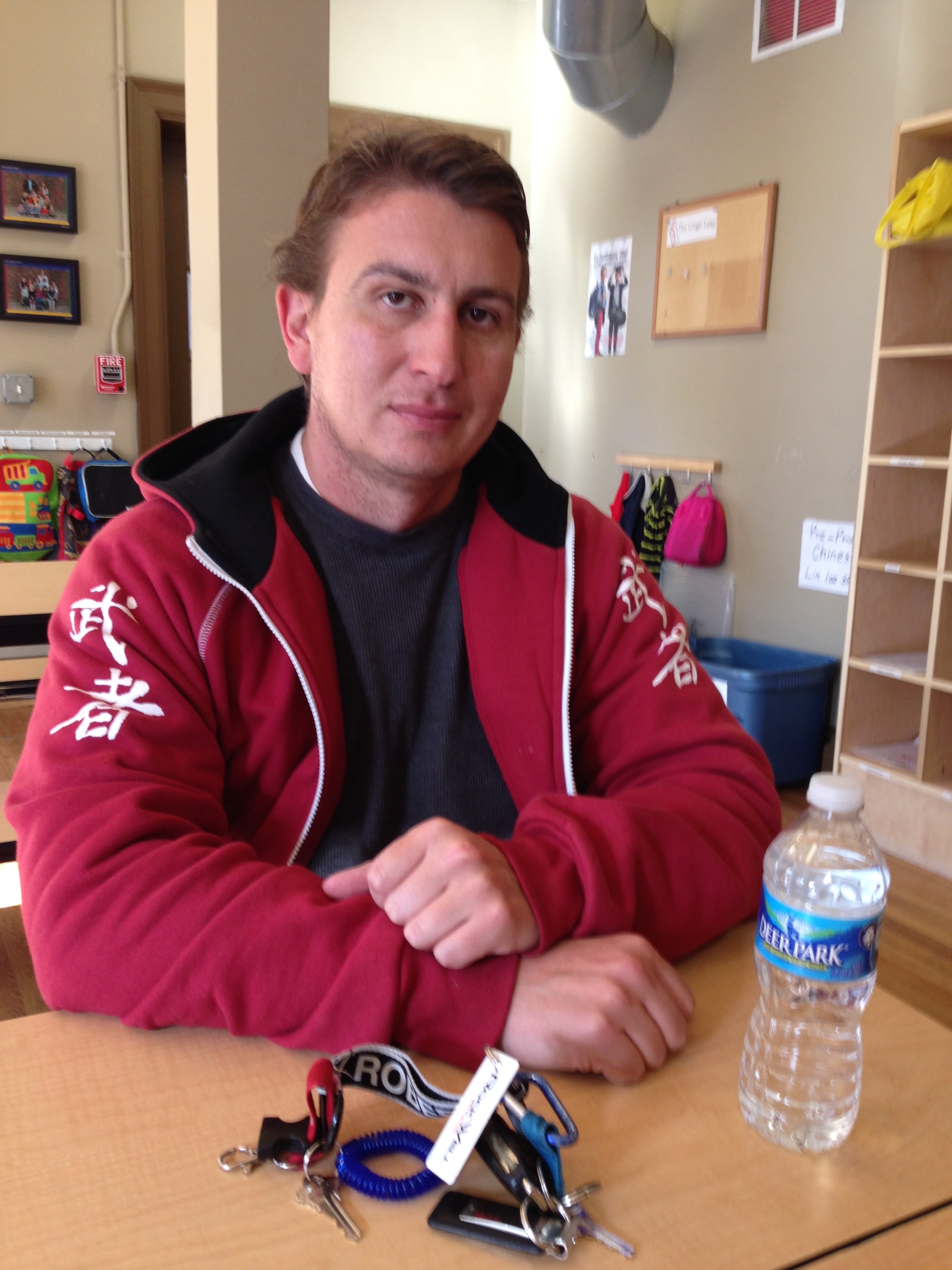
phys-ed-teacher

Phys ed teacher Robert Bekas joined TNCS at the start of the 2014–2015 academic school year.

The New Century School was founded on the principle of educating the whole child, which many schools have neither the luxury nor the capacity to do. Art, Music, and Physical Education are typically first on the chopping block in the current standardized education environment. But, in keeping with its firm commitment to providing a well-rounded scholastic experience, TNCS has not only retained these disciplines critical for development of creativity as well as specific skills, but it has continued to grow its “specials” program and offers a very balanced ratio of academic-to-specials classes.

One emphasis of the 2014–2015 school year is on movement, explained Head of School Alicia Danyali in the fall. True to her word, she has implemented regular yoga throughout the upper programs, encourages teachers to allow plenty of time for their students to move within their individual classrooms—such as K/1st teacher Mrs. Jacoby’s games to hone hand–eye coordination (see TNCS Gets the Wiggles Out and the Learning In!)—in addition to providing dedicated gym time in a formal physical education class. Movement is not only essential for physical health, but evidence in support of movement being just as vital for cognitive health is mounting fast.

Enter Mr. Robert Bekas, TNCS’s new phys ed instructor. Mr. Bekas is The Real Deal in terms of what he brings to the gym. Born and raised in Poland, he graduated with a Master’s Degree in Physical Education from the Academy of Physical Education. His main interest was in martial arts, and he competed for many years in karate, specifically, the Shotokan style. After graduating from college, he opened his own kickboxing academy and taught there for 4 years. In 2004, he came to the United States to do an internship at Sport FIT, a fitness club. (He met his future wife there and has been here ever since apart from brief annual trips back home.) He then worked for 7 years at a Wheaton Catholic school, but when it closed, he came here to teach K and up.

His classes start with basic stretching, then advance to an activity that incorporates some cardio (e.g., playing “Freeze,” “Sharks and Minnows,” or “Lions and Tigers”), and wrap up with skill-building in strength training, gymnastics, or team sports. He is hoping to increase classes from once a week to twice a week so the students are more accustomed to the routine. In Poland, he explained, PE class is usually four times a week. “Elsewhere, it seems to be getting less and less. This is bad for kids; they are spending too much time indoors and on devices and will end up with postural problems. I know this is the 21st century, but playing too many video games is a bad habit.” For his own fitness routine, he does a whole-body workout at the gym incorporating stretching, strength training, and cardio. For fun, he continues his martial arts training and also enjoys hiking.

As for his TNCS students he says, “The kids are doing great. The goal is overall fitness, but I also want them to learn the basic rules of baseball, football, soccer as well as fairplay. I also try incorporate team spirit. When we play, we play for fun. We don’t keep score; I want the students to be nice to each other, not get in arguments over who is winning. I try to keep it on the fun level, not necessarily the sports level.” He also uses the Gerstung equipment to teach basic gymnastics, such as forward and backward roll on the balance beam.

This slideshow requires JavaScript.

Mr. Bekas commands respect from his students, and they adore him. “I like being at this school,” he said. “It’s a great place. It’s family oriented, and the classes are kept small.” By the way, Mr. Bekas also speaks four languages (Polish, English, German, and Russian) and might attempt to learn Japanese to support his martial arts endeavors. He is certainly a good fit for the multilingual/multicultural environment at TNCS! Future projects at the school for Mr. Bekas might include some extracurricular martial arts instruction; stay tuned for developments!

TNCS Students Get the Wiggles Out and the Learning In!

Moving Is Learning

The New Century School has always known that movement is good for kids’ brains. For example, studies show that exercise improves both focus and academic performance in children and that fitness and attentiveness go hand in hand. Exercise has recently been studied as a nonpharmacologic way to treat attention deficit/hyperactivity disorder. (Read Put the Physical in Education.)

Even while evidence supporting this notion is accumulating like crazy, many schools are reducing physical education class time or cutting it out altogether. Time spent in recess is also dwindling. In many traditional classrooms, students are expected to “sit still!” “Stop fidgeting!” “Pay attention!”

The irony is, kids can’t pay attention if they aren’t permitted to move! Moving gets adequate blood flow to the brain—enough that the brain is awake and ready to get to work, not sleepy and dulled. Many experts suggest that fidgeting is actually a sign that the brain is trying to turn itself back on.

students-climbing-at-recess

Climbing, running, and jumping are crucial ways for kids to recharge their brains for learning!

Don’t Skimp on Playtime!

Another recent study attributes similar benefits to unstructured playtime. In Finland, schools give children 15 minutes of unstructured play after every 45 minutes of instruction, and their in-class attentiveness is the higher for those frequent breaks. (Read How Finland Keeps Kids Focused through Free Play.)

TNCS educators know that the mind–body connection is supremely important, and that exercise and play do not necessarily have to be limited to scheduled gym classes or recesses. Teachers are encouraged to incorporate movement into the daily routine at regular intervals to stimulate blood flow to the brain in a variety of ways. When kids take a break from the books, their cognition actually improves.

elementary-students-build-core-strength-and technologic-skill

While doing their work at the computer, elementary students have the option of sitting on stability balls to simultaneously work on their core strength.

Stability Balls

What are some of their innovative strategies? Last year we reported on how using stability balls in class improves concentration, for example. Says Angela Hanscom, a pediatric occupational therapist:

Ironically, many children are walking around with an underdeveloped vestibular (balance) system today–due to restricted movement. In order to develop a strong balance system, children need to move their body in all directions, for hours at a time. Just like with exercising, they need to do this more than just once-a-week in order to reap the benefits . . . We quickly learned after further testing, that most of the children in the classroom had poor core strength and balance. In fact, we tested a few other classrooms and found that when compared to children from the early 1980s, only one out of twelve children had normal strength and balance. Only one! Oh my goodness, I thought to myself. These children need to move!

(Read Why so many kids can’t sit still in school today for more.)

Walking Tours

TNCS teachers are getting quite creative in finding other ways to incorporate movement and are seeing positive pay-offs. For “Teacher’s Choice” time one afternoon a couple of weeks ago, elementary teacher Dan McDonigal decided to take advantage of being located so near the Inner Harbor. His class embarked on a walking tour to take photos of their surroundings and got a spontaneous tour of The Pride of Baltimore II (a replica of the civilian vessels that were used to capture British merchant ships and were critical to our victory in the War of 1812). That walking tour brought together many important TNCS themes, in fact—movement, history, our local community, and art.

Singing, Dancing, and . . . Sweeping?!

When Teresa Jacoby starts to see signs of inattention in her kindergarten/1st-grade class, she plays movement games with the whole class. One, that is similar to “Simon Says” but with an important twist, requires merging physical and mental deftness to play. The trick is that they have to mimic the last movement she made while she has moved onto another movement. It’s surprisingly difficult to do, but she is sharpening their minds even as they have a ball! Her students managed to tap into and draw from the two brain hemispheres simultaneously, that is the key to pulling this off, much more readily than their parents did at Back-to-School Night! Another way Mrs. Jacoby harnesses the mind–body connection is by having her students bounce on the exercise trampoline while reading/learning sight-words.

In the Montessori and pre-primary classrooms, movement is also a natural part of the day. These students are learning independence and self-regulation and are given the freedom to move about the space to pursue their activity of choice. The Practical Life lessons in the Montessori classes are very much about moving and doing, at their core. Activities such as flower arranging and sweeping/tidying are fun, practical ways to get kids up and moving while boosting their self-esteem as they experience what it’s like to contribute meaningfully to their classroom and group. All of the younger TNCS students participate daily in songs accompanied by movement.

Patio Yoga!

Finally, yoga, which has always been in the mix to varying degrees, is now being taught regularly by our very own Head of School Alicia Danyali. She uses yogic techniques with the older elementary students to cultivate mindfulness and focus in addition to gentle exercise. These students take to it like naturals. They seem to genuinely appreciate the opportunity to stretch, relax, and take a break from class. Mrs. Danyali is a certified yoga instructor and a very skilled educator to begin with. She had them breathing and flowing like veteran yogis and yoginis within minutes. Importantly, she shared with them that the breathing techniques they were learning could serve them well in other contexts, too. Anytime they need to regroup or regain focus or equilibrium, they now have some tools to help them arrive at a calmer place.

This slideshow requires JavaScript.

School-wide, TNCS students are demonstrating that being allowed to be kids makes them all-around better learners!

TNCS Gets Ready for School!

Always follow the green for TNCS events!

Always follow the green for TNCS events!

On Friday, August 22nd, The New Century School hosted a very special Back-to-School Orientation/Open House—this event marked the beginning of TNCS’s 5th year in its 724 South Ann St. location! During each of those marvelous 5 years, the school has grow, adapted, and blossomed into what it is today, an educational environment where each child is nurtured, challenged, and celebrated. This is no small achievement, and the 2014–2015 academic year promises to be the best yet.

Exciting and important changes are afoot, each moving progressive, multilingual, independent TNCS forward. Families who attended the Open House learned of many of these changes during the event while they met teachers and explored school grounds, got to know each other or caught up from summer break, and enjoyed some of Chef Emma’s tasty refreshments. For those of you were unable to attend, read on to learn what this school year holds in store!

This slideshow requires JavaScript.

 TNCS Staff: New Additions and New Roles

Although we bade farewell to a few instructors at the end of last semester, their contributions to the TNCS community will not be forgotten, and they will always remain part of the TNCS family. With great joy, we also welcome some new members to the caring, talented, all-around amazing TNCS staff.

Robert Bekas (Elementary Physical Education Teacher): Mr. Bekas was born and raised in Poland, where he graduated from The Academy of Physical Education in Warsaw with a Master of Arts degree in Physical Education/Sport Science. During college, Mr. Bekas specialized in strength training, fitness, and martial arts. In 2004, he moved to the United States and began teaching PE to local private schools. His other hobbies include teaching martial arts. He holds black belts in karate, taekwondo, and kickboxing.

Teresa Jacoby (Kindergarten/1st-Grade General Studies Teacher): Mrs. Jacoby holds a Master’s Degree as a Reading Specialist from Loyola University in Maryland and a Bachelor of Science in Elementary Education and Special Education with an Art Education Minor from Northern Arizona University in Flagstaff. She also has an Advanced Professional Certificate Special Education 1–12 and an Advanced Professional Certificate Reading Specialist Certification, both from the state of Maryland. She has taught a wide variety of students ranging from Kindergarten through 8th grade Special Education in all content areas in both self-contained and inclusion environments. She also has run many extracurricular activities from chairing the Science Fair to Chess Club to Lego Robotics Club. She lives in Baltimore and enjoys using her artistic skills in and out of the classroom, gardening, riding bikes, and spending time with her family.

Jie Liang  (Mandarin Primary & Elementary Assistant): Ms. Liang holds a Master’s Degree in Secondary Education for Chinese Language from Towson University, and a Bachelor of Arts degree in German Language and Literature from the University of China. Ms. Liang has facilitated Startalk programs in Vermont and was an immersion teacher for the Confucius Institute in Nuremberg, Germany. She has taught kindergarten at the Baltimore Chinese School and interned at Perry Hall High School teaching advanced-level Chinese classes. She was a Lead Teacher in TNCS’s inaugural and highly successful Summer Startalk program in Summer 2014.

Dan McDonigal (STEM Teacher Grades 2–4): Mr. McGonigal grew up in Pennsylvania and attended Bloomsburg University, where he received a Bachelor of Arts degree in Communications, specializing in Journalism. Mr. McGonigal worked professionally for 8 years with a market research company prior to changing his career to education. In 2006 he earned his Master’s Degree in Education from Notre Dame of Maryland University. He has 7 years’ teaching experience in Harford and Baltimore Counties. He is currently working toward a STEM (science, technology, engineering, and math) certification through a Cohort with Towson University. He is passionate about bringing STEM-related learning experiences to the students of TNCS. Mr. McGonigal is married and the father of two young boys. He enjoys sports, working on home improvement projects, and spending time outdoors. He also enjoys traveling, especially his trips to Italy and Ireland.

Maria Mosby (Montessori Lead Teacher): Montessori has felt like home for Ms. Mosby for quite some time. She began at age 2 ½ years at Columbia Montessori School, in Columbia, MD. After several moves with her family throughout New England and the Washington, D.C. area, she rediscovered Montessori while studying Early Childhood Education at Towson University. Ms. Mosby was a primary assistant for 3 years, and a toddler assistant for 5 years at Greenspring Montessori School (formerly, The Montessori School), where she decided to take her Early Childhood training through the Maryland Center for Montessori Studies. During her internship, she worked at The New Century School summer camp and loved the warm, peaceful community. In her free time, Maria enjoys running, making crafts, studying foreign languages, and yoga. She is also a certified children’s yoga instructor and will complete her 200-hour yoga training in 2015.

As we welcome these new members to TNCS, we also congratulate current staff members on continuing the wonderful work they do so well and with such big hearts. Some are adopting new roles, including Cassidy Bryson, who will work in the Primary group to support language immersion; Jennifer Hodapp, who will lead Elementary Spanish classes and assume directorship of Spanish school-wide; and Yurisan Gonzalez, who will be moving to the Pre-Primary Spanish immersion class.

Elementary Athletic Programs

For the first time, TNCS and Coppermine at Du Burns Arena at 3100 Boston St. are partnering to offer exciting afterschool athletic programs to TNCS students, including transportation to the facility! The Fall session runs September 9–November 13, 2014 and is available to students ages 5–10 years old. Choose from Flag Football on Tuesdays, Lacrosse on Wednesdays, or All-Star Sports on Thursdays. Younger students can participate in Coppermine Soccer on premises at TNCS on Tuesdays. Direct your questions about the programs and enrollment to Coach Mark (mark@copperminefieldhouse.com).

Kindergarten—It’s Official!

New for the 2014–2015 academic year, Kindergarten/1st-grade teacher Teresa Jacoby introduces her students to the classroom and its special routines.

New for the 2014–2015 academic year, Kindergarten/1st-grade teacher Teresa Jacoby introduces her students to the classroom and its special routines.

The kindergarten program may be the enjoying the biggest changes of all. Kindergarten students will henceforth join elementary students on the third floor as part of a mixed K–1st classroom. The weighty decision to take K out of the primary classroom will better equip students for their elementary years. In addition to a focus on reading and writing in English, K students will receive a thorough introduction to meaningful technology as well as daily Mandarin Chinese and Spanish reading and writing lessons. Read Mrs. Jacoby’s bio above to meet our new kindergarten/1st-grade teacher! She says: “Mrs. Tyson* (our class Assistant Teacher) and I are both thrilled to be new members of The New Century School Team! We look forward to building a strong, respectful learning community where learners have the structure, opportunity, and support to develop intellectually and emotionally.”

(*Note that Mrs. Tyson was a last-minute [though no less welcome!] addition to the staff, and her bio details were not yet available at this writing.)

Class Commences!

It bears repeating—TNCS is 5 years old and going strong! Previously Patterson Park Montessori, a one-room preschool that opened in 2007, the growing school moved in the Summer of 2010 to Fell’s Point and was renamed The New Century School to gradually add a K–8th grade program to the preschool. Founders, Co-Executive Directors, and Baltimore City residents Roberta Faux and Jennifer Lawner have succeeded in creating a very special school with progressive academic programming that allows students to thrive at their own unique skill and ability levels.
 
The elementary program at TNCS started in Fall, 2010 with only a handful of kindergartners but has now expanded to include three elementary classes through 4th grade and will continue to add a grade each year to accommodate the maturing student body through the 8th grade. It’s a glorious prospect!
 
TNCS looks forward to seeing you bright and early for class on Monday, August 25th, 2014, and we greatly anticipate assisting each child to make huge personal and intellectual strides this school year!

TNCS Summer “Move It!” Camp Gets Kids Moving and Learning!

TNCS's new Kindergarten teacher/first-grade teacher also taught the Move It! summer camp

TNCS’s new Kindergarten teacher/first-grade teacher Teresa Jacoby also taught the Move It! summer camp

At The New Century School‘s Move It! camp, campgoers learned all about movement—how their own bodies move as well as some of the physics of how other things move—and they also moved, a lot. This ages 3–K 2-week summer camp emphasizing learning and physical activity through art, music, movement, and play was led by Teresa Jacoby, TNCS’s new for the 2014–2015 academic year Kindergarten/first-grade teacher. Mrs. Jacoby brings a wealth of knowledge, experience, and enthusiasm to the classroom, and TNCS is pleased to welcome her!

A former 3rd- and 4th-grade science teacher in the Baltimore City school system, this “self-proclaimed scientist” gears even her reading and art lessons toward science, and Move It! camp was no different. She designed the camp curriculum herself, and it becomes not just about expending some pent-up summertime energy but also a thoughtful way to incorporate scientific thinking into having fun. “The kids are so naturally curious; it’s nice to discuss [science] with them, and they like to talk about it,” said Mrs. Jacoby.

A typical class discussion starts with something the kids can relate to—their own bodies—and moves progressively outward from there to the world beyond. “We talked a lot about, ‘what is movement?’ and ‘what can we move on our bodies?’. I get the typical legs and arms response and then ask, ‘what about our faces?’ Do we move anything on our faces?’,” she recounts. She invites them to blink their eyes, smile, wiggle their eyebrows, etc. She also talks a good deal about deep, yogic breathing, which has the dual benefit of teaching them how to calm themselves while still continuing the exploration of body movement. “I teach them how to listen to their breath hit the back of their throats and fill into their lungs. They really worked hard to get this right and made a lot of progress,” said Mrs. Jacoby.

As the light starts to dawn and they begin to see that movement really is a continuous, perpetual process fundamental to life, she expands the perspective, and they talk about what we use our bodies to move, such as picking up objects and carrying them from one place to another. “We talk about what’s hard to move and why and what’s easy to move and why,” said Mrs. Jacoby. Next, the line of inquiry widens farther still. “What do we see outside that moves?” she asks. “Cars. Well how do cars move?” This leads into a discussion of wheels and how it’s easier to move something on wheels than to push it. The kids really benefit from this inquiry-based, hands-on approach. They are learning about movement while moving, which reinforces the learning but also makes it applicable and more real. Relevant knowledge is learned more effectively and efficiently.

But hang on—this is summer camp, and fun is supposed to be an integral part of that. Move It! camp cannot be accused of skimping on the fun! With the particular focus on physical activity built in to this camp’s theme, Mrs. Jacoby really gets the kids moving with ample time either in the outdoor playground or on the Gerstung equipment and Imagination Playground located in TNCS’s gym, The Lingo Leap. Campgoers also get “water play day” every Friday, which includes playing with water toys outside and running in the sprinkler. Weather permitting, campgoers might also take neighborhood walks.

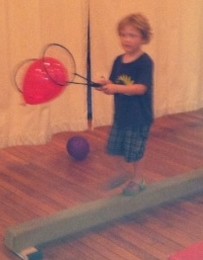
At TLL, Mrs. Jacoby sets up obstacle courses with the Gerstung equipment that the kids navigate while carrying balloons, to develop an extra layer of skill. “They do such a great job,” she said, “and it’s delightful to see how hard they work to walk on the balance beam, for example. It’s really fun to watch them practice those gross motor skills.” She also incorporates the parachute into movement time, which she is again able to tie back to physics, with observations about how the parachute behaves differently under different circumstances, such as with fast versus slow movements.

This camper has a lot going on! He walks across the balance beam without falling off, while delicately carrying a balloon between two rackets without popping or dropping it! What skill!

This camper has a lot going on! He walks across the balance beam without falling off, while delicately carrying a balloon between two rackets without popping or dropping it! What skill!

Other fun ways to get them moving include playing badminton with balloons and learning and performing funny songs and dances. Songs like “A Tooty Ta Ta,” a hipper, updated take on the “Hokey Pokey,” get them isolating one movement at a time, then building progressively on each movement until by the end they are wriggling in time to the music with thumbs up, elbows back, knees together, feet apart, bottoms up, and tongues out! (Picture playing Twister to “Gangnam Style,” or similar.) “The kids did a fabulous job getting all that together while singing along and turning in a circle with their eyes closed!” said Mrs. Jacoby. See below for the lyrics to “A Tooty Ta Ta”—your kids will be thrilled to do this with you!

“I really, really enjoyed camp Move It!,” said Mrs. Jacoby. “I got to meet some of the students I’ll have next year, which is so nice. This camp has been a lot of fun.”

Those breathing exercise sure work some relaxing magic!

Those breathing exercise sure work some relaxing magic!

A Tooty Ta Ta

Thumbs up

A tooty-ta, a tooty-ta, a tooty ta-ta!

Thumbs up, Elbows back

A tooty-ta, a tooty-ta, a tooty ta-ta!

Thumbs up, Elbows back, Knees together

A tooty-ta, a tooty-ta, a tooty ta-ta!

Thumbs up, Elbows back, Knees together, Feet apart

A tooty-ta, a tooty-ta, a tooty ta-ta!

Thumbs up, Elbows back, Knees together, Feet apart, Bottoms up

A tooty-ta, a tooty-ta, a tooty ta-ta!

Thumbs up, Elbows back, Knees together, Feet apart, Bottoms up, Head back

A tooty-ta, a tooty-ta, a tooty ta-ta!

Thumbs up, Elbows back, Knees together, Feet apart, Bottoms up, Head back, Tongue out

A tooty-ta, a tooty-ta, a tooty ta-ta!