Last week, Immersed profiled self-taught Baltimore multimedia artist Matt Muirhead’s visit to The New Century School to present his crankie to a rapt group of preprimary students (read TNCS Preprimary Gets Wounds Up for a Very Special Art Show). This week, some of the older students give their inner artists a turn.
Teachers Nameeta Sharma and Jon Wallace escorted the 3rd- through 7th-graders on a field trip to the American Visionary Art Museum (AVAM), a true Baltimore gem. “We wanted to expose the students to Baltimore art as well as make that connection with what [art teacher Jenny Miller] teaches and frequently discusses,” said Mrs. Sharma. “These students love to be hands on, and we try to make opportunities available to them to deepen their understanding and engage them.”
“We are the National Museum for Self-Taught Artisans”
(No really–Congress said so!) It’s a great fit. Like TNCS, AVAM is special in so many ways. AVAM was founded in 1995 by Rebecca Alban Hoffberger who envisioned a “museum and education center that would emphasize intuitive creative invention and grassroots genius.” Rather than displaying specific artists or styles, themed exhibitions circulate through AVAM to complement its permanent installations.
The museum’s 7 educational goals are:
- Expand the definition of a worthwhile life.
- Engender respect for and delight in the gifts of others.
- Increase awareness of the wide variety of choices available in life for all … particularly students
- Encourage each individual to build upon his or her own special knowledge and inner strengths
- Promote the use of innate intelligence, intuition, self-exploration, and creative self-reliance.
- Confirm the great hunger for finding out just what each of us can do best, in our own voice, at any age.
- Empower the individual to choose to do that something really, really well.
TNCS’s visit began in the Jim Rouse Visionary Center with an introduction and a run-through of the rules by museum educators Sara and Emily. They explained that AVAM features truly visionary art, which they defined as “art produced by self-taught individuals, usually without formal training, whose works arise from an innate personal vision that revels foremost in the creative act itself.” The visionary artist typically receives an inspirational message or vision that he or she is compelled to manifest, often not considering the manifestation to be actual art. Another key characteristic of visionary art is the use of unusual materials.


To get the most out of this wondrous experience, the large group split into two, with 3rd- and 4th-graders first taking a docent-led tour of the exhibits in the main building, and 5th-, 6th-, and 7th-graders heading upstairs to make some art in The Thou Art Creative Classroom. The groups then switched activities.
The Great Mystery Show
The main exhibit currently is The Great Mystery Show, which “. . . artfully peels away the veil of the unknown, playfully exploring mystery as that one secret power behind great art, science, and pursuit of the sacred . . . [in a] wildly visual exaltation of the strangeness and wonder of Life itself.” The viewer gets transported to other-worldly realms, lost in the experience. TNCS students deemed it “cool.”


Planetary Pendants
To get their minds spinning, TNCS students were asked to consider whether they would create an imaginary planet or reproduce a known one. Would it have rings? What kind of weather would it have and would the weather be visible in the planet’s atmosphere? Is the planet inhabited? If so, by what or whom? What do the inhabitants eat?
TNCS students are incredibly fortunate to not only have this world-renowned museum of “outsider art” (also known as “intuitive art,” “raw art,” or “art brut”) just a couple of neighborhoods away but also to have teachers who understand the importance of taking them there. Visiting museums and engaging with art paves the way for students to live richly and meaningfully. It also connects them with their fellow humans and their humanity, helping them to become responsible world citizens.
More Great AVAM Offerings
The list would be never-ending, but here are some highlights that shouldn’t be missed!
- Onsite restaurant, Encantada
- World’s most interesting gift shop, Side Show
- World-famous Kinetic Sculpture Race—20th annual happening May 5, 2018!
- Free outdoor summer movies, Flicks from the Hill
Meet the Teacher: Pei Ge Rejoins TNCS!

Pei Ge first joined The New Century School as an assistant in 2016 after earning a bachelor’s degree at Towson University. She then decided to pursue a master’s in early childhood education also at Towson. On graduating this past January, she returned to TNCS in an enhanced role.
“Peggy,” better known as “Pei-Pei Laoshi” to her students, is originally from Shanghai, in China. There, she taught children ages 3 to 6 years. In 2012, she came to the United States and taught in the English program at Georgetown University in Washington, D.C.
Now, living in Towson and back at TNCS, she assists as a floater among the primary classrooms during the mornings, and then teaches the Mandarin Chinese language each afternoon to the lower elementary classes. In fact, the kindergarten/1st-grade level is her favorite grade, but she is certified to teach toddlers up through 3rd-graders. “I’m kind of flexible for the grade,” she said. “My hope is that, maybe next semester if they have a position available for me, I can take the whole class. The Chinese immersion program would be perfect for me.”


Pei-Pei Laoshi is really a perfect fit for the TNCS approach to education. “I really like it here because they have a lot of choice for the language,” she explained. “Teaching Spanish and Chinese provides children with a really great opportunity to learn new languages at a young age. I really think that’s a good idea for young kids, especially with Chinese, because they are able to correctly reproduce the tones when they’re that young. When they’re older, there will be no problem for them.”
She also appreciates the TNCS emphasis on meeting each child at the child’s level: “Because in my class I know there is a Chinese level difference, I try to make sure that I meet everyone’s needs. I use differentiation for each one to make sure that they can learn based on their level.” She works with Li Laoshi to get an idea of each student’s learning profile, as many of her current students were formerly taught by Li Laoshi. They communicate regularly.
Her own style also aligns with TNCS’s overall approach:
For me, my goal is that students can play while learning—not just sitting there while I say, ‘you have to remember this and remember that’—we play and have fun, but we learn something, too. They enjoy it more and learn more when they have hands-on activities. For example, instead of rote memorization of vocabulary words, they might create their own books and vocabulary charts, which will be fun for them as well as being something they created.
For the Chinese Lunar New Year, she and her students made dumplings together. Pei-Pei Laoshi is a lucky rat in the Chinese zodiac.
In her spare time, she enjoys listening to music, reading, and painting. She also likes to relax at home and favors Towson for being a small, quiet town. When she feels like being social, she watch movies with friends and scouts out new restaurants to try (for good, authentic Chinese food, she recommends Orient Express, near the Hopkins campus).
Traveling is also important to Pei-Pei Laoshi. So far, she has visited San Diego; Los Angeles; Seattle; Las Vegas; and, of course, Orlando.
In closing, she affirmed, “I want the students to want to come to my class everyday, and happily. Then, parents will feel the same, and that’s my goal, too.”
Well said, indeed, Pei-Pei Laoshi!
Meet the Teacher: Megan Dematteo Joins TNCS Lower Elementary!
Now in its 10th year, The New Century School continues to grow up, with a new grade added each year and an expanding student body. With greater numbers of students comes the need for additional teachers, especially in the elementary division. This year, TNCS welcomed Megan Dematteo to teach one of the four lower elementary classes.
Ms. Dematteo is one of those perfect fits that the school seems to attract, with her varied background, progressive approach to education, and her love of language and culture.
 Background
Originally from Pittsburgh, Pennsylvania and growing up in nearby Harford County, Ms. Dematteo majored in Spanish at the University of Tennessee, with an additional focus on Journalism. On graduating with her undergraduate degree, she sought some real-world experience and joined AmeriCorps. “I volunteered for a year in Southeast Utah, primarily working for a non-profit that mostly served the Mexican community there,” she recounts. “We called ourselves the multicultural center and were open to serving any population, but we did have the only Spanish translation services in town. That’s where I began using Spanish on a daily basis.”
That experience made an impression on her that still informs her approach to education and life today. “I loved that community, and I felt like that was my first opportunity to see how language can open you up to meeting a whole new group of people and learning about them. A different perspective and a broadening world view comes with that,” she said.
After completing her volunteer service with AmeriCorps, she returned to the Southeast in 2015 and pursued a master’s degree in Creative Writing. During this process, she also took up teaching. “I got a job offer teaching part-time to K through 2nd-grade students at a Title 1 public school in Asheville, North Carolina doing literacy in small groups, which was was a skill set I had acquired. That was a lot of fun. I loved teaching and opening kids up to reading and writing,” she said.
The school where she taught had an incredibly diverse community, representing 32 countries ranging from Central and South America to Eastern Europe to the Pacific Islands. She enjoyed both the school and its students and the community surrounding it. She also found the experience to be “eye-opening” insofar as Asheville draws a lot of affluent tourists who do not necessarily reflect the social fabric of the people living there full time. “It was a very interesting place to be a public school teacher,” she explained, “because the public school kids don’t represent the facade that you see.” She realized that being a full-time classroom teacher was going to be her next step.
Although she was originally accepted into TNTP, an alternative credentialing program for public schools that seeks to “reimagine teaching,” in order to teach in Baltimore City public schools, she found herself instead at The Nueva School’s Innovative Teacher Program. Thus, her step turned out to be another big one, taking her all the way to the West Coast to teach at an independent school for gifted and talented students in the San Francisco Bay area. “I wanted to diversify my training,” she said. “That school has a progressive approach to education that I found really exciting, and I loved working with the gifted population. It was just fun. You could throw anything at them, and they would typically rise to the occasion.”
At TNCS
Although that experience was fun, she always looked on it as temporary: “I knew ultimately that I wanted to be closer to my family and be in a place where I could see myself settling down for a while, so California was my last hurrah.” And that’s how she wound up in Baltimore, at TNCS. “I’m only in my 4th year as a teacher, but I’ve tasted every little sampling from the platter of environments to work in, and TNCS is kind of a hybrid of all the different experiences I’ve had,” she explained. “I feel like TNCS is all of those pieces of training put together in one program.”
Things are certainly coalescing—she brings bilingualism, a service orientation, and a focus on reading and writing to the classroom, which are key elements of the TNCS identity. As for ways she integrates her background of creative writing, journalism, and Spanish in the classroom, she says:
We do writing workshop a lot. I think the kids like the opportunity to be creative. We’re going to switch our focus to a little more reading this semester because we got really excited about a writing project toward the end of the year—the kids created their own book. They learned about character and plot, the beginning, middle, and end. The created their own original books, then dictated them to me, and then illustrated them. It really made them come alive. Kids that formerly weren’t super interested in the technical aspects of writing, all of a sudden found that they had a voice and became really excited and proud of the stories they were telling. It was wonderful to see that process.
To bring Spanish in, I read stories in the language, such as Mexican folk tales. I also have a couple of ‘Spanglish’ books that are written in English, but the characters might have Spanish names, for example. The students are sometimes surprised to hear me, an English native speaker, speak Spanish. I like being an example to them of somebody who is bilingual. So, I try to use Spanish in the classroom a little every day, but I am primarily an ELA teacher, and I can’t switch too much because I don’t want to confuse my students.
Ms. Dematteo is glad to see TNCS flourishing as a school and is especially appreciative of the Mandarin Chinese and Spanish language teaching. “They are doing something in Baltimore that’s never been done before, and I think it’s really commendable,” she said. “It’s also a big year as far as reaching a critical mass of students and being able to be fully operational as a pre-primary to middle school. That’s very exciting.”
She and Profesor Manuel share classes, each having 15 homeroom students. Ms. DeMatteo handles ELA and Math for the cohort of 30 total, and Prof. Manuel, Global Studies and Science. “I’m enjoying this,” she said. “It’s good to be back in Baltimore!”
Writer in Residence Joins TNCS: Meet Ilia Madrazo!
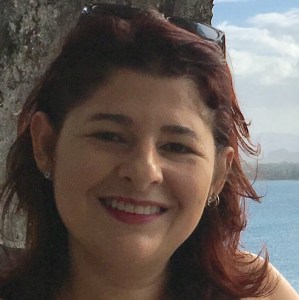 This past November, The New Century School embarked on a new approach to English Language Arts instruction. Welcoming Ilia Madrazo to the faculty, TNCS now features dedicated ELA teaching for 3rd-grade through middle-school students, which allows intensive focus in the all-important skills of enhanced reading comprehension and effective writing.
Although the elementary and middle school teaching staff had already been established for the 2017–2018 academic year, when Ms. Madrazo became available, new opportunities that were too good to pass up likewise opened for TNCS’s academic offerings. Ms. Madrazo is a passionate educator with over 20 years’ experience teaching ELA, English as a Second Language, and Reading to school-aged students of all levels as well as at the university level. She earned her master’s degree in Curriculum & Instruction from the University of Houston and pursued doctoral level studies in English Linguistics at the University of Puerto Rico. She is a published researcher and has presented at various conferences. In addition to scoring such a credentialed instructor, bringing Ms. Madrazo on as “Writer in Residence” also allowed the other elementary and middle school teachers at TNCS to specialize in their preferred subjects, such as Jon Wallace now being science guru full time.
About Ilia Madrazo
Ms. Madrazo came to Baltimore last March via Houston, Texas but is originally from San Juan, Puerto Rico, where much of her family including her son still resides. (Her son is currently studying Physics at the University of Puerto Rico with the goal of becoming a radiologist.) She decided to move from Houston (just in time to avoid Hurricane Harvey, she added) because, after 10 years there, she needed a change. Having a brother, sister-in-law, and a nephew here made Baltimore the logical choice. One day in the future, she hopes to move to Spain.
Once here, though, she jumped in with both feet, establishing clear rules and expectations from the outset. She jokes: “So far it’s going very well. I think the kids and I are in the honeymoon period because they are working really well for me.” She immediately implemented “literature circles,” which got students engaged in reading in new and deeper ways—a primary goal of Ms. Madrazo’s. She describes the literature circle as akin to a book club, with a facilitator (her) and a group of students discussing the book theme and associated topics. She also incorporates writing instruction in an innovative way here: “We approach the book not only as the reader, but also as the writer. Good books teach you how to write well. I’m big on non-fiction because it allows students to see the form of the writing, and that can be helpful. Writing is very hard to teach and learn, so starting from another perspective can reduce students’ anxiety about it.”
Despite being Spanish/English bilingual and having experience teaching ESOL, Ms. Madrazo’s preferred medium is definitely ELA. She discovered this while teaching adults during her doctoral studies in Puerto Rico. “Honing in and concentrating on English learners came naturally to me, and I just fell in love with it,” she explained. This came as somewhat of a surprise to her because she did not set out to pursue literature and writing in college. “My bachelor’s is in Psychology,” she explained. “I entered college as a premed, but I wanted to have a life outside of studying, so I thought I would be a child psychologist. I always knew I wanted to work with children, older children.” On graduating, she began pursuing a master’s in Education on her mother’s advice, as something to always be able to fall back on, but marriage and starting a family temporarily interrupted those plans. As mentioned above, however, she did get that master’s and has been a teacher ever since. Her whole family, in fact, even though they study very different disciplines, are all teachers.
Developing her writing skills is another story: “I was never trained to write. So when I got to college, I had to learn how to write a perfect story. I found that I had to do an outline to organize my thoughts and then add the meat to it.” She still uses this formula today to ensure that each piece of writing is coherent, measured, and makes a clear argument.
Writing Program at TNCS
With abundant expertise and experience, Ms. Madrazo has lots of ideas for expanding the writing program at TNCS. Writing is communication, and good communication is an absolutely essential 21st-century skill. She says: “I want to move writing forward, not only writing a good story but writing a solid essay or opinion piece in which students must give me evidence to support what they’re saying. So, if they’re reading a book, I want them to be able to tell me not only that a character went through a change but also to be able to cite in what paragraph and on what page that change occurred. This practice will be very good preparation for high school and college.”
So far, she is using some of the same materials already in play in ELA, such as Wordly Wise for vocabulary expansion and the Lucy Calkins curriculum for elementary writers, and is also incorporating new ones, like the Just Write series and Words Their Way for 3rd and 4th grades. Middle school students will have an entirely separate curriculum using, for example, Empowering Writers. She will be refining the curricula throughout Quarters 3 and 4.
She is also finding ways to manage the different levels within each group by utilizing the Daily 5 classroom management rotation. This includes “Word Work” in the Wordly Wise website, or SuccessMaker, or Raz kids; a small group that works with her; writing or reading alone, and doing “Word Sorts”—a method of classifying words based on their spelling pattern and phonetics; among other writing and reading-related activities.
“I’m excited to be able to dedicate myself to ELA and really focus here,” said Ms. Madrazo.. “I fell in love when I came to TNCS the first time. Having a greenhouse, chickens, I loved it. The cafeteria is focused on healthy food. I like that the classes are small. I love Fells Point. I also want to thank the parents and administration for embracing me. It’s been lovely so far and I hope to have a great partnership with them.”
If you have not done so already, make time to meet Ms. Madrazo, such as during second-semester Parent–Teacher conferences. Besides being an excellent teacher and writer, in her free time, she enjoys traveling, listening to podcasts, playing board games, and hanging out with her Puggle, Jupiter.
TNCS Students Save the World!
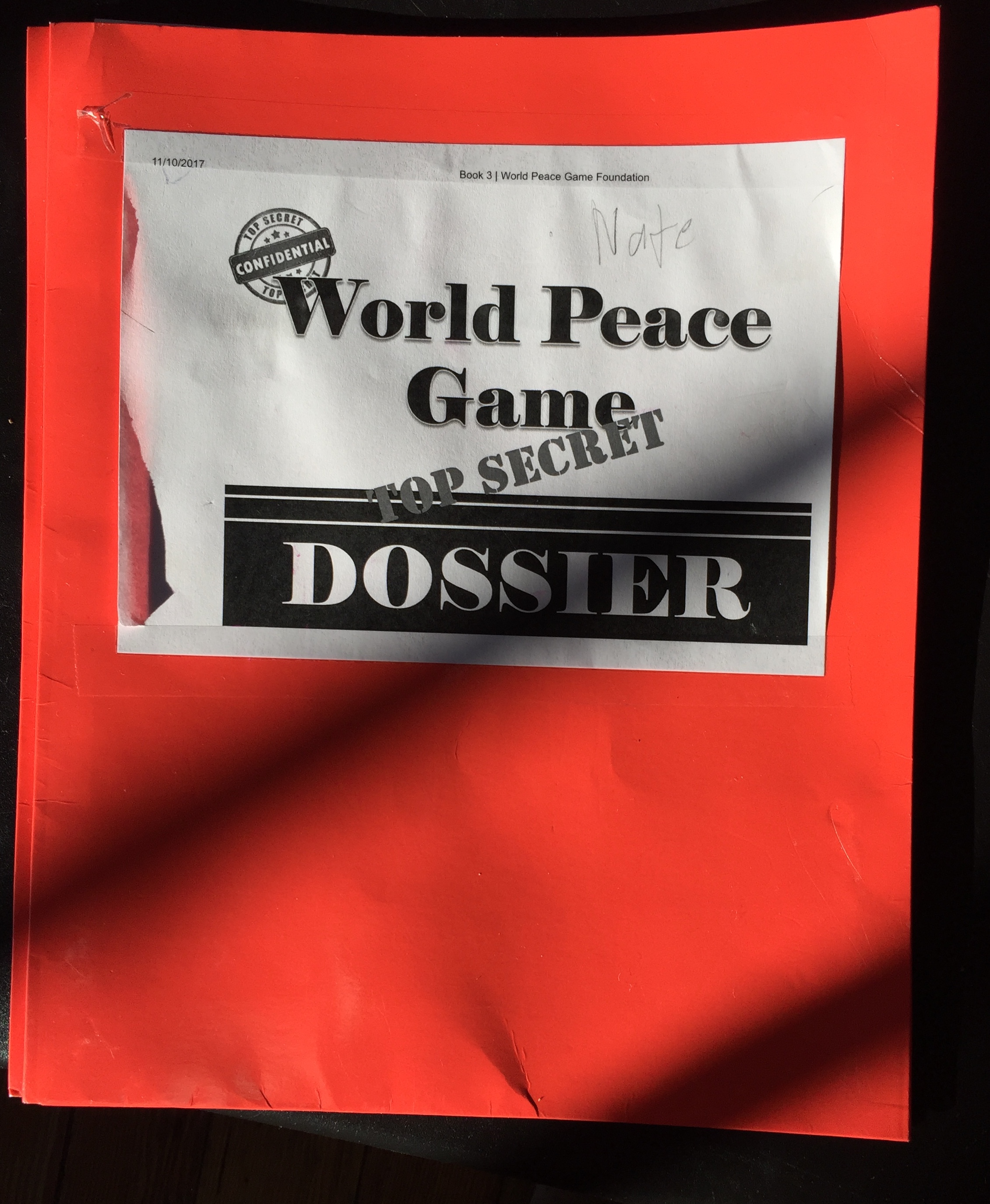
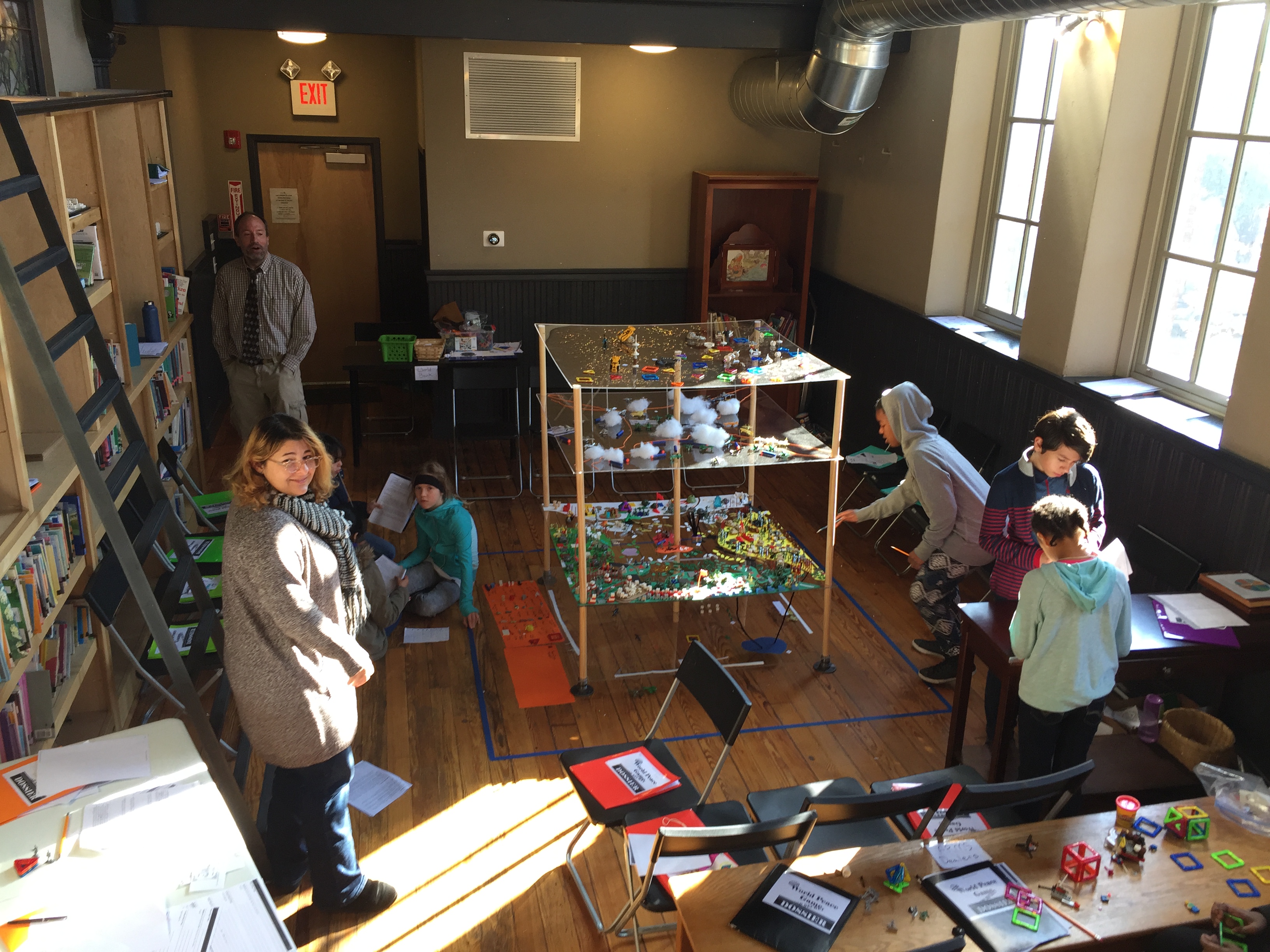
During the week of November 13th through 17th, upper elementary and middle school students at The New Century School participated in a very special nationwide event: the World Peace Game (WPG). Said Head of School Alicia Danyali, “We chose the World Peace Game to be a part of the the curriculum since it is in line with TNCS’s focus on global citizenship, which includes problem solving. Both of these areas also make up part of the TNCS student learner profile.”
Teaching Children the Work of Peace
Started in 1978 by Virginia native John Hunter, this special game, according to the website, “is a hands-on political simulation that gives players the opportunity to explore the connectedness of the global community through the lens of the economic, social, and environmental crises and the imminent threat of war. The goal of the game is to extricate each country from dangerous circumstances and achieve global prosperity with the least amount of military intervention. As ‘nation teams,’ students will gain greater understanding of the critical impact of information and how it is used.”
At TNCS, the game was facilitated by science teacher Jon Wallace, who attended training for this role over the summer in Charlottesville, VA. “The World Peace Game was not all fun and games,” he said—and, indeed, “teaching children the work of peace” is ultimately about “learning to live and work comfortably in the unknown.”
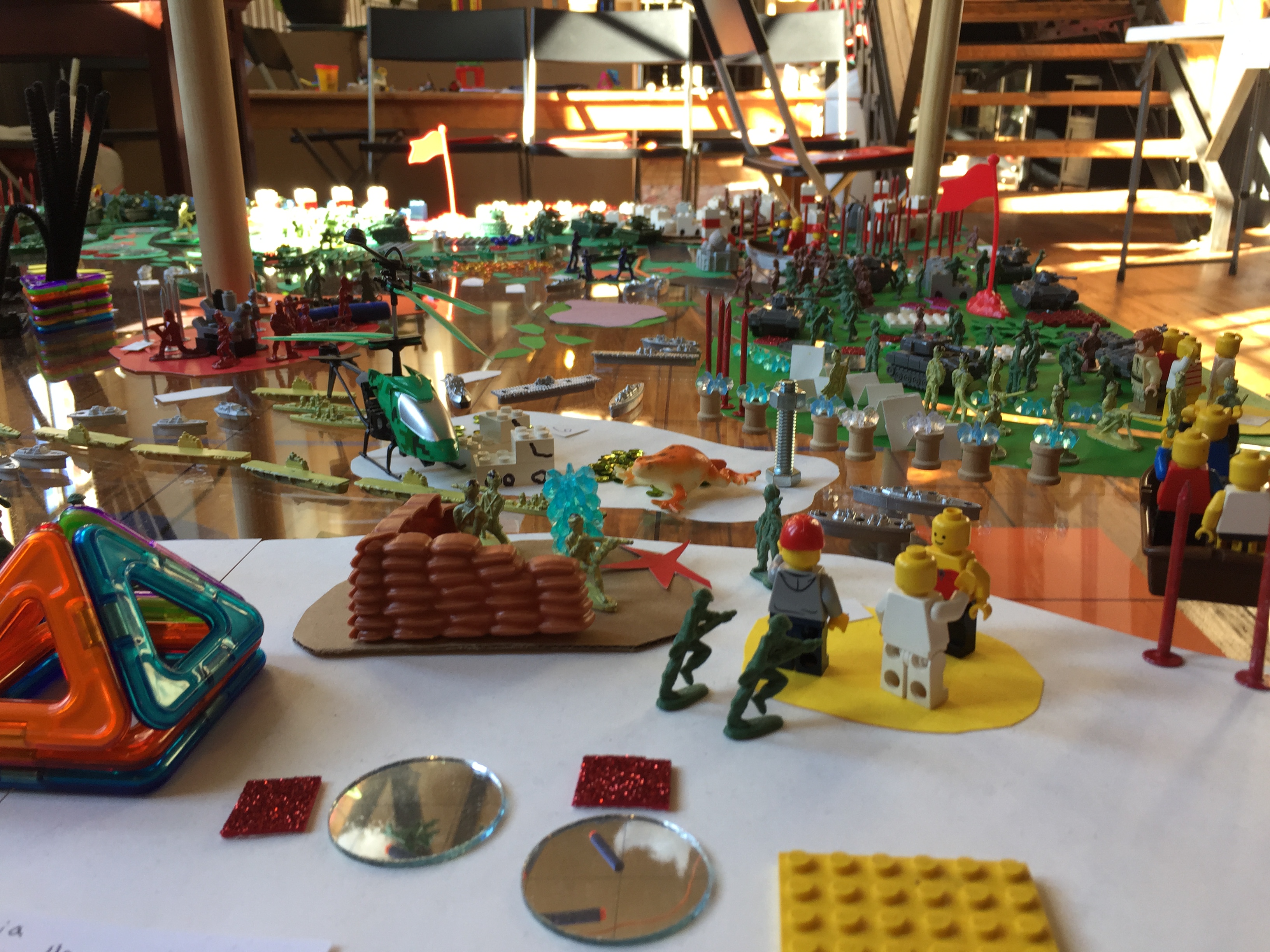
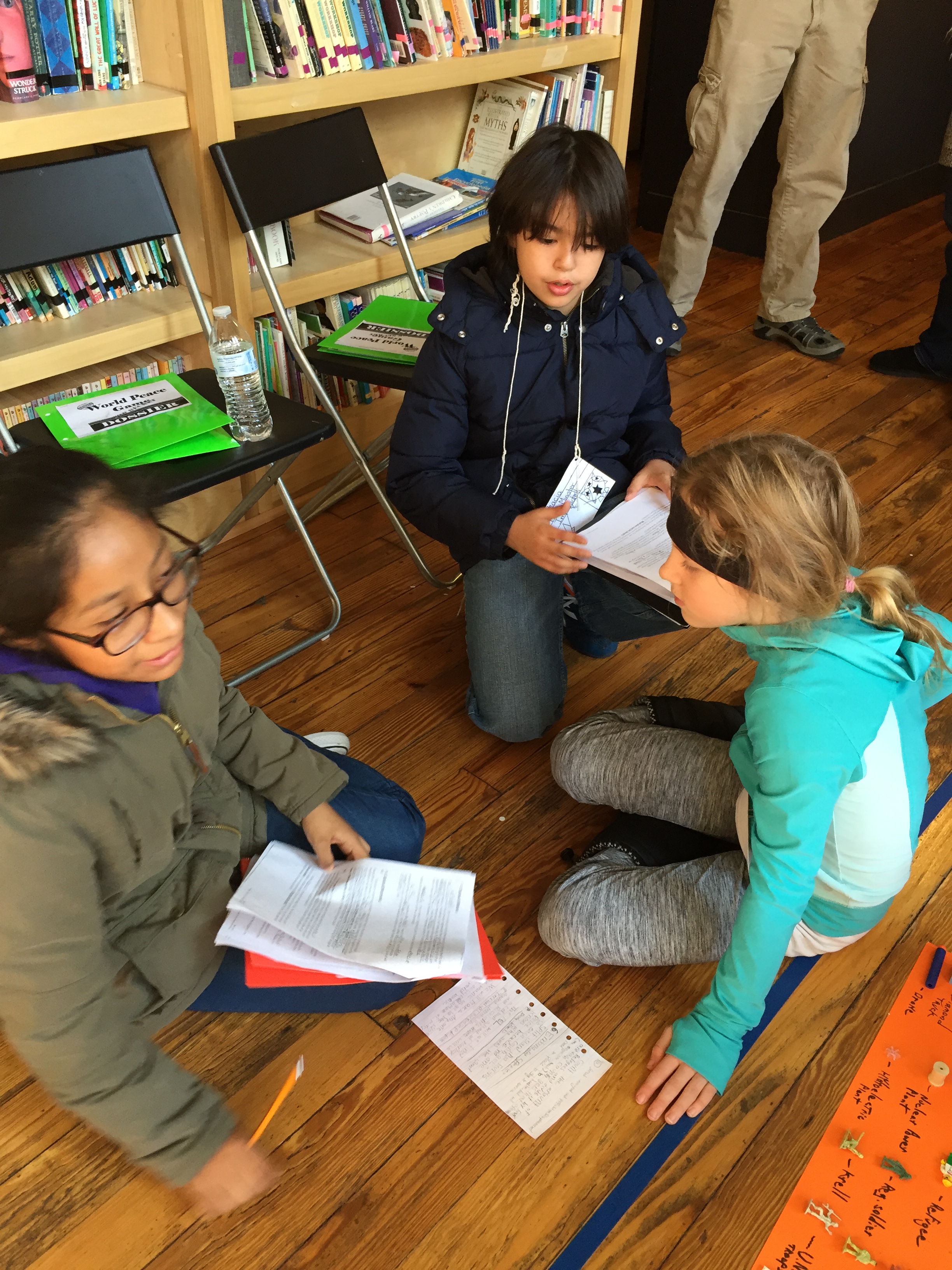
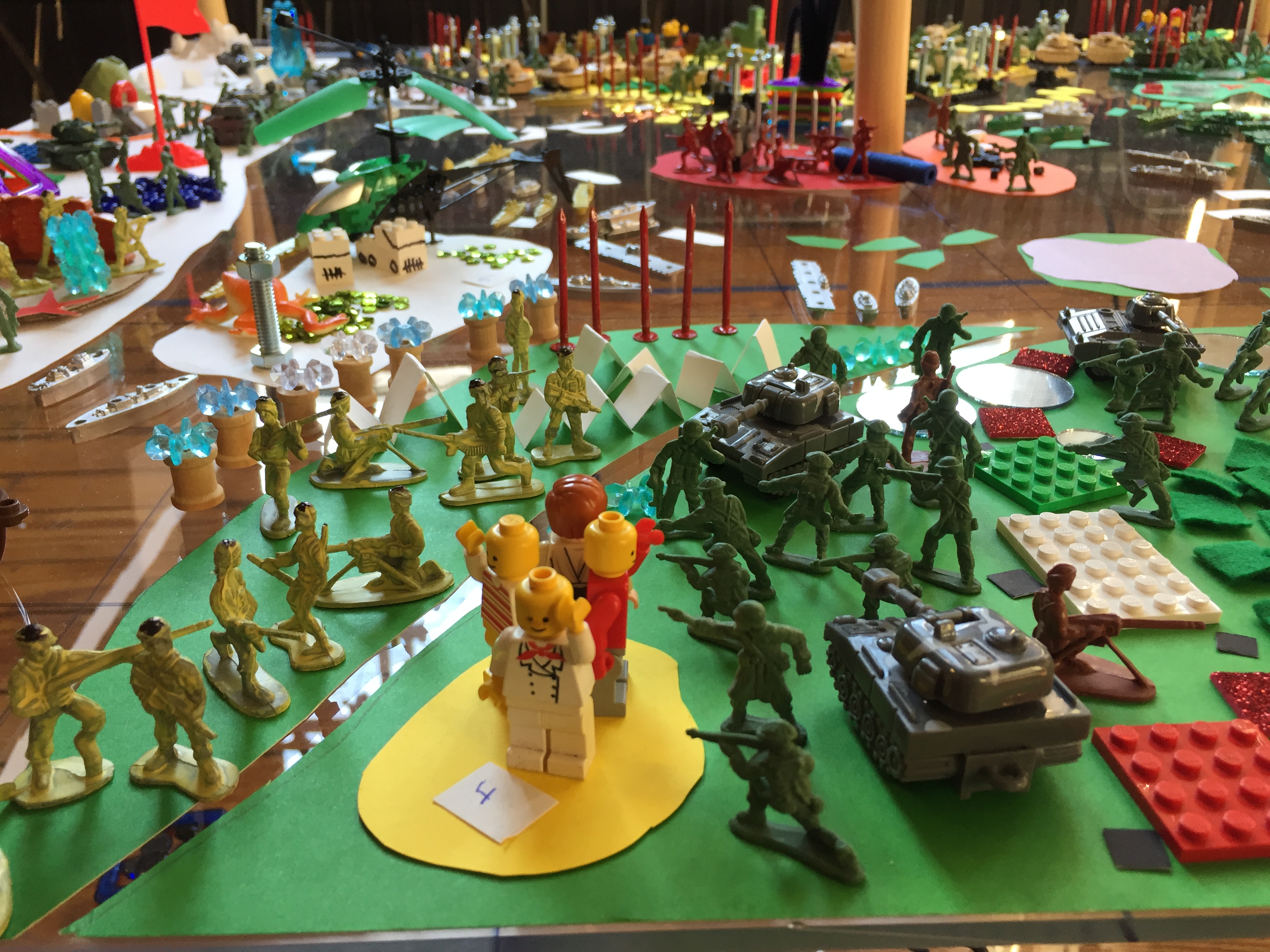
So, from 10:00 am through 2:30 pm for 5 days, TNCS 4th- through 7th-graders stepped up to the challenge of finding themselves in unfamiliar, chaotic, and sometimes dangerous real-world situations, assuming various political roles among four fictional countries, such as prime ministers, secretaries of state, ministers of defense, CFOs, and secretaries of trade and commerce, among others. WPG places enormous problems before students that must be solved within a strict time constraint and requiring collaboration and creativity. The first 2 days demanded a lot of patience and attention from students because they had to learn how to play—the facilitator presented descriptions about how the leadership of each nation was structured, geographic and economic details about each country, and the specifics of each of the 50 crises the teams would face. They also had to familiarize themselves with one very complicated game board. The following 3 days involved negotiations between the nations teams in order to solve each crisis.
(As randomly assembled as the board may appear, each component and game piece is stipulated by the rules of the game. To gather them all, they must be purchased from a parts list. For the assembly itself, we have TNCS Facilities Manager Christine Rice to thank. Ms. Rice, a former contractor, is evidently quite the handywoman!)


Learning how to work with each other is a stated goal of WPG. Mr Wallace explains: “Part of the game is, simply put, being thrown into chaos, into positions you’ve never performed, and having to negotiate in order to win. If countries don’t communicate, the game is over. Interestingly, you don’t really state the purpose of the game to the students; you kind of let them have their way about it. They don’t really know how you win. So, after the game was over, a couple of students wondered who won. It was interesting to see how different students were looking at it.”
It turns out, in order to win the game, all participating nation teams need to be at least $1 above their initial budget, and all crises must be resolved. Mr Wallace reports that the hardest part for his students to get a handle on was accounting and keeping good track of budget records. “When you’re dealing with 4th graders, you can’t expect perfectly accurate accounting. They’re trying to account for losses and gains, but it’s extremely difficult. But, as facilitator, I can decide if they have managed well enough. For me it was a matter of, “is the CFO trying?’,” he said.


As for the participants themselves, WPG players are supposed to be volunteers, but in TNCS’s game, they were more or less “conscripted.” This meant that some were more enthusiastic than others. “I know some kids felt, ‘I don’t like this mentality,’ and other kids were really into it, which to me is reflective of what goes on in the classroom in terms of willingness to get something done. Some have that ‘middle school malaise,’ whereas others are more like, “I want to learn just for fun; count me in’,” he explained.
The mandatory participation also meant that students who don’t necessarily get along well had to nevertheless play together:
We had a number of students who hadn’t volunteered, so that adds a little extra difficulty because they really had no desire to be there, which made it difficult for some of the leaders to motivate them. Even though I picked the Prime Ministers, and the PMs picked their cabinets and did the best they could, assuming that it would be a smooth situation, it doesn’t always work out that way. On one team, everything was really flowing and working, but if every team were like that, the game wouldn’t really do much because they’re already communicating so well. The purpose of the game is to put kids in an uncomfortable position so chaos does happen, and somehow they have to figure out how to cut through that and communicate well enough to get something done. The threat of loss has to be part of the game.
Playing the Game
Mr. Wallace provided the following synopsis of the TNCS players and what happened during their game.
The Weather Goddess’s job is of great importance in the game: She determines the severity of storms and what impact that might have on each nation. She must make quick, on-the-spot decisions that have serious consequences for the four nations involved. Student KH did a tremendous job and had to make necessary decisions that inevitably caused hardship for some players. One of her many roles is to enforce participant conduct laws that, if not followed, may result in a country incurring heavy financial penalties. For example, speaking out during a nation’s declaration period may result in a $10 million fine. Our weather goddess reached a point when she was almost unable to enforce the laws due to negative feedback by those fined. Yet, KH recovered, understanding that her role was simply that, a role. She saw that it was a role necessary for the game to be played, just as laws in our society must exist to preserve order and provide a stable platform for peace.
Each country had a different initial budget. Peacia, an ice-locked poor nation, had many early challenges to face in order to keep their budget in check. They were able to solve a crisis involving a volcanic eruption that threatened a nearby nuclear power plant. Prime Minister AI found that the struggle to maintain lines of communication doesn’t just exist between countries, but also within countries. The greatest obstacles to peace may lie within a country rather than between countries.
Richy Hill, an oil rich nation, had serious issues right off the bat as they were short a CFO. This greatly impacted their ability to manage money. It didn’t take long for their entire fleet of aircraft to be permanently grounded due to lack of refueling. Prime Minister DI had a lot on his plate. Fortunately, Chief Legal Counsel IM stepped into the CFO position, literally saving the nation from looming financial crisis. Prime Minister DI was able to stop a massive money hemorrhage caused by the nuclear proliferation by his own country. He saw the need for nukes was secondary to the need for cash.
Richland, the wealthiest of nations, had many crises including a mountainous region that not only contained gold, but also the remains of NIN, a tribe of peoples that had existed in the area for thousands of years prior to the formation of the nations. What was more important, the gold or the ancestral remains of the NIN? It isn’t easy to give up gold, but Prime Minister FC didn’t blink and allowed the NIN to keep their ancestral burial ground intact. Nice work! Her cabinet worked outstandingly well together. We witnessed a nation that was functioning well in Richland.
Folium, an eco-oriented nation, accomplished much. It seemed that they were all too willing to accept refugees but had to solve the problems that refugees bring. Folium was willing and able to work with other leaders to spread the refugees all over world in order to reduce the financial woes that come with being a bit too nice. Relations between Richland and Folium were in jeopardy due to a secret island owned by Richland that also had been used by the NIN for worshiping purposes for thousands of years. Tensions boil over with the threat of violence between the tanks and soldiers of Richland and Folium. Both countries came together and negotiated swiftly, bringing peace to the area by simply dividing the island. These two countries made it look easy.
 An unusual occurrence happened in this game when members of Folium broke off to form a separate independent nation called Coralfield. Coralfield’s apparent mission was to facilitate the negotiation process between nations by providing a greater area for peace to occur. Fascinating idea! Co-Prime Ministers PH and NB took on development and leadership of this new nation.


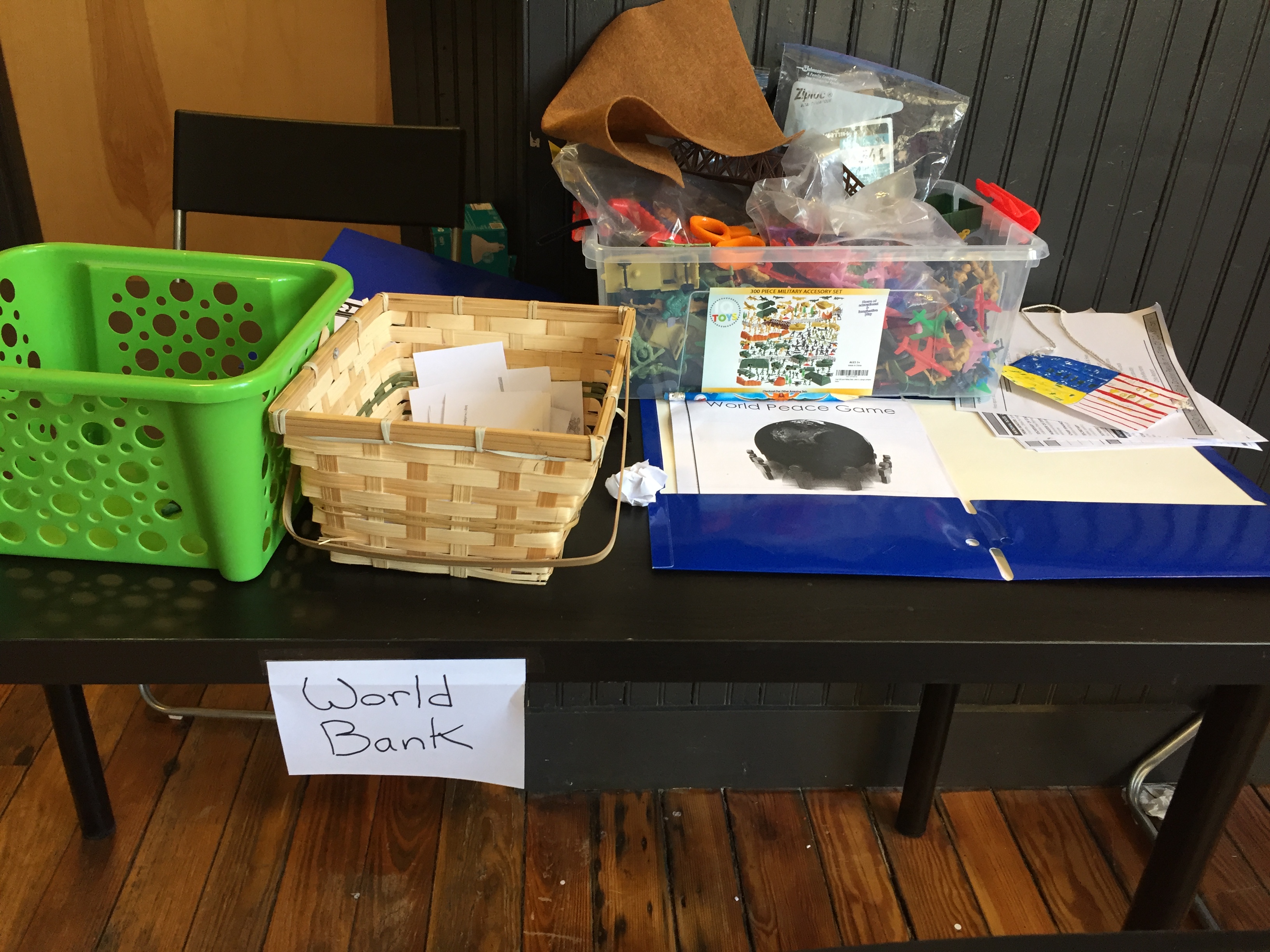
The role of the World Bank in the game is to receive checks and keep an accounting of the payments of all nations. President DL did an excellent job keeping track of payments. At times it seemed as though President DL’s pen was smoking hot due to all the receipts he was writing. Nice work!
 The Role of the UN in this game is to maintain peace worldwide. Secretary General ED did a wonderful job living up this role as world peacekeeper. He was in constant motion and took on the responsibility of tracking crises completed and yet to be completed. The UN also helped nations with providing extra funds.
The Arms Dealers are tasked with providing small arms to nations but may also design and invent new creations that are not necessarily providing fuel for war. President WM designed an oil gusher cap that cost a bunch of the UN’s money.
 Last but not least, the Legal Counsel was tasked with ratifying treaties from the UN. Chief Legal Counsel IM did an outstanding job not only with checking treaties but also with helping out whereever help was needed. She worked as CFO for Richy Hill and generally really stepped up. Nice work!
World Peace Is in Their Hands
You can exhale—we are safe for the moment. Mr. Wallace said, “There were plenty of tense moments and times when students just wanted to quit. The majority who stood strong and would not accept failure are responsible for the win. They are the leaders of our future, the ones who have a chance at making the world a better place. It is not going to be easy. The obstacles will seem insurmountable at times, but we have seen that peace can be achieved.”
You’ll also be very relieved to learn that John Hunter has never lost in the nearly 40 years he has been playing. (Talk about hope for the future!)
In response to what he ultimately though of this experience, Mr. Wallace said, “I think it tends to magnify the social scene in a good way. A lot of things that weren’t obvious became obvious, in terms of interactions. That can make things difficult, and, for some, it made things very difficult. There are a lot of emotions that come out when you’re Prime Minister and you’re trying to get your cabinet together but they don’t want to be together. It’s a hard role for some students who have never been put in those roles before, having to lead others and so forth.”
Although having willing volunteers would makes things easier for both participants and for the facilitator, the EPG became a real lesson in how to make something work when the situation is not straightforward or ideal. “That’s the real world, you know?” said Mr. Wallace. “That’s the cool thing. As far as a learning experience, it made it better for the leaders because that is the way the world works. It was real in that sense,” he said.
As far as how he thinks the game went overall, he feels it went just as it should. “There were times when students were really discouraged, which is normal, but they had to work together to get through it, and they eventually did.”
Now that he is trained, a process that involved watching John Hunter himself play the game, taking notes, then discussing what happened with other trainees,” Mr. Wallace thinks WPG could potentially happen annually at TNCS. “The philosophy of the game is that it can be run every year, but it runs better if students have no idea, going in cold.,” he explained. “Otherwise it may be too easy, especially for folks who volunteered to be involved. It’s not that difficult if you already know how to get it to happen. But the way I look at it, the game can go many different ways, and the facilitator can throw a lot of sticks in the wheel if he or she chooses to.”
For this initial game, our friendly facilitator did not intervene to complicate the already complex events students were embroiled in. However, Saboteur LR did a good job of gumming up the works from time to time: “His job is to just make things hard. And he is an anonymous person in the room, so the players don’t know who it is. They can have a trial to see if they have an accusations or suspicions about his identity,” said Mr. Wallace. “There are so many variables—like 350 pages of different possibilities.”
In some ways WPG shaped students or brought out nascent qualities that Mr. Wallace was very pleased to see. “I thought it was fascinating to see some really step up and try to help out in ways we don’t always see in the classroom.” Others who are usually motivated to try anything were not so surprising, if no less vital. “If we didn’t have these leaders,” said Mr. Wallace, “the game would have sunk, and there’s nothing I could do about it.”
It sounds like we’ll be in good hands once these youngsters grow up to take the helm! In the meantime, watch John Hunter’s TED Talk to learn more about this truly wondrous enterprise.