Excitement and Creativity Build at TNCS Lego Camp!

Play Well!

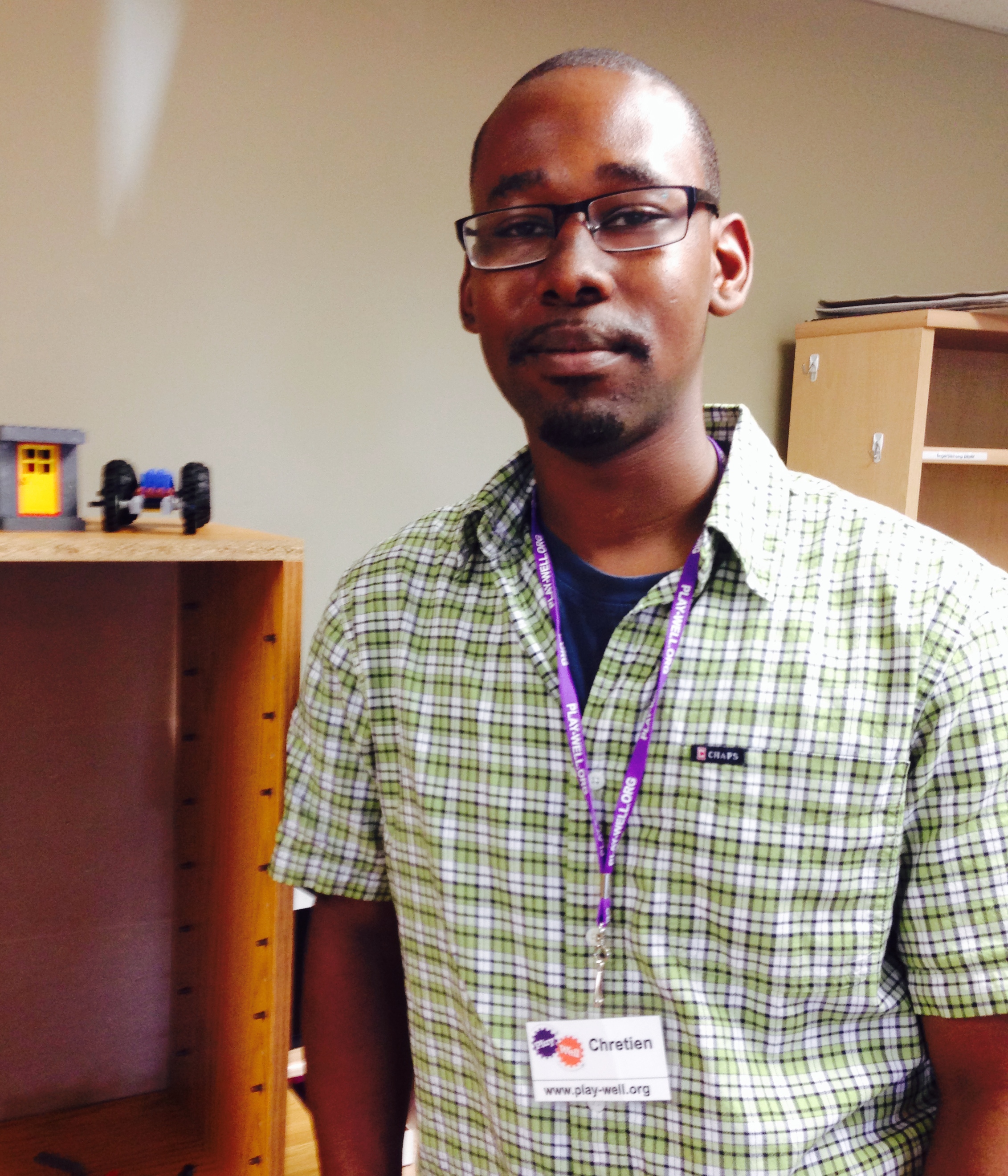
Chretien Mayes, aerospace engineer and Play-Well TEKnologies instructor.

Chretien Mayes, aerospace engineer and Play-Well TEKnologies instructor.

“We teach kids engineering using Legos,” said The New Century School‘s Lego summer camp leader Chretien Mayes simply and succinctly. Mr. Mayes, an aerospace engineer, and co-camp leader Chris Miller, an industrial engineer, are on loan to TNCS from Play-Well TEKnologies, the company that designed these “LEGO-inspired engineering classes for kids K–8.” Play-Well is made up of instructors who are by and large either engineers or scientists of various stripes. “The beauty is,” says Mr. Mayes, “each instructor brings his or her own particular flair and expertise to each camp.”

Now in 23 states, Play-Well has built quite a following from their establishment in California in 1997. TNCS, however, has the proud distinction of being the first Baltimore school to host a Play-Well Lego camp, and Mr. Mayes says that’s not surprising because of the particular TNCS resources, the staff, and the students. “The New Century School has a philosophy and a culture of being hands-on with kids in small classes. That’s us, too—we can provide individual, personalized time with each kid. Basically, we can foster whatever each child is into. Some kids like to build buildings; some prefer to make things go.”

Everything Is Awesome!

Mr. Miller hands out Lego people to each child who can correctly answer a question about engineering, such as "What is Lego glue"? (Answer: Overlapping.)

Mr. Miller hands out Lego people to each child who can correctly answer a question about engineering, such as “What is Lego glue”? (Answer: Overlapping.)

Instructors are there to teach basic principles of engineering and physics and then to turn the kids loose to follow whatever interlocking whims they choose. The instructors weave in and out among groups of builders, answering the questions that spring up all over like geysers. A frustrated, “Why isn’t this working?”  is met with a patient but no less technical answer, and the child is encouraged to try again, applying the new information to her whirligig—but not before proudly demonstrating her “wiggly tooth.”

Transmissions are a fundamental “building block” in engineering and get a lot of play at Lego camp. They start with a simple pull-back transmission (think of the toy cars that you pull back, hold, and then let fly) and progress from there to gear transmissions and all of the different things that can be done with those. Three or more gears touching makes a “gear train,” which can ultimately produce anything from cars to spinning tops to gondolas.”Overlapping” is another principle and also what the camp instructors teach the kids is like “glue for Legos”—stability and strength are derived from the shared surface area of overlapping bricks. With that concept entrenched, they can design houses, construct bridges, etc. An important point is that no fancy or specific kits are required here, and this is largely so that kids can replicate what they have learned at home. A common complaint about Legos in general among parents is that once their kids put a kit together, they no longer seem to know what to do with the individual pieces or are unwilling to “think outside the box.” “Our thing is,” said Mr. Mayes, “is that we focus on the basics, and then kids can go anywhere from there.” Starting with a simple gear, for example, kids might end up with anything from a monster truck to a ski lift. “Once we get to the level of gear train, you can do this, you can do that—you can do anything you want with it,” Mr. Mayes says he tells kids.

Everything Is Cool When You’re Part of a Team!

Thus, Lego camp boosts kids’ confidence, their creativity, and, importantly, their ability to collaborate. We always aim for individual or group projects that we can mesh together at the end,” says Mr. Mayes. The collaborative project for this camp was a vast, interconnected arch bridge. “Every kid made one and then we put them side by side, covered them with bricks to link them together, and put a road on top. It was probably 5- or 6-feet long by the time we were done,” said Mr. Mayes. “And then the kids sent all of their cars across.” Imagine the sense of accomplishment—not to mention sheer fun—that must have engendered! “And hopefully, the idea is, that we’ll create some future engineers!” said Mr. Mayes.

How well does Play-Well play at TNCS? “I’ve been to other schools that I can tell don’t invest in technology or that ‘outside-the-box’ education,” said Mr. Mayes. “At The New Century School, the kids get all that. In addition, the staff and program directors are so on top of it, here. It’s a really great school.”

Finally, the burning question: What did a Play-Well TEKnologies aerospace engineer think of the Lego movie? “Awesome. If I could miniaturize myself, I wouldn’t mind playing a character in it!” said Mr. Mayes. Pretty convincingly, as a matter of fact!

International Camp at TNCS

For 2 weeks this summer, The New Century School will be hosting five visitors from China to participate in International Camp. From August 5th through 17th, three elementary-age girls and two of their mothers joined TNCS elementary students for an opportunity to be immersed in English. As TNCS moves more fully into its own foreign language immersion style, this pilot camp presents a unique way to reciprocate—to immerse foreign students in English. Let’s meet them!

Mr. Lapreziosa and our Chinese and American friends say cheese!

Mr. Lapreziosa and our Chinese and American friends say cheese!

Alice (Cui Jianing*), Grace (Kuang Juoqui*), and Michelle (Ma Rai*), each age 9 years, came all the way from Guangzhou, China’s second largest city and located in the southeast. During their stay, they will participate in camp activities such as cooking and gardening, they will visit key Baltimore sites such as the aquarium and the Walter’s Art Museum, and they will take daytrips to Philadelphia and Washington, D.C. Michelle, mom Kelly, and Grace are staying at the home of TNCS Executive Director Roberta Faux and her family. Alice and mom Jane are being hosted by another hospitable TNCS family.

As is China’s custom, the girls presented a gift to their American campmates upon arrival. The girls had lots of fun together wearing their beautiful handpainted masks.

Having lots of fun together is more or less the itinerary every day, in fact. They love playing with each other’s toys and games, for example, making the most of that particular cultural exchange. Here are some excerpts from a visit to the classroom:

TNCS: What is the one thing you want to do most while you are here?

Alice: (Thoughtful pause.) Maybe shopping.

TNCS: What would you like to do during your visit to Washington, D.C.?

Grace: Play on the playground!

Michelle: Go shopping for long, pink dresses!

TNCS: What has been your favorite part of being here so far?

Alice: Playing with Michelle and Grace.

Grace: Playing with Kathryn’s toys . . . her weaving set.

Michelle: Playing with kitty Ebony (Kathryn’s cat).

TNCS: What is your favorite thing to eat here in the United States?

Michelle: Blueberries and spaghetti! (Not together.)

TNCS: What flavor of ice cream do you hope to get later at Pitango (the afternoon’s scheduled activity)?

Alice: Chocolate!

Grace: Cookie dough!

Michelle: Chocolate, strawberry, and vanilla!

As you can see, the girls are simply delightful! When asked why they decided to come to International Camp at TNCS, their mothers said, “We want the kids to experience a different culture and to improve their English.” The girls had studied English for 3 years prior to coming here, but there’s nothing like immersion to encourage fluency. The TNCS natives agree. “Our job is to help them learn English and not speak bad grammar,” explained the TNCS gals when asked whether they were taking the chance to practice their Mandarin with their new friends. Moms Kelly and Jane report that by Day 2, they could hear a big difference in their girls’ English, so the no-Mandarin-allowed policy strictly enforced by the TNCS cohort seems to be working!

The camp is being taught by a newcomer to TNCS, and we’re very fortunate to have him and his special expertise. Craig Lapreziosa is a former engineer turned English as Foreign Language instructor, who says, “If you have to communicate in a foreign language, you will.” Of the experience so far, he says that the biggest challenge has been keeping the Chinese and American students integrated during learning activities. They tend to cluster off because it’s more comfortable for them. Socially, it’s a different story, however. “I was worried about how to break the ice among them, but they did it on their own—there’s no shyness among them at all,” laughs Mr. Lapreziosa and points to where the girls were supposed to be having their morning snack. Instead, they were all dancing and singing along to the Beatles playing over the computer, not a drop of inhibition to be seen from anybody! Six 7- to 9-year-old girls will certainly tend to be an exuberant group. “I have new respect for elementary teachers,” jokes Mr. Lapreziosa.

With their daughters having such a nice time, Kelly and Jane have decided to extend their trip a week longer to visit New York City, Boston, Niagara Falls, and (of course!) Disneyworld after leaving Baltimore to take full advantage of being in the United States. Neither Kelly nor Jane has been here before, though Kelly got her M.B.A. in Canada. She now teaches business at Guangdong AIB Polytechnical College, and Jane is a data processing engineer. They describe how different education is at TNCS in contrast to home, where instruction is always lecture style. “Here, they can actually experience things to learn,” says Kelly. She describes Mr. Lapreziosa as being very patient and helpful with the girls. The ladies have some good camp ideas of their own brewing, too. We just may see them back again next year, which would be a real honor. They are most welcome!

Fortunately, our visitors didn't actually have to walk here ;).

Fortunately, our visitors didn’t actually have to walk here ;).

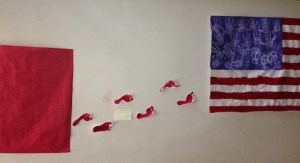
"Walking around the world from China to the United States": This related art project was done during Mandarin Immersion Camp, held earlier this summer.

“Walking around the world from China to the United States”: This related art project was done during Mandarin Immersion Camp, held earlier this summer.

*English spellings helpfully provided by Charlotte Chen—our former and well-loved Chen Laoshi! Thanks Charlotte!

Summertime Theatrics: Drama Camp at TNCS

The lovely and talented drama camp instructor, Alex Hewett.

The lovely and talented drama camp instructor, Alex Hewett.

“All the world’s a stage . . .” observed Jacques in Shakespeare’s As You Like It, and The New Century School students are proving it so this summer in drama camp! First- and second-graders from several different city schools joined TNCS elementary kids to learn the art of theater July 8th through 12th from the lovely and talented Alex Hewett. Ms. Hewett also instructed pre-primary campers during the prior week. Though currently a Greater Baltimore resident, she grew up in New Jersey and started going to see Broadway plays at a very young age. She says she always knew she “wanted to be on the other side” and began her acting career at the tender age of 5. She now acts in plays, television shows, and commercials; writes; narrates digital books for the Maryland State Library for the Blind and Physically Handicapped; is a licensed psychotherapist; does yoga daily; and is a mother of two boys. With such a busy schedule, sounds like TNCS was lucky to get her!

“Theater is fun,” she says, “I want the kids to have fun while teaching them how to be relaxed yet confident on stage.” Acting both requires and builds confidence, a skill that the kids will use in all areas of their lives. Safety, respect, and collaboration are also important, adds Ms. Hewett. So, drama camp students got to learn the fundamentals of acting and theater, starting with the many varieties of performances, including staged readings, improvisation, and more traditional plays.

After some free time on the playground, a typical morning’s exercises began with a staged reading of Shel Silverstein’s poem “Sick” (see below). Ms. Hewett sets the tone for the performance, explaining to her students that the character in the poem, Peggy Ann McKay, is exaggerating her imagined ailments to be able to stay home from school. “Everything seems bigger than it really is,” she says, “so Peggy can convince her parents. You have to be really convincing.” Creativity comes into play here as well; the kids are encouraged to find their own means of expression. One student read the poem on stage wrapped in a “blanket” for effect. “Think about what you’re saying and how you’re saying it,” coaxed Ms. Hewett.

“I cannot go to school today,”

Said little Peggy Ann McKay.

“I have the measles and the mumps,

A gash, a rash and purple bumps.

My mouth is wet, my throat is dry,

I’m going blind in my right eye.

My tonsils are as big as rocks,

I’ve counted sixteen chicken pox

And there’s one more–that’s seventeen,

And don’t you think my face looks green?

My leg is cut–my eyes are blue–

It might be instamatic flu.

I cough and sneeze and gasp and choke,

I’m sure that my left leg is broke–

My hip hurts when I move my chin,

My belly button’s caving in,

My back is wrenched, my ankle’s sprained,

My ‘pendix pains each time it rains.

My nose is cold, my toes are numb.

I have a sliver in my thumb.

My neck is stiff, my voice is weak,

I hardly whisper when I speak.

My tongue is filling up my mouth,

I think my hair is falling out.

My elbow’s bent, my spine ain’t straight,

My temperature is one-o-eight.

My brain is shrunk, I cannot hear,

There is a hole inside my ear.

I have a hangnail, and my heart is–what?

What’s that? What’s that you say?

You say today is. . .Saturday?

G’bye, I’m going out to play!”

After the reading, Ms. Hewett provided a few pointers. “What does the director do after a performance?” she asked her class. “Gives notes!” they chorus in unison (this is a well-trained troupe). Next, drawing on that confidence and creativity that Ms. Hewett believes theater inspires and develops, another student performed an improvisational version of the poem and did a fantastic job of coming up with his funny ailments—such as mud in his eye—on the spot.

These exercises were warm-ups for the biggie—the students next acted out Dr. Seuss’s The Cat in the Hat. They will perform it for the younger students in other camps on the last day of drama camp, using the Imagination Playground equipment for props in addition to some costumes and props of their own devising. By Thursday, they already knew their lines quite well, but Ms. Hewett as narrator is ready with prompts as needed. “What’s the narrator?” she asks her players. “Someone who tells the story,” they dutifully answer back. In this way, Ms. Hewett teaches them the vocabulary of the theater. By integrating these terms within their “playing,” she keeps camp fun yet informative.

She has them repeat and refine each scene a few times and says to them encouragingly, “it might seem boring to keep doing it over and over, but what are we doing?” “Rehearsing!” they proudly reply. They didn’t seem bored in the slightest—quite the contrary. They eagerly incorporated her suggestions for improvement and worked well together. Though work was undeniably being done, the atmosphere in class was fun.

In fact, another skill Ms. Hewett has is finding ways to use the kids’ high energy instead of suppressing it. High energy was one reason she chose The Cat in the Hat as their culminating performance. “There’s a lot going on in that story,” she says, “so I can channel the kids’ energy to convey it on the stage.” “It’s also a story that everybody knows, she continues, “and one that we could bring to life in a different way.” Getting 6- and going-on-8-years-olds to keep still in the background while another actor is center stage probably isn’t going to happen, so when the “Cat” was pirouetting around the stage waiting for her next line, Ms. Hewett praised her for staying in character (you may recall that the original book Cat was also prone to fidgeting, often with stacks of dishes balanced on his head, even). When another student hammed it up with a fake voice in her role as the Fish, Ms. Hewett’s gentle response was, “I like that you are using a different voice, just make sure each word is clear.” Still another student wandered off the stage altogether. “Where are you going? You have fallen into the orchestra pit,” Ms. Hewett teases.

Thus, with patience and good humor, she keeps them on task, and the play starts to look pretty good. The kids remember to face out because the audience won’t enjoy watching the backs of their heads, they remember to speak loudly and clearly, and they remember their stage directions—with a little help from some masking tape on the floor to show them their stage positions. They also learn how to exhibit their characters’ emotions quite convincingly. The Fish learns to convey fear by widening her eyes, for example, and Sally does disbelief with her mouth slightly agape. They even learned the concept of the “fourth wall,” that imaginary line between stage and audience.

After rehearsal, we chatted. When asked why they decided to take drama camp, they all said innocently that Mommy and Daddy had decided for them. “But I am a little bit of a drama queen,” said one girl, completely oblivious to her comedic charm. Next we talked about whether they wanted to be actors and actresses when they grow up. Only one student replied in the affirmative, but with the fundamentals of drama under their belts, these kids have a host of future career possibilities. “Saving tigers,” for instance, is one girl’s dream, so remembering to always face her audience will certainly come in handy in that particular job!

Camp Invention Returns to TNCS in June

Does the thought of summer-long video games give you a headache? Do you find the notion of watching the antics of mutant turtles—ninja or otherwise—a little creepy? Does the prospect of relinquishing your child to 9 weeks of these frequently vapid pursuits fill you with dread?

Parents, despair no longer: enroll your boys and girls entering grades 1 through 6 in Camp Invention this summer and give them the opportunity to explore, create, invent, and have loads of active, imaginative fun! Important: your child does not need to be enrolled at TNCS to join—this is a community-wide opportunity. Nationally acclaimed Camp Invention is a week-long summer day program, the brainchild of the National Inventors Hall of Fame in partnership with the United States Patent and Trademark Office. Presenting kids with real-world challenges that encourage them to solve problems and present their solutions through themed, scientific, engaging hands-on investigation, the program integrates four key components:

1. STEM enrichment: These four vital education areas—Science, Technology, Engineering, and Math—are explored via hands-on, creative problem-solving activities. Camp Invention inspires kids to be curious about their world and prepares them for a future of responsible, engaged participation within it.

2. Consistent and effective implementation: Programs are all-inclusive; Camp Invention provides curricula and step-by-step instructions for the TNCS instructors to follow as well as training and all program materials. This ensures that programs are carried out correctly and consistently, maximizing the benefits to participants.

3. Collaboration and other 21st-century skills: Working in teams, children are presented with real-world challenges that promote the direct application of critical thinking and communication skills demanded by colleges, careers, and citizenship in the 21st century.

4. Teacher and student development: Teachers gain direct, reproduceable experience in how to integrate STEM content in daily lessons and beyond. Kids benefit from the student-centered approach to learning; they are led by their own desire to solve the presented problem, to see it through.

Camp Invention Comes to TNCS!

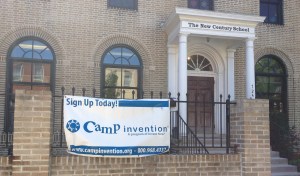
Camp Invention is returning to TNCS for Summer 2013! Enroll for June 17–21!

The honor of hosting this exciting exploration is reserved for only about 1,200 schools nationwide, and TNCS has earned the distinction of being the only location in the downtown Baltimore area to host the camp this summer. Says TNCS Summer Camp Director Lisa Warren, “We got first dibs—it’s a great honor for us to be hosting it here for the second year!”

TNCS’s Camp Invention session will be held during the week of June 17–21, and camp runs for a full day, from 9:00 a.m. to 3:30 p.m. This year’s program theme is CREATE, which features four modules the kids cycle through each day: Problem Solving on Planet ZAK, SavingSludge City, I Can Invent: Launchitude, and Geo-Games (click the CREATE link above to read more about what skills and learning each module focuses on). Each one promises some really wacky fun, including re-engineering household items to create the ultimate Rubber Duck–Chucking Device, for example. What kid isn’t going to love that? Best of all, they’re using scientific principles in actual applications. These lessons will stick. Or fly, as the case may be. Even kids who have previously participated in Camp Invention will benefit from brand new adventures throughout the week.

Space is still available! To register your child for Camp Invention at TNCS, click here!

Summer camp at TNCS

Enriching summertime activities make happy kids!

Other specialty summer camps open to the public are also available at TNCS, including Lego + Brain Games, Drama, Music, Mandarin Immersion, Painting, and Launch Pad Academic Bridge Camps, as well as camps for younger children. As we wrote in “Making Summer Count—Weekly Camps at TNCS,” using summertime to learn while having fun will enrich them academically throughout their school careers.

To register for any TNCS camp, click here.

Mandarin immersion camp

Don’t let the important skills your child has practiced all year atrophy over summer—keep them happy and engaged at TNCS summer camp!

Making Summer Count—Weekly Camps at TNCS

No more pencils, no more books, no more . . . development?

Empty classroom, empty heads

This forlorn image is a disturbing visual metaphor for the blankness that can descend on kids’ brains without enriching activities to occupy them during extended school breaks.

Pop culture would have us believe that summer is a time of sanctioned hedonism—a 9-week-long cannonball into a pool of unrestricted play, unbroken by stints of focused study. A vacation for the brain. Such is how many of us grew up, in fact.

But before we let our kids’ hair completely down this coming summer, we’d do well to consider that more and more researchers agree that throwing academics to the wind for such an extended period is hurting kids’ cognitive development as well as reversing their academic progress. In fact, in Lasting Consequences of the Summer Learning Gap, a 2007 report, researchers not only categorically demonstrated that this regression was occurring, but also found that it’s cumulative, so that the time squandered during the elementary years shows up as marked deficits in the high school years:

We find that the . . . achievement gap at 9th grade mainly traces to differential summer learning over the elementary years.

This was the major finding from the Johns Hopkins University’s Beginning School Study (BSS), which launched in 1982 and tracked testing data, learning patterns, high school placement, high school completion, college attendance, and other indicators among a representative sample of Baltimore school children from first grade through age 22 years.

A related report from the National Summer Learning Association finds that “A conservative estimate of lost instructional time is approximately 2 months or roughly 22% of the school year . . . It’s common for teachers to spend at least a month re-teaching material that students have forgotten over the summer. That month of re-teaching eliminates a month that could have been spent on teaching new information and skills.”

Keep your kids off the summer slide!

On the heels of these sister benchmark studies, both President Obama and best-selling author Malcolm Gladwell took up arms in the fight against “summer slide.” President Obama argues for education reform with a longer school year at the heart of this platform. Noting that U.S. students attend classes, on average, about a month less than children in most other advanced countries, he said in a 2010 interview, “That month makes a difference. It means students are losing a lot of what they learn during the school year during the summer . . . The idea of a longer school year, I think, makes sense!”

In Outliers: The Story of Success, Malcolm Gladwell urges us to rethink our notion of what makes someone successful, because according to him, it isn’t usually the individual gifts a person is endowed with but rather some special opportunity that befell him or her at an optimal point. Wouldn’t it be great if such opportunities were more broadly available, such as, say, summer camp? (In point of fact, the BSS found that “unequal access to summer learning [italics mine] opportunities during the elementary school years” is responsible for most of the achievement gap. Scary.) Tying this to academic performance, Gladwell writes, the “only problem with school, for kids who aren’t achieving, is that there isn’t enough of it.”

Inquiring minds

This inquisitive little girl is all set to explore some insect life!

If, as he believes, “It is not the brightest who succeed, nor is success simply the sum of the decisions and efforts we make on our own behalf. . .  Outliers are those who have been given opportunities—and who have had the strength and presence of mind to seize them,” then let’s seize back those June, July, and August weeks and help our kids make the most of them!

How to let them have fun while they learn: summer camp at TNCS

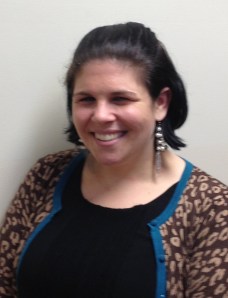
Lisa Warren, Language Curriculum Specialist

Lisa Warren, Language Curriculum Specialist

The New Century School Summer Camp Director Lisa Warren says, “Camp is still a ‘break’ from the school year, but it keeps bodies and minds engaged in a fun way.” (You might recognize Ms. Warren from “Language Curriculum Specialist Joins TNCS.” That’s right, she’s not only the TNCS Summer Camp Director, but also the Foreign Language Curriculum Specialist as well as the Lingo Leap Program Director. That’s one devoted educator!)

As camp director, Ms. Warren developed the themes each weekly camp will be based on, making sure to include a wide variety to appeal to many interests. “I’m especially excited about the construction theme,” she said. “That’s a unique one you don’t always see, but so many kids love it.” She also provides the educational resources and some activity ideas to the instructors who will be overseeing each camp. Most camp instructors are already part of TNCS staff, so they know the ropes.

Themes will vary among the preprimary, primary, and elementary camps, and instruction will also be differentiated within each of those three strata. No matter what level your child is working at, he or she will receive individualized and group learning support. And again, even though academic engagement is the camp’s foundation, fun is at the heart of each session. See the primary session schedule at right. Themes guaranteed to keep kids’ interested include everything from Cooking/Gardening and Mandarin Immersion to Under the Bigtop. Preprimary camp will be immersion-style, and parents can choose from either Spanish or Mandarin. All camps will feature an in-class language assistant, however, so kids at all levels will have the opportunity to practice the other languages they are learning.

Primary summer camp themes

An example of themes from TNCS’s primary summer camp itinerary. Gosh, can adults attend???

The elementary camp takes a slightly different tack, comprising “specialty sessions.” These are a bit more targeted as befits the older child. Kids here can start the summer with Camp Invention, of which TNCS is proud to be the exclusive downtown provider. In Camp Invention, the brainchild of a nonprofit organization, kids are challenged with a project that they must execute collaboratively. The project goal always centers around solving a particular, real-world problem. (Camp Invention will be profiled at length in these pages in the weeks to come. Stay tuned!) Toward the close of summer, kids ages 5–11 will move into “Launch Pad Academic Bridge” camp, which is just what it sounds like: “a means to recapture and reactivate knowledge learned during the previous school year to prepare for the coming year,” in the words of Ms. Warren.

Other important camp highlights—read on!

Chef Emma Novashinski will offer a Brown Bag lunch as the summertime extension of the Kitchen Garden Tuck Shop program, available for weekly sign-up. As always, her lunch will be healthy, locally sourced, and hand-prepared. Even this will have a fun summer twist; lunches come in paper bags for easy transport to an outdoor picnic spot!

Regular camp hours run from 8:30 a.m. to 3:30 p.m. (or to 12:30 p.m. for half days). Before-  and aftercare will also be available, starting as early as 7:30 a.m. and running through 6:00 p.m.

Just as in previous years, the camp week culminates with Fridays, better known to camp attendants as Water Playday. Sounds fun, right? Kids can run and jump through the spray from a sprinkler, and a water table will also be on hand to foster those skills that any budding civil engineers, marine biologists, and geophysicists might require. (And, of course, synchronized swimmers.)

Finally, if you have any questions, please visit the website or contact Lisa Warren at lwarren.newcentury@gmail.com.

Find additional reading, including more tips for academically enriching summer activities here: