TNCS Science Fair 2016: It All Starts with a Good Question!

tncs-science-fair-2016

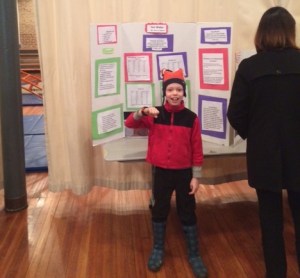
Fist bump for science!

The annual Science Fair is always a highly anticipated event at The New Century School, and 2016 was no different! Last week, parents and students came out in droves to see what science experiments TNCS 2nd- through 5th-graders undertook and what they learned from their experimentation.

Headed up for the second year by STEM teacher Dan McGonigal, this year’s Science Fair had a slightly different focus than last year’s (read about Science Fair 2015 here). Explains Mr. McGonigal:

This year we focused on the Scientific Method as opposed to the Engineering Design Process like last year. The students selected their own testable question related to Physical Science. We focused on creating tests that used manipulated variables versus creating a demonstration of a science concept. For example, instead of showing what happens when you combine baking soda and vinegar, a predictable reaction, I encouraged students to compare the amount of gas released by baking soda and vinegar to Alka-Seltzer and water. Or, instead of building a potato clock, students were asked to compare the volts of different produce to see which would produce the greatest amount of voltage. This helps improve instruction to more closely match how scientists actually work.
Mr. McGonigal also shared a “prezi” to give parents and other Science Fair attendees a closer look into how he framed this year’s endeavors. An important point is that students were encouraged to follow their own interests rather than replicate standard Science Fair experiments. The thrust was to start with a question then follow what various avenues that question presented, always maintaining a logical next-step approach.
“We worked hard on our projects,” said Mr. McGonigal, “and the projects were 100% representative of the students’ own work. I did not correct, edit, or change the student’s work in any way, but they were guided to stay focused on their scientific thinking and reminded of certain measures to help create accurate, neat work, that would be valid. The instructional focus was on the thinking, not necessarily the content related to their projects.”

As always, Mr. McGonigal’s enthusiasm for science adds a special touch. “The results and feedback were very positive about the student’s work. We had a lot parents show up to support their student’s science education!”he said. One such parent (and TNCS Co-Founder), Jennifer Lawner, said, “Mr. McGonigal give a wonderful presentation to parents about the goals of the science fair.  In particular he talked about how he did not do their work for them. For example, the write-ups are imperfect—he reminded them of the rules of punctuation and left them to write the work themselves. The students came up with testable questions, procedures for testing the questions, and reported on their data. There were flaws, but the date it was reported accurately. I was really impressed!”

TNCS lower elementary students also got a chance to see the projects and were given first-hand explanations by the older students. (Stay tuned for an upcoming post on the K/1st Science Fair!)

This slideshow requires JavaScript.

And the exploration will not end with the folding up of the three-paneled cardboard displays. As a result of their self-led science journeys, students will continue asking themselves, “What did I learn? What do I still wonder about?” for months to come.

Meet the Teacher: Elementary STEM Instructor Dan McGonigal Joins TNCS

elementary-stem-teacher

Dan McGonigal, TNCS’s new elementary STEM teacher. Mr. McGonigal is married and the father of two young boys. He enjoys sports, working on home improvement projects, and spending time outdoors.

“I like spending time with people,” said Dan McGonigal who joined The New Century School as STEM (science, technology, engineering, and math) teacher for the 2014–2015 school year. “With just about any job I’ve had, I’ve always helped or trained new people to do the job. I really like that aspect, so getting into education was a natural fit for me.” Before coming to TNCS, Mr. McGonigal taught in the Harford and Baltimore County school public systems for the prior 7 years. He began his professional life as a newspaper journalist, however. Originally from Stroudsburg, Pennsylvania, his first stint was interning at The Daily Item in Sunbury, PA. He quickly realized that job wasn’t going to cut it. “I spent 90% of my time sitting at my desk talking on the phone,” he said. “That was not the direction I wanted my career to go in. It’s not what I had imagined it would be.”

Background

With a degree in communications from Bloomsburg University, he next joined the Nielsen Company as a field representative, doing market research for television ratings. After various promotions, he became a supervisor, but eventually the long hours, the constant travel, and the stress of hiring and firing people grew tiresome. “I got to the point where I felt like I wasn’t doing any good for anybody. At the end of the day I felt unfulfilled,” he said. Knowing how much he enjoyed the training side of supervising, he decided to pursue a Master’s Degree in education at Notre Dame of Maryland University. “Because of work, I found myself moving around the country a lot. I’ve lived in seven different states, and I’ve come back to Maryland three different times. Now it’s meant to be and it’s for good!”

Having found his true calling, he next had to figure out what grades and subjects he was best suited to teach. Those realizations came very quickly. “I wasn’t initially sure about what my target age group was going to be but I discovered that 3rd through 5th grade areas are where I feel most comfortable. My comfort zone is with this age group. They are easy to inspire but still need my help—they are very teachable.”

As for what to teach, he says he feels a special affinity for STEM subjects. “I really enjoy math and especially science. I like the hands-on aspect that science can bring to education, and I feel that’s not only how I learn best, but it’s also my natural teaching style.”

The road to TNCS where he could give free rein to his inquiry-driven teaching approach was not a straight path, however. Although he knew he liked teaching and he liked the schools where he worked, morale had sunk quite low among his fellow teachers for a variety of reasons, but not least because the rate of compensation remained static for years, while resources dwindled and expectations rose. “It became challenging to work in that environment,” he said. “The administration was very difficult to work with in terms of being very restrictive with what I could teach and what kind of approach I could use. You had to be very much inside the box.” The final straw was when “teaching to the test” began to override any hands-on or project-based learning. “Not enough time or focus was devoted to science.”

In the meantime, he had joined a pilot program at Towson University for STEM certification. His cohort will be the very first to earn the new Maryland State Department of Education endorsement, “Instructional Leader—STEM (Pre K‑6)” in Spring 2015.

I wanted to practice some of this project-based learning I was studying, and Baltimore County hired me as a STEM teacher. I worked there for a year, but it was a pretty similar situation to what I experienced in Harford County—math was ‘in the box,’ and science was not supported. Many times I wouldn’t even get to science because I had to teach so much math. Also, it was a high-needs school, so I had to spend most of my time on test-taking strategies. The pressures that are put on elementary school teachers and kids with standardized testing lead to mutual frustration. Students start getting burned out; that joy of learning and love of coming to school is dying out earlier and earlier for some of these kids. It used to be not until middle school when students would hit that proverbial wall, but now it’s in elementary that kids start to feel all the pressure and stop enjoying school. Inevitably, this leads to major behavior problems.

Common Core also presented challenges insofar as it changed how everything is done and not necessarily in a readily executable way. “There are definitely some good aspects to it,”said Mr. McGonigal, “it encourages more depth versus breadth in studying topics, but everything is getting pushed down to younger and younger ages, and some kids aren’t developmentally ready to master certain skills that CC calls for. It was not developed by professional educators, so there was really no voice for teachers.”

Arrival at TNCS

By contrast, he is very happy at TNCS, where he is given the space to actually teach STEM. He says, “I love the small, intimate class size that lets you really get to know the students. There’s so much freedom with the curriculum. The owners and the administration have really embraced trying new things. If something doesn’t work, we adapt—learn from the experience and try it differently next time.” He sees the students also benefiting from this approach. “The students really like the opportunity to work together and to be hands-on,” he said. “They get really excited anytime I tell them we’re doing a design or engineering challenge—in-depth, 1-day teamwork/teambuilding activities that engage them, intrigue them, and get them looking for different solutions to various problems.” He uses Engineering is Elementary (EiE) in his classroom, with the goal of incorporating at least four of their units of study per grade level; these range from electricity to the human body to astronomy, etc.

Says Mr. McGonigal,” We’re encouraged to try something different, even if it’s out of our comfort zone, so I really appreciate that. When I was interviewing and being hired, they were very supportive of me instituting STEM. There’s a lot to like here—in addition to the class size, a lot of stress is taken off the teachers so the workload is manageable. My biggest issue is time—I wish I had more time with my students, which certainly isn’t a bad thing. I want to do more with the time that I have.” In his first year so far, he has spent time getting to know the school and what works for the different age groups. “It’s my first time teaching 1st- and 2nd-graders, so I’m figuring what to bring to their level and how best to bring it to their level,” he said.

Another thing he appreciates about TNCS is the synergy created by combining STEM and multilingual education: “Problem-solving skills are definitely being applied during language learning. Overall, that positively impacts brain development and how you learn. The kids are enthusiastic about it—they seem to enjoy it!”

Mostly he’s just glad that he gets the opportunity at TNCS to be the instructor he is at heart:

Part of why I like this hands-on style of learning is that the 21st-century skills that students are going to need to be competitive in the job market, they learn from problem-based learning experiences. It’s not just play or for fun. There are a lot of skills that go into it—cooperation, learning to resolve problems, how to meet and stay within certain parameters, how to think creatively—that are met by doing these challenges. I’ve really enjoyed learning about engineering, and I might have even chosen that as a career path if I had the chance to learn it as a student in school. That’s part of why I want to be in STEM education—to enlighten kids about what’s out there—what options and different career choices are open to them now.

Welcome to TNCS, Mr. McGonigal! It’s so nice to have you! And the projects are awesome!

Camp Invention Takes Creativity to New Heights (and New Depths) at TNCS!

A hand-drawn Camp Invention logo and motto inspires TNCS inventors.

A hand-drawn Camp Invention logo and motto inspires TNCS inventors.

Over a clamor of hammering, chatter, whirring, and buzzing, a shout is heard—“What’s our number one rule?” “Have fun!” is the enthusiastic reply of a dozen or so 1st-grade voices. For the third summer running, The New Century School hosted Camp Invention, a week-long day program and the brainchild of the National Inventors Hall of Fame in partnership with the United States Patent and Trademark Office. Presenting kids with real-world challenges that encourage them to solve problems and present their solutions through themed, scientific, engaging hands-on investigation, the Camp Invention program integrates four key components: 1) STEM enrichment, 2) consistent and effective implementation, 3) collaboration and other 21st-century skills, and 4) teacher and student development (read details here).

TNCS Kindergarten/1st-Grade teacher Teresa Jacoby headed up the program as Camp Director, joined by Camp Instructors Miss Danielle, Miss Fanta, Miss Katie, and Miss Sarah, who are public school teachers in various subjects during the school year. “I really enjoyed this program,” said Mrs. Jacoby, “because it’s very thorough, and everything is broken down into steps.” A science enthusiast in her own right, she plans to use some of the Camp Invention approach in her classroom. The thematic aspect, she says, shows students where a particular lesson is heading and what it all leads up to.

This year’s theme was Morphed!, which is divided into four modules that participants in one of three groups (orange = 4th–6th graders, green = 2nd and 3rd graders, and blue = 1st graders) cycle through each day:

1. Amplified: Kids explored the dynamic realm of the five senses on a bionic adventure. They joined “research teams” and unlocked clues to uncover nature’s blueprints (i.e., animal evolutionary adaptations), which hold the key to superhuman senses. To build essential STEM skills, they developed bionic gadgets and explored sensory illusions.

2. Super Go: Kids created morphing, motor-powered vehicles that operate on land, in the air, and underwater. Using nature’s designs, they explored energy, fuel, movement, and animal features and then applied these discoveries to motor-powered vehicles. In preparation for the Super Go Road Rally, they used their STEM skills to build their vehicles, ramps, and tunnels and let ’em rip!

3. I Can Invent: Pinbug: Kids disassembled electronics to build insect-themed pinball machines. They used tools to uncover mechanical guts and upcycle them into bumpers, targets, and scoreboards. Then they used physics, anatomy, and math to propel ping-pong balls onto the playfield with a cardboard launcher and insect leg flippers.

4. Design Studio: Morphed!: Kids invented and tinkered with circuits and design solutions to nature-based challenges. As entrepreneurs, team leaders, and designers, they worked alongside other campers to bring their inventions “to market” in an environment modeled after real-world research and development.

What did this happy camper like best about Camp Invention? "Making stuff!"

What did this happy camper like best about Camp Invention? “Making stuff—I made a car, and I’m also making a pinbug machine!”

Thus, each module intersected with and built on the others, resulting in kids really making the connection between what they were doing and why. Said Mrs. Jacoby: “One of the things I got the biggest kick out of is that [Camp Instructor Miss Danielle, an AP Physics teacher] told me that a lot of her advanced high school students would have trouble putting the circuit boards used in Design Studio together, but these elementary-aged Camp Invention students are totally getting it. This is amazing!”

Look what I can do!

Look what I can do!
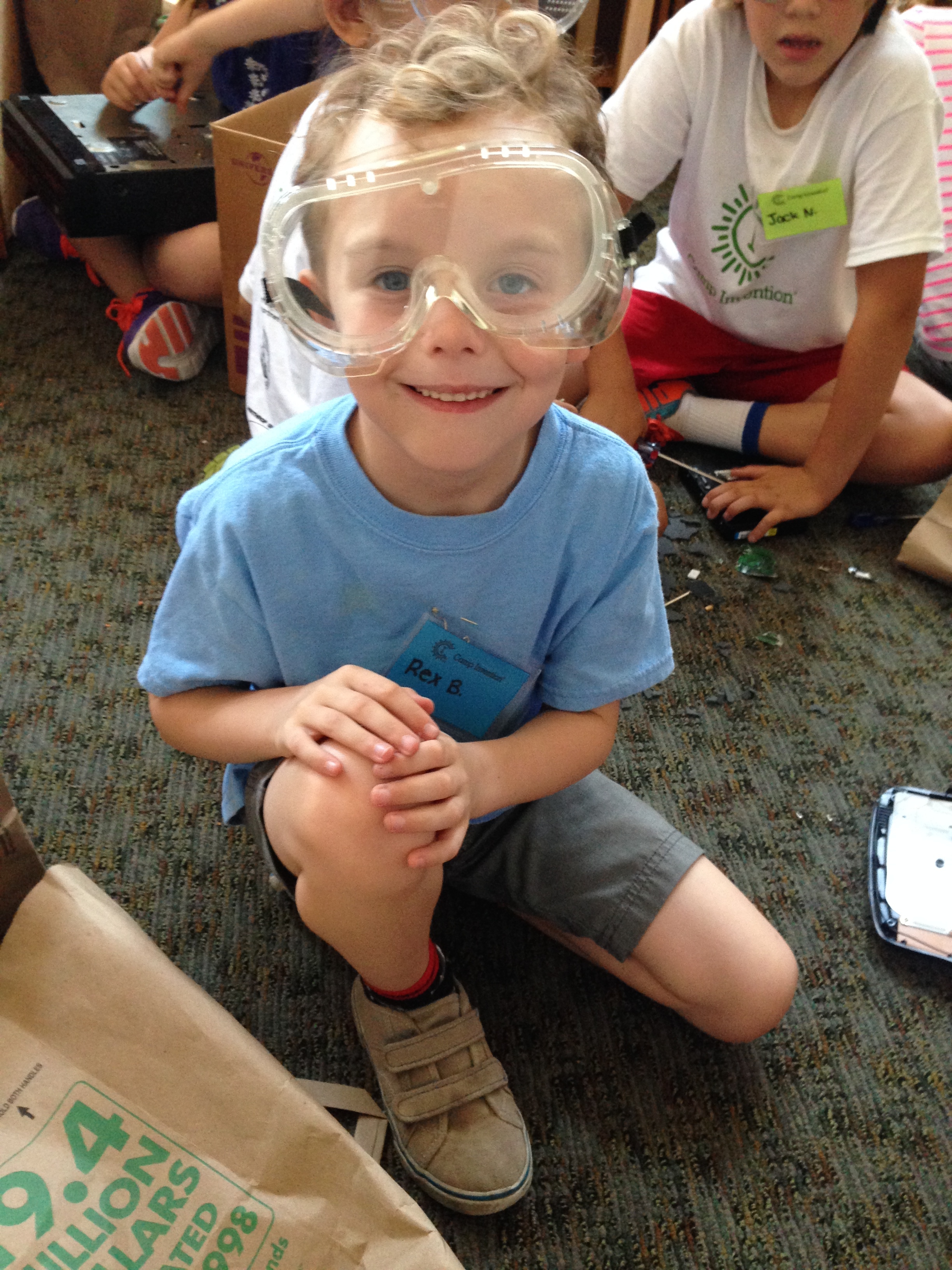
Using tools is so much fun!

Using tools is so much fun!

Mrs. Jacoby thoroughly enjoyed teaching the camp she says because she was impressed with how much the kids actually used tools to figure things out and to create, fix, and experiment. She also appreciated the number of girls participating; the ratio of girls to boys was equal. “There’s not a girl in here who’s going to be afraid to change her own light fixtures,” she said.

Camp Invention Returns to TNCS in June

Does the thought of summer-long video games give you a headache? Do you find the notion of watching the antics of mutant turtles—ninja or otherwise—a little creepy? Does the prospect of relinquishing your child to 9 weeks of these frequently vapid pursuits fill you with dread?

Parents, despair no longer: enroll your boys and girls entering grades 1 through 6 in Camp Invention this summer and give them the opportunity to explore, create, invent, and have loads of active, imaginative fun! Important: your child does not need to be enrolled at TNCS to join—this is a community-wide opportunity. Nationally acclaimed Camp Invention is a week-long summer day program, the brainchild of the National Inventors Hall of Fame in partnership with the United States Patent and Trademark Office. Presenting kids with real-world challenges that encourage them to solve problems and present their solutions through themed, scientific, engaging hands-on investigation, the program integrates four key components:

1. STEM enrichment: These four vital education areas—Science, Technology, Engineering, and Math—are explored via hands-on, creative problem-solving activities. Camp Invention inspires kids to be curious about their world and prepares them for a future of responsible, engaged participation within it.

2. Consistent and effective implementation: Programs are all-inclusive; Camp Invention provides curricula and step-by-step instructions for the TNCS instructors to follow as well as training and all program materials. This ensures that programs are carried out correctly and consistently, maximizing the benefits to participants.

3. Collaboration and other 21st-century skills: Working in teams, children are presented with real-world challenges that promote the direct application of critical thinking and communication skills demanded by colleges, careers, and citizenship in the 21st century.

4. Teacher and student development: Teachers gain direct, reproduceable experience in how to integrate STEM content in daily lessons and beyond. Kids benefit from the student-centered approach to learning; they are led by their own desire to solve the presented problem, to see it through.

Camp Invention Comes to TNCS!

Camp Invention is returning to TNCS for Summer 2013! Enroll for June 17–21!

The honor of hosting this exciting exploration is reserved for only about 1,200 schools nationwide, and TNCS has earned the distinction of being the only location in the downtown Baltimore area to host the camp this summer. Says TNCS Summer Camp Director Lisa Warren, “We got first dibs—it’s a great honor for us to be hosting it here for the second year!”

TNCS’s Camp Invention session will be held during the week of June 17–21, and camp runs for a full day, from 9:00 a.m. to 3:30 p.m. This year’s program theme is CREATE, which features four modules the kids cycle through each day: Problem Solving on Planet ZAK, SavingSludge City, I Can Invent: Launchitude, and Geo-Games (click the CREATE link above to read more about what skills and learning each module focuses on). Each one promises some really wacky fun, including re-engineering household items to create the ultimate Rubber Duck–Chucking Device, for example. What kid isn’t going to love that? Best of all, they’re using scientific principles in actual applications. These lessons will stick. Or fly, as the case may be. Even kids who have previously participated in Camp Invention will benefit from brand new adventures throughout the week.

Space is still available! To register your child for Camp Invention at TNCS, click here!

Summer camp at TNCS

Enriching summertime activities make happy kids!

Other specialty summer camps open to the public are also available at TNCS, including Lego + Brain Games, Drama, Music, Mandarin Immersion, Painting, and Launch Pad Academic Bridge Camps, as well as camps for younger children. As we wrote in “Making Summer Count—Weekly Camps at TNCS,” using summertime to learn while having fun will enrich them academically throughout their school careers.

To register for any TNCS camp, click here.

Mandarin immersion camp

Don’t let the important skills your child has practiced all year atrophy over summer—keep them happy and engaged at TNCS summer camp!