TNCS Primary Workshop: Connecting Montessori to Home

A few weeks ago, The New Century School Montessori teachers gave their bi-annual Primary Workshop to provide parents with a firsthand experience of the Montessori approach to pre-K education. But this time, they also added a new twist—how to support Montessori principles in the home.
tncs-primary-workshop-connecting-montessori-to-home

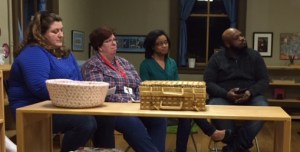
Our illustrious panel of Montessori teachers.

Joining teachers Catherine Lawson, Martellies Warren, Lisa Reynolds, and Maria Mosby, Head of School Alicia Danyali introduced the workshop and was quick to reassure parents that they needn’t run out and “remodel the home with Montessori materials”; rather, “this presentation is to show ways that Montessori can be connected naturally to what you already do in the home.”

Although previous workshops, including in the fall of this academic year, have demonstrated specifically what students are learning and doing during their daily class time, this one did not cover teacher and learning with Montessori materials per se. For those parents who did not attend Montessori school as kids, the materials are a marvel—both eye-opening and fun. For those who did grow up in a Montessori environment, the chance to reacquaint themselves with the materials must evoke the most delicious nostalgia. Maria Montessori developed the Montessori materials based on her extensive observation of children ages 2 1/2 through 6 years. Her goal was to put academic success within their reach by setting realizable achievement milestones, so to do that, she tailored materials to be used the way she saw children interacting with their world. Primary students use these materials nearly exclusively, and seeing how the materials are actually used and learning what each does for the child’s development was the focus of prior Primary Workshops.

As such, the Montessori classroom is a very deliberately “prepared environment.” Every nook and cranny is optimized for both the child’s size and the child’s development (accommodating a range of both, of course). Similar child-optimization can also be accomplished with a little careful tweaking of the existing environment, such as in the home, as the TNCS Montessori teachers went on to demonstrate.

To make the home–school connection, they covered the following four areas.

Part 1

Up first, Mrs. Lawson described how to prepare the interior and exterior of the home and the car, joking that “we aren’t going to force anyone to set up this way. No one is coming to your home to check on you! But we’re trying to teach independence, and here are some ways you can further this at home.”

Entryway

  • Install low hooks for children to hang up their own coats or use child-sized hangers so they can hang their coats with everyone else’s (Mrs. Lawson showed an old, well-loved hanger one of her daughters had decorated for this use).
  • Create a place to put wet boots and dirty shoes.
  • Designate a place to keep lunch boxes, backpacks, and other regularly used gear.

Living Room and Family Room

  • Make these areas child friendly so children feel welcome—said Mrs. Lawson: “Children like to be where their parents are, but they need their things handy also.”
  • Make books available in every room, if possible, with a bookshelf or basket to hold them.
  • Keep some toys available for use in an organized way, which encourages easy clean up:
    • Use low bookshelves or the bottom shelf of a television cart to hold toys.
    • Give each particular toy a place on the shelf. Place activities with many pieces in dedicated holders (e.g., shoe boxes, baskets, etc.).
    • Offer limited choices of activities that fit on the shelves provided, and rotate the toys when interest wanes.
    • Use a bathmat, throw rug, or bath towel for the child’s designated activity area, à la Montessori.
  • Although these might be hard habits to break, try to avoid:
    • Using a toy box or big basket that holds many toys because children can get overstimulated with too many choices.
    • Allowing the child to play with many toys and then doing a big clean-up. Instead, encourage playing with one toy and putting it away before moving onto the next.

Bedroom

  • Make books available in every room, if possible, with a bookshelf or basket to hold them.
  • Use low shelves for children’s toys and activities:
    • Each toy should have its own place, and rotate toys as necessary.
    • Only have bedroom-appropriate toys in the bedroom because you will not always be present to supervise. Markers, for example, are not a good choice!
  • Keep a laundry basket handy that allows the child to dispose of his or her own dirty clothes each night.
  • If possible, install in the closet an easy-to-reach rod and child-sized hangers.
  • In the dresser, place season-appropriate clothes in the lower drawers so the child can choose the clothing and dress him or herself.
  • Install a bulletin board at the child’s eye level to display pictures of family members, artwork, postcards, etc.:
    • When they are reading, post reminders about things or just love notes.
    • Add a calendar to mark off days.
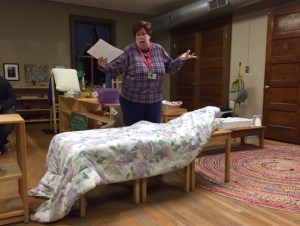
  • Consider using a comforter instead of a bedspread on the bed. Let it be the child’s job or to help pull up the comforter each morning.
    tncs-primary-workshop-connecting-montessori-to-home

    “It hides the wrinkles and looks tidy even if it isn’t perfect,” demonstrated Mrs. Lawson.

Outside

  • Make a place for outdoor toys (not just a big plastic tub for everything), such as a laundry basket.
  • Have opportunities for gardening (i.e., digging in the dirt) available.

Car

  • The car is an extension of home for many commuting families. Make it a happy environment with car-appropriate activities:
    • Books
    • CD of music or stories
    • DVDs
    • Activity books (avoid crayons, which melt)
  • Keep a supply of snacks and drinks on hand. Make a snack bag that allows the child to decide when and how much to eat (this encourages responsible decision making and avoids a power struggle).
  • For longer trips, consider making a goodie bag filled with tissue paper–wrapped activities or toys (they can be new things or things from around the house, e.g., rubber ducks, trucks, sticker books).

Part 2

Mr. Warren spoke next. “My part of today’s presentation is on allowing for mistakes. A huge part of Montessori and overall development is making mistakes.” He read essential parts from “Mistakes and Freedom,” an article published by The Center for Guided Montessori Studies and starting with this famous quote by Dr. Maria Montessori:

“It is a commonplace that the child must be free. But what kind
of freedom has he been given? The only true freedom for an
individual is to have the opportunity to act independently. That
is the condition sine qua non of individuality. There is no such
thing as an individual until a person can act by himself. The
instinct guiding the child to seek his independence thus leads us
to realize what the whole of nature demonstrates – that any sort
of association is composed of separate individuals. Otherwise
there would be no such thing as societies, but only colonies.
Education must foster both the development of individuality
and that of society. Society cannot develop unless the
individual develops, as we learn from observing the child, who
immediately uses his newly won independence to act on a social
environment.”

Read the article in its entirety here: http://www.guidedstudies.com/2011/04/mistakes-and-freedom/.
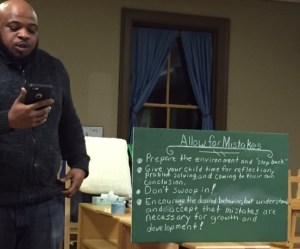
tncs-primary-workshop-connecting-montessori-to-homeMr. Warren ended with his own classroom tenets of allowing for mistakes:

  • Prepare the environment and step back.
  • Give the child time for reflection, problem-solving, and coming to their own conclusions.
  • Don’t swoop in!
  • Encourage the desired behavior, but understand and accept that mistakes are necessary for growth and development!

Part 3

Next up, tying into Mr. Warren’s theme, Mrs. Reynolds discussed the difference between praise and encouragement and how to allow children to cultivate the courage to be imperfect. “I like praise,” she joked, “it’s like candy.” Audience laughter ensued. “But what is the long-term effect,” she asked? “Children who are praised choose less challenging work.” That might seem counterintuitive—it’s why we praise our kids, after all, to ostensibly build up their self-esteem—but studies are unequivocal in demonstrating that our good intentions are having deleterious effects.

Mrs. Reynolds brought up the example of kids’ art, which parents can tend to gush over, even when what is depicted is basically a scribble. Not only does this signal to the child on some level that he or she doesn’t need to really try hard to make something praiseworthy, but the praise itself also becomes less meaningful.

The upside is, said Mrs. Reynolds, “Children who are encouraged for their efforts are willing to choose more challenging tasks on their own.” Encourage the deed, rather than praising the outcome. “Show respect for and interest in the child’s point of view.” Also, make sure to provide opportunities for the child to develop his or her life skills, such as making the bed. (Recall from Part 1, though, that the idea is to set the child up for success by “preparing the environment.”  See above.) This will help the child develop self-confidence and independence, as well as independence from the negative opinions of others.

“Who doesn’t want that for their children?” she concluded.

Part 4

Ms. Mosby then took up the thread of independence by presenting specific ways that parents can give children these opportunities at home. “Have you ever been approached by your children while your cleaning the house because they want to help?” she asked. Our tendency can be to brush aside these offers as sweet, but not really very helpful because we want an actually clean outcome for our efforts. But, this is exactly the time, explained Ms. Mosby, to tap into that natural excitement and teach them how to tackle some of these household tasks before they become too jaded to want to help. Sure, the results might not be perfect, but the ultimate reward of cultivating independence and a fundamental helpfulness in your child will outweigh this temporary downside.

She went on to tell parents how eager her students are to help clean the classroom and how she seizes those opportunities to both accept the help as well as teach the correct methods. “All of the materials I’m showing you are things you’ll already have around the house, such as dust cloths, dustpans, and plastic bins to wash dishes or other items ‘the old-fashioned way’.” (She gave parents the helpful tip that her students love polishing tables and will rub the polish practically off in their zeal for this task.)

Kids are also natural sous chefs—they love to help make their lunches, for example, such as by spreading ingredients on bread and peeling vegetables. Learning to use kitchen implements also helps them develop their fine motor skills. They can also be recruited to put dishes away. “Let them know you trust them,” said Ms. Mosby, ” and start with unbreakable pots and pans in a low cabinet, progressing as the child is ready to more fragile dishes.”

They can also help with pets. “They love to have another little someone to care for,” said Ms. Mosby. Let them brush the cat or dog and help put out the food and water. They can even help with younger siblings and get practice with gentle care in the classroom with babydoll models.

The garden or backyard is another area where kids can be a huge help, whether with cleaning up or actual gardening. A “pooper scooper,” she pointed out, makes a great child-sized leaf picker-upper.

Resources

Head of School Alicia Danyali offers the following resources “to support your family’s educational journey” with a young learner.

Books

  • The Child in the Family, by Dr. Maria Montessori
  • Positive Discipline for Preschoolers, by Jane Nelson
  • Child of the World: Montessori, Global Education for Age 3-12+, by Susan Mayclin Stephenson
  • How to Raise an Amazing Child the Montessori Way, by Tim Seldin
  • The Whole-Brain Child, by Daniel J. Siegel and Tina Payne Bryson
  • How to Talk So Kids Will Listen, and How to Listen So Kids Will Talk, by Adele Farber and Elaine Mazlish
Websites

TNCS Parent Workshop: Making the Transition from Pre-Primary to Primary

This week’s Immersed post is a very special one, brought to you by TNCS Primary Teachers Maria Mosby (main author, photographer) and Lisa Reynolds (main photographer), with additional contributions from TNCS Head of School Alicia Danyali and Pre-Primary Teacher Yu Lin.

Their topic? The New Century School‘s Pre-Primary Parent Workshop held January 21, 2016, which was in itself something a little different, focusing on how to make the transition from the pre-primary classroom to the primary classroom a smooth one for our 3-year-old friends. It’s quite a big step for such small children, and many parents experience considerable anxiety about how their child will handle it—a baby in diapers in spring, to a self-possessed student of a multilingual Montessori classroom come fall? Impossible! Yet this is exactly what occurs each year, to the amazement of parents, the delight of the kids themselves, and with knowing smiles by the teachers. And so without further ado, here’s how they do it, as written by Ms. Mosby as well as an excerpt from Lin Laoshi!

The purpose of the Parent Workshop was to give parents an overview of what their child’s experience would be like once they move up to the primary classroom, as well as answer any questions, and perhaps help alleviate any anxiety they might be feeling. It began with Lin Laoshi talking about the difference between the pre-primary and primary classrooms, with the focus being more on independence in primary:

The TNCS pre-primary program is a language immersion program, focusing on foreign language enrichment. Children are exposed to the language 100% of school time. They learn languages through singing fun songs, playing games, doing hands-on activities, and attending cultural presentations. The classroom setting relies mainly on group work with the guidance of the program teacher.

The TNCS primary program is a mixed-age Montessori program, which encourages students to be independent, explore freedom within limits, and learn to establish a sense of order. They are encouraged to choose any activity from within a prescribed range of options and do their work independently most of their school time.

In order to bridge the gap between the two programs, students in the pre-primary program are gradually encouraged to do more things by themselves to enhance their abilities of self-awareness and self-control.”

Mrs. Danyali then gave the parents insight into the placement process and an overview of the primary program, while I walked them through a typical day. From there, it became more of an open discussion and question-and-answer session.

tncs-preprimary-to-primary-transition

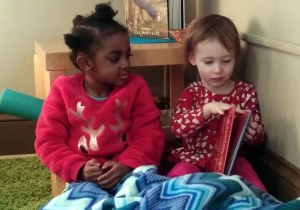
A quiet, cozy moment with a friend in the peace corner goes a long way to making children feel comfortable and at ease.

What particular challenges the children will face was a big part of the discussion. Separation tends to be the biggest issue in my experience. Even though these students have been to school before, they are entering a different environment with new teachers, new friends, and new routines. That’s a lot for a young child at once. We try to make the transition as gentle as possible, and make them feel at home.

Another difficult aspect for the new children can be understanding that not all of the Montessori materials are available for them to use just yet. Everything is so new and enticing—in fact, the Montessori materials are specifically designed to call to the children. However, a new 3-year-old, though very excited by the movable alphabet or bead cabinet, is most likely not quite ready to use these materials. That’s why it’s so important to go over preliminary lessons, or the “ground rules” of the classroom, several times in group and individual situations to kindly but firmly give reminders to all.

tncs-preprimary-to-primary-transition

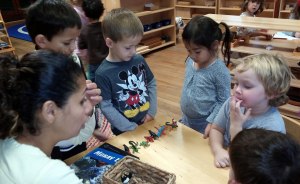
This group Spanish lesson on rainforest animals shows that little kids really can focus . . . even it means keeping their hands otherwise occupied!

Another point to remember is that we make sure each individual child is ready for this transition. Our administrators are very skilled at making sure that children who move up are both physically and emotionally ready. In the rare cases in which a child has shown signs of not being comfortable in the new environment, we worked with the parents to help the child become more independent and develop the skills he or she needed to feel secure in the primary classroom. Consistency and partnership between home and school is, thus, vitally important, as is respect for the child and his or her individual needs.

The photos below (picturing kids who just moved up to primary this school year) erase any doubt that young children are eager to embark on journeys of independence and self-exploration. They learn by doing at this age, and allowing them this opportunity does wonders for their self-esteem, let alone their physical and cognitive development.

The take-away message is, parents should be reassured that this transition needn’t be a scary experience, and there isn’t much special preparation* necessary. We are set up to welcome all children as they are, and the primary classroom is the next step in the work that they’ve already been working so hard at in pre-primary—developing self-help skills, socialization, motor skills, and working within a community.

*Here are some practical tips for parents to familiarize themselves and their children with the exciting changes to come.

  1. It’s great for parents to prepare their children for the transition by talking about it in a positive way, perhaps choosing new items together for the new school year.
  2. Talk about it—but not too much too soon. Constantly discussing the transition, especially when it might be months away, may create anxiety for your child.
  3. Slowly begin introducing more opportunities for independence (allowing your child to dress himself with support, help to pack lunch, etc.). However, I don’t advise rushing toileting or to cause children think there is a “deadline” for them to be ready. This may have the opposite of the desired effect.
  4. Visit the primary classrooms and read up on Montessori theory. A great introduction is A Parents’ Guide to the Montessori Classroom, by Aline Wolf. It’s a quick read and gives an overview of philosophy and materials. Lin Laoshi also recommended the book, Mindful Discipline, by Shauna Shapiro, PhD. Additionally, Mrs. Danyali provided a Reading List that includes these and other very helpful titles.
  5. Come to the “Back-to-School Meet and Greet” with your child at the beginning of the school year. It’s a great opportunity for your child to meet his teachers, new friends (and likely some old friends!), and become acclimated to the new environment.
tncs-preprimary-to-primary-transition

This sweet smile kind of says it all.


Cutting Edge Skills at TNCS

A recent Food for Thought article that aired on NPR explored the seemingly counterintuitive notion of letting toddlers play with knives. Sujata Gupta, the author and mother of a 3-year-old, writes, “Both my mother and mother-in-law recoiled when I suggested letting my son try his hand at chopping. Yet research, and the experience of educators, suggest that parents such as me would be wise to hand a tot a knife.”

That “recoil” is understandable, given that maternal instincts are to protect, not arm our children with implements of self-destruction. But, as Gupta discovers, allowing small children to wield real tools is a means of attaining self-efficacy, something that kids these days urgently need.

It may come as no surprise to TNCS parents that The New Century School has always operated according to this principle. TNCS primary classrooms follow the classic Montessori curriculum, a huge part of which is fostering independence, even in the very young. The Montessori philosophy is based on the observation that children learn by doing. They crave hands-on experiences, which is also a form of “play.” (In this sense, there’s a profound difference between “playing with knives” and “playing” with knives. The former is an invitation to accidents; the latter is an absorptive lesson in proper use.)

Of course, TNCS students are not handed honorary steak knives on matriculation. Step by step and through practice with preliminary “works,” they earn the privilege of using knives in the classroom for helping with food preparation in the Practical Life mode of the curriculum. Says TNCS primary teacher Martellies Warren: “I trust students with real tools once they show that they can be responsible individuals in other areas of the curriculum—such as if they have mastered or are working toward mastery in the art of using materials with care, working with materials from start to finish, working independently, caring for the classroom environment, and just overall being gentle and empathetic toward others.”

Catherine Lawson, TNCS’s most senior Montessori teacher, agrees. “Children want to do activities that include using knives; however, they know that they have to show that they are focused and responsible.” Once students have shown this level of consistency, says Mr. Warren, “they are allowed to use such tools as knives, hammers, graters, and peelers to prepare real food as well as serve themselves and each other.”

tncs-students-learn-responsible-knife-use

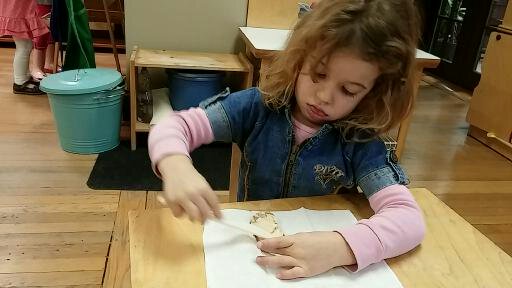
A TNCS primary student carefully spreads hummus on mini toast.

TNCS primary teacher Maria Mosby describes her process this way: “We use knives for spreading first (hummus, cream cheese, sunflower seed butter). The kids love to practice spreading butter on their bread at lunch time, and it’s a great opportunity to help out and practice at home with toast or sandwiches.”

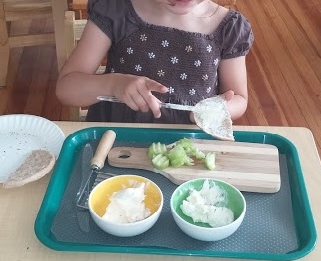
Once the children demonstrate responsible spreading, they can move on to slicing, starting with softer foods and progressing to firmer fruits and vegetables. “We always stay nearby, but trust that the children are capable,” said Ms. Mosby.

And that, says Mr. Warren, encapsulates the “spirit and uniqueness of the Montessori philosophy!” He says that this type of “honor system” stems from Maria Montessori’s belief that the child should self-direct. “I often tell parents to ‘let go and trust’ their little individuals. In my experience this has been one of the most challenging task for parents to do.”

tncs-students-learn-responsible-knife-use

A TNCS primary student cuts cucumbers, slices bread, and spreads cream cheese to make a cucumber sandwich.

Letting go and trusting might come more easily if parents knew just how successful this model is for cultivating that self-efficacy mentioned above. Ms. Mosby offers this explanation: “I have never been let down. I think it’s the fact that the students know they are using real tools that makes such a difference. They don’t use them as weapons. They are very careful and know that tools used improperly can be harmful.”

So, as Gupta says, “Go ahead and give your toddler a kitchen knife.” You might just get breakfast in bed from your aspiring cheflets.

Meet the Teacher: Montessori-Trained Maria Mosby Joins TNCS

It's clear from her beautiful smile that this is one caring educator!

It’s clear from her beautiful smile that this is one caring educator!

The Montessori environment has “felt like home” to Maria Mosby for quite some time, she says, so she was a natural fit for Lead Teacher in one of The New Century School‘s four Primary Montessori classrooms. In fact, she began her own education at age 2 1/2 years at Columbia Montessori School, in Columbia, MD. “I grew up in Montessori,” she says, “so it has always been in my heart.”

After several moves with her family throughout New England and the Washington, D.C. area, which entailed a stint in public school, she rediscovered Montessori while studying Early Childhood Education at Towson University, and it has been Montessori all the way ever since. She had considered studying psychology, but says, “I’ve always had an affinity for children and wanted to be around them in my career. As a teacher, you do end up being a psychologist of sorts.” She knew that the primary age group was her target age group all along. “I worked with older children, elementary-age children, toddlers . . . but the 3 to 6 age group is really where my heart is.”

Even though she just joined TNCS full time this academic year, Ms. Mosby was no stranger to the school. As a primary assistant for 3 years and a toddler assistant for 5 years at Greenspring Montessori School (formerly, The Montessori School), she decided to take Early Childhood training through the Maryland Center for Montessori Studies. During her internship, she worked at TNCS’s summer camp and “loved the warm, peaceful community.” Even with a whole year-long absence, students remembered her and were excited to have her back.

Having been through the first semester and ironed out those wrinkles that inevitably come with introducing young children to new routines and new faces, she reports that “things are going very well. I love my students with their unique personalities, and I’m glad that there’s a 3-year cycle to look forward to with them. It has really been a growing experience for me.” She also attributes some of the successful transition-making to her Assistant Teacher Elizabeth Salas, who also joined TNCS this academic year. Señora Salas came to TNCS from Chile and besides being “wonderful,” in Ms. Mosby’s words, provides the Spanish immersion component to the classroom. Ms. Mosby herself is picking up some Spanish, although not as quickly as the students, she confessed.

Being such a staunch proponent of Montessori education, Ms. Mosby has a lot of insight from several perspectives into what makes it so effective. “The children are given the opportunity to reach their potential,” she said. “They’re not stifled. When I compare [Montessori education] to traditional education, I remember how I struggled with math, especially when my family was moving around. I needed help with fractions, but the class I entered had already studied them and were not going to backtrack just for me. And that’s not an issue here. Everyone is working at their own pace.”

Once a shy student, she also credits the independence that Montessori confers as part of its success. She sees daily in her classroom younger and older children working together, which often means a younger child absorbing a lesson he or she might be considered too young for in a conventional learning environment. “I don’t hinder them,” she says. “I let them see what they can do and also let them learn from their mistakes, which fosters that sense of independence that I love about Montessori.” It’s easy to see how this process builds confidence in children and primes them to learn.

Although she is incredibly well versed with all of them, her favorite Montessori materials are those associated with Practical Life. “They make a really nice school–home connection,” she said. Kids can play at cooking, flower arranging, tidying up, etc., and as they perfect these skills, they translate them to home and develop motor skills and a sense of responsibility to the immediate environment in the bargain.

“Another thing they have been working on is how to use the ‘peace table’ if upset and words to use when solving a conflict with others. They really enjoy the sensory items at the peace table, and it’s a good place to go when someone needs a place to chill out.” Just like the other Maria M., Ms. Mosby values treating others with kindness and receiving the same in return.

One very special project they have been working on as a group is writing to another Montessori class in Saskatoon, Canada. “The children have been very excited about it and have been drawing pictures to include. They have been learning about Canada’s cities and will also be learning a few French words,” she said.

In her free time, Maria enjoys running and does the Casey Cares Foundation 5K every year, which raises money for critically ill children in Baltimore and surrounding areas so that they can have things like birthday presents, vacations, and pajamas for long hospital stays. “I also work with Girls on the Run of Central Maryland as a “SoleMate.” “GOTR coaches pre-teen and middle school–aged girls to run their first 5K. It is a great organization that increases the girls’ self-esteem, overall health, and sense of sisterhood,” she says. She is also a certified children’s yoga instructor and will complete her 200-hour yoga training this year.

In closing, she said, “After I was away for a year, coming back [to TNCS] just felt like coming home. Everyone is so welcoming, and I feel very supported from the other teachers and from the administration. We all have something to offer. We collaborate and work together very well, even among the different divisions.” TNCS is thrilled to have the warm, compassionate Ms. Mosby in her very first Lead Montessori Teacher role!

Happy Birthday, Immersed!

Dear Readers, this is a proud day, marking the end of Year 1 of The New Century School‘s blog. That’s right, 52 posts later, here we are (this is #53). To celebrate, let’s take a look back at what your favorite posts have been—after all, we’re here for you.

Top 10 Most Popular Posts

  1. Preschool Conundrum Solved: Research Demonstrates Benefits of Montessori Education  (224 views so far)
  2. Achieving Balance in Education at TNCS  (215 views so far)
  3. Sustainable School Lunch: Garden Tuck Shop Program Part I  (199 views so far)
  4. Elementary Science Fair!   (175 views so far)
  5. Top 10 Reasons to Attend Montessori Kindergarten  (171 views so far)
  6. Inside the Montessori Classroom  (156 views so far)
  7. Exercising That Mind–Body Connection  (146 views so far)
  8. Elementary Program Merges Montessori and Progressive Education at The New Century School  (130 views so far)
  9. A TNCS Original  (128 views so far)
  10. Language, Math, and Science—Montessori Style!  (125 views so far)

Because a little analysis is just irresistible, let’s draw some conclusions. It’s pretty clear that Montessori and Elementary are the  commonest themes on this list, which is entirely appropriate. TNCS is achieving something entirely unique in education in meshing a progressive, rigorous curriculum with the gentleness and humanity of the Montessori approach. TNCS students learn the standard academics but also get a firm grounding in foreign language and an abundance of the arts, movement, and technology. Perhaps most important and often overlooked in conventional schools is the attention to social relationships and building mutually respectful interactions with peers and with the administration.

So thank you, readers, for your following and your support. What would you like to read more about in future?