Making the Case for Cursive

The summer of 2013 will go down in American history as the summer that polarized the country over the fate of Trayvon Martin and the man accused of killing him. Another rather unforeseen partisan debate also arose from the Zimmerman trial, however, that is particularly relevant for The New Century School elementary students: reading and writing in cursive. Witness Rachel Jeantel, age 19 years, told the courtroom that she was unable to read a letter written in cursive, a key piece of evidence (see story here). Suddenly, whether cursive should be taught in schools or not has become the education polemic du jour.

In the New York Times, assistant professor of education at the University of Southern California’s Rossier School of Education Morgan Polikoff wrote that there’s no good reason to continue teaching cursive. It has been left out of the Common Core Standards and fewer and fewer people use it anymore (in favor of printing or keyboarding). “Additionally, there is little compelling research to suggest the teaching of cursive positively affects other student skills enough to merit its teaching,” he writes.

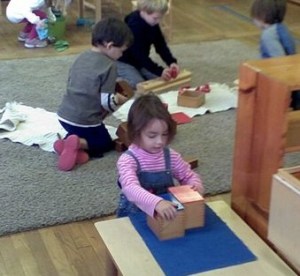
TNCS student practices writing in cursive.

TNCS student practices writing in cursive.

Advocates of cursive vehemently disagree. Writing in the Los Angeles Times, Suzanne Asherson from Handwriting Without Tears, a handwriting program for teachers, says, “Cursive is faster and more efficient than print. When [children know] the mechanics of forming letters in cursive, they can better focus on their content.” A somewhat controversial study of SAT scores found that test takers who wrote in cursive rather than print on the essay portion scored significantly higher. Analysts suggest that this is because the efficiency, better flow, and connectedness of cursive writing allowed the students to focus on making coherent arguments. The kinesthetic process paralleled the cognitive one.

Another consideration is that regardless of whether cursive continues to be taught, documents written in cursive will nevertheless exist . . . should we be able to read them? Finally, many argue that cursive—unlike print or especially keyboarding—boosts brain activity in positive ways. Read a blog post by Dr. David Sortino, a psychologist and current Director of  Educational Strategies here.

Although Maryland is an adopter of the Common Core State Standards, which doesn’t require that cursive be taught, many schools in the state teach it nevertheless. At TNCS anyway, elementary students are taught to write in cursive. Both Montessori and Waldorf schools believe that cursive writing promotes the mindfulness required of genuine scholastic engagement. In fact, last year, TNCS took the issue head on with typical good humor when the elementary kids made “Cursive Haunted Houses”:

“There once was an old house on a hill. No one would go near it. Someone said it was Cursive! It started in the tall dry grass around the house. People noticed how wavy and spiky it was: VVVVVVVVVVVVVVVVVVVVVVVVVVVVVVVVVVV.

Then they notice how the paint on the house peeled in long and short curls: eeeeeeeeeeeeeeeeeeelllllllllllllllllllllllllllllllllll.

And when the shutters flapped on a stormy night, people saw shapes in the windows—shapes that looked like letters! It was the old house speaking to the town’s people in a spooky and beautiful way.”

It might be considered just plain “loopy” by some, but cursive isn’t gone yet!

What do you think? Should cursive be taught in or omitted from elementary curricula? Tell us your thoughts in the comments section!

Imagination Playground Comes to TNCS

“Play is the work of the child,” said Maria Montessori a century ago, and with that simple yet compelling concept, launched a revolution in early childhood education. The Montessori method is often mistakenly faulted for not making room for “imaginative play,” but the converse is actually true, and it’s also why the method is so downright effective. By integrating “work” (i.e., learning) with materials and lessons that children are naturally drawn to, the Montessori method allows kids to do what they do best—play, explore, touch, smell, absorb—but in a constructive, productive way. In other words, they are learning because they want to without even realize it’s happening. It’s sheer genius.

Fast-forward to this century, and an offshoot of this concept has begun to take root: play facilitated by “playworkers.” Playworkers describe (they resist defining it—you’ll see why) play as “a set of behaviors that are freely chosen, personally directed, and intrinsically motivated.” Activities such as building a sand castle and playing make-believe fit this description, whereas playing Angry Birds on an iPad is something else entirely (no judgment implicit here, parents!). It’s no accident that the playwork model of play sounds a lot like what Dr. Montessori had in mind. Playworkers’ (also called “play associates”) roles are to be the caretakers of the play environment. Unlike the bored, inattentive playground monitor of yore, these are trained adults who oversee an open setting in which children can direct their own play, maintaining a safe, welcoming environment for them.

Trained to what, exactly? Enter Imagination Playground, The New Century School’s latest schoolwide initiative to ensure a happy, adjusted, engaged student body. Launching soon, a focus on constructive play is what makes Imagination Playground a natural fit for TNCS. Says school cofounder Jennifer Lawner, “We will begin using it in the gym space during school hours and also make it available to The Lingo Leap for birthday parties and other activities.”

So What is Imagination Playground, Exactly?
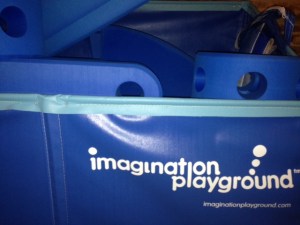
Imagination Playground blocks close-up

A close-up of the foam blocks . . . makes you want to reach out, grab one, and start playing!

The flagship Imagination Playground opened in New York City in 2010; since then, more than 700 Imagination Playground sets have been implemented internationally . . . including right here in Fell’s Point, Baltimore, very soon. To backtrack a bit, Imagination Playground is a “play system that encourages unstructured, child-directed ‘free play.’” It looks like giant Tinker Toys—only soft, on an extremely large scale, and powder blue! Developed by the architectural firm The Rockwell Group, this play system “in a box” (or cart, as the case may be) can be used anywhere, indoors or outdoors, and comprises three key elements:

1. Manipulable Environment: Traditional playgrounds consist of fixed equipment. The experience kids get from swinging or sliding is somehow passive, even though they are actively moving. There is still the element of deriving enjoyment passively rather than having created/designed the experience. Not so here, where kids manipulate the play environment according to their own lights, then do with it what they will.

2. Loose Parts: An assortment of age-appropriate “found parts” can be integrated with the signature blue building blocks to expand on and extend play in new directions.

3. Play Associates: Workers are trained with a specific curriculum developed by KaBOOM!, a national nonprofit organization dedicated to “saving play” as well as addressing America’s “play deficit” to properly implement and oversee an Imagination Playground.

According to Imagination Playground website’s FAQs, “This unique combination of elements enables children to create a great new playground each time they visit.” Click here for a video demonstration/profile.

More About the Blocks, Please

These are really the core of the Imagination Playground. The biodegradable foam blocks are nontoxic, cleanable, recyclable, resistant to microorganisms, and nonflammable. They are all blue—no variations are possible. This is to both encourage the use of, that’s right, imagination, rather than getting distracted by colors (or worse, fighting over them) as well as because that color was best received among kid focus groups. The blocks kit includes shapes like “l’il cheeses,” “clover gears,” and “arched chutes.” Are you getting excited yet? This basic kit can enhanced with angles and curves add-on sets to build endless combinations of kid-engineered “playgrounds.” They also promote collaboration among children to build their place space together.

And the Play Associates?

Must be the world’s best job, right? Probably pretty close, though training is a nonnegotiable prerequisite. This job is really more about managing the environment than playing with kids, however. Performing safety checks, setting up and putting away the loose parts, and cleaning the materials are their primary responsibilities, all to enable kids to let their imaginations take them where they will. “Play Associates set up and step back.”

As stated above, Play Associates are a kind of “playworker,” a profession written extensively about by Penny Wilson in the U.K., herself a professional playworker. Together with a nonprofit organization right here in our own backyard, Ms. Wilson and the Alliance for Childhood in College Park, MD aim to “[establish] playwork as a profession in the U.S. . . . [in] its efforts to restore play to children’s lives.” Read their Playwork Primer 2010 here.

Play: Not Something to Mess Around With

In the end, there’s a very serious side to play—not in a bad way, but in terms of the no-nonsense list of benefits that this kind of play yields. Playing with loose and found parts, researchers agree, hones cognitive, creative, and social development. In fact, it is precisely through play that kids develop. By playing, they are actually transforming their dreams into reality as noted pediatrician-turned-psychoanalyst David Winnicott believed and for whom the concept of play was a central motif. Tied to influential architect Simon Nicholson’s Theory of Loose Parts:

“in any environment, both the degree of inventiveness and creativity and the possibility of discovery are directly proportional to the number and kind of variables in it”

and the fundamental logic of Imagination Playground emerges. Did you watch the video yet? Those parent and education professional testimonials were full of words like “problem-solving,” “engaged,” “higher-level thinking,” “teamwork,” and even “character strengths like grit, resilience, and self-control.” (Remember education researcher/author Paul Tough? One of the NYC school principles he wrote about, Dominic Randolph, is an Imagination Playground advocate and user.) All of these blog themes are really starting to, uh, “connect”!

For a final word on the child’s sheer driving need to play, here is an excerpt from an interview with playworker Penny Wilson in the American Journal of Play:

“It is a common mistake that adults make to think that play is frivolous and fun, a pretty frill of childhood. But play not only develops physical and mental strength and agility, it is the mechanism by which children work out their thoughts and emotions. As adults we struggle to explain and understand ourselves and the things that happen around us. We wrestle with words. For example, I find it very difficult to capture the words I need to explain this thought to you now. Children have exactly the same need to grapple with their thoughts. But they use their playing as their language.”

Please contribute to this dialogue; let us know your thoughts or share an anecdote in the Comments section!

Inside the Montessori Classroom

Many of us have at least a vague idea of what Montessori education is about and that Maria Montessori was an expert in child development and education, but some of us—even parents of Montessori-educated kids—still have questions. Or, maybe you have tried to explain Montessori education to curious friends and family members and have been met with blank stares or frank puzzlement in return.

colorful materials and inviting tableaux comprise a TNCS class layout

The Montessori classroom invites and inspires

In this post, we’ll compare a Montessori classroom to a traditional one to characterize The New Century School educational experience and gain some insight into how the classroom works, why Montessori students love learning, and why the Montessori method is so wonderful for our kids. In fact, despite obstacles (e.g., budgetary, legislative), the U.S. public educational system has begun to show the Montessori influence here and there, as educators wake up to the fact that students graduate from school and are at loose ends for how to live enriched, fulfilling lives. The traditional model has certain shortcomings that the Montessori education inherently prevents. (However, this discussion is not intended to belittle traditional education, only to investigate how Montessori can enhance learning for many by virtue of a radically different approach.)

children work independently and in groups in the smoothly functioning primary Montessori classroom

Children working independently and in groups in the smoothly functioning Montessori classroom

At TNCS, pre-primary classes (ages 2–3 years) follow the classic Montessori model; primary and elementary classrooms (ages 3–5 years and 5 years and up, respectively) use a Montessori-based approach. Classes comprise mixed age groups quite deliberately, and this is the first big difference between Montessori and traditional classrooms, in which each grade level corresponds to a single age. A vital element in Montessori education is that older children assist younger ones and that younger children not only learn from their mentors but also develop better social skills through this interaction. The older children also benefit greatly; another key element in Montessori education is consideration for others. Practicing compassion and kindness for their younger classmates teaches the older children how to conduct themselves graciously in any social milieu. Yet another advantage to mixing ages in this way is that students remain with the same teacher and many of the same children for 3 years, developing trusting, long-term bonds. The teacher also comes to know each child very well and gains an intimate knowledge of how each child best learns.

practical life materials teach kids everything from proper handwashing to garment buttoning

Practical Life materials

Another difference an observer would note immediately on entering a Montessori classroom is the room itself. Students are not seated in rows facing a teacher who is lecturing at a chalkboard as in a traditional classroom. Rather, individuals or small groups either completely independently or with the aid of the teacher are each engaged in separate activities that they have voluntarily chosen. They might be seated at small work tables or kneeling on rugs as they go about their tasks, which vary from sensorial (such as tracing sandpaper letters with their fingers) and practical-life activities (such as practicing folding towels) in the pre-primary and primary classrooms to working at computer stations at the elementary level. The point here is that students be inspired to learn by engaging in what draws them instead of required to sit passively and be lectured to. Not only will the consequent learning be deeper and richer, but the student will look forward to learning as the natural extension of his or her innate curiosity. School should not be something our kids dread, after all!

having completed work with the number rods, this child surveys his work before putting away the materials

A child in the Primary classroom works intently on the number rods

More importantly, this room for individual concentration and focus is the hallmark of Montessori education. It fulfills the child and allows him or her to become the person who intrinsically wants to help others and to make a difference in the world. Although it’s easy to imagine that a classroom full of kids each doing what he or she individually wants would be chaotic and noisy (a very common misconception), the complete opposite is true. TNCS classrooms are warm and peaceful places. The children are engaged in their work, and the atmosphere is one of pleasant, purposeful exploration. It goes without saying that passive, rote memorization–based learning has no place here. Learning is a dynamic, absorbing experience. It’s truly a marvel to see the self-discipline TNCS kids exhibit as they go about their daily work.

Yet another difference is the breadth of the classroom. TNCS extends the classroom to encompass the surrounding neighborhoods, fostering a sense of community and instilling the importance of community involvement—“our extended campus is the city.” And, for that matter, the world. TNCS has a very diverse student body, and students are encouraged to share their culture, promoting mutual respect and a broad, global perspective. Getting outside and seeing what’s going on around the school is a regular part of TNCS curriculum.

A final difference to be discussed here (though there are many more) is in the approach to “success.” AT TNCS, the product of the work done is not the focus; rather, the doing of the work is what’s important. Making mistakes and having another try is all part of the process. Students learn to relish the endeavor, of trying over and over, instead of being afraid to make those mistakes: “They welcome a challenge, and they do the work that’s required to meet that challenge. They are willing to take risks because they understand that often the most valuable learning comes when you try, fall, get up, and try again.” (This hearkens back to an earlier post on “grit”; see “Getting the Education Nitty Gritty” in Recent Posts, top right.) This also touches on another concept fundamental to the Montessori classroom—work cycles. Although Montessori methods are often criticized for not allowing imaginative “play” and focusing all on “work,” children do not make this distinction. If they are doing what they themselves have chosen to be doing, it follows that they will be enjoying it. The work cycle, though, by having a beginning (choose work), a middle (do the work), and an end (put away the work), additionally teaches them commitment, focus, and persistence. The rhythm of the work cycle has applications in all areas of daily life, not just in the classroom.

In The Absorbent Mind, Dr. Montessori wrote, “The child is endowed with unknown powers, which can guide us to a radiant future. If what we really want is a new world, then education must take as its aim the development of these hidden possibilities.” And this sums up the difference between a Montessori and a traditional classroom best. All too commonly, the traditional classroom, even at its pinnacle, can do no better than produce test-takers, albeit skillful ones; the Montessori classroom, by contrast, yields happy, inquisitive, well-rounded citizens of humanity.*

playing on the geodome on a beautiful, sunny fall dayplaying on the geodome on a beautiful, sunny fall dayplaying on the geodome on a beautiful, sunny fall day

For more information, including articles and videos, visit The Montessori Foundation’s website. And, find some hard data on the learning experience delivered by traditional versus Montessori approaches here.

*You want proof, you say? Consider this illustrious list of well-known folks, from silicon valley entrepreneurs to great chefs to princes, who were either Montessori educated or educators, and see for yourself!