It’s just plain hard to believe that the 2015–2016 school year is almost over, but with only a handful of weeks remaining, this is a great opportunity to reflect on all that The New Century School does for its students as well as all that education has given us. In perhaps a similarly nostalgic frame of mind, TNCS Head of School Alicia Danyali posed the following questions to her staff recently: “What is your fondest memory of school? What teacher/school event influenced you the most in your educational experience?”
It’s interesting to note the various ways the questions were interpreted—some answering from their past school experiences as young students, and others bringing their more recent TNCS experiences to bear. Regardless, Dear Readers, what follows are their heartwarming, often funny, and always insightful responses. You will get to know these wonderful educators in a new way, seeing what particular experiences and moments shaped them into who they have become as well as whence the unique gifts each brings to the art of educating your children.
Tissues handy? Okay, in no particular order, here we go!
Teresa Jacoby, K/1st Math & Science Teacher
Mrs. Jacoby, fittingly, reveals being awed by the power of science.
I think my fondest memory is winning first place in my 8th-grade Science Fair. My father who was a plumber helped me build a water cycle table. My water cycle table actually rained and had thunder and lightning. It showed the path that water follows from the mountains to the ocean. My father being my first and best teacher taught me to weld pipes and install a small water pump, which pumped the water to a showerhead hidden in the clouds. The water then followed a small river from the top of the mountain to the seashore draining into a bucket where the pump pumped it back to the showerhead.
Catherine Lawson, Lead Primary Montessori Teacher
Mrs. Lawson shows us where her compassion for students and her fun-loving side may have begun to develop in earnest.
I have two vivid memories from attending Fernwood Elementary School in Bethesda, Maryland. The first was in the 3rd grade, when my class did a play called “February On Trial,” which was about February not having enough days to be counted as a month. All of the holidays in February were represented by a character who were called on to defend why February was important to have. I was the bailiff and got to walk the defenses (characters) across the stage and have them say that they would tell the truth and nothing but the truth. These included The Groundhog, Cupid, George Washington, and February 29. I was very proud of my part. As I think back now as an adult, I realize that my teacher, Mrs. Reader, made up this part just for me because I wanted to be in the play so badly. I could not remember lines, so she simply had me have to say the same line over and over: “Do you promise to tell the truth and nothing but the truth?” I love Mrs. Reader for that.
The second activity was 6th grade Outdoor Camp, lasting 3 days and 2 nights. We had to hike to the camp, which was probably only a short hike, but I remember it feeling like miles. Once there, we got to dissect an owl pellet. It was so exciting to open up the pellet and finding the bones of a mouse—even a mouse skull. We slept on bunk beds in sleeping bags. It was very exciting. We had a dance one of the nights and all the boys were expected to ask all the girls to dance. The boy (Ralph Miller) who I liked from afar asked me to dance, and I thought I had died and gone to heaven. I thought nothing could be better than dancing with him. It is so interesting how your prospective changes as you grow up and mature. I know that we must have done more activities on that trip; however, these are the things that I can remember all these years later.
I hope as a teacher that I can make memories that children will remember all their lives. I am thankful for all the teachers that shaped my life and made me who I am today.
Dominique Sanchies, Admissions Director and Assistant Head of School
Mrs. Sanchies proves that teachers truly make a difference in their students lives.
I’ve had three life-changing teachers:
-
Mr. Carlo Tucci, my childhood guitar teacher who made me sing during each lesson. This taught me that I had a voice.
-
Mrs. Patricia Brawn my high school French teacher (4 years), who taught me that my voice (point of view and expression) was beautiful.
-
My college Avant Garde Film instructor Ms. Kathryn Lasky, who taught me how to organize my voice to best be heard and to think outside the proverbial box.
Elisabeth Willis, Elementary Art Teacher
Ms. Willis demonstrates the undeniable value of differentiation in a child’s education and what it can do for self-esteem when teachers give the learner ways to use their strengths to grow!
It’s very hard to pick just one. Growing up, I had art teachers who recognized my abilities at a young age and always encouraged me to do more. Each art teacher, from 1st grade through high school, all played a major roll in how I learned and what I strived to become. In elementary school, my teacher created an AP art class based on me and a few other students in my class needing more than just one art class a week. It also meant skipping gym for a day, which, for a clumsy kid, was amazing.
In high school, my teachers all encouraged me to take classes outside of just what the school had to offer. I ended up taking classes at the Metropolitan Museum of Art and doing precollege at both Parsons and MICA. Without the teachers I had throughout my life, I’m not sure I would have become who I am now or have experienced all I have been able to experience.
Lisa Reynolds, Lead Primary Montessori Teacher
Mrs. Reynolds’ sense of humor shines through in these funny memories from her tenure at TNCS.
A student and teacher go into the greenhouse to pick grapes. The student walks in first with teacher behind him. They startle two doves sitting in the grapevines, and the only way out is the door that the teacher and student are standing in. The birds swoop toward them, as they both duck so not to get struck by the anxious birds. The student looks up with a serious grin and says, “[Teacher], you have bird___ on your forehead!” The teacher says, “Thank you . . . would you please hand me a leaf?” This always makes me laugh when I think back on it!
Another time, I asked a student if her unique name had a special meaning. She thought for a moment and replied, “I just might be related to poison ivy and [my parents] wanted to mix it up a bit.” LOL!
Yu Lin, Pre-Primary Lead Mandarin Immersion Teacher
Lin Laoshi’s fondest memory of her time at TNCS happened when she saw her hard work paying off in a surprising way and in a brand-new context.
We took a field trip to the Baltimore Zoo last year. I was so surprised that many of our children were able to name the animals using Chinese, and they sang Chinese songs about the animals that they had learned in class. I was so proud of them.
Wei Li, Elementary Mandarin Teacher
Li Laoshi used this opportunity to reflect on the new experience of teaching Mandarin as a second language in this country and how she will use it to inform ongoing improvements—a lifelong learner!
This is my first year at TNCS, and it is also my first job in the U.S. I am so excited to be a member of this big and warm family, and I really enjoyed my job in the past year. I gained tons of practical experience in teaching a second language (Chinese), and I am becoming better in communicating with students who are in various ages and learning styles. I believe with the support from all my friendly colleagues, I will run the Chinese program better and better in the following years.
Maria Mosby, Lead Primary Montessori Teacher
Ms. Mosby shares recollections that show her both coming to terms with the need to persist in the face of possible failure as well as her overcoming obstacles with her newfound resolve.
One memory of mine that had a big impact on me was a poetry reading I was supposed to participate in in high school. Only a few students were selected to read their poetry, and I had worked on it for weeks. At the assembly, my teacher could tell that I was very nervous. She asked me if I would rather opt out, and, without thinking, I said “yes.” Everyone else read their poetry, and I stayed in the audience, wincing. I was angry at myself for not having the courage to go up there. I have always regretted that moment and promised myself that I wouldn’t let fear get in the way of another opportunity.
One of my fondest memories would have to be an accomplishment from middle school French class. I created a model of The Louvre while dealing with pneumonia. Several students suggested that I give up and that I would fail, but I pushed through and did it. I was very proud of that model, and kept it for several years.
Martellies Warren, Lead Primary Montessori Teacher and Elementary Music Teacher
Mr. Warren not only gives us another fascinating peek inside his illustrious career, but he also demonstrates that sometimes “the show must go on” even in the face of unimaginable tragedy to lift spirits and spread some love.
In 2001, Wynton Learson Marsalis “trumpeter, composer, teacher, music educator” asked the Morgan State University choir to record his work “All Rise” and perform it at the Famous Hollywood Bowl. We were scheduled to fly from the Dulles international airport headed to Hollywood California on none other than September 11, 2001. This was a huge deal for all of us, and we quickly told everyone we knew. Three weeks before we were scheduled to leave, Wynton called the late and former head of the Morgan State University music department Dr. Nathan Carter to ask if it would be a problem to move our departure date up to September 9th. Dr. Carter agreed, and this decision probably saved all of our lives.
On September 11, 2001, I awaken in Hollywood, California to several choir friends crying and frantically trying to call loved ones. I looked at the news and saw the first airplane fly into the World Trade Center. It was like something out of a horror movie, except it was really happening. Shortly after, the second airplane flew into the other tower, and we watched in horror as both buildings came crashing down. I had been trying to call my parents to let them know we were safe and that we had already flown out prior to the 11th but could not get through. My family and friends thought I was on the flight that left Dulles and had been calling my parents all day with their condolences.
Shortly after the 11th, Wynton and the producers felt that we should still do the show at the Hollywood bowl. We opened the show with an arrangement of the “Star-Spangled Banner” and sang to a packed stadium of patriotic concertgoers. A day later, we were cleared to fly back across the country to Dulles airport, where we learned we were the first flight allowed back into Washington, D.C. airspace! I’ll never forget being escorted into D.C. by fighter jets that surrounded our aircraft (yikes!). We landed safely and taxied to our gate on a runway lined with pilots waving American flags and cheering.
This experience shaped me as an educator. My life was spared for a reason. I have purpose and a duty to educated and provide the highest quality of education I can provide. It was that experience that helped shape me into the passionate educator and musician I am today!
Alicia Danyali, Head of School
And here’s what it all comes down to. Mrs. Danyali reveals both how important it is to be nurtured as a learner, in this case as a young teacher, as well as how essential to provide a nurturing space for the teachers now in her care as Head of School.
The teacher–mentor dynamic can be life-changing in every profession, especially in education. My most significant mentor, whom I find myself quoting throughout my career, is a 3rd-grade teacher, Mrs. Sharon Bleumendaal. Mrs. Bleumendaal was my first mentor and colleague in my first position after graduating from Florida International University with a BS in Elementary Education. I was given the opportunity to work overseas as a Grade 3 teacher, and my path into the international educational community allowed me to grow as a professional in ways I never expected.
Mrs. Bleumendaal was a veteran teacher who had many degrees. Of all these, the Montessori Philosophy was closest to her heart, even though the school where we taught was not Montessori. She opened my eyes to a community of learners who, under her guidance, were compassionate, intrinsically motivated, and excited about being in her classroom. This was the environment I aspired to create as an educator new to the profession. The key to her student success was her ability to differentiate instruction, meet the students right where they were academically, and challenge those students to tap into their full potential.
I was the luckiest new teacher in the world! I could throw out the traditional views and assessments through standardizing tests in the public domain, a bureaucracy that instilled fear into the generation of teachers from the early 90s and beyond, teachers who were, and are, desperately trying to make a difference, even with many odds against them.
At a recent staff development day in my current role, as Head of School, I quoted Sharon Bleumendaal while discussing the application of differentiating techniques to student needs, and not conforming students by honoring their learning style. Mrs. Bleumendaal was nurturing but held her students accountable. The classroom shined with high self-esteem and teamwork, years before these “buzzwords” were a concern for stakeholders worldwide.
Mrs. Bleumendaal was tapped into her students, and offered her full attention and dedication to them daily. She also trusted her students, which goes a long way in making choices that can guide decisions all the way through adulthood. It would be a big claim to state that if I never had Sharon Bleumendaal to mentor me right out of university, I can’t say if I would have stayed in education. My experiences and opportunities since those early days have undoubtedly shaped my career path and my own intrinsic motivation to stay in the field.
Want more? Never fear, Part 2 of this lovely exercise (thanks Mrs. Danyali!) will be published in future, as more responses come in from those who have not yet had a chance to share. The prospect might just make closing out another great year at TNCS bearable!
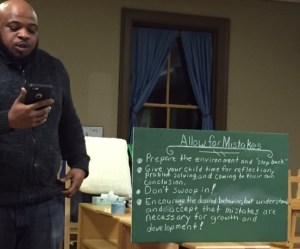 Mr. Warren ended with his own classroom tenets of allowing for mistakes: