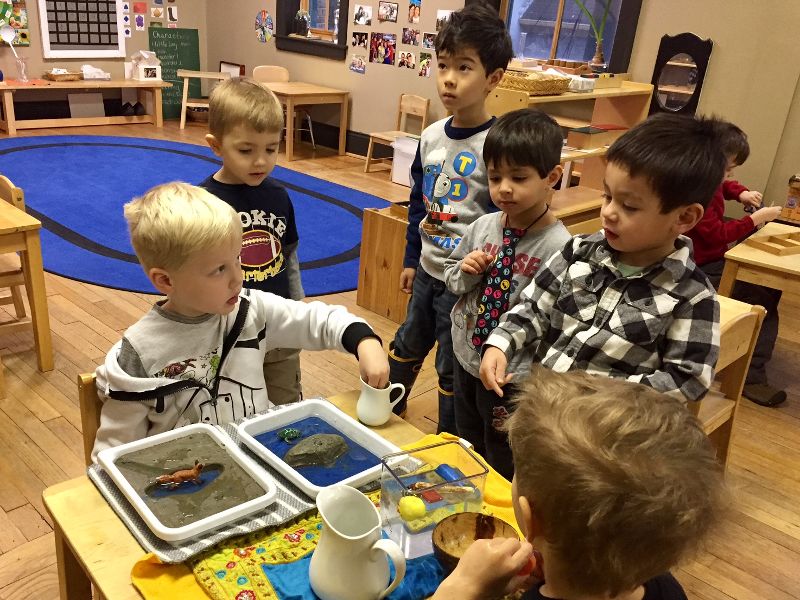
Last month, The New Century School hosted a Primary Workshop to provide parents with a firsthand experience of the Montessori approach to pre-K education. Unlike Open Houses and Information Nights that are general question-and-answer forums, a workshop’s purpose is to show you specifically what your children are learning and doing during their daily class time. For those parents who did not attend Montessori school as kids, the primary workshop is a marvel—both eye-opening and fun. Maria Montessori developed the Montessori materials based on her extensive observation of children ages 2 1/2 through 6 years. Her goal was to put academic success within their reach by setting realizable achievement milestones, so to do that, she tailored materials to be used the way she saw children interacting with their world. Primary students use these materials nearly exclusively, and seeing how the materials are actually used and learning what each does for the child’s development was the focus of the workshop.
There are four lead Montessori teachers this year: Lisa Reynolds, Elizabeth Bowling, Maria Mosby, and Yangyang Li, and each presented an aspect of the primary curriculum.

Work Cycle
Mrs. Bowling went first, introducing the foundational concept of the work cycle. “This is so incredibly important and something we are always looking for in the children,” she began. “The classroom environment focuses on independence, sense of order, concentration, and coordination. This takes time not only to develop within a child but it takes time in the day as well, so we do our best to provide an uninterrupted work time, usually 3 hours, in the morning.” She explained that, as Montessori educators, they are closely observing what materials that the students opt to work with because it demonstrates where their interests lie and also shows the student’s mindset. “You want them to practice lessons you’ve given them, but you also want them to be able to go back to works that they’ve mastered as well.”
The work cycle has three parts: preparation, working, completing (putting away). To prepare, the student spreads out a throw rug and lays out the components of the “work*” in an orderly fashion. Next the student does the work, following the steps as the teacher has previously shown them. Finally, they clean up the work, put it away on the shelf, and choose a new work. “That’s a lot when you’re 3, or 4, or even 5 and 6,” said Mrs. Bowling. “So, again, that takes some time to develop but it’s what we’re working on every day with your child, that complete follow through. This consistency aids the development of care and respect for their belongings and the environment. It also shows their ability to follow directions. It even introduces the basics for plot structure, which will aid them in reading comprehension. A lot goes into everything your child is doing in a day,” she said.
Montessori Skillset
Ms. Mosby spoke next, to talk about the theme of independence, confidence, and risk-taking within safe parameters. “From the time the child is born, he is working on little things that develop his independence,” she explained. “Before he learns to walk he has to learn to crawl. The child continuously seeks opportunities to increase his independence through a series of natural developments and milestones. The adult’s role, the parents role, the teacher’s role—-especially in this environment—is to foster it.” It’s a well-known Montessori tenet that we should never let a child risk failure until he has a reasonable chance of success. One way this bears out in the classroom is that everything is child-sized, from all furniture to the tools and materials, and the environment is prepared by the teacher.
“Everything we set up for the child to do helps them successfully do each work. The child is allowed to manipulate all of the things we have set up.” And here is where the risk-taking can come into play. The child may not be ready for a particular work or may need another lesson on how to complete it. But the important thing is, mistakes are okay. “We don’t correct the child,” said Ms. Mosby. “We let him discover his mistake and then we’ll go back and assess it later, we don’t interrupt his concentration. What we’re working on in this stage is developing that concentration and really helping him to focus on one thing at a time, isolating one concept and then adding more and more.”
This will help get them ready for elementary, where they’ll be doing new things, encountering additional challenges, and collaborating with other children. “At this stage, she said, “they’re working with just one thing at one time by themselves. That’s why you’ll see mostly one or two seats at a table. We don’t want too many children working together because they tend to distract one another. So, allowing a child to develop skills unhindered by an adult helps to develop independence, confidence, and appropriate risk assessment. We’re watching to make sure they’re safe while at the same time giving them that ability to assess risk for themselves, make mistakes, and learn from them.”
Practical Life
Newly certified Yangyang Li spoke about the Practical Life component of the Montessori curriculum, which, she explained, comprises four areas: care of self, care of the environment, grace and courtesy, and movement of objects. She said that, “practical life connects the child to the world, to the environment. It’s also indirect preparation for math and other academics.” If a child is interested in something, she explained, “the child will concentrate on it.” She also said that children at this age want real experiences, which also cultivates concentration as well as self-motivation. “Please help me to do the work by myself,” said Li Laoshi, is the attitude they convey. All of this also develops emotional independence.
Importantly, the child uses all of the senses when engaged in a practical life work, which could be cleaning tables, sweeping, arranging flowers, or anything else that is a part of daily chores. When the instructor demonstrates a practical life lesson, as you can see in the video below, she moves slowly and deliberately, taking care to experience all of the tactile sensations, sounds, smells, and so on, and follows an orderly sequence of steps. Thanks to the parent volunteer who now understands the correct way to do some washing up!
Interconnections
Mrs. Reynolds explored how the Montessori curriculum is interconnected, from practical life to science and geography, math, and language. “The materials build upon one another, making the progression important,” she explained. “Some works isolate one skill and focus on it while others may be educating the child in multiple ways. Many of the materials are self-correcting, which also promotes independence and problem solving.”
Questions and Answers
A Q&Q followed, and parents were given the chance to inquire about specific aspects. Two that brought home a lot of the concepts are reproduced here.
Parent: What are some examples of work that the child is doing on a daily basis?
Instructors: The children are all working on different things. An example might be a group of 3-year-olds having a lesson on sounding where we would go around the room have them try to pick out something that starts with a certain sound. There is a lot of preliminary work so they might be doing pouring work, cleaning work and then you might take those things away and they might start pouring their own snack or working with some food preparation. They have started making coffee for us (laughter). It’s such a caring, loving thing for them. So they’re all working on different things in all different levels. You might see a teacher on the rug giving a lesson and the other teacher will be observing other children working independently on their lessons.
Parent: One question related to independence, where do you strike a balance between letting them explore on their own and then finding out it’s not working to putting them on the right track? At what point do you reorient them?
Instructors: First of all, we’re looking at, did they choose a work they’ve actually had a lesson on because you want to make sure they have. If they haven’t had a lesson on something then we intervene and redirect. If you have given this child a lesson and they’re picking up this work and it’s becoming too playful and not purposeful work then that might be a time we might come along side them and redirect them. We are watching that. There’s a purpose for the work. Of course, if they are trying and having difficulty, that is just part of the process. If they’re throwing things or being disruptive, that’s a different story. So we have to use our judgment to determine which direction to take.
———
*Searching with the keywords “work cycle” in the search bar of this blog will bring up past years’ posts about primary workshops. They all have slightly different perspectives and are worth checking out if you are interested in learning more about Montessori education at TNCS.
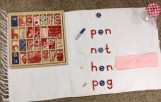
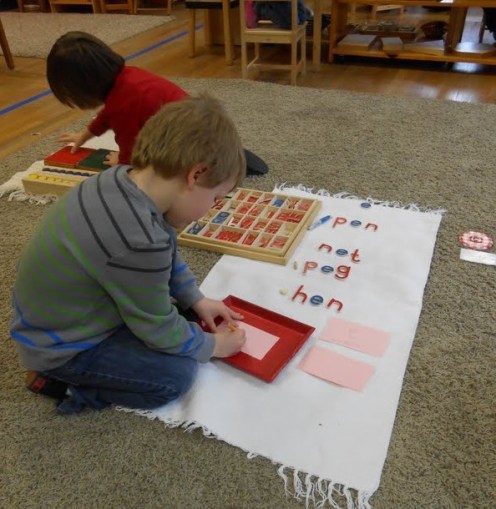 Mrs. Lawson says that language acquisition is perhaps the most important facet of child development, enhancing every other aspect. Communication also inherently conveys order—there’s a beginning, middle, and end, which underpins the Montessori approach as well.
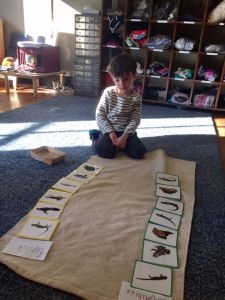 Maria Mosby handled the Science portion of the workshop. Just as with the other Montessori categories, the scientific disciplines are taught from simple to complex, but here the progression can be less linear, as students are strongly encouraged to discover the natural world, rather than simply be told about it, explained Ms. Mosby. Science tends toward botany and biology, with kids exploring, for example, life cycles and habitats or getting a tactile boost from perusing the sundry contents of the “nature basket.” Ms. Mosby says she uses every opportunity to get kids out of their “comfort zones” by asking questions like, “What is this made of?” to launch various lines of inquiry and expand student’s views of their worlds.
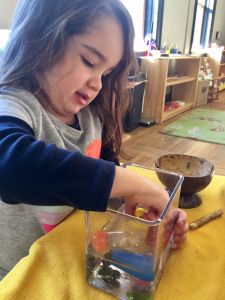 Probably the favorite activity among the younger primary crowd is the Sink and Float work, in which kids get to pour water (what?) into a vessel and then systematically dunk items (what?) into the vessel to see which will float and which will sink. Montessori is nothing if not kid-friendly!
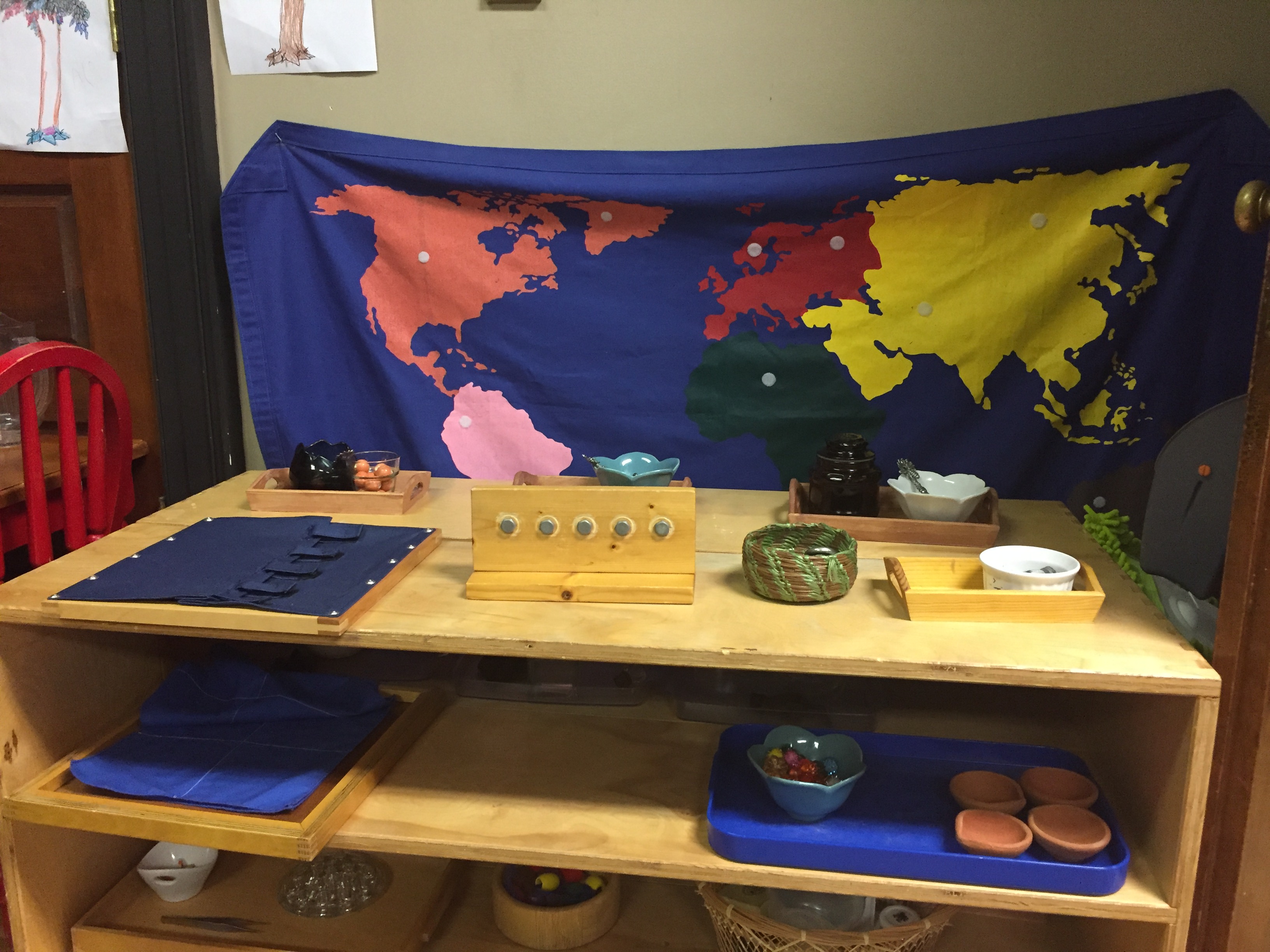
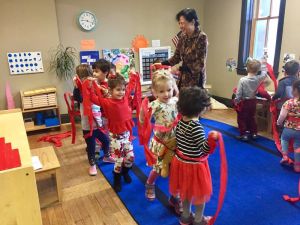 Lisa Reynolds introduced the group to Global Studies. “These lessons, she says, “give students the opportunity to learn about other cultures.” Primary teachers also display objects from around the world in their classrooms to have a physical representation of a particular locale always on hand.
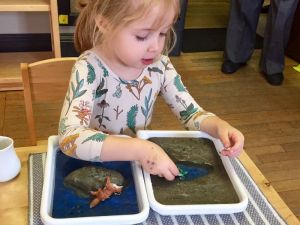 A typical activity here might be doing puzzle maps to promote visual recognition of the names and topography of the seven continents and their relationship to each other. Students also develop manual control with manipulation of the puzzle pieces. From here, kids advance to push-pinning the outlines of the various land masses and creating their own “maps.” Another popular Global Studies activity is learning about the relationships between various types of land masses and water.