New Year’s Resolutions TNCS Style

Keeping New Year’s resolutions is notoriously difficult. Some experts advise against making any at all due to the consequent self-loathing that can envelope us once we realize we have failed epically! A new study claims that only 8% of those who make New Year’s resolutions keep them, and those who don’t give up after just 1 week. On the flip side, however, “People who explicitly make resolutions are 10 times more likely to attain their goals than people who don’t explicitly make resolutions.” So do we or don’t we make resolutions?!

We absolutely should (we’re actually hardwired to) . . . but with two key differences. Part of the key is not putting so much emphasis on target dates. Without room to slip, fall, and pick yourself back up, a resolution becomes one of those all-or-nothing pipe dreams with a built-in escape hatch—“I just couldn’t do it. Maybe next year.” Failure and recovery is an inherent part of any worthwhile process, so be realistic about that and don’t let slip-ups completely derail you. “Fail better.” The other difference is in setting small, specific goals instead of grand, sweeping changes. Abstractions such as “lose weight” or “stop smoking” are doomed without a plan in place that provides incremental and achievable daily steps. Ultimately, those small steps will yield the desired result.

Thus, the list below comprises a manageable, realistic, yet worthy set of goals that are universally beneficial. Even better, methods to accomplish each individual goal are also given, taking all of the guesswork out of making 2014 a healthy, happy year!

1. Eat a healthier diet, full of fresh vegetables and fruit: Join One Straw Farm CSA (even if it isn’t a stated goal, you’ll likely drop some pounds in the bargain).

The available bounty ranges from onions, peppers, lettuces, chard, kale, cabbage, broccoli, cauliflower, etc. to herbs—rosemary, oregano, thyme, chives, cilantro, parsley, etc.—and fruit, such as raspberries, strawberries, watermelon, and gorgeous varieties of heirloom tomatoes. . . Starting in June and running through November, on a set day of the week, “shareholders” get 8 pieces of 3–6 items, primarily vegetables . . . for about $24 per week.

2. Read more: Spend 20 minutes reading with your kids before bedtime (as well as curl up with your own reading material before lights-out). The benefits are varied and far-reaching . . . and what better way to close out the day?

[A study shows] that math and reading ability at age 7 years are linked with socioeconomic status (SES) in adulthood. Interestingly, although math and reading ability was also significantly associated with intelligence scores, academic motivation, and education duration, the association with later SES was independent of the family’s SES during childhood. Moreover, the researchers were not expecting to find that specifically math and reading ability were more important than general intelligence in determining SES. In other words, what we’re born with and what we’re born into may not be as important as what we learn in second grade. [The] findings emphasize the importance of learned skills. What this boils down to is really good news for students—the return on improving these skills at all levels is huge, from remedial to the most gifted. “Math and reading are two of the most intervention-friendly topics,” [researchers] say. “Practice improves nearly all children.”

3. Hone math skills: Spend 15 minutes playing math games with the kids before bedtime (like the TNCS Facebook page for games you can play at home to dovetail with Ms. Roberts’s work in class). You may be surprised at how these simple exercises improve your own day-to-day efficiency and obviate that smartphone calculator!

STEM is all over the media, and with good reason. STEM subjects are inherently investigative in nature, cultivating self-guided exploration and producing a greater understanding of the physical world. Ms. Roberts says, “STEM is important for everyday life; for example, we use math at the grocery store and at the bank. And science explains how the world works.” Another appeal of early STEM learning is the downstream payoff. Recently, NPR did a Planet Money story about what job fields yield the highest incomes. In “The Most (And Least) Lucrative College Majors, In 1 Graph,” STEM came out almost scarily far ahead (that discrepancy is another story). The focus of other media coverage is the nation’s big move to catch up to other developed countries, whom the United States currently lags far behind in depth and breadth of STEM education.

4. Get more sleep: Impose a consistent bedtime (for kids’ and parents’ improved overall health).

“Sleep is no less important than food, drink, or safety in the lives of children.” And yet, with our busy lives and comings and goings, we can inadvertently contribute to sleep deprivation in our kids. “With parents working long hours, schedules packed with school, after-school activities, and other lifestyle factors, naps are missed, bedtimes are pushed back, mornings start earlier and nights may be anything but peaceful. Missing naps or going to bed a little late may not seem like a big deal, but it is. It all adds up, with consequences that may last a lifetime.”

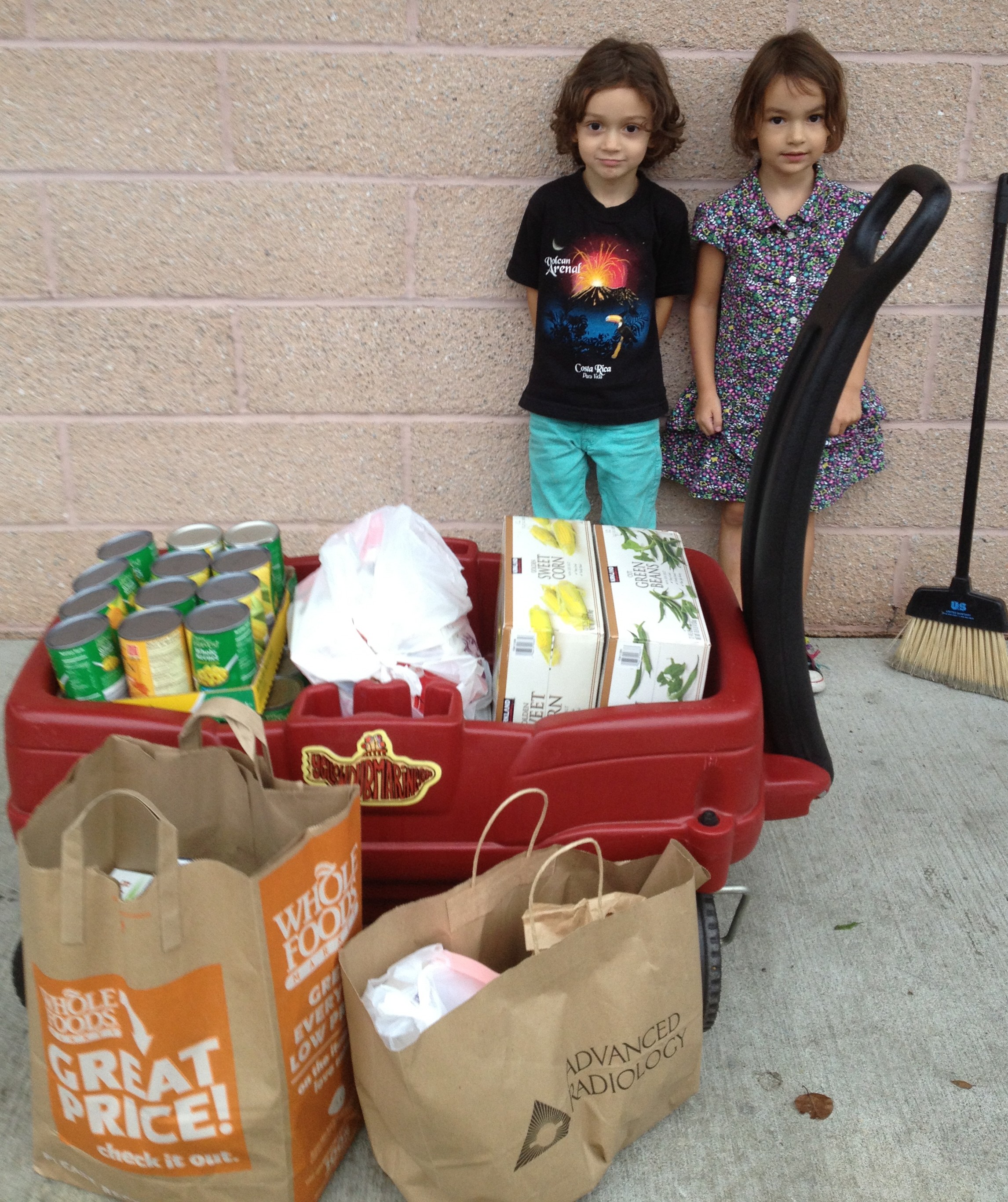
5. Be more altruistic: Donate to local and international charities through TNCS’s food, clothing, and dime drives.

Howsoever you decide to share your wealth, remember that you will actually derive personal benefit from your selflessness—a beautiful paradox! Being altruistic is a  recognized happiness inducer!

6. Be more environmentally conscious: Join Clean Currents (bonus—you’ll actually save money on your power bill).

The most obvious benefit to wind energy is its environmental friendliness. “Windustry” ameliorates climate change by not only providing a non-polluting source of energy but also by displacing the greenhouse gas emissions that have already polluted the atmosphere from conventional power. But there are other tremendous advantages, too. By reducing our dependence on fossil fuels, for instance, clean energy also makes us less vulnerable as a nation to the vagaries of the international oil market . . . and to the associated security risks. Moreover, ever-renewable wind is a cash cow for farmers. Wind farming almost effortlessly generates considerable income without taking up land needed for crops as well as creating jobs and boosting the economy.

7. Learn a foreign language: Practice Words of the Week with the kids, and read the monthly classroom newsletters. Words of the Week are posted each Monday on both The New Century School website (during active school semesters) and on TNCS’s Facebook page (with pronunciations). Stay tuned for a blog post this month dedicated to other ways you can learn Mandarin and Spanish along with your kids at home!

8. Get more exercise: Take a class at Sanctuary Bodyworks while the kids are downstairs at The Lingo Leap. People who exercise are not only in better physical shape, they are also more cognitively and emotionally fit.

Exercise dramatically enhances circulation to the brain and encourages synaptic growth, thereby priming the brain for improved function—providing the “spark,” in other words. Improvements in function include both mental health as well as cognitive ability.

9. Make mornings less stressful:  Sign up the kids for the Garden Tuck Shop lunch program. As if you don’t have enough to do in the mornings—why not let somebody else provide your child with a wholesome, nutrition-packed homemade hot lunch? Even better many ingredients come from TNCS’s on-premise greenhouse, and all others are locally sourced.

You grow in the same environment as your food, so you have a divine connection. Your children and your plants are growing under the same sun and being touched by the same wind, seeing the same clouds and the same moon. The plants growing in your environment have withstood those particular elements. They are perfectly engineered by nature to be exactly what you physically need, right now.

10. Volunteer!: Complete your volunteer hours. Another way to connect with your community is to give something back to it.

Volunteering at TNCS is not a burden; it’s a pleasure—no, an opportunity, a gift even. It’s a chance to be deeply involved in your children’s day-to-day school lives, to connect with them on their turf, and to see and experience what’s going on in their lives from their points of view, all while providing a service to the school. There’s nothing so reassuring in parenting than to get proof that your child is happy and flourishing even when you aren’t there.

So go ahead—pick one (or several) and reap the fruits of your labor. Just don’t get discouraged by bumps in the road. We’ve got all year!
TNCS Gives Thanks by Giving Back

Beans & Bread---it's not only the nutritionally perfect combination of protein and carbohydrate, but it suggests new possibilities, just as Jack's magic beans opened up a new world via his giant beanstalk.

Beans & Bread—it’s not only the nutritionally perfect combination of protein and carbohydrate, but it suggests new possibilities, just as Jack’s magic beans opened up a new world via his giant beanstalk.

With the autumn holiday season gearing up, The New Century School is counting blessings, taking stock of its manifold accomplishments, and looking for ways to share its good fortune with the surrounding community. So, just as TNCS did last year, we are once again hosting a food drive from 11/13 through 11/22 to donate to St. Vincent de Paul’s Beans & Bread program. Head of School Alicia Danyali says, “We chose Beans & Bread because they are close to the school, and we feel strongly that giving back should be kept in the neighborhood or in close proximity to what would make a difference locally.” TNCS is participating in a measurable way in keeping Fell’s Point viable and sustaining.

“Beans & Bread is a comprehensive day resource program that offers a complete range of supportive services designed to help individuals attain stabilization and self-sufficiency. Services are client-centered and focused in four core areas:  housing, employment, health, and recovery,” according to their website. TNCS is making it extremely convenient for us to assist with these very worthy pursuits. Simply bring your donatable food items to drop off in boxes placed outside the school office when you come for your parent–teacher conferences in the coming 2 weeks. “I cannot remember how much we collected last year,” says Ms. Danyali, “but I know we filled an SUV to the brim when delivering the goods! This year, I hope every family at TNCS can participate and donate a minimum two items from the needs list, if possible.”

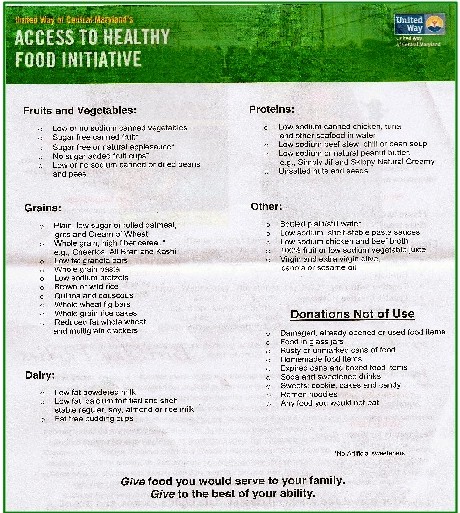
Emphasize low-fat, low-sugar, whole-grain foods that you would serve your own family! A copy of this list was sent home in your child's school bag.

Emphasize low-fat, low-sugar, whole-grain foods that you would serve your own family! A copy of this list was sent home in your child’s school bag.

Sounds eminently doable! Partnering with United Way of Central Maryland’s Healthy Food Initiative, Beans & Bread asks for food items to be those that you would serve to your own family. Also, choose whole-grain and low-fat options when possible, avoiding sugar-added and sweetened food and drinks.

True to form, the TNCS community is finding other ways to demonstrate their inherent altruism. Such creative and inspiring acts include donating surplus Halloween candy to deployed armed forces, for example. Another idea that caught on like wildfire among TNCS families was asking for charitable donations in lieu of birthday gifts at kids’ parties. Local hunger charities (such as Beans & Bread and Our Daily Bread) welcome canned goods collected at these parties, or cast your net more broadly and request small monetary donations to buy livestock through Heifer International, as one family did. Not only do the beneficiaries of these donations see immediate life improvement and empowerment, but your kids get the lifelong reward of learning to share and give. It’s wonderful to see how they so naturally welcome the idea, even when it means giving up birthday presents!

Howsoever you decide to share your wealth, remember that you will actually derive personal benefit from your selflessness—a beautiful paradox! Being altruistic is a  recognized happiness inducer!

Proceeds from our 5th birthday party went to Our Daily Bread! We were so happy that our friends helped us feed our Baltimore neighbors, and we enjoyed meeting the volunteers at ODB and seeing their huge kitchen :)!

Proceeds from our 5th birthday party went to Our Daily Bread! We were so happy that our friends helped us feed our Baltimore neighbors, and we enjoyed meeting the volunteers at ODB and seeing their huge kitchen :)!

Giving Back: TNCS Kids and Heifer International

As 2012 drew to a close, The New Century School students had the holidays on their minds. They played the dreidel game, trimmed trees, and put on a holiday show for parents. They ate latkes and applesauce and strung popcorn garlands.

today's snack is special---latkes and applesauce made by the kids right in their classroom

. . . Later, the fascinated kids got to sample homemade latkes garnished with applesauce—YUM!

holidays include Hanukkah latkes and other cultural customs at TNCS

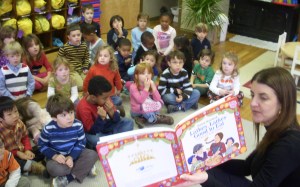
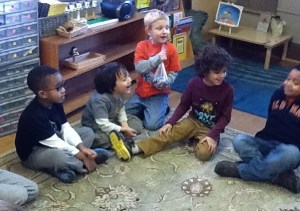
A rapt TNCS audience listens to Mrs. Cooper-Danyali read about Hanukkah latkes . . .

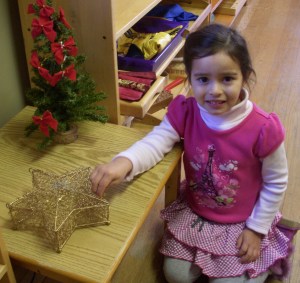
student poses proudly with her holiday practical life work

I trimmed this little tree all by myself!

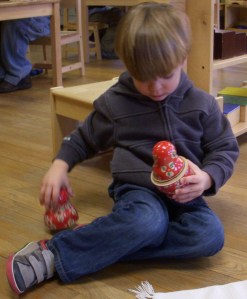
student works his way to the smallest doll, while strengthening hand muscles and learning persistence

Having multilayered holiday fun with a Matryoshka doll—S-RazhdestvOm!

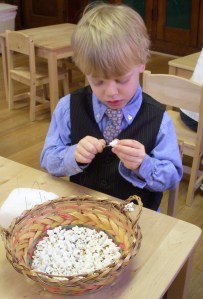
these popcorn and cranberry garlands will decorate trees on TNCS grounds for natural ornamentation and snacks for visiting birds

A kindergartner strings popcorn to drape on a tree for birds visiting the school grounds. Cranberry garlands were also presented to the lucky birds!

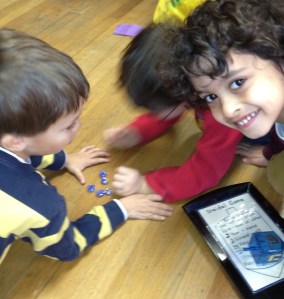
playing with the dreidel is fun and educational

A spectator pops in to check on how the dreidel game is going. All clear!

But amidst all the festivities and the jolly atmosphere, they didn’t lose sight of core TNCS values. Environmental sustainability, social involvement from community through global levels, and human compassion informed their daily activities, giving a special resonance to their merry-making. With the help of their teachers, they collaborated on an important project to donate livestock to a family in need through Heifer International.

“Heifer International’s mission is to work with communities to end hunger and poverty and care for the Earth,” states the Heifer International website. But, “it all started with a cow.” In the 1930s, an American named Dan West volunteering in wartorn parts of Western Europe put the “Give a man a fish, you have fed him for today; teach a man to fish; and you have fed him for a lifetime” proverb to work in a new way. He saw that by giving people cows, they would have a replenishable milk source. Their nutrient requirements would be satisfied in both the short and the long terms. Thus, Heifer International was born.

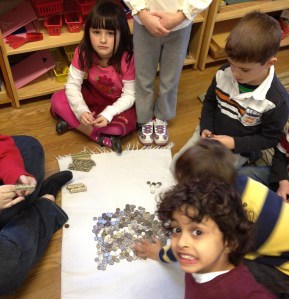
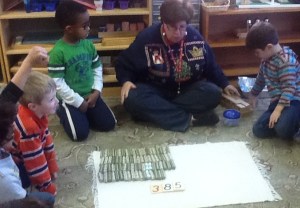
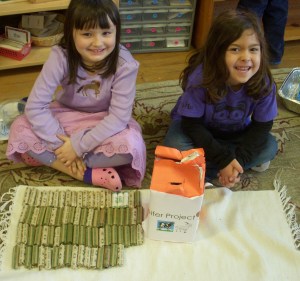
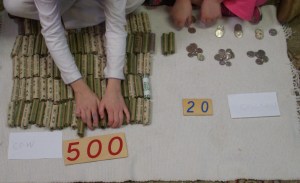
Eighty years later, the development nonprofit organization has expanded to all reaches of the globe and continues to nourish the world. TNCS kids were thrilled to be part of this altruistic work and experience the joy of giving firsthand! In Operation Donate your Dimes, primary teachers (Mr. Sellers, Mrs. Lawson, Mr. Warren, and Ms. Lazarony) asked their students to collect dimes and bring them to class over a 2-week period in December. As the mountain of coins grew, rising K’s and kindergartners were assigned to estimating, then counting, then rolling them, and, finally, graphing progress toward the goal. Said teachers:

As we start to see how much money we can raise, the children are going to vote on what animals they want to buy. They will be doing projects and games to help them understand what the money is going for. We hope that you will be willing to help us with this project. The more dimes we collect, the more animals we can buy!

estimating number of dimes by weighing the sack to determine how much money TNCS primary students will donate to Heifer International

A student weighs the sack of dimes to estimate how many it contains. Laughter ensues as some pretty wild guesses are thrown out!

TNCS kindergartners get the mathematically challenging task of counting thousands of dimes to donate to Heifer International

Counting the dimes takes all hands on deck!

TNCS kindergartners all worked together to roll the thousands of dimes to donate to Heifer International

Rolling dimes is hard work—sheesh!

TNCS kindergartners have rolled and counted $385 worth of dimes to donate to Heifer International

So far we have raised $385!!!!! Fist pump!!!!

TNCS kindergartners proudly package their dimes to donate to Heifer International

The dimes keep on “rolling” in!

TNCS kindergartners collected $520 and were able to donate a cow and a flock of chickens to a family in need through Heifer International

Ultimately, the kids collected $520—enough for a cow and a flock of chickens!

It was an exciting way to get the kids involved in community service while honing math skills, working as a group, and exploring the deeper meaning of the holiday season. They can feel glad for the family they have helped, and they will not likely forget this experience. It was an important lesson for our budding philanthropists.

Whatever holiday you celebrate this time of year, may it bring you joy, warmth, and peace.

—Thousands of candles can be lighted from a single candle,
and the life of the candle will not be shortened.
Happiness never decreases by being shared.
Siddhārtha Gautama Buddha
Kindly let us know your thoughts in the comments section—we love to hear from you!