TNCS Rings in the Year of the Sheep!

chinese-zodiac

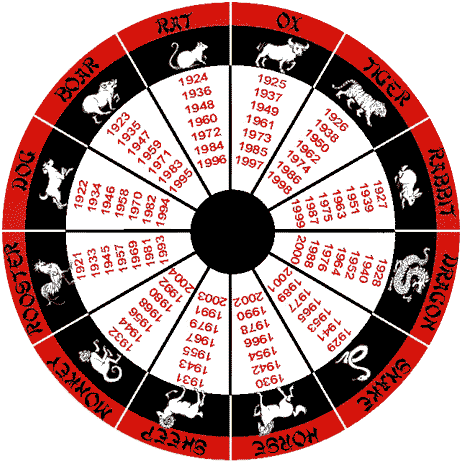
Each of the 12 zodiac signs are represented by an animal. This year, 4713, is the Year of the Sheep (or Goat).

As always at The New Century School, the Chinese Lunar New Year is a big deal. It brings numerous opportunities to practice spoken and written Mandarin as well as the chance to participate in Chinese cultural celebrations. This year, Year of the Sheep (Yáng de yī nián, 羊的一年), New Year celebrations started on February 19th and will continue through March 5th. An ancient legend credits Buddha with creating the Chinese zodiac, when he asked all animals to meet him one Chinese New Year and named a year after each of the 12 who arrived. He also proclaimed that a person’s attributes would correspond with the traits of the animal whose year he or she is born in. Those born in sheep (some say goat) years tend to be artistic, charming, sensitive, and sweet, and it is considered the most creative sign in the Chinese zodiac. Not surprisingly, then, Michelangelo, Jane Austen, and Mark Twain were “sheep.”

At TNCS, where language-learning is the hallmark of the school’s scholastic identity, culture and customs intersect with communication to enhance language acquisition. Cultural understanding is essential to language learning. Experiencing another culture develops understanding of its relationship to its corresponding language as well as deepens the student’s appreciation of his or her native culture. Students begin to see other people’s points of view, ways of life, and contributions to the world (see TNCS’s Foreign Language Program Embraces the 5 Cs).

The benefits are, therefore, obvious, but the plain fact is, Chinese New Year is fun! School-wide, classes are honoring the New Year with a variety of activities. In addition to their regular Mandarin studies, elementary students have made dumplings (包了饺子) as well as wove traditional silk bracelets (布纹手镯).

This slideshow requires JavaScript.

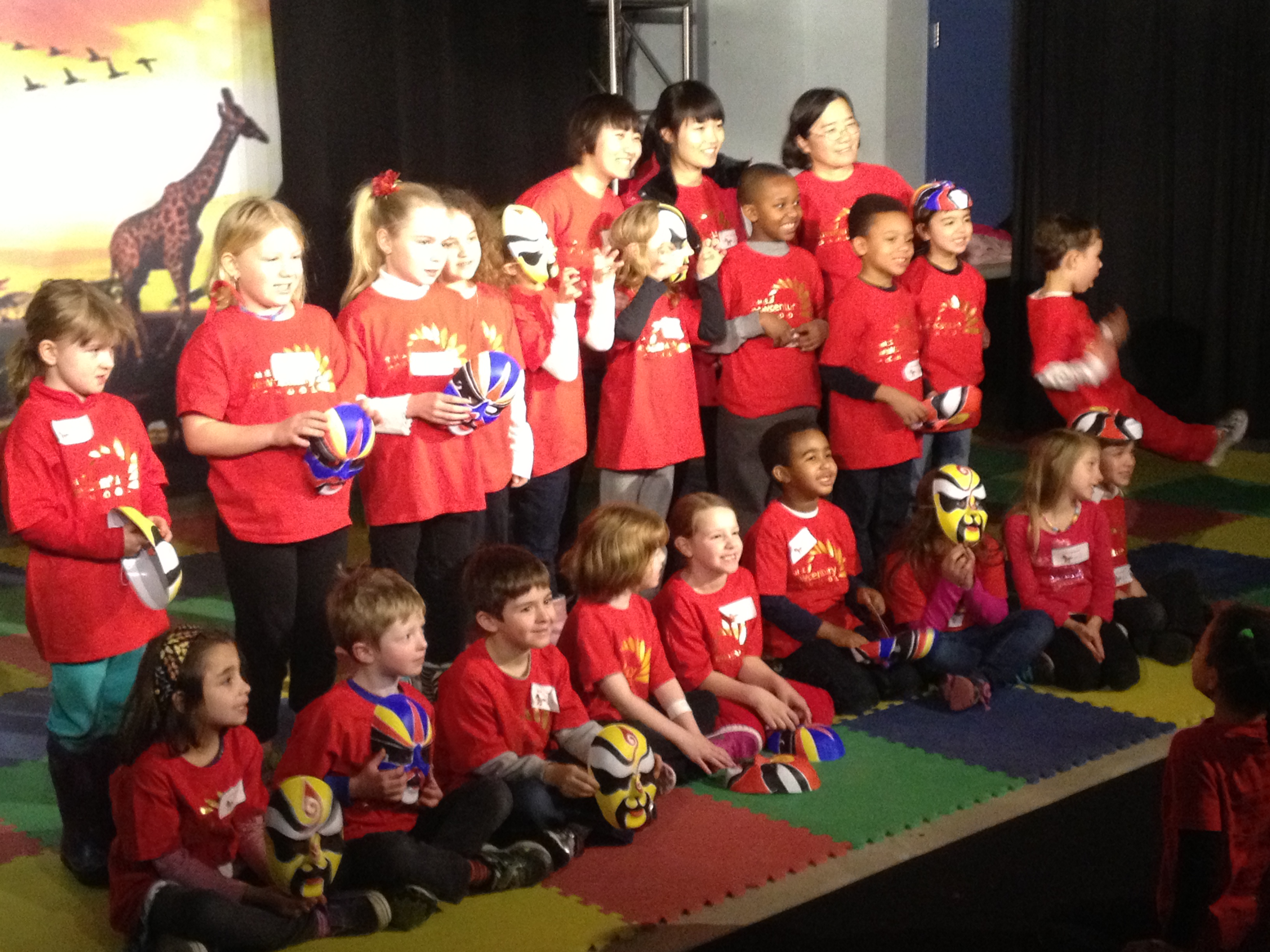
And, for the third year running, TNCS students performed at Port Discovery before a proud audience of parents. Xie Laoshi once again outdid herself in organizing and emceeing this eagerly anticipated annual tradition. (See Year of the Horse Festivities Giddy-Up at TNCS and Charmed by TNCS’s Year of the Snake Performance for highlights from the previous 2 years.)

And now for the moments you’ve all been waiting for—here are the performances! TNCS kindergarteners/1st-graders sang first about a dog with a bone and then performed a chant.

TNCS lower elementary students next took the stage for their song.

The older elementary students performed next with songs and some exciting Chinese drumming.

The whole gang convened at the end for the grand finale about achieving international peace!

Readers, we wish you peace and good health in the Year of the Sheep!
Year of the Horse Festivities Giddy-Up at TNCS

Lunar New year celebration is a big event at The New Century School! Enter a world of food, music, culture, and fun!

Lunar New year celebration is a big event at The New Century School! Enter a world of food, music, culture, and fun!

Chinese Lunar New Year is a big deal at The New Century School. It affords numerous opportunities to practice spoken and written Mandarin, but it also presents a window into a pinnacle of Asian culture. This year, the New Year celebrations started on January 31 and will end today, February 14. At TNCS, where language-learning is the hallmark of the school’s scholastic identity, culture and customs intersect with communication to enhance language acquisition. Cultural understanding is essential to language learning. Experiencing another culture develops understanding of its relationship to its corresponding language as well as deepens the student’s appreciation of his or her native culture. Students begin to see other people’s points of view, ways of life, and contributions to the world (see TNCS’s Foreign Language Program Embraces the 5 Cs).

The benefits are, therefore, obvious, but the plain fact is, Chinese New Year is fun! (And captivated kids are primed for learning!) This year is Year of the Horse (马年 [mǎ nián]), which is part of a 12-year cycle of animals (rat, cow, tiger, rabbit, dragon, snake, horse, sheep, monkey, chicken, dog and pig) comprising the Chinese zodiac. Each animal in turn interacts with the five elements: wood, metal, fire, water, and earth. This is year of the wood horse, taking over from the year of the water snake. In Chinese lore, the horse represents travel, competition, and victory and is a symbol of leadership, nobility, and freedom. Those born in the Year of the Horse (2014, 2002, 1990, 1978, 1966, 1954, and 1942) are said to be cheerful, popular, and fun-loving. Click here for other interesting tidbits about the Year of the Horse.

TNCS elementary students performed two Chinese songs at Port Discovery to celebrate Chinese New Year.

TNCS elementary students performed two Chinese songs at Port Discovery to celebrate Chinese New Year.

School-wide, classes honored the New Year with a variety of activities. In addition to their regular Mandarin studies, elementary students learned Chinese paper cutting (剪纸) and how to make traditional Chinese New Year cake and dumplings, did special art projects, shared traditional stories, and sang songs. They performed two of their new songs at Port Discovery on Saturday, February 8th for a proud audience of parents. Xie Laoshi said, “I’m really proud of the students. They sang their songs very well!” Elementary students also read about Chinese New Year in Spanish!

Not only do TNCS students learn both Chinese and Spanish, but they also learn about China---in Spanish!

Not only do TNCS students learn both Chinese and Spanish, but they also learn about China—in Spanish!

Primary students also made dumplings and learned new words and songs relating to Chinese New Year:

  • “Singing and Smiling”: 歌声与微笑 (song)
  • “Happy Chinese New Year”: 新年好 (song)
  • “That’s Wrong, That’s Wrong”: 不对, 不对 (story about a family preparing for a New Year celebration, but everything goes wrong)
  • “Feet”: 脚 (nursery rhyme incorporating movement)
  • “Looking for a friend”: 找朋友 (game)

All students learned about customs that take place during Chinese New Year celebrations, such as:

  • 做饺子: To make dumplings
  • 拿红包: To receive red envelopes
  • 放鞭炮: To set off firecrackers
  • 吃汤圆: To eat tangyuan (boiled balls of glutinous rice flour, eaten during the Lantern festival)
  • 挂灯笼: To hang lanterns

Readers, we wish you peace and good health in the Year of the Horse (馬年安康, mǎ nián ān kāng)!

Charmed by TNCS’s Year of the Snake Performance

February 10th, 2013 marked the beginning of The Year of the Snake (蛇 Shé) in the Chinese Lunar New Year, also known as the Spring Festival.  Although in Chinese lore the snake year is commonly considered less propitious than its predecessor (Year of the Dragon), The New Century School rang in the new year in high style. The meteor strikes, nightmare cruises, and olympic athlete scandals that the lunar year commenced with notwithstanding, TNCS honored the snake with weeklong festivities (such as making and eating dumplings, or 饺 jiǎo), culminating with a special performance at Port Discovery on Saturday, February 16th.

This was TNCS’s second annual Port Discovery performance in honor of Chinese New Year, and the primary and elementary students just loved it! The Chinese teachers spent weeks teaching them the songs and poems that made up the program. Chen Laoshi (a.k.a. Charlotte) and Xue Laoshi (a.k.a Cici, or 薛雪) presided over the actual performance, keeping their little red-and-gold-garbed snakes, mice, roosters, dragons, etc. on task. Xue Laoshi  says, “I am so proud of all the students. They all did a good job.”

The performance comprised two songs and a poem. Xue Laoshi explains that the first song was the Happy New Year song, sung by the primary students. Next, the primary and elementary students together sang the Chinese Zodiac Song and acted out the characters they were describing. Lastly, the elementary students recited a famous Chinese poem about a snowy landscape. Because the poem is quite long, they read in unison from placards printed with both English phonetic and Chinese characters. The students are clearly making remarkable progress—not only can they speak Mandarin beautifully, but they can also read and write it!

Xue Laoshi isn’t prepared to stop there, however. She says, “For the Year of Snake, I plan to help the students make even more progress. Maybe they will even tell you a story in Chinese not just read it!”

Sounds like this Year of the Snake might not be so bad after all!