Why You (Yes, You!) Should Consider Becoming a Host Family!

Given its firm emphasis on global citizenship, The New Century School is working harder than ever to expand cultural programming for 2016. In addition to the ongoing guest interns from around the world who act as assistant teachers and immerse TNCS students in their native languages in the classroom, a big part of this year’s push will include hosting separate groups of teachers and students (and chaperones) both during the rest of the school year and during the summer months.

International Campers

Camp Instructor Craig Lapreziosa and our Chinese and American friends say cheese!

A trial of such programming happened in the summer of 2013, when a group of three Chinese girls age 9 years and the mothers of two of the girls attended a 2-week International Camp at TNCS. On the heels of that initial success, TNCS Co-Founders Roberta Faux and Jennifer Lawner are finding ways to make international exchanges a regular happening.

Later this month, for example, a group of 15 Chinese kindergarten and preschool educators will be visiting Baltimore, hosted by TNCS, for a week-long conference on various aspects of education. Their conference will include lectures on such topics as Montessori education, multilingual education, classroom management, and more as well as school tours of John Hopkins University, Loyola University, The Key School, the Baltimore School for the Arts and—of course—TNCS. Immersed looks forward to covering this visit and conference, so please stay tuned!

In the meantime, there are other possible programs in the works that are more student oriented. Groups of both Chinese and Spanish elementary-age children have been invited to join TNCS this summer—opportunities so rich in possibility for both host and visitor that this topic bears exploring even before program details are finalized.*

tncs-new-admissions director

Hosting Expert Dominique Sanchies!

Depending on the group and its country of origin, the programs will likely vary in certain details, but they will all include the chance for the TNCS community to act as host family to one or more visiting children (and, possibly, chaperones). Admissions Director and Assistant Head of School Dominique Sanchies, in fact, is a huge fan of hosting and says, “I can’t say enough about hosting. I’m very passionate about it.” You may recall from a post back in the fall that Mrs. Sanchies put herself through college working as a group representative for EF Foundation for Foreign Study, a foreign exchange student company headquartered in Switzerland.

What was not reported in that bio, however, was that her family also hosted while she was in high school. Mrs. Sanchies says that the French girl, Gabine, they hosted remains her best friend to this day. The idea was that would improve her English during her stay with the U.S. family of French Canadian origins, but Mrs. Sanchies says that her own French also improved immeasurably at the same time. “She came into our home and was like an adopted child—my sister—for the entire summer. I was driving, so we went everywhere together. It was this great opportunity for me to learn all about Parisian culture, to live with somebody from that culture . . .to have her cook for us one night, to see how she dressed . . .it was just lovely. It was the best experience.”

Drawing on the memory of this wonderful time, it was a natural choice for her to join the EF Foundation. She worked with groups of Spanish 30 students ranging in age from 14 to 18 years to make hosting and being hosted an experience available to others. Her primary task was to place students with host families from the community, which came easily to Mrs. Sanchies because her first-hand experience and obvious passion quickly won over prospective hosts. Another part of Mrs. Sanchies’ position included hosting the Spanish teacher who accompanied the students. This friendship has also held fast through the years.

“Growing up in Portland, Maine, I was starved for culture,” said Mrs. Sanchies. “But the world opened up when my family hosted an exchange student, and the same will be true of TNCS families who host. Your kids are studying Chinese and Spanish languages, but imagine what could happen if a Chinese or Spanish student stayed in your home and accompanied your child throughout the day. The language fluency, the relationships, the cultural understanding . . . it just makes the world more accessible.”

Mrs. Sanchies and her husband have also hosted Chinese and Japanese students themselves in the past and may do so again, circumstances permitting. “I would love to host a child from another country—any country,” she said. “It’s just so enriching.” As for what is required of the host family, besides providing appropriate accommodations and meals, “it’s basically just keeping [the visiting child] safe and sound. Just like you’d do for your own children,” said Mrs. Sanchies. “It’s not much work. But the benefits could potentially explode.

Hosting Benefits

Never hosted or even considered hosting? Here are some of the tangible and intangible reasons why hosting is a transformative experience for both host and guest, most courtesy of ExchangeStudentWORLD.com and of Pitzer College. (You’ll surely add your own benefits to this list once you join the ranks of host families!)

  • Personal and familial development. Be it travel, school or work, foreign interaction with diverse cultures is a part of life. When individuals and families open their homes to students, personal development is inevitable. Familiarization with another culture and ethnicity expands the mind. It offers the entire family a study on how to be adaptive to intercultural interactions and demonstrates how different yet similar we all are.
  • The chance to help a student experience life in another country and culture. This is an amazing journey. They will have many questions about why you do things. They will want to try new activities and learn about your traditions. You will get to see your culture and your town through another’s eyes, which will likely be rejuvenating. This is also an excellent chance to learn about their country and culture as well.
  • The chance to gain a son/daughter. This experience will give you the chance to bond with a child in a way you never expected. Many will have so much gratitude for the opportunity you have given them. You will share many laughs along the way and make memories to last a lifetime. Often you will remain in contact long after they return home, and if you are really lucky you will get to see the child again!
  • You help your children to learn and grow. If you already have children this is a great way to help them learn about another country and culture—they will have a Host Sibling right there! Kids are great at asking questions and often you will learn through their questions. The bond children make no matter the age is wonderful to watch.
  • New language possibilities. Learning another language as a host family can be a lot of fun. Children in host families—even adult children—develop and expand analytical skills and even improve their English when they compare languages. As globalization redefines the world we live in, learning a new language is a rapidly growing asset in the business world. It can be beneficial for both a host and their family. When children are exposed to exchange students, they can learn the fun and simplicity of learning a new language.
  • Lifelong attachment. Although it might be hard to let go at the end, it is such a great feeling to know you have made this special bond with this student. You will make plans to email and call each other. Maybe he or she will want to come back for college, or to come back in a couple years to see you again. Maybe you will plan a trip to their country to see him or her. You have spent time getting to know this person, and the bond can be deep.
  • Have fun. Host families and students laugh. A lot. Whether giggling over the mispronunciation of words or sharing students’ excitement about newfound joys, host families have a tremendous amount of fun.
  • Change the world. Most important is the rewarding sense of fulfillment you will experience as a host family, knowing that you have played a key part in helping a young person achieve his or her dream.

But Mrs. Sanchies sums it up best: “You’ll fall in love, the kids will remain in touch, and who know what the future might bring.”

Additional Resources

Now that you’re convinced of the benefits of hosting and ready to host a student or students yourself, here are some other helpful resources for making the experience the best it can be:

From the Bureau of Cultural and Educational Affairs: Commonly Asked Questions

From Wandering Educators: 8 Tips for Hosting an Exchange Student

From One Life Log: Advice for the Host Family

*Although the enthusiasm for these programs is very much in place on all sides, the inevitable red tape surrounding foreign travel might take a little longer to work out in some cases. But it will happen!

Lessons in Gratitude at TNCS

Gratitude, according to psychologists, is the healthiest of all human emotions—good for both giver and receiver alike. Gratitude stimulates the hypothalamus (the brain’s stress regulation center) and the ventral tegmental area, which is a key part of our “reward circuitry” that produces the sensation of pleasure. Hans Selye, a renowned scientist who “discovered” stress, believes that gratitude produces more positive emotional energy than does any other temperament.

We don’t need science to tell us that focusing on life’s positive aspects makes us happier than does dwelling on the negatives—that’s pure common sense, or so says ancient Greek philosopher Epictetus: “He is a man of sense who does not grieve for what he has not, but rejoices in what he has,” as quoted in a recent NY Times article on the subject.

tncs-shows-gratitude

A Thanksgiving Feast to remember, put together by our wonderful TNCS teachers and our faithful TNCS parent volunteers.

This month, students at The New Century School have been demonstrating gratitude in all kinds of ways, from giving back to the local community to collaborating on a special feast (and, true to the TNCS spirit, in multiple languages!).

After donating a good-sized food collection to community outreach center Beans & Bread during American Education Week—and thank you to the Burton family for delivering the TNCS collection—TNCS students used the following week to show their thanks a little closer to home. First, Head of School Alicia Danyali interviewed the Upper Elementary students for their thoughts on what they are grateful for. Here are some highlights:

  • “I am thankful for my health.”
  • “I am thankful for my family and the opportunities they have given me.”
  • “I am thankful for my family, food, and really everything.”

Professor Manuel’s K/1st students made cornucopias holding pictures of family members—and worked in plenty of relevant Spanish vocabulary!

Finally, Li Laoshi and Yangyang Laoshi filmed Lower Elementary students expressing their gratitude for their family members in Mandarin.

It all culminated with the annual Thanksgiving Feast, which K/1st teacher Teresa Jacoby started off with a moving thank-you to the students, fellow teachers, and the TNCS families who together make up our magnificent community.

This time of year brings out the best in us, but we can do ourselves a lot of good by making gratitude a routine all year long. That’s what TNCS students seem to be telling us anyway.

And so thank you, as always, for reading!

ColorCycling Comes to TNCS!

Does having to throw away something plastic but perhaps unrecyclable make you uneasy, especially single- or short-term-use items? Plastic drinking straws, for example, were once thought to be wonderful innovations because of their apparent cost-effectiveness and ease of manufacture. But when you consider that, globally, about 300 million tons of plastic are produced, half of which is for such disposable items, blithely discarding that straw starts to loom a little larger in significance (and, ultimately, cost). The plastic problem makes many among The New Century School community uncomfortable, too, so TNCS is doing something about it!

Bold Strokes

Head of School Alicia Danyali has enrolled TNCS as a participant in Crayola’s ColorCycling Program, which allows K–12 students to collect and repurpose used markers of any brand. This program also offers classroom opportunities for emphasizing each individual’s capacity for protecting the Earth. In fact, says TNCS Art Teacher Jenny Miller, “I steer away from markers or any other individually plastic encased art product for the very reason of unnecessary waste. I will investigate any other ways that we can practice sustainability in art class.”

tncs-recycles-markers

Don’t throw away used markers—colorcycle them!

It’s good to note, though, that the Crayola company is implementing ColorCycling and other green initiatives, such as “using 100% reforested wood for colored pencils  . . . and recycling ground water through [their] crayon cooling process.” How are the colorcycled markers repurposed? Into fuel!

Crayola conducted extensive research into various new and emerging technologies that would allow the company to repurpose its markers and found the most efficient and beneficial solution at this time is the plastic to energy process, which allows the company to repurpose the entire marker. If a classroom recycles 193 markers, that is enough to move a city bus for 3 miles.

For the marker program, all we have to do, TNCS community, is bring our “dead soldiers”—again, any brand—to TNCS, where they will be collected in a specially designated box and kept in the art room. TNCS students will count them and pack them up for shipping—and Crayola even pays the shipping costs!

And voilà—TNCS is an “eco-cool school”!

Fine Print

Most of us are well aware that plastic waste is a huge environmental concern and a growing problem for future generations, but it never hurts to read the plain, if pretty horrifying, facts.

• Plastics impair human health. Plastics contain a variety of endocrine-disrupting chemicals (EDCs) that have been demonstrated to interfere with human endocrine, cardiovascular, respiratory, and neurodevelopment systems. The long-term effects of these EDCs are still being investigated, and researchers are uncovering other insidious effects all the while.

• Plastics damage the environment. All the plastic so far produced is still with us in some form because it takes 500 years for plastic to decompose. Recycling plastic is not always easy or possible to do, and what doesn’t get recycled winds up in landfills, a clearly unsustainable practice at close to 30 million tons per year (just in the United States!). However, incinerating plastic is an even worse proposition, as burning plastic causes it to release EDCs and other toxins into the air, polluting it and adding to the human bioaccumulated burden. It also gives off CO2, contributing to global warming. And then there’s plastic litter that ultimately finds its way into waterways, polluting the ocean and inducing a cascade of effects on the environment and on wildlife.

Plastics have infiltrated almost every aspect of life because of their sheer convenience, but we are now reckoning the hidden costs. Programs like ColorCycling not only help start to address the problem, but also increase awareness that there is a problem—a marker is such a seemingly innocent thing, after all . . . until the magic wears off.

Help TNCS Support Pratt’s Summer Reading Program!

The New Century School is pleased to be helping Enoch Pratt Free Library and Pratt Contemporaries get the word out about their summer reading programs to prevent the loss of academic ground known as “summer slide” that can occur when school is out and students lack scholastic materials to stay engaged with. “In 2014, more than 38,500 kids participated in Pratt’s summer programs, with more than 15,800 children enrolled in the cornerstone Summer Reading Program. According to last year’s records, kindergarten through 5th-grade participants logged more than 5.2 million minutes of reading, and teen participants read over 8,000 books,” said Pratt’s Deputy Director of Institutional Advancement, Shelly Terranova.

Studies show that reading helps reduce the academic loss that is “nearly impossible to make up, compounds over time, and particularly impacts children in underserved communities.” (Read more about summer slide in Making Summer Count—Weekly Camps at TNCS.) Pratt’s 9-week Summer Reading Program encourages kids to keep reading during the summer months by making it fun with incentives (see below) and an annual theme. This year’s theme is “Every Hero Has a Story.” Participants are treated to performances by musicians, dancers, magicians, storytellers, authors, illustrators, and cartoonists. The program runs through August 8th.

Says Pratt Contemporaries board member and TNCS mom Jung Lieu, “Our focus is on funding children’s programs at the library and promoting child literacy. Many Baltimore city libraries serve as a safe haven for children, especially in underserved communities.” For just $60 each, you can sponsor one or more children for a whole summer’s worth of library programs. Footage from last year shows just how wonderful this program really is.

This year, however, brings even more compelling reasons to become a sponsor. “I think the Summer Reading Program campaign this year is very timely because of recent unrest in Baltimore city, and this is a way for us to be able to have a positive impact in these children’s lives and promote education as the solution,” said Mrs. Lieu. TNCS will be coordinating various community outreach efforts on an ongoing basis, but in the meantime, please consider sponsoring one or more children this summer.

Another great way to participate is by registering your own pre-K to rising 5th-grade children, who can win prizes (not to mention keep their brains fit) just by reading! Visit http://www.prattlibrary.org/home/summerreadingkids.aspx for details on how to register at your local library branch, see what fun prizes your kids can win, access suggested reading lists, and download a free tracker to chart your child’s progress. Got library fines? You can even read them away!

Finally, here are Tips for reading as a family from Baltimore City Schools for promoting reading as a daily activity.

TNCS Elementary Takes Earth Day by Storm!

Recently, The New Century School elementary students participated in their annual STEM Fair, and each division (K/1st and upper and lower elementary) tackled a problem related to water. The upper elementary students, in particular, focused on the Chesapeake Bay and what steps can be taken to reduce pollution in the bay and protect its natural flora and fauna (read TNCS STEM Fair 2015 Makes a Huge Splash! for more).

Last week was Climate Education Week, with Earth Day being the week’s main attraction. Earth Day 2015 was the 35th annual and a very big deal, globally . . . and locally! To reinforce the concepts his students had begun exploring during STEM Fair preparations, TNCS’s STEM teacher Dan McDonigal revisited the problem of pollution in the Chesapeake Bay for a clever and very rewarding Earth Day project: Operation Storm Drain Beautification!

blue-water-baltimore

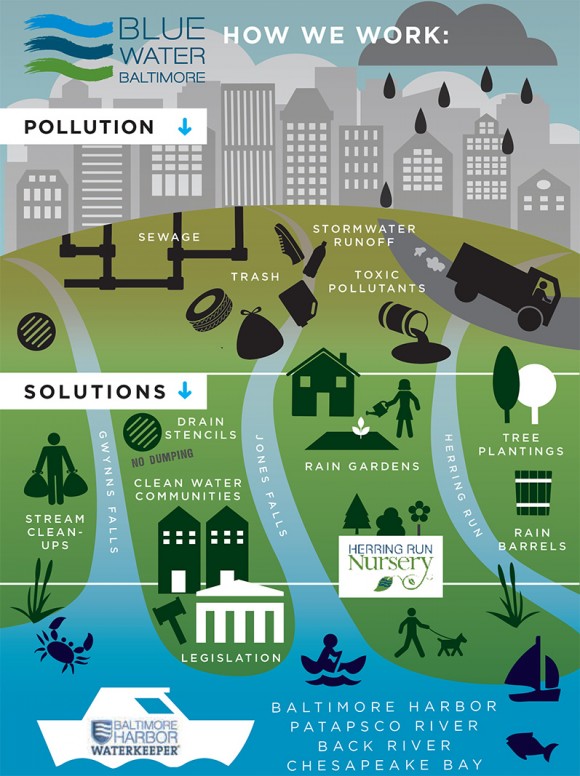
Blue Water Baltimore offers community-led solutions to clean up Baltimore’s waters.

The idea for the project came to him from Blue Water Baltimore, an advocacy group dedicated to using community-based restoration to achieve clean water in Baltimore watersheds. One way is by stenciling storm drains to educate the community and raise awareness about the improper disposal of household garbage, overflowing street corner trash cans, and litter on sidewalks and in gutters and storm drains. Because storm drains are entryways to our bodies of water, including the Chesapeake Bay, when it rains, trash and pollutants in the streets are carried into the storm drains and directly to our waters.

So, Mr. McDonigal attended one of Blue Water Baltimore’s stenciling workshops, applied for and obtained the necessary materials to paint two nearby storm drains, and celebrated Earth Day 2015 by making a difference in our wonderful Fell’s Point community! His students were thoroughly engaged in this project, which demonstrates its inherent worthiness. Really, what’s not to love about an activity that applies scientific concepts studied thus far, helps the environment, teaches responsible community involvement, integrates art, and gets the kids outside?

However, TNCS students were not the only group to appreciate this endeavor—Ann St. residents stopped by periodically to see what was happening and were thrilled to receive this community gift. Well done, indeed, TNCS upper elementary! And a huge thanks to Mr. McDonigal for this initiative!

This slideshow requires JavaScript.