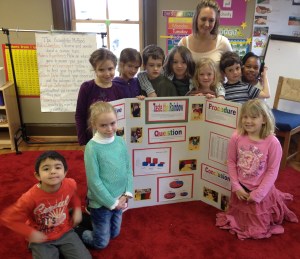
The second annual Science Fair at The New Century School came off with a bang! Actually, it was a drip. And a slide. And a buzz and a whir. There was Jell-O™ . . .
Despite numerous weather-related school closings, TNCS elementary students were hard at work in February and March, designing science experiments to conduct and present. “There are two different projects in each class. The pre-1st and 1st-grade class created an ‘Art Bot’ (a robot that draws pictures) and worked on centripetal force. The 2nd–3rd-graders worked on mass flow rate along with friction using an ice ramp and a dry ramp,” said Alisha Roberts, elementary STEM teacher.
To decide what experiments they were going to do, says Ms. Roberts, “I had them make a list of what they might be interested in. I saw lots of boys versus girls suggestions, like who can exercise longer. Those were all great ideas, but I was looking for topics we’ve covered, things that incorporate other parts of our STEM program, so combining math and science, for example.” Getting ideas and generating interest was not difficult, she says, quite the opposite. “They were very eager to get started!”
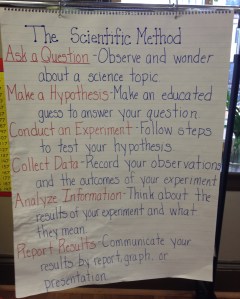
Once they nailed down their project topics, they dutifully followed the Scientific Method, like any good scientist worth his or her NaCl. In groups of 3 or 4, they started by asking a question about their project, then did some research (some teacher guided; some independently at the computer) to get background details, then formed a hypothesis based on this information. Next, they implemented their procedure. Each group had collaborated on what procedure they needed to follow to conduct their experiment and wrote out the individual steps in their journals. “They even typed them up independently for their experiment displays,” said Ms. Roberts. “They did all the work. I’m just there to help monitor and answer questions.” Finally, they report results and form a conclusion on that basis. “But,” said Ms. Roberts, “they tested each experiment several times to make sure they get accurate, reliable results to report.”
Pre-1st and First Grade
Art Bot!
The lower elementary had been learning about electricity, ultimately building snap circuits in class. “They were obsessed with snap circuits, said Ms. Roberts. “That’s all they want to do! They love being able to make something work. They can make it make sounds, they can make it flash, make it move in a certain direction, or make pieces of it fly off.” So, building a DC-motor-powered robot that can draw held immediate appealed. How will it work best with different weight distributions? Will vibrations in the motor make it move a certain way, or will they cause it to tip over?


Centripetal Force
Another class topic was Newton’s laws of motion, which are essential to understanding, say, what keeps you in your seat on a giant loop-de-loop roller coaster—centripetal force. For this, they constructed a bucket with green jello on the bottom, red jello on the top, and a marble in the middle. They then spin the bucket around the same way every time to observe movement in the marble.
Predictions included that the marble would change color and that jello would explode all over the room. They were very excited about this latter prospect. Supercool! Instead they learned that for every action, there is an equal and opposite reaction. A little more prosaic than jello-covered walls, but still awfully cool!


2nd and 3rd Grade
Friction
To study friction (also related to Newton laws), the older elementary kids soaked a board and then froze it to compare movement along the resulting icy ramp to that of a dry ramp. When sand is poured on it, which one produces more friction and why? At what height and “slip angle” create slide? Ms. Roberts explained that a practical application of this experiment for kids is to learn about slipping on ice or being able to come to a stop from a full run.


Mass Flow Rate
To study the concept of mass flow rate (the mass of a substance which passes through a given surface per unit of time), the students fitted a funnel in the top of a box and measured out the same weight in certain materials like dried pasta, coffee, and water. Then, they pour each substance down the funnel and time how long it takes to flow through. What travels more quickly? Why? Placing the funnel in a box was an ingenious way to control for height and eliminate the possibility of that variable affecting the results. “Everything must be precise!” said Ms. Roberts. They also brought in some math skills with this experiment and learned to measure and cut so that the holes on their boxes would be evenly centered.


“The students have been working extremely hard on their science fair projects and are very excited to share the results with you!” says Ms. Roberts. “The science fair will be held the week of March 24th-–March 28th from 8:00 am–8:30 am. Please feel free to visit the fair as many times as you would like during this week with your child!”
What is it that has the kids so excited about doing these experiments and presenting them? “They just want to know,” said Ms. Roberts. “Was my hypothesis correct? That’s what it comes down to—did I get it right?”