TNCS Teachers and Admin Share School Memories, Part 2

As mentioned in TNCS Teachers and Admin Share School Memories a couple of weeks ago, with the 2015–2016 school year almost over, it’s a great time to reflect on all that The New Century School does for its students as well as all that education has given us. Prompted by TNCS Head of School Alicia Danyali’s questions, “What is your fondest memory of school? and What teacher/school event influenced you the most in your educational experience?” here is another round of teacher and staff responses that provide a window into who they are as people, as educators, and as friends.

Emma Novashinski, Executive Chef & Master Gardener

Chef Emma draws on her love of growing things and the importance—and rewards—of practicing environmental sustainability.

My fondest memory at the school was actually this year’s Earth day. I have always wanted to watch a weeping willow tree grow, and I bought one to donate to the school as they are too large for a conventional garden. It was a little bittersweet.
I heard they were going to plant it on Earth day and got a call during lunch to join them. When I got out there the whole school was there! They all clapped and thanked me for the tree! To put roots into the Earth on Earth day was so fulfilling. My heart burst with love for everyone at the school. So thoughtful and meaningful and kind!!

Dan McGonigal, Elementary STEM Teacher

Mr. McGonigal shows us where his drive for protecting the environment began to develop and also that sometimes you just can’t take yourself too seriously.

My most influential teacher was one of my high school teachers, Mr. Shearer. He taught Environmental Issues. I remember him because he was so passionate about what he did, and it really hit home with me. I always had an appreciation for the outdoors, but he made me look at our environment in a different way. He discussed things in his class that came true later in my life, such as climate change, population problems, and even the flooding of New Orleans. It was a very memorable class for me and has impacted my own teaching.
My most memorable school moment was also my most embarrassing. I was called to the foul line during our assembly in the gym to show how I used routine to help me shoot a foul shot for our basketball team. I started my routine and heard some people laughing, and I continued and made the shot. I was asked to do it again, and more people laughed, but I made the shot again. The third time everyone was laughing and I didn’t realize why. But as it turned out part of my routine was sticking my tongue out! It was something that still makes me smile when I think about it.

Johanna Ramos, Pre-Primary Lead Spanish Immersion Teacher

Sra. Ramos gives some well-deserved props to a colleague and probably speaks for many in so doing.

I could say that the teacher that influenced me the most in my educational experience is Mr. Warren because of his hard work and dedication toward the school and the students.

Kiley Stasch, Elementary Language Arts & Global Studies Teacher

In her recollection, Ms. Stasch demonstrates the undeniable value of service learning and of mixed-age activities—two core TNCS elementary values!

One of my fondest memories of school was when my school had what they called “Stewardship Day.” On this day, we were split up into groups from K–12th grade and assigned different tasks to help improve our community. Not only was this a fun time to have the chance to climb on top of school buses to wash them, go on long hikes to pick up trash, and clean up community gardens, but it was also one of the few times
out of the year that we were able to interact with students of all ages that attended our school!

Elizabeth Salas-Viaux, Pre-Primary Lead Spanish Immersion Teacher

Sra. Salas’s takes a different approach and gives a shout out to the awe-inspiringly involved families of the TNCS community.

One of the things that have inspired me as a teacher is to see how families and communities work along with teachers in order to provide the best positive learning experience for our students.

It’s true that the educational environment works best when all stakeholders are invested both internally and externally. The TNCS community is a beautiful synergy in the truest sense of that word, as the students who go on to enter the world as kind, compassionate, caretakers of it will reveal.

TNCS Teachers and Admin Share School Memories

It’s just plain hard to believe that the 2015–2016 school year is almost over, but with only a handful of weeks remaining, this is a great opportunity to reflect on all that The New Century School does for its students as well as all that education has given us. In perhaps a similarly nostalgic frame of mind, TNCS Head of School Alicia Danyali posed the following questions to her staff recently: “What is your fondest memory of school? What teacher/school event influenced you the most in your educational experience?”

It’s interesting to note the various ways the questions were interpreted—some answering from their past school experiences as young students, and others bringing their more recent TNCS experiences to bear. Regardless, Dear Readers, what follows are their heartwarming, often funny, and always insightful responses. You will get to know these wonderful educators in a new way, seeing what particular experiences and moments shaped them into who they have become as well as whence the unique gifts each brings to the art of educating your children.

Tissues handy? Okay, in no particular order, here we go!

Teresa Jacoby, K/1st Math & Science Teacher

Mrs. Jacoby, fittingly, reveals being awed by the power of science.

I think my fondest memory is winning first place in my 8th-grade Science Fair. My father who was a plumber helped me build a water cycle table. My water cycle table actually rained and had thunder and lightning. It showed the path that water follows from the mountains to the ocean. My father being my first and best teacher taught me to weld pipes and install a small water pump, which pumped the water to a showerhead hidden in the clouds. The water then followed a small river from the top of the mountain to the seashore draining into a bucket where the pump pumped it back to the showerhead.

Catherine Lawson, Lead Primary Montessori Teacher

Mrs. Lawson shows us where her compassion for students and her fun-loving side may have begun to develop in earnest.

I have two vivid memories from attending Fernwood Elementary School in Bethesda, Maryland. The first was in the 3rd grade, when my class did a play called “February On Trial,” which was about February not having enough days to be counted as a month.  All of the holidays in February were represented by a character who were called on to defend why February was important to have. I was the bailiff and got to walk the defenses (characters) across the stage and have them say that they would tell the truth and nothing but the truth. These included The Groundhog, Cupid, George Washington, and February 29. I was very proud of my part. As I think back now as an adult, I realize that my teacher, Mrs. Reader, made up this part just for me because I wanted to be in the play so badly. I could not remember lines, so she simply had me have to say the same line over and over: “Do you promise to tell the truth and nothing but the truth?” I love Mrs. Reader for that.

The second activity was 6th grade Outdoor Camp, lasting 3 days and 2 nights. We had to hike to the camp, which was probably only a short hike, but I remember it feeling like miles. Once there, we got to dissect an owl pellet. It was so exciting to open up the pellet and finding the bones of a mouse—even a mouse skull. We slept on bunk beds in sleeping bags. It was very exciting. We had a dance one of the nights and all the boys were expected to ask all the girls to dance. The boy (Ralph Miller) who I liked from afar asked me to dance, and I thought I had died and gone to heaven. I thought nothing could be better than dancing with him. It is so interesting how your prospective changes as you grow up and mature. I know that we must have done more activities on that trip; however, these are the things that I can remember all these years later.

I hope as a teacher that I can make memories that children will remember all their lives. I am thankful for all the teachers that shaped my life and made me who I am today.

Dominique Sanchies, Admissions Director and Assistant Head of School

Mrs. Sanchies proves that teachers truly make a difference in their students lives.

I’ve had three life-changing teachers:

  1. Mr. Carlo Tucci, my childhood guitar teacher who made me sing during each lesson. This taught me that I had a voice.

  2. Mrs. Patricia Brawn my high school French teacher (4 years), who taught me that my voice (point of view and expression) was beautiful.

  3. My college Avant Garde Film instructor Ms. Kathryn Lasky, who taught me how to organize my voice to best be heard and to think outside the proverbial box.

Elisabeth Willis, Elementary Art Teacher

Ms. Willis demonstrates the undeniable value of differentiation in a child’s education and what it can do for self-esteem when teachers give the learner ways to use their strengths to grow!

It’s very hard to pick just one. Growing up, I had art teachers who recognized my abilities at a young age and always encouraged me to do more. Each art teacher, from 1st grade through high school, all played a major roll in how I learned and what I strived to become.  In elementary school, my teacher created an AP art class based on me and a few other students in my class needing more than just one art class a week. It also meant skipping gym for a day, which, for a clumsy kid, was amazing.

In high school, my teachers all encouraged me to take classes outside of just what the school had to offer. I ended up taking classes at the Metropolitan Museum of Art and doing precollege at both Parsons and MICA. Without the teachers I had throughout my life, I’m not sure I would have become who I am now or have experienced all I have been able to experience.

Lisa Reynolds, Lead Primary Montessori Teacher

Mrs. Reynolds’ sense of humor shines through in these funny memories from her tenure at TNCS.

A student and teacher go into the greenhouse to pick grapes. The student walks in first with teacher behind him. They startle two doves sitting in the grapevines, and the only way out is the door that the teacher and student are standing in. The birds swoop toward them, as they both duck so not to get struck by the anxious birds. The student looks up with a serious grin and says, “[Teacher], you have bird___ on your forehead!” The teacher says, “Thank you . . . would you please hand me a leaf?” This always makes me laugh when I think back on it!

Another time, I asked a student if her unique name had a special meaning. She thought for a moment and replied, “I just might be related to poison ivy and [my parents] wanted to mix it up a bit.” LOL!

Yu Lin, Pre-Primary Lead Mandarin Immersion Teacher

Lin Laoshi’s fondest memory of her time at TNCS happened when she saw her hard work paying off in a surprising way and in a brand-new context.

We took a field trip to the Baltimore Zoo last year. I was so surprised that many of our children were able to name the animals using Chinese, and they sang Chinese songs about the animals that they had learned in class. I was so proud of them.

Wei Li, Elementary Mandarin Teacher

Li Laoshi used this opportunity to reflect on the new experience of teaching Mandarin as a second language in this country and how she will use it to inform ongoing improvements—a lifelong learner!

This is my first year at TNCS, and it is also my first job in the U.S. I am so excited to be a member of this big and warm family, and I really enjoyed my job in the past year. I gained tons of practical experience in teaching a second language (Chinese), and I am becoming better in communicating with students who are in various ages and learning styles. I believe with the support from all my friendly colleagues, I will run the Chinese program better and better in the following years.

Maria Mosby, Lead Primary Montessori Teacher

Ms. Mosby shares recollections that show her both coming to terms with the need to persist in the face of possible failure as well as her overcoming obstacles with her newfound resolve.

One memory of mine that had a big impact on me was a poetry reading I was supposed to participate in in high school. Only a few students were selected to read their poetry, and I had worked on it for weeks. At the assembly, my teacher could tell that I was very nervous. She asked me if I would rather opt out, and, without thinking, I said “yes.” Everyone else read their poetry, and I stayed in the audience, wincing. I was angry at myself for not having the courage to go up there. I have always regretted that moment and promised myself that I wouldn’t let fear get in the way of another opportunity.

One of my fondest memories would have to be an accomplishment from middle school French class. I created a model of The Louvre while dealing with pneumonia. Several students suggested that I give up and that I would fail, but I pushed through and did it. I was very proud of that model, and kept it for several years.

Martellies Warren, Lead Primary Montessori Teacher and Elementary Music Teacher

Mr. Warren not only gives us another fascinating peek inside his illustrious career, but he also demonstrates that sometimes “the show must go on” even in the face of unimaginable tragedy to lift spirits and spread some love.

In 2001, Wynton Learson Marsalis “trumpeter, composer, teacher, music educator” asked the Morgan State University choir to record his work “All Rise” and perform it at the Famous Hollywood Bowl. We were scheduled to fly from the Dulles international airport headed to Hollywood California on none other than September 11, 2001. This was a huge deal for all of us, and we quickly told everyone we knew. Three weeks before we were scheduled to leave, Wynton called the late and former head of the Morgan State University music department Dr. Nathan Carter to ask if it would be a problem to move our departure date up to September 9th. Dr. Carter agreed, and this decision probably saved all of our lives.

On September 11, 2001, I awaken in Hollywood, California to several choir friends crying and frantically trying to call loved ones. I looked at the news and saw the first airplane fly into the World Trade Center. It was like something out of a horror movie, except it was really happening. Shortly after, the second airplane flew into the other tower, and we watched in horror as both buildings came crashing down. I had been trying to call my parents to let them know we were safe and that we had already flown out prior to the 11th but could not get through. My family and friends thought I was on the flight that left Dulles and had been calling my parents all day with their condolences.

Shortly after the 11th, Wynton and the producers felt that we should still do the show at the Hollywood bowl. We opened the show with an arrangement of the “Star-Spangled Banner” and sang to a packed stadium of patriotic concertgoers. A day later, we were cleared to fly back across the country to Dulles airport, where we learned we were the first flight allowed back into Washington, D.C. airspace! I’ll never forget being escorted into D.C. by fighter jets that surrounded our aircraft (yikes!). We landed safely and taxied to our gate on a runway lined with pilots waving American flags and cheering.

This experience shaped me as an educator. My life was spared for a reason. I have purpose and a duty to educated and provide the highest quality of education I can provide. It was that experience that helped shape me into the passionate educator and musician I am today!

Alicia Danyali, Head of School

And here’s what it all comes down to. Mrs. Danyali reveals both how important it is to be nurtured as a learner, in this case as a young teacher, as well as how essential to provide a nurturing space for the teachers now in her care as Head of School.

The teacher–mentor dynamic can be life-changing in every profession, especially in education. My most significant mentor, whom I find myself quoting throughout my career, is a 3rd-grade teacher, Mrs. Sharon Bleumendaal. Mrs. Bleumendaal was my first mentor and colleague in my first position after graduating from Florida International University with a BS in Elementary Education. I was given the opportunity to work overseas as a Grade 3 teacher, and my path into the international educational community allowed me to grow as a professional in ways I never expected.

Mrs. Bleumendaal was a veteran teacher who had many degrees. Of all these, the Montessori Philosophy was closest to her heart, even though the school where we taught was not Montessori. She opened my eyes to a community of learners who, under her guidance, were compassionate, intrinsically motivated, and excited about being in her classroom. This was the environment I aspired to create as an educator new to the profession. The key to her student success was her ability to differentiate instruction, meet the students right where they were academically, and challenge those students to tap into their full potential.

I was the luckiest new teacher in the world! I could throw out the traditional views and assessments through standardizing tests in the public domain, a bureaucracy that instilled fear into the generation of teachers from the early 90s and beyond, teachers who were, and are, desperately trying to make a difference, even with many odds against them.

At a recent staff development day in my current role, as Head of School, I quoted Sharon Bleumendaal while discussing the application of differentiating techniques to student needs, and not conforming students by honoring their learning style. Mrs. Bleumendaal was nurturing but held her students accountable. The classroom shined with high self-esteem and teamwork, years before these “buzzwords” were a concern for stakeholders worldwide.

Mrs. Bleumendaal was tapped into her students, and offered her full attention and dedication to them daily. She also trusted her students, which goes a long way in making choices that can guide decisions all the way through adulthood. It would be a big claim to state that if I never had Sharon Bleumendaal to mentor me right out of university, I can’t say if I would have stayed in education. My experiences and opportunities since those early days have undoubtedly shaped my career path and my own intrinsic motivation to stay in the field.

Want more? Never fear, Part 2 of this lovely exercise (thanks Mrs. Danyali!) will be published in future, as more responses come in from those who have not yet had a chance to share. The prospect might just make closing out another great year at TNCS bearable!
TNCS Primary Workshop: Connecting Montessori to Home

A few weeks ago, The New Century School Montessori teachers gave their bi-annual Primary Workshop to provide parents with a firsthand experience of the Montessori approach to pre-K education. But this time, they also added a new twist—how to support Montessori principles in the home.

tncs-primary-workshop-connecting-montessori-to-home

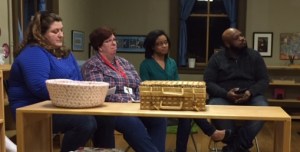
Our illustrious panel of Montessori teachers.

Joining teachers Catherine Lawson, Martellies Warren, Lisa Reynolds, and Maria Mosby, Head of School Alicia Danyali introduced the workshop and was quick to reassure parents that they needn’t run out and “remodel the home with Montessori materials”; rather, “this presentation is to show ways that Montessori can be connected naturally to what you already do in the home.”

Although previous workshops, including in the fall of this academic year, have demonstrated specifically what students are learning and doing during their daily class time, this one did not cover teacher and learning with Montessori materials per se. For those parents who did not attend Montessori school as kids, the materials are a marvel—both eye-opening and fun. For those who did grow up in a Montessori environment, the chance to reacquaint themselves with the materials must evoke the most delicious nostalgia. Maria Montessori developed the Montessori materials based on her extensive observation of children ages 2 1/2 through 6 years. Her goal was to put academic success within their reach by setting realizable achievement milestones, so to do that, she tailored materials to be used the way she saw children interacting with their world. Primary students use these materials nearly exclusively, and seeing how the materials are actually used and learning what each does for the child’s development was the focus of prior Primary Workshops.

As such, the Montessori classroom is a very deliberately “prepared environment.” Every nook and cranny is optimized for both the child’s size and the child’s development (accommodating a range of both, of course). Similar child-optimization can also be accomplished with a little careful tweaking of the existing environment, such as in the home, as the TNCS Montessori teachers went on to demonstrate.

To make the home–school connection, they covered the following four areas.

Part 1

Up first, Mrs. Lawson described how to prepare the interior and exterior of the home and the car, joking that “we aren’t going to force anyone to set up this way. No one is coming to your home to check on you! But we’re trying to teach independence, and here are some ways you can further this at home.”

Entryway

  • Install low hooks for children to hang up their own coats or use child-sized hangers so they can hang their coats with everyone else’s (Mrs. Lawson showed an old, well-loved hanger one of her daughters had decorated for this use).
  • Create a place to put wet boots and dirty shoes.
  • Designate a place to keep lunch boxes, backpacks, and other regularly used gear.

Living Room and Family Room

  • Make these areas child friendly so children feel welcome—said Mrs. Lawson: “Children like to be where their parents are, but they need their things handy also.”
  • Make books available in every room, if possible, with a bookshelf or basket to hold them.
  • Keep some toys available for use in an organized way, which encourages easy clean up:
    • Use low bookshelves or the bottom shelf of a television cart to hold toys.
    • Give each particular toy a place on the shelf. Place activities with many pieces in dedicated holders (e.g., shoe boxes, baskets, etc.).
    • Offer limited choices of activities that fit on the shelves provided, and rotate the toys when interest wanes.
    • Use a bathmat, throw rug, or bath towel for the child’s designated activity area, à la Montessori.
  • Although these might be hard habits to break, try to avoid:
    • Using a toy box or big basket that holds many toys because children can get overstimulated with too many choices.
    • Allowing the child to play with many toys and then doing a big clean-up. Instead, encourage playing with one toy and putting it away before moving onto the next.

Bedroom

  • Make books available in every room, if possible, with a bookshelf or basket to hold them.
  • Use low shelves for children’s toys and activities:
    • Each toy should have its own place, and rotate toys as necessary.
    • Only have bedroom-appropriate toys in the bedroom because you will not always be present to supervise. Markers, for example, are not a good choice!
  • Keep a laundry basket handy that allows the child to dispose of his or her own dirty clothes each night.
  • If possible, install in the closet an easy-to-reach rod and child-sized hangers.
  • In the dresser, place season-appropriate clothes in the lower drawers so the child can choose the clothing and dress him or herself.
  • Install a bulletin board at the child’s eye level to display pictures of family members, artwork, postcards, etc.:
    • When they are reading, post reminders about things or just love notes.
    • Add a calendar to mark off days.
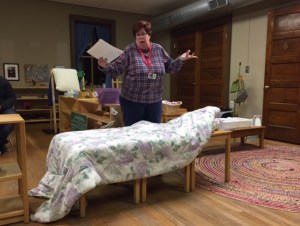
  • Consider using a comforter instead of a bedspread on the bed. Let it be the child’s job or to help pull up the comforter each morning.

    tncs-primary-workshop-connecting-montessori-to-home

    “It hides the wrinkles and looks tidy even if it isn’t perfect,” demonstrated Mrs. Lawson.

Outside

  • Make a place for outdoor toys (not just a big plastic tub for everything), such as a laundry basket.
  • Have opportunities for gardening (i.e., digging in the dirt) available.

Car

  • The car is an extension of home for many commuting families. Make it a happy environment with car-appropriate activities:
    • Books
    • CD of music or stories
    • DVDs
    • Activity books (avoid crayons, which melt)
  • Keep a supply of snacks and drinks on hand. Make a snack bag that allows the child to decide when and how much to eat (this encourages responsible decision making and avoids a power struggle).
  • For longer trips, consider making a goodie bag filled with tissue paper–wrapped activities or toys (they can be new things or things from around the house, e.g., rubber ducks, trucks, sticker books).

Part 2

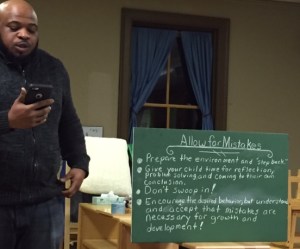
Mr. Warren spoke next. “My part of today’s presentation is on allowing for mistakes. A huge part of Montessori and overall development is making mistakes.” He read essential parts from “Mistakes and Freedom,” an article published by The Center for Guided Montessori Studies and starting with this famous quote by Dr. Maria Montessori:

“It is a commonplace that the child must be free. But what kind
of freedom has he been given? The only true freedom for an
individual is to have the opportunity to act independently. That
is the condition sine qua non of individuality. There is no such
thing as an individual until a person can act by himself. The
instinct guiding the child to seek his independence thus leads us
to realize what the whole of nature demonstrates – that any sort
of association is composed of separate individuals. Otherwise
there would be no such thing as societies, but only colonies.
Education must foster both the development of individuality
and that of society. Society cannot develop unless the
individual develops, as we learn from observing the child, who
immediately uses his newly won independence to act on a social
environment.”

Read the article in its entirety here: http://www.guidedstudies.com/2011/04/mistakes-and-freedom/.

tncs-primary-workshop-connecting-montessori-to-homeMr. Warren ended with his own classroom tenets of allowing for mistakes:

  • Prepare the environment and step back.
  • Give the child time for reflection, problem-solving, and coming to their own conclusions.
  • Don’t swoop in!
  • Encourage the desired behavior, but understand and accept that mistakes are necessary for growth and development!

Part 3

Next up, tying into Mr. Warren’s theme, Mrs. Reynolds discussed the difference between praise and encouragement and how to allow children to cultivate the courage to be imperfect. “I like praise,” she joked, “it’s like candy.” Audience laughter ensued. “But what is the long-term effect,” she asked? “Children who are praised choose less challenging work.” That might seem counterintuitive—it’s why we praise our kids, after all, to ostensibly build up their self-esteem—but studies are unequivocal in demonstrating that our good intentions are having deleterious effects.

Mrs. Reynolds brought up the example of kids’ art, which parents can tend to gush over, even when what is depicted is basically a scribble. Not only does this signal to the child on some level that he or she doesn’t need to really try hard to make something praiseworthy, but the praise itself also becomes less meaningful.

The upside is, said Mrs. Reynolds, “Children who are encouraged for their efforts are willing to choose more challenging tasks on their own.” Encourage the deed, rather than praising the outcome. “Show respect for and interest in the child’s point of view.” Also, make sure to provide opportunities for the child to develop his or her life skills, such as making the bed. (Recall from Part 1, though, that the idea is to set the child up for success by “preparing the environment.”  See above.) This will help the child develop self-confidence and independence, as well as independence from the negative opinions of others.

“Who doesn’t want that for their children?” she concluded.

Part 4

Ms. Mosby then took up the thread of independence by presenting specific ways that parents can give children these opportunities at home. “Have you ever been approached by your children while your cleaning the house because they want to help?” she asked. Our tendency can be to brush aside these offers as sweet, but not really very helpful because we want an actually clean outcome for our efforts. But, this is exactly the time, explained Ms. Mosby, to tap into that natural excitement and teach them how to tackle some of these household tasks before they become too jaded to want to help. Sure, the results might not be perfect, but the ultimate reward of cultivating independence and a fundamental helpfulness in your child will outweigh this temporary downside.

She went on to tell parents how eager her students are to help clean the classroom and how she seizes those opportunities to both accept the help as well as teach the correct methods. “All of the materials I’m showing you are things you’ll already have around the house, such as dust cloths, dustpans, and plastic bins to wash dishes or other items ‘the old-fashioned way’.” (She gave parents the helpful tip that her students love polishing tables and will rub the polish practically off in their zeal for this task.)

Kids are also natural sous chefs—they love to help make their lunches, for example, such as by spreading ingredients on bread and peeling vegetables. Learning to use kitchen implements also helps them develop their fine motor skills. They can also be recruited to put dishes away. “Let them know you trust them,” said Ms. Mosby, ” and start with unbreakable pots and pans in a low cabinet, progressing as the child is ready to more fragile dishes.”

They can also help with pets. “They love to have another little someone to care for,” said Ms. Mosby. Let them brush the cat or dog and help put out the food and water. They can even help with younger siblings and get practice with gentle care in the classroom with babydoll models.

The garden or backyard is another area where kids can be a huge help, whether with cleaning up or actual gardening. A “pooper scooper,” she pointed out, makes a great child-sized leaf picker-upper.

Resources

Head of School Alicia Danyali offers the following resources “to support your family’s educational journey” with a young learner.

Books

  • The Child in the Family, by Dr. Maria Montessori
  • Positive Discipline for Preschoolers, by Jane Nelson
  • Child of the World: Montessori, Global Education for Age 3-12+, by Susan Mayclin Stephenson
  • How to Raise an Amazing Child the Montessori Way, by Tim Seldin
  • The Whole-Brain Child, by Daniel J. Siegel and Tina Payne Bryson
  • How to Talk So Kids Will Listen, and How to Listen So Kids Will Talk, by Adele Farber and Elaine Mazlish

Websites

TNCS Goes to the Grammys!

Or, to be more precise, a member of the TNCS community is going! Music Director and Primary Lead Teacher Martellies Warren (“Mr. Warren” as he is known among The New Century School community) is a tenor with gospel group Anthony Brown & Group TherAPy in his off-teaching hours. (Please read Music is in the Air at TNCS for more on Mr. Warren’s fascinating background.)

This group heads to Los Angeles, California on February 15th to attend the 58th Grammy Award Ceremony, having been nominated for Best Gospel Performance (click on Nominees and scroll to #36). Their live performance of “Worth” from their second album Everyday Jesus was recorded in December 2015. “Worth” has so far spent 41 weeks on the Gospel Billboard Charts, 20 of those weeks at the #1 position. In fact, the album itself debuted at #1. “It’s doing really well,” said Mr. Warren with a proud smile. “And to be nominated out of hundreds of people is just an amazing feeling. We’re super excited!”

image1

Anthony Brown (left) and Martellies Warren (right) hold two of the three Stellar awards they won for their first album. How many will they take home this time?

As if a Grammy nomination weren’t enough, Anthony Brown & Group TherAPy has also been nominated for a 2015–2016 Stellar Award (the 31st annual). Make that 10 Stellars—yes, 10! “They nominated us for every single thing we were eligible for!” said Mr. Warren. (By the way, Stellar awards are not new to this group, who nabbed three for their first album.) In the past few weeks, the group has rehearsed almost daily for 3–4 hours in preparation for that show happening just days after the Grammys, which they will open and which will take place in Las Vegas. Opening a show, explained Mr. Warren, isn’t just your typical performance. There will be complex choreography, pyrotechnics, and even some special, as-yet undisclosed attire, which secret he would not divulge, except to say that it would be fun and colorful in the beginning, changing to classic toward the end.

Although many would be starstruck by the amount of celebrity Anthony Brown & Group TherAPy have suddenly attained, Mr. Warren remains the consummate professional musician. Not content to rest on their laurels, he says he and the rest of the group want to continue honing their crafts and making worthwhile contributions:

This is the biggest thing we’ve ever undertaken. As artists, we want our music to be well-received by our peers. We have put something out there, and it’s scary, because we want to top the last [and their first, self-titled] album. “Testimony” [from that album] made history as the longest-running gospel single ever. It’s still on the charts, actually. That’s huge, and we want our sophomore album to be even better.

Before releasing these two masterpieces, Group Therapy functioned as background vocalists for just about every other gospel outfit they could before Anthony Brown decided it was time to write and record their own songs. Mr. Warren met Mr. Brown during their college days at Morgan State University, the former on a full vocal scholarship, the latter, piano. Mr. Warren accepted an invitation to audition as a singer for a group Mr. Brown was putting together. As the story goes, the line-up came to Mr. Brown in a dream, which must have been some kind of divine intervention, given that, 16 years later, they are still harmonizing.

This video taken at the Orpheum Theatre in Los Angeles, shows their live appearance on the TV show Celebration of Gospel, which features new and rising artists. Although they have been around in some form or another for years, Anthony Brown & Group TherAPy are considered “break-out” artists in their current incarnation, having emerged in superstar fashion on a scene typically dominated by entrenched artists.

Of course, there are probably two questions on everyone’s mind at this point. First, will the TNCS community get to hear Mr. Warren sing? Maybe so. He has pitched the idea to Mr. Brown of making an appearance at TNCS, although not for a full-scale performance, but more so to explore some of the aspects of the genre of gospel music just as TNCS students would any other genre. Second, how has he requested his green room to be stocked, now that he has made the big time? The amazingly talented but ever humble and always professional Mr. Warren says, “I get excited when I see a spread with tea, honey, and lemon. That’s so important to relax the muscles of a singer’s throat. That’s what you want to see.”

If you can’t send tea but want to show your support, send the group all of your good-luck vibes to snare the win(s) at their two upcoming awards shows :)!

Cutting Edge Skills at TNCS

A recent Food for Thought article that aired on NPR explored the seemingly counterintuitive notion of letting toddlers play with knives. Sujata Gupta, the author and mother of a 3-year-old, writes, “Both my mother and mother-in-law recoiled when I suggested letting my son try his hand at chopping. Yet research, and the experience of educators, suggest that parents such as me would be wise to hand a tot a knife.”

That “recoil” is understandable, given that maternal instincts are to protect, not arm our children with implements of self-destruction. But, as Gupta discovers, allowing small children to wield real tools is a means of attaining self-efficacy, something that kids these days urgently need.

It may come as no surprise to TNCS parents that The New Century School has always operated according to this principle. TNCS primary classrooms follow the classic Montessori curriculum, a huge part of which is fostering independence, even in the very young. The Montessori philosophy is based on the observation that children learn by doing. They crave hands-on experiences, which is also a form of “play.” (In this sense, there’s a profound difference between “playing with knives” and “playing” with knives. The former is an invitation to accidents; the latter is an absorptive lesson in proper use.)

Of course, TNCS students are not handed honorary steak knives on matriculation. Step by step and through practice with preliminary “works,” they earn the privilege of using knives in the classroom for helping with food preparation in the Practical Life mode of the curriculum. Says TNCS primary teacher Martellies Warren: “I trust students with real tools once they show that they can be responsible individuals in other areas of the curriculum—such as if they have mastered or are working toward mastery in the art of using materials with care, working with materials from start to finish, working independently, caring for the classroom environment, and just overall being gentle and empathetic toward others.”

Catherine Lawson, TNCS’s most senior Montessori teacher, agrees. “Children want to do activities that include using knives; however, they know that they have to show that they are focused and responsible.” Once students have shown this level of consistency, says Mr. Warren, “they are allowed to use such tools as knives, hammers, graters, and peelers to prepare real food as well as serve themselves and each other.”

tncs-students-learn-responsible-knife-use

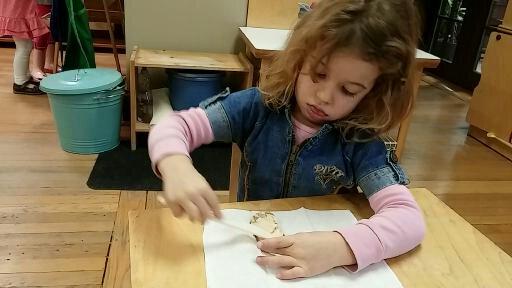
A TNCS primary student carefully spreads hummus on mini toast.

TNCS primary teacher Maria Mosby describes her process this way: “We use knives for spreading first (hummus, cream cheese, sunflower seed butter). The kids love to practice spreading butter on their bread at lunch time, and it’s a great opportunity to help out and practice at home with toast or sandwiches.”

Once the children demonstrate responsible spreading, they can move on to slicing, starting with softer foods and progressing to firmer fruits and vegetables. “We always stay nearby, but trust that the children are capable,” said Ms. Mosby.

And that, says Mr. Warren, encapsulates the “spirit and uniqueness of the Montessori philosophy!” He says that this type of “honor system” stems from Maria Montessori’s belief that the child should self-direct. “I often tell parents to ‘let go and trust’ their little individuals. In my experience this has been one of the most challenging task for parents to do.”

tncs-students-learn-responsible-knife-use

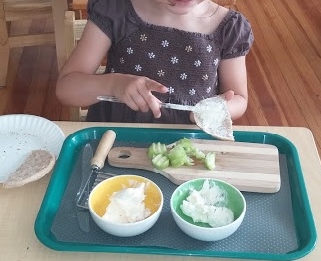
A TNCS primary student cuts cucumbers, slices bread, and spreads cream cheese to make a cucumber sandwich.

Letting go and trusting might come more easily if parents knew just how successful this model is for cultivating that self-efficacy mentioned above. Ms. Mosby offers this explanation: “I have never been let down. I think it’s the fact that the students know they are using real tools that makes such a difference. They don’t use them as weapons. They are very careful and know that tools used improperly can be harmful.”

So, as Gupta says, “Go ahead and give your toddler a kitchen knife.” You might just get breakfast in bed from your aspiring cheflets.