Cutting Edge Skills at TNCS

A recent Food for Thought article that aired on NPR explored the seemingly counterintuitive notion of letting toddlers play with knives. Sujata Gupta, the author and mother of a 3-year-old, writes, “Both my mother and mother-in-law recoiled when I suggested letting my son try his hand at chopping. Yet research, and the experience of educators, suggest that parents such as me would be wise to hand a tot a knife.”

That “recoil” is understandable, given that maternal instincts are to protect, not arm our children with implements of self-destruction. But, as Gupta discovers, allowing small children to wield real tools is a means of attaining self-efficacy, something that kids these days urgently need.

It may come as no surprise to TNCS parents that The New Century School has always operated according to this principle. TNCS primary classrooms follow the classic Montessori curriculum, a huge part of which is fostering independence, even in the very young. The Montessori philosophy is based on the observation that children learn by doing. They crave hands-on experiences, which is also a form of “play.” (In this sense, there’s a profound difference between “playing with knives” and “playing” with knives. The former is an invitation to accidents; the latter is an absorptive lesson in proper use.)

Of course, TNCS students are not handed honorary steak knives on matriculation. Step by step and through practice with preliminary “works,” they earn the privilege of using knives in the classroom for helping with food preparation in the Practical Life mode of the curriculum. Says TNCS primary teacher Martellies Warren: “I trust students with real tools once they show that they can be responsible individuals in other areas of the curriculum—such as if they have mastered or are working toward mastery in the art of using materials with care, working with materials from start to finish, working independently, caring for the classroom environment, and just overall being gentle and empathetic toward others.”

Catherine Lawson, TNCS’s most senior Montessori teacher, agrees. “Children want to do activities that include using knives; however, they know that they have to show that they are focused and responsible.” Once students have shown this level of consistency, says Mr. Warren, “they are allowed to use such tools as knives, hammers, graters, and peelers to prepare real food as well as serve themselves and each other.”
tncs-students-learn-responsible-knife-use

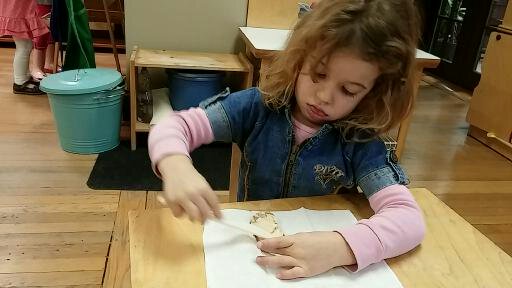
A TNCS primary student carefully spreads hummus on mini toast.

TNCS primary teacher Maria Mosby describes her process this way: “We use knives for spreading first (hummus, cream cheese, sunflower seed butter). The kids love to practice spreading butter on their bread at lunch time, and it’s a great opportunity to help out and practice at home with toast or sandwiches.”

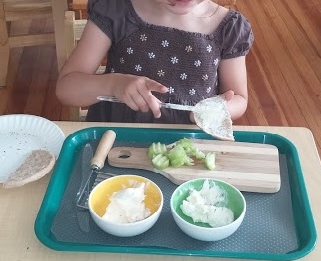
Once the children demonstrate responsible spreading, they can move on to slicing, starting with softer foods and progressing to firmer fruits and vegetables. “We always stay nearby, but trust that the children are capable,” said Ms. Mosby.

And that, says Mr. Warren, encapsulates the “spirit and uniqueness of the Montessori philosophy!” He says that this type of “honor system” stems from Maria Montessori’s belief that the child should self-direct. “I often tell parents to ‘let go and trust’ their little individuals. In my experience this has been one of the most challenging task for parents to do.”
tncs-students-learn-responsible-knife-use

A TNCS primary student cuts cucumbers, slices bread, and spreads cream cheese to make a cucumber sandwich.

Letting go and trusting might come more easily if parents knew just how successful this model is for cultivating that self-efficacy mentioned above. Ms. Mosby offers this explanation: “I have never been let down. I think it’s the fact that the students know they are using real tools that makes such a difference. They don’t use them as weapons. They are very careful and know that tools used improperly can be harmful.”

So, as Gupta says, “Go ahead and give your toddler a kitchen knife.” You might just get breakfast in bed from your aspiring cheflets.
TNCS Primary Students Have Something to Crow About!

tncs-rent-a-coop

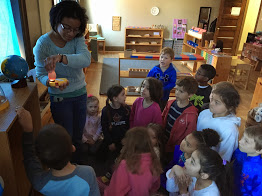
Primary teacher Maria Mosby hatches a great idea for a class project!

The New Century School‘s primary Montessori program is truly special, inspiring children to be self-directed and independent yet truly community-minded individuals through hands-on engagement with their world.

Primary teacher Maria Mosby has recently taken this concept to the next level by “renting a coop”! Her students have been participating in a chick-raising and egg-hatching program, all designed to “hatch ideas, grow compassion, and lay foundations,” according to Rent a Coop‘s tagline. Owned by Tyler Phillips and Diana Samata of nearby Potomac, MD, the company rents chicken coops and chicks to homes and schools in Maryland, D.C., and Virginia to “provide an educational and fun experience, bring families and communities closer together, and to help others become more self-sustainable and get back in touch with nature!”

Ms. Mosby said of the idea for her initiative, “Señora Salas and I had been talking to the children about where things come from as well as doing a lot of food preparation work (including egg slicing). So I wanted to do a bird unit and let them actually see and participate in the raising of these chicks so they could understand where our eggs come from. We had to talk about the difference between the eggs we eat and the eggs that are fertilized with potential chicks inside of course!” Eggzactly!

She has been very happy with the company and their responsiveness. “It has been a wonderful program. [Mr. Phillips and Ms. Samata] are on call and answered my emergency chick and egg questions right away,” said Ms. Mosby.

It all began back in April when two chicks appeared in Ms. Mosby’s classroom, which the children subsequently named Olive and Miamaura Cadenza, along with a half dozen or so fertile eggs. One of the chicks was a male Bielefelder breed, and the other an Easter Egger/Copper Maran mix, whose sex was indeterminate until it started “either crowing or laying eggs,” according to Mr. Phillips. [Fun fact: the Bielefelder breed (as well as the Golden Comet, which is what most of their hens are) are 2 of only 10 breeds out of 300 in which the sex can be determined in a chick.] The students voted from a list of names to come up with their final picks. “I think that Miamaura Cadenza is from ‘My Little Pony,'” said Ms. Mosby. “Olive, the male, stems from our class name, ‘The Olive Tree Class.'”

The students got to watch the chicks grow for 21 days inside the egg and for 7 days outside the egg to develop an understanding of emerging and then early life, from “egg tooth” to first feathers. Meanwhile, they also enjoyed observing Olive and Miamaura grow and change. Wait—inside the egg? “They are fascinated when we candle the eggs and what we’ve been learning about in books about the growth of the chick embryo comes to life,” said Ms. Mosby. “Candling” involves a special light that reveals what is happening within the egg.

As luck would have it, three of the chicks hatched the night before Ms. Mosby’s beautiful Mother’s Day breakfast on May 8th, and the rest during that happy occasion! What more fitting celebration of parenting? Indeed, Ms. Mosby’s students developed some very nurturing ways as a result of this wonderful project. “My students have been really interested in doing individual projects about birds, and are so gentle, caring, and protective of the chicks,” she said. They named the new hatchlings “Peep,” “Foxy,” “Oreo,” “Thing One,” and “Thing Two.” Awwwwwww!

Many other TNCS classes stopped by to visit, and Mrs. DuPrau’s class even helped maintain the brooder, which is where the chicks live soon after hatching (after 24–48 hours in an incubator). The brooder features a heat lamp and water and feed bowls and chicks are added one at a time. Think of this as analogous to the Montessori mixed-age classroom, where the new “chicks” learn from the seasoned pros!

tncs-rent-a-coop

Enjoying Ms. Mosby’s backyard before returning to the coop.

After 4 weeks of this eggstraordinary program, the chicks returned to the Rent a Coop farm, as agreed in the terms of rental. Not surprisingly, the class really misses their chicks. “We just wrote a letter [yesterday] to send to Rent a Coop. The kids really miss the chicks and want to know how they’re doing,” said Ms. Mosby. “I’d love to do this again next year, if possible,” she continued. “I’d honestly love to keep one or two hens at school. What a great experience for the kids to care for them and get fresh, organic eggs every day!”

Wondering what the mystery chick turned out to be? “I do think Miamaura Cadenza is also male,” said Ms. Mosby, “because I heard a low sound similar to a crow toward the end!”

Meet the Teacher: Montessori-Trained Maria Mosby Joins TNCS

It's clear from her beautiful smile that this is one caring educator!

It’s clear from her beautiful smile that this is one caring educator!

The Montessori environment has “felt like home” to Maria Mosby for quite some time, she says, so she was a natural fit for Lead Teacher in one of The New Century School‘s four Primary Montessori classrooms. In fact, she began her own education at age 2 1/2 years at Columbia Montessori School, in Columbia, MD. “I grew up in Montessori,” she says, “so it has always been in my heart.”

After several moves with her family throughout New England and the Washington, D.C. area, which entailed a stint in public school, she rediscovered Montessori while studying Early Childhood Education at Towson University, and it has been Montessori all the way ever since. She had considered studying psychology, but says, “I’ve always had an affinity for children and wanted to be around them in my career. As a teacher, you do end up being a psychologist of sorts.” She knew that the primary age group was her target age group all along. “I worked with older children, elementary-age children, toddlers . . . but the 3 to 6 age group is really where my heart is.”

Even though she just joined TNCS full time this academic year, Ms. Mosby was no stranger to the school. As a primary assistant for 3 years and a toddler assistant for 5 years at Greenspring Montessori School (formerly, The Montessori School), she decided to take Early Childhood training through the Maryland Center for Montessori Studies. During her internship, she worked at TNCS’s summer camp and “loved the warm, peaceful community.” Even with a whole year-long absence, students remembered her and were excited to have her back.

Having been through the first semester and ironed out those wrinkles that inevitably come with introducing young children to new routines and new faces, she reports that “things are going very well. I love my students with their unique personalities, and I’m glad that there’s a 3-year cycle to look forward to with them. It has really been a growing experience for me.” She also attributes some of the successful transition-making to her Assistant Teacher Elizabeth Salas, who also joined TNCS this academic year. Señora Salas came to TNCS from Chile and besides being “wonderful,” in Ms. Mosby’s words, provides the Spanish immersion component to the classroom. Ms. Mosby herself is picking up some Spanish, although not as quickly as the students, she confessed.

Being such a staunch proponent of Montessori education, Ms. Mosby has a lot of insight from several perspectives into what makes it so effective. “The children are given the opportunity to reach their potential,” she said. “They’re not stifled. When I compare [Montessori education] to traditional education, I remember how I struggled with math, especially when my family was moving around. I needed help with fractions, but the class I entered had already studied them and were not going to backtrack just for me. And that’s not an issue here. Everyone is working at their own pace.”

Once a shy student, she also credits the independence that Montessori confers as part of its success. She sees daily in her classroom younger and older children working together, which often means a younger child absorbing a lesson he or she might be considered too young for in a conventional learning environment. “I don’t hinder them,” she says. “I let them see what they can do and also let them learn from their mistakes, which fosters that sense of independence that I love about Montessori.” It’s easy to see how this process builds confidence in children and primes them to learn.

Although she is incredibly well versed with all of them, her favorite Montessori materials are those associated with Practical Life. “They make a really nice school–home connection,” she said. Kids can play at cooking, flower arranging, tidying up, etc., and as they perfect these skills, they translate them to home and develop motor skills and a sense of responsibility to the immediate environment in the bargain.

“Another thing they have been working on is how to use the ‘peace table’ if upset and words to use when solving a conflict with others. They really enjoy the sensory items at the peace table, and it’s a good place to go when someone needs a place to chill out.” Just like the other Maria M., Ms. Mosby values treating others with kindness and receiving the same in return.

One very special project they have been working on as a group is writing to another Montessori class in Saskatoon, Canada. “The children have been very excited about it and have been drawing pictures to include. They have been learning about Canada’s cities and will also be learning a few French words,” she said.

In her free time, Maria enjoys running and does the Casey Cares Foundation 5K every year, which raises money for critically ill children in Baltimore and surrounding areas so that they can have things like birthday presents, vacations, and pajamas for long hospital stays. “I also work with Girls on the Run of Central Maryland as a “SoleMate.” “GOTR coaches pre-teen and middle school–aged girls to run their first 5K. It is a great organization that increases the girls’ self-esteem, overall health, and sense of sisterhood,” she says. She is also a certified children’s yoga instructor and will complete her 200-hour yoga training this year.

In closing, she said, “After I was away for a year, coming back [to TNCS] just felt like coming home. Everyone is so welcoming, and I feel very supported from the other teachers and from the administration. We all have something to offer. We collaborate and work together very well, even among the different divisions.” TNCS is thrilled to have the warm, compassionate Ms. Mosby in her very first Lead Montessori Teacher role!