The New Century School started off 2014 with a bang—on the very first Thursday of the new semester, TNCS held a 1-hour Elementary Information Night followed in a second hour by the first-ever Town Hall. This exciting and important double event was geared toward all current TNCS families regardless of student age and to prospective families interested in joining TNCS’s community. Acknowledging the 2-hour duration, a table of gorgeous appetizers was prepared by Chef Emma Novashinski to see us through, and light beverages were also served. To make attendance even easier, free parking was provided as well as free childcare. The lucky kids got Fell’s Point’s B.O.P. pizza and healthy snacks. This delightful evening, which TNCS administration plans to repeat annually, was a testament to the dedication and commitment of both the TNCS staff for organizing and executing it as well as the families who gladly attended in order to learn more about how TNCS was founded, the current state of the elementary program, and TNCS’s future. These joint efforts ensure that this special school will continue to flourish.

Chef Emma Novashinski provided an array of healthy but delicious hors d’oeuvres to tide over guests arriving just after work.
After an introduction to the evening by Admissions Director Robin Munro, Co-Executive Director Roberta Faux gave a heartfelt, enthusiastic, and at times funny speech about TNCS’s rather surprising origins as well as where its heading—“why we got started and how we got here,” as she put it. After attempting to eschew childcare for their daughter born in 2005 and care for her themselves with their “flexible work schedules,” Ms. Faux says that process wore her and her husband down pretty quickly (drawing quite a sympathetic collective chuckle from the audience). She met the other TNCS Co-Executive Director Jennifer Lawner soon thereafter, and together they decided to do something about the lack of stimulating preschool options in Baltimore. They especially identified with the work of education luminaries such as Dr. Maria Montessori and creativity expert Sir Ken Robinson. “In October of 2007, we opened Patterson Park Montessori with five students,” she recalled. That one-room preschool would very quickly prove too small, and TNCS came to be in its current incarnation at 724 S. Ann St. in Fell’s Point in 2010. The Co-Executive Directors felt that the Montessori method “really resonated” with their vision of what early childhood education should be. “Prepared spaces,” said Ms. Faux, set the stage for individual discovery. Within this “freedom within limits that fosters independence,” kids can explore, wonder, touch, and learn about their worlds. They are, moreover, empowered to do so.
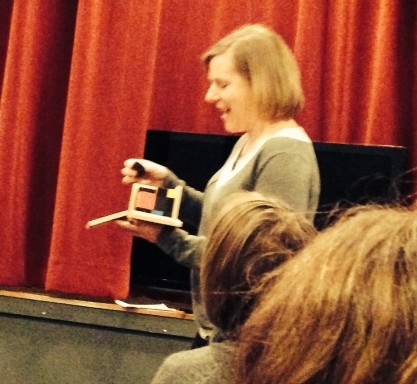
Co-Executive Director Roberta Faux speaks fondly of discovering how naturally children learn with Montessori materials and how eye-opening and gratifying an experience that was for her.
This story becomes the more poignant when you consider that both Founders/Co-Executive Directors not only have children attending TNCS in the Elementary and Primary classes, but also that the programs were created very much for those children. And isn’t it very comforting to know that your kids are being taught, nurtured, and cared for every day by a staff hand-picked by these mothers of fellow students? As any new school—or any other kind of establishment for that matter—goes through certain growing pains, that process of becoming can be unsettling. Though TNCS is still a new school and is still coming into itself, the knowledge that it was born out of the simple desire to provide actual, real children a place to truly thrive preempts any doubt about its integrity, its child-centered approach, and the rosy future it promises itself and its graduates.
After Ms. Faux spoke for about 15 minutes, Head of School Alicia Danyali next took the floor to give an overview of TNCS’s philosophy for elementary education. As the school matures alongside the student body, it’s more and more identifying itself as an elementary school rather than a preschool. A tremendous amount of thought, planning, and resources have gone into the creation of this special elementary program to continue fostering the school’s defining value—whole-child education. Unlike the pre-primary and primary programs, the elementary is not strictly Montessori by any means, which is entirely intentional. With the spirit of independent but guided inquiry very much intact, however, it is certainly “Montessori-inspired.” The commitment to small class sizes as well as the mixed ages within them, says Ms. Danyali, ensures that each student gets individualized instruction and that no one is pigeon-holed according to age but is rather met at his or her skill level. For Ms. Danyali, the emphasis on multilingualism is also a key component of TNCS’s elementary program and one that sets the school truly apart. Elementary students get 45 minutes in each Mandarin and Spanish instruction daily. No other area school can boast this degree of language concentration, even despite the multitude of benefits experts agree that learning other languages confers. (See Top 10 Benefits of Multilingualism.)
Another point Ms. Danyali drove home was that the elementary program is designed to teach kids to learn and be curious about the world around them rather than set up primarily to see them through a test. But she was likewise not about to throw the baby out with the bathwater. Though many curricula are criticized for “teaching to the test,” there is a value to testing when it’s done appropriately. Ms. Danyali wants to implement a test used in other language immersion schools that would give TNCS a yardstick on which to measure overall progress and to give students that practice . . . but not to guide or interfere with the school’s scholastic approach and especially not to assess a teacher’s performance, a criticism that has been leveled at standardized testing in recent news (see the article here). There are also elements of the new Common Core curriculum standards for public schools that she feels are on the right track and could be selectively implemented if appropriate.
And that’s just it. Being a small, independent school offers the freedom to stretch and explore and continue to find ways to really engage students in learning that many schools just cannot have. Another advantage is in the simply amazing educators such an educational model attracts. Speaking of whom, elementary teachers Alisha Roberts and Adriana DuPrau next spoke, each presenting a 10-minute overview of their specialties. Ms. Roberts handles Math and Science (read more here), while Ms. DuPrau teaches English Language Arts, and both teachers mix independent work with small groups. They also create synergies among their disciplines, such that reading and writing is always a component of the science classroom, and discussion and inquiry likewise a component of the reading lesson. Foreign Language Curriculum Director Xie Laoshi spoke last and painted a portrait of how and why teaching foreign language at TNCS is a unique affair. Xie Laoshi creates a dynamic classroom, emphasizing the importance of making the activities relevant for students rather than asking them to complete book lesson after dreary book lesson. In fact, she had the audience in stitches after recounting how she ordered a slew of the best acclaimed books and materials for her curriculum, only to judge them unsuitable and set about making her own from scratch!
An evident degree of preparation and planning went into this evening. Why? Because the elementary program is where it all coalesces—it’s where all of the students are headed and it will define the school in a way that the pre-primary and primary programs do not. Not that those programs aren’t important—they absolutely are! They set the stage for what comes next, and building that solid foundation is critical for development. But making the decision of where to send your child to elementary school carries a lot of additional weight insofar as that education is what will equip him or her for life. The choice to send your child to an environment where his or her whole self is nurtured, not just the academic part, is certainly a lucky choice to have. Again, TNCS is unparalleled in this regard. In addition to their math, science, language arts, and foreign language instruction, elementary students get art, music, and physical education twice weekly to stimulate all areas of development. They also get “Teacher’s Choice” time, which often targets the cultivation of those character qualities a conventional classroom probably lacks the resources for. For instance, Ms. Roberts’s class is learning to crochet, with the help of some parent volunteers, and the scarves they make will be given to Baltimore’s homeless community. Pitching in and helping out is a school-wide value that manifests continually, setting an example to kids to be active, responsible members of their communities (as Dr. Montessori would have utterly sanctioned).
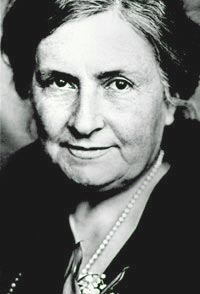
Maria Tecla Artemesia Montessori (August 31, 1870–May 6, 1952) created the child-centered approach to education that TNCS grounds itself in and grows from.
In one of her very first remarks of the evening, Ms. Faux perhaps best described TNCS’s elementary program trajectory, which has its roots in Montessori but also branches beyond into language immersion and other forms of progressive education and continues to grow. In mentioning that Dr. Montessori, who believed that revolutionizing education would ultimately give rise to a more peaceful society, had been nominated for the Nobel Peace Prize no less than five times, she paused and said, “She would have continued to evolve, just as we are doing.” It was quite a revelatory moment. Of course Dr. Montessori would be exploring new ways to engage children and embracing new platforms on which to do so—her methodology was built around innovation. TNCS is currently approved to teach through Grade 5 and will continue to add a grade level annually through Grade 8, staying one or two steps ahead of the current “pioneer” elementary student body as well as continuing to find new ways to stimulate and engage them. In the Fall of 2014, a third elementary classroom will be added and a new teacher hired to accommodate that growing elementary student body.
Wait a sec, did you say Grade 8? That’s right. A Middle School comprising Grades 6-8 will open in the Fall of 2016, with new classrooms, new spaces, a science lab, etc. But you’ll have to check back for a follow-up post on what happened during the Town Hall meeting that followed the elementary discussion. Stay tuned!


