Goodbye 2015–2016 School Year! It’s Been Great!

Well folks, another school year at The New Century School has just ended. Immersed finds this news bittersweet—grateful for all the good times, learning, friendships, and memories it gave us, but also wistful that it’s over. Sniff.

To cheer ourselves up, let’s take a look at all the special ways TNCS teachers and staff made the end of the school year one big, happy celebration. Overseeing each event with warmth and grace was Head of School Alicia Danyali.

Primary Field Day

Although the scheduled Elementary Field Day got rained out, TNCS Primary students dodged the weather a week before school let out and had a . . . “field day” in Patterson Park! Primary teachers Maria Mosby, Catherine Lawson, Lisa Reynolds, and Martellies Warren pulled out all the stops, with games, snacks, and even a special guest performance by former TNCS Primary teacher, Ms. Laz! (Read more about Ms. Lazarony’s alter ego as Planet Uptune songwriter and vocalist here!)

There were beads, balls, bubbles, balloons, badminton, and bats—and that’s just the b’s! Frisbees, kites, and even baby ducks were also on hand to make this event the perfect send-off for the 3- to 5-year old set. See for yourself in this slide show that will make you wish you were a kid again.

This slideshow requires JavaScript.

All-School Picnic

Next up was the chance for parents to join their kids during the annual TNCS outdoor picnic lunch. Initially rained out, the weather cooperated beautifully on Monday, and the playground was full to capacity of happy TNCS community members. Mrs. Duprau brought along a special new guest (and future TNCS enrollee), and Mr. Warren once again got mauled by his adoring fans. (But seemed to be okay with that ;).)

Grade 5 Graduation Ceremony

The following day saw a truly momentous occasion unfolding, not to mention a huge TNCS first. The oldest cohort of TNCS students graduated out of the Elementary program. You can read on their faces the many emotions this inspired. From pensive to elated to quite somber, they are clearly aware of the significance of graduating. This event not only means that this group, whom we have watched grow and mature into fine young ladies and gentlemen over the years under the expert tutelage of Elementary teachers Dan McGonigal and Kiley Stasch, will embark on a whole new scholastic phase—Middle School—but also that TNCS itself has grown and will embark on its own Middle School journey. These are wonderful tidings . . . notwithstanding their undeniable poignancy. Such great things lie ahead.

Kindergarten/Grade 1 End-of-Year Celebration

On the penultimate day of school, another graduation ceremony of sorts transpired. What started as a low-key, in-classroom potluck brunch grew into a full-on TNCS event, courtesy of K/1st teachers Teresa Jacoby and Manuel Caceres. They even had the kids collaborate on a “quilt” of self-portraits that will grace the halls of TNCS in perpetuity.

The Kindergarteners were awarded diplomas to signal their imminent passage grade-school status.

And the first-graders passed on some pearls of wisdom to their junior counterparts to ease their transition to the Big Time.

So thanks for the memories TNCS . . . and for making school such a positive experience for students and their families. What a profound gift this is. Other than being able to share these memories, the only other thing that makes closing out the school year bearable is knowing we’ll be back for 2016–2017 to share more great times :)!


TNCS Upper Elementary Bond in the Great Outdoors!

Last month, The New Century School 4th- and 5th-grade students went on an overnight field trip to Echo Hill Outdoor School, in Whorton on Maryland’s Eastern Shore. Chaperoned by teachers Kiley Stasch and Dan McGonigal, girls bunked together in a cabin, and boys bunked together in a separate cabin. “I did this trip when I was in Middle School,” said Ms. Stasch, who initiated the excursion, “and it was a fantastic bonding experience.”

Echo Hill Outdoor School’s mission is “to provide students with positive experiences in the outdoors that are exciting, interesting, and fun. Through [their] programs, students learn more about the wonders of nature, the value of history, and the diversity of individual qualities. [They] are dedicated to creating a safe and supportive environment for students to feel challenged and successful with the freedom to think, question, and express themselves.”

Ms. Stasch explains that of the many different kids of curricula EHOS offers, team-building was what she wanted to focus on to tie in with what they had been doing in class to strengthen their ability to work together. There’s also an adventure course with ziplining and other activities, bonfires, hikes, etc. TNCS students would have loved to stay longer and participate in some of those activities, but they managed to fit a lot in even with their short stay. Their first day started with a basic team-building activity, in which they each had to get to a platform opposite where they were standing without crossing a line drawn on the ground—the “hot lava.” Their means of conveyance was a 5-foot rope, but the rope hung over the platform, meaning that they first had to figure out how to obtain the rope. They eventually arrived at the solution of tying their shirts and jackets together in a long line and sort of lassoing the rope in their direction.

“They found this very challenging at first and were expressing negativity about their ability to see this through, but once they pulled together, it was really great to see them come up with a successful solution,” said Ms. Stasch. Each then caught the rope and swung across to the platform, which was part two of the challenge. They all had to assemble on the small square platform without falling into the “lava,” which meant catching each other and helping each other steadily dismount onto it. This got harder and harder as more students reached their goal and space inversely decreased. It’s not only a great solution, using what materials they had at hand, but it also demonstrated their collective efficacy when working as a unit. “No one fell in the lava, joked Ms. Stasch. “At this point in the exercise, they were working very well together and encouraging each other. It was a flip-flop from the beginning of the challenge when they were having difficulty working together. When they figured it all out, there was this sudden switch, which is exactly what we wanted to see with this group, and this great collaborative spirit has continued back at school.”
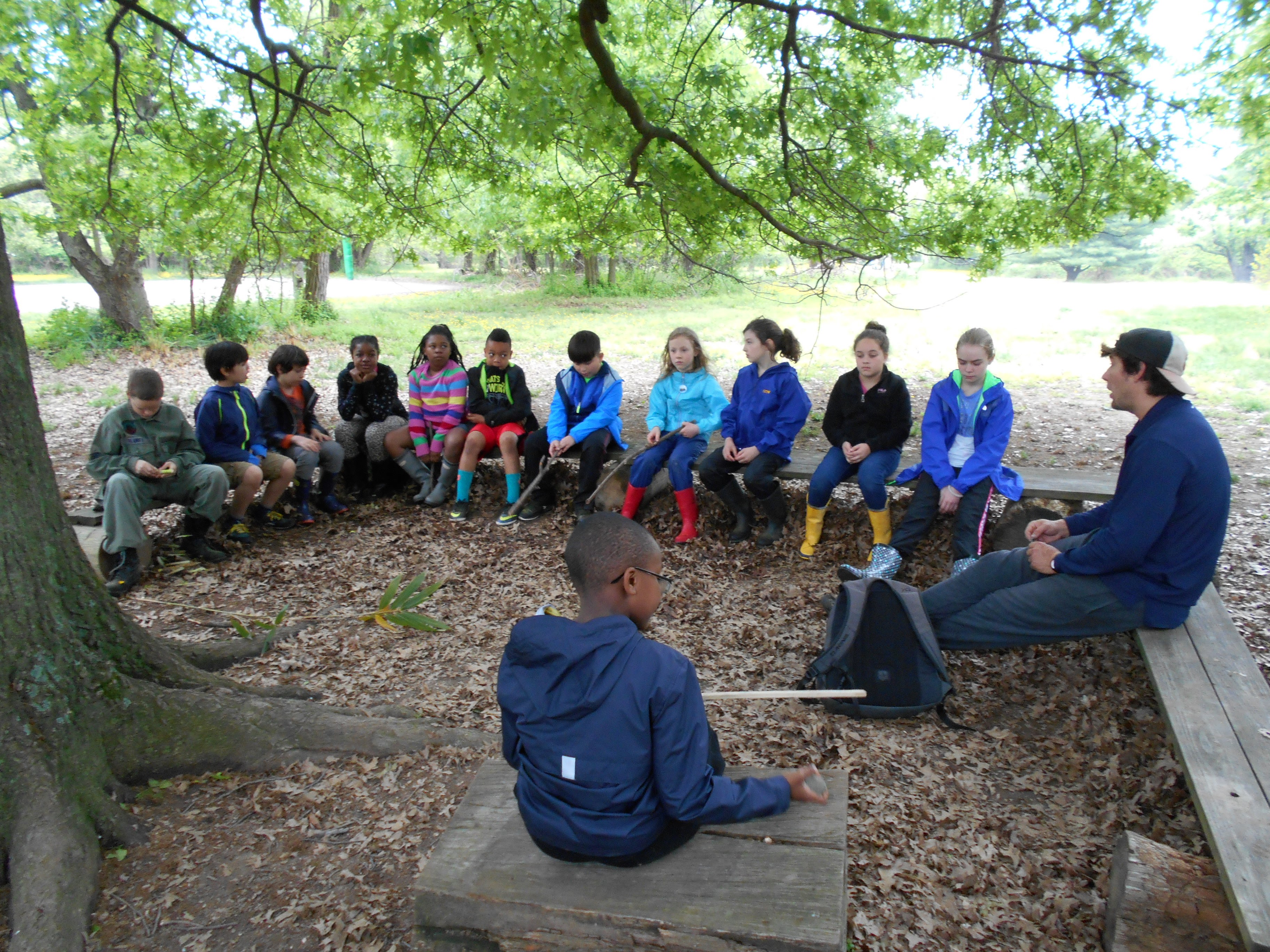
tncs-elementary-echo-hill-outdoor-school-field-trip

Another fun exercise they did was to practice echolocation in which one blindfolded student pretended to be a bat in search of food. This was pretty much a dry version of that pinnacle of pool games, Marco Polo. “Food” in the form of the other students, formed a circle and clapped to indicate their whereabouts for the hungry bat, who had to tag his prey to be successful.
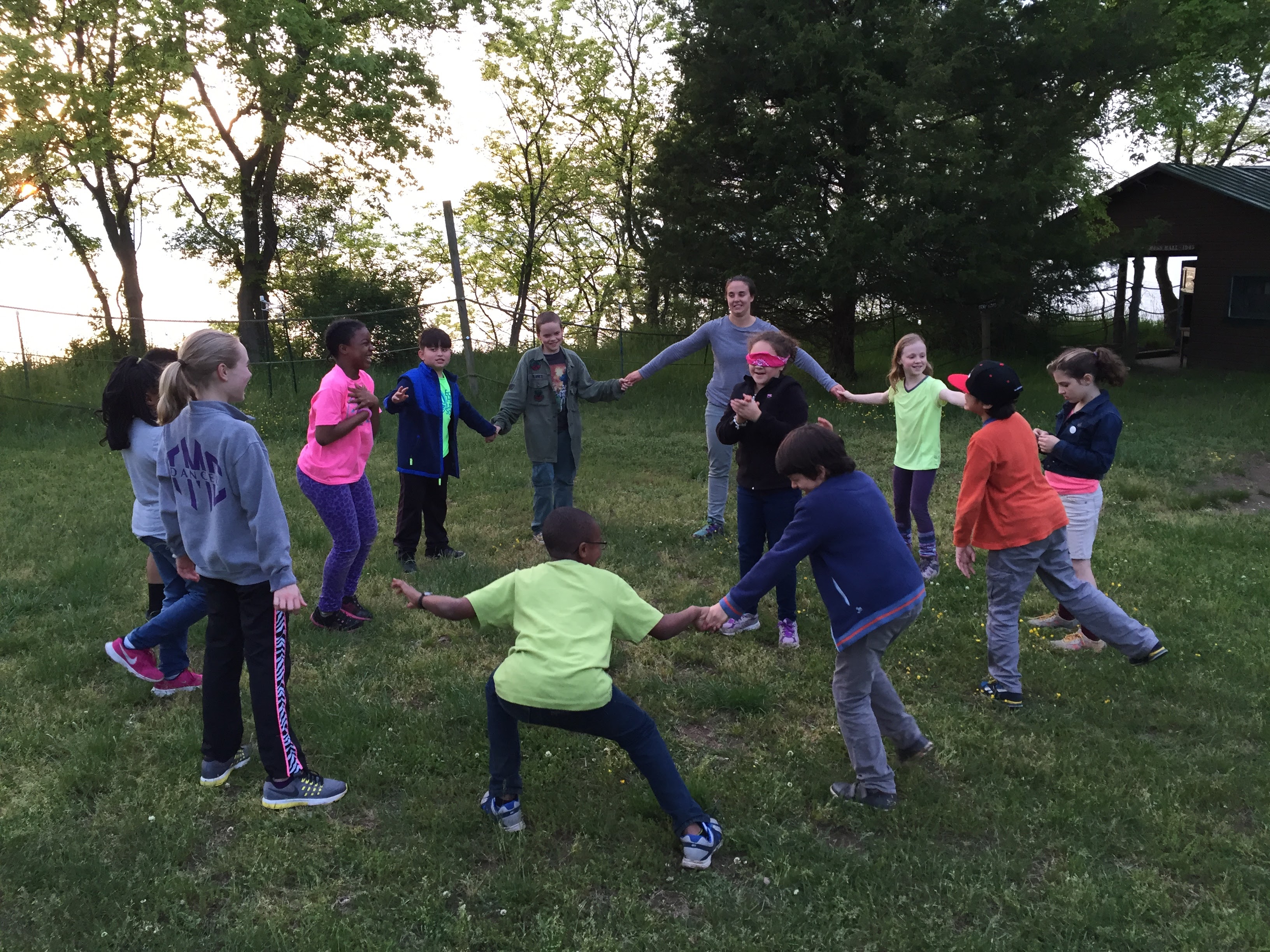
tncs-elementary-echo-hill-outdoor-school-field-trip

Their next activity was a night hike, and they loved that. The teachers let their students embark on that activity with the staff alone so they could feel as far removed from school as possible and really embrace the environment they were in. They heard owls and other wildlife.

The next day started with canoeing, another activity that requires a certain degree of cooperation in order to be able to move across the water purposefully. This was their “survival day,” which also included building a fire and experimenting with what material burned best, what building technique to use (e.g. “log cabin” style versus “tent style”), and what could be done to make the fire stronger. It took TNCS students a bit longer than usual due to the long stretch of rain that bookended their trip and dampened the kindling, but under normal circumstances, Echo Hill campers would also build a shelter from wood found on the beach. Nevertheless, this was nearly unanimously voted to be the best activity. They even used the ash to decorate their faces afterward in a show of . . . tribal solidarity? Creative expression? Plain old outdoor fun? (Probably all three.)

For dining, they mingled with other non-TNCS campers and tried to meet someone new at each meal. They also minded their intake very carefully so as to prevent unnecessary food waste. “They loved the food, but took only what amount they were certain they could eat. If they were still hungry, they could get more.” At the end of each meal, plate scrapings went in a slop bucket, which was then weighed—the goal being to reduce the weight of the bucket contents. “They were constantly aware of the bucket and their desire to keep it light, which was a nice reminder of food waste.”
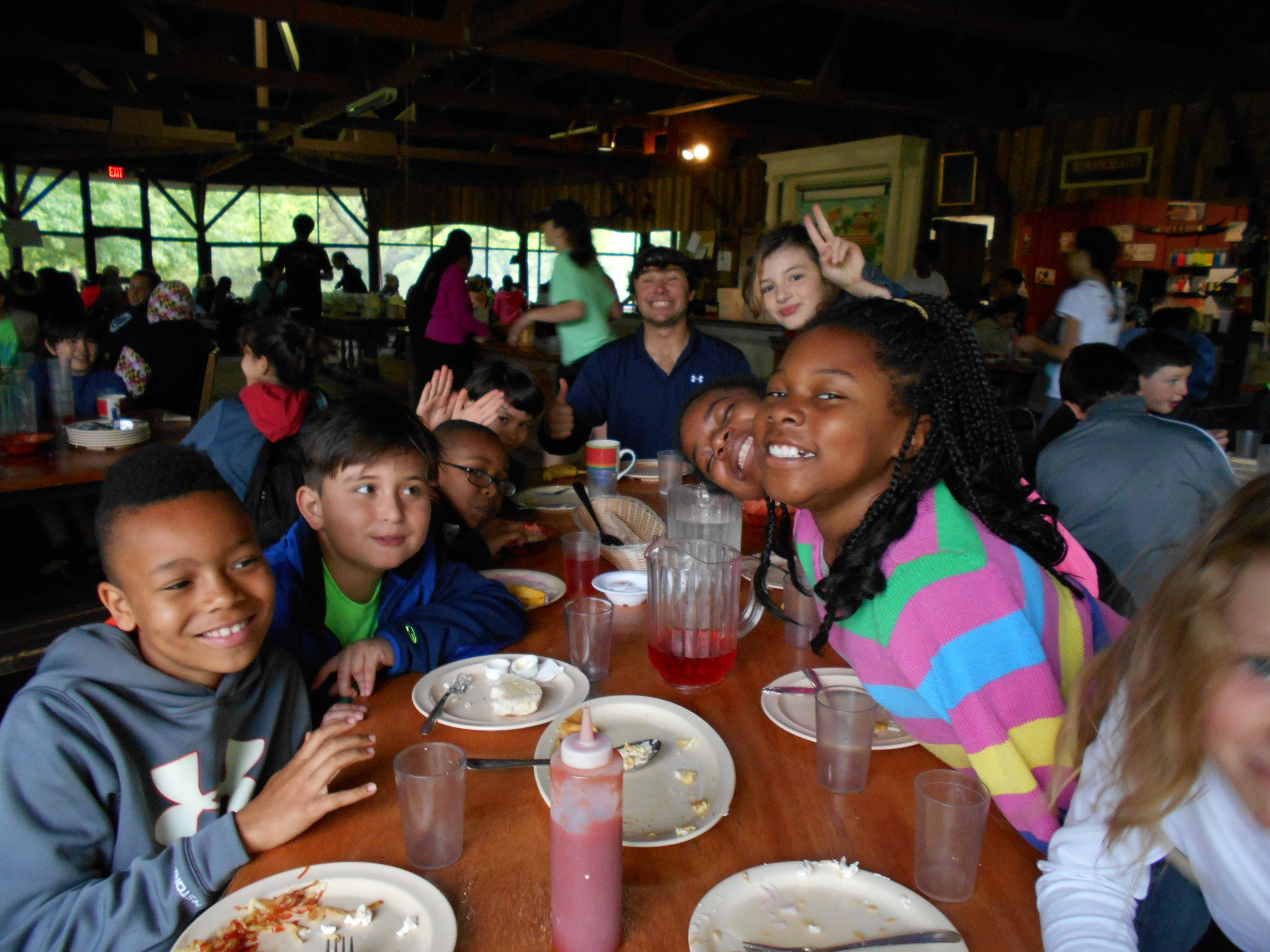
tncs-elementary-echo-hill-outdoor-school-field-trip

“I wanted to do this trip,” said Ms. Stasch:

because I knew we’d all get to see each other in a different setting. It was a lot of fun. We all hope to do a longer trip—more than just a night—next year. The staff were amazing. They were so well trained, and every activity was so well planned out and so well structured. The students were really enthusiastic and happy that we had gone. Overall, it was a great experience, and I’d like to take them again. They reflected verbally afterward on how important collaboration is. Some students were starting to ‘check out’ out of frustration in the beginning, but when they came back and worked together, they saw that that’s when it all comes together. We had some good discussion on that theme. It was a good age to be away from home for a night. They’ve grown and matured a lot this year, and hopefully they will internalize what they learned about collaboration from Echo Hill and can take it with them in their future endeavors.

Mr. McGonigal agreed: It was really great—a cool trip. We got to see the kids outside their element from a different perspective, and we could see the kids really working together. At first there were a couple of kids who were apprehensive about joining in, but by the end of the trip, everyone was into it and having a great time.”

TNCS Elementary Engages in Conservation By the Barrel

With Earth Day 2016 only a week away, you must be wondering, what awesome environment-friendly project will The New Century School students be involved in this year? You are certainly recalling that, since his tenure at TNCS began, elementary STEM teacher Dan McGonigal has made the most out of Earth Day annually to explore conservation and ways to help the environment both locally and globally. Read about last year’s efforts here: TNCS Elementary Takes Earth Day by Storm!

And this year will not disappoint! In fact, this year’s project is one of those learning experiences where individual components come together in a beautiful whole worth far more than the sum of its parts. Mr. McGonigal managed to harness science, art, team-building, environmental advocacy, and fundraising for TNCS to do some actual, measurable good for the Chesapeake Bay Watershed area.

What is the product of this amazing, synergy? Handpainted rain barrels! Even better, these rain barrels will be raffled to four lucky winners on Friday, April 29th!

The project was a partnership with Barrels by the Bay, which Mr. McGonigal learned about through Blue Water Baltimore, who he worked with on last year’s storm drain stenciling. According to their website, “Barrels by the Bay is a non-profit organization focused on contributing to sustainable development of the communities within the Chesapeake Bay watershed and surrounding regions. [They] work to help combat flooding and stormwater runoff concerns throughout communities within these regions, educate community members about our world’s water issues and the importance of water conservation efforts, and inspire students to preserve our world’s water resources.”

The organization came into being on the 22nd Annual United Nations World Water Day, on March 22, 2015, in Annapolis, Maryland, kicking off with a project for area schools to repurpose 50-gallon Coca-Cola syrup drums as rain barrels. In 2016, they expanded their reach to other schools within the Chesapeake Bay Watershed region, including TNCS. Their efforts are having quite an impact: An average of 700 gallons is collected in one rainfall (1 inch of rain in 24 hours) in the 50-gallon rain barrel drum. If Maryland has an average of 41 inches of rain per year, then in just 1 year, one barrel can collect 28,700 gallons of water. That’s no mere drop in the bucket!

But, as mentioned, collecting tons of water is not all they are good for. Says Mr. McGonigal: “In the fall, we used the barrels to develop teamwork and cooperative learning skills in the 2nd–5th grades. They designed the artwork and then voted on the best designs (two per class). They then prepped the barrels for painting by sanding and priming them. They traced their designs on the barrels and, finally, painted them.”

You can watch the 6-month evolution of their creations in this slideshow.

This slideshow requires JavaScript.

“This was also another opportunity for us to put our environmental learning into action. It was a great experience and I hope to make this a yearly event in my class,” said Mr. McGonigal. They then decided to turn the rain barrel project into a fundraiser for TNCS and Barrels by the Bay (each organization gets half of the proceeds). “We also have one more barrel that will be used on our school campus. This will be decorated by student handprints on Earth Day. We hope to use it to help water our school garden,” he said.

Don’t miss the chance to win one of these beautiful and functional rain barrels for your home—get your raffle tickets through the TNCS office through Friday 4/29/16 (by 8:30 am). And don’t worry, Barrels by the Bay even offers workshops to demonstrate how to  harvest rainwater from your roof, store it, and use it for your own home as well as to explain how rain barrels also improve water quality in our rivers and streams.

Thanks to TNCS 2nd–5th science classes, Barrels by the Bay, and the TNCS community, what a great Earth Day this one will be! And a big shout-out to Mr. McGonigal for his continued in-class focus on environmental conservation!

TNCS Science Fair 2016: It All Starts with a Good Question!

tncs-science-fair-2016

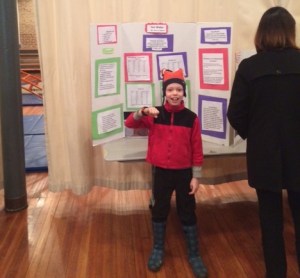
Fist bump for science!

The annual Science Fair is always a highly anticipated event at The New Century School, and 2016 was no different! Last week, parents and students came out in droves to see what science experiments TNCS 2nd- through 5th-graders undertook and what they learned from their experimentation.

Headed up for the second year by STEM teacher Dan McGonigal, this year’s Science Fair had a slightly different focus than last year’s (read about Science Fair 2015 here). Explains Mr. McGonigal:

This year we focused on the Scientific Method as opposed to the Engineering Design Process like last year. The students selected their own testable question related to Physical Science. We focused on creating tests that used manipulated variables versus creating a demonstration of a science concept. For example, instead of showing what happens when you combine baking soda and vinegar, a predictable reaction, I encouraged students to compare the amount of gas released by baking soda and vinegar to Alka-Seltzer and water. Or, instead of building a potato clock, students were asked to compare the volts of different produce to see which would produce the greatest amount of voltage. This helps improve instruction to more closely match how scientists actually work.
Mr. McGonigal also shared a “prezi” to give parents and other Science Fair attendees a closer look into how he framed this year’s endeavors. An important point is that students were encouraged to follow their own interests rather than replicate standard Science Fair experiments. The thrust was to start with a question then follow what various avenues that question presented, always maintaining a logical next-step approach.
“We worked hard on our projects,” said Mr. McGonigal, “and the projects were 100% representative of the students’ own work. I did not correct, edit, or change the student’s work in any way, but they were guided to stay focused on their scientific thinking and reminded of certain measures to help create accurate, neat work, that would be valid. The instructional focus was on the thinking, not necessarily the content related to their projects.”

As always, Mr. McGonigal’s enthusiasm for science adds a special touch. “The results and feedback were very positive about the student’s work. We had a lot parents show up to support their student’s science education!”he said. One such parent (and TNCS Co-Founder), Jennifer Lawner, said, “Mr. McGonigal give a wonderful presentation to parents about the goals of the science fair.  In particular he talked about how he did not do their work for them. For example, the write-ups are imperfect—he reminded them of the rules of punctuation and left them to write the work themselves. The students came up with testable questions, procedures for testing the questions, and reported on their data. There were flaws, but the date it was reported accurately. I was really impressed!”

TNCS lower elementary students also got a chance to see the projects and were given first-hand explanations by the older students. (Stay tuned for an upcoming post on the K/1st Science Fair!)

This slideshow requires JavaScript.

And the exploration will not end with the folding up of the three-paneled cardboard displays. As a result of their self-led science journeys, students will continue asking themselves, “What did I learn? What do I still wonder about?” for months to come.

TNCS Teachers Get Mindful!

Last week Immersed featured guest blogger Carisa Perry-Parrish writing about her presentation to The New Century School staff on how to bring mindfulness principles into the classroom in Stop and Smell the Roses. This week, we’ll hear from some of the TNCS attendees about what they took away from the presentation.

Screen Shot 2016-03-25 at 3.16.51 PM

Courtesy of Dr. Carisa Perry-Parrish

TNCS Head of School Alicia Danyali organized this staff development initiative after hearing from several staff members that Dr. Perry-Parrish’s mindfulness workshop for parents inspired them to want to learn more about the topic and how to use it to help them better relate to their students. This meshed very well with Mrs. Danyali’s own overall approach. “My mom always reminds me that when you are on an airplane and the oxygen masks drop, you are instructed to care for self before assisting others. What this translates to for me personally is, the more we take care of self, incorporate deliberate choices to model appropriate behaviors when it comes to support, the more others around us benefit,” she said. Thus, for Mrs. Danyali, practicing mindfulness is an important part of personal and social health.

tncs-mindfulness-classroom

Courtesy of Carisa Perry-Parrish.

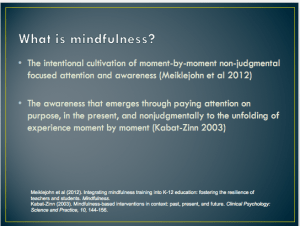
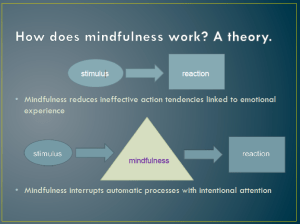
Although practicing mindfulness is arguably beneficial everywhere, all the time, for educators it has a particular resonance. A central tenet of mindfulness is regulation of emotion, the ability to make a considered response rather than reflexively react, as Dr. Perry-Parrish’s slide at right illustrates. This idea reverberates in many ways inside the classroom, where teachers continuously interact with children who are still in varying stages of development. Teachers must find ways to bridge the cognitive, emotional, and social gaps this interaction entails as well as model for their students the right way to handle various challenges.

Says Mrs. Danyali: “The role teachers play in a student’s life is defined in part by cultural expectations, social norms, and organizational rules that usually operate outside the classroom. Mindfulness is one more ‘tool’ in a teacher’s toolbox to help their students think things through for themselves, take accountability, and make choices that tune into their emotional needs. On the social aspects of teaching, mindful practices encourage students to feel important and cared about, as well as gain confidence in their own abilities. To acquire a personal sense of respect and responsibility for themselves and others is the focus.”
tncs-mindfulness-classroom

Courtesy of Dr. Carisa Perry-Parrish

This seminar was a very natural fit for the primary teachers, who implement a classic Montessori curriculum in their classrooms. Maria Montessori was a proponent of what would evolve as what we know today as mindfulness practice. Let’s hear from a TNCS teachers who asked for, attended, and learned from this seminar.

TNCS primary teacher Maria Mosby: “It was great to get a more in-depth understanding of mindfulness and its many benefits for adults and children alike. Several teachers that I talked to were excited to read and learn more, and begin incorporating mindfulness into their lives and classrooms. I would definitely like to begin a practice of mindfulness meditation before each school day begins, to help prepare myself for being more present with the children and other teachers. It was interesting to learn how the practice has helped so many others in many different professions and walks of life. Though we occasionally do a group meditation in class (such as the flower and candle breathing exercise), I think it would be a great way to begin every day, as opposed to the typical circle time. When the children are sitting in the peace corner alone or as a group sitting on the rug, you can see them begin to try to quiet their bodies and minds and prepare for the day. It’s a practice we can all benefit from- tugging at the leash, and getting the easily distracted little puppy dog in our minds to focus on the path in front of us. Everyone needs time to breathe between tasks and have a moment to themselves.

The children who have a teacher who is present and is calm, not reacting based on his or her instinctive thoughts in a given situation, are likely to learn better coping and social skills themselves. They will also have more focus and joy in the classroom environment. Integrating mindfulness into any classroom can help everyone to become more focused on each individual task, and improve student-teacher and student-student relations, thus enhancing the experience for the entire class.”

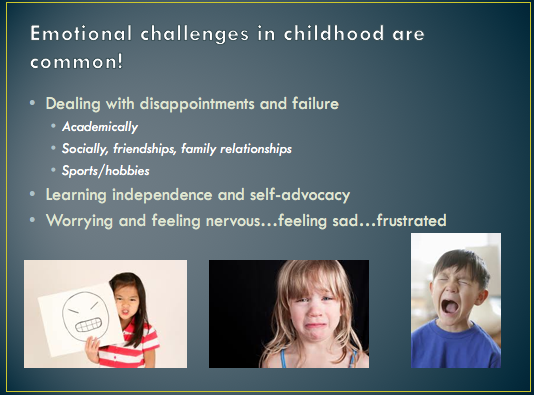
Other non-Montessori TNCS teachers also benefited in multiple and sometimes surprising ways, as well. The elementary teachers, for example, face daily challenges that are different from what teachers of 3 to 5-year-olds might face, but these challenges are no less real and no less vital to handle in the best way for the child.

TNCS upper elementary STEM teacher Dan McGonigal: “My take-away from this presentation was really simple but something I need to remind myself of is that our students are not adults and they aren’t going to behave that way. After this presentation I have tried to take a step back and just teach in the moment and be present for that moment and not think about past or future difficulties. I try to remind myself of what was important to me when I was 7–11 years’ old. This has helped me better relate to some of the decisions students make on a daily basis. I try to better appreciate the student’s perspective of things, especially those that may have a learning disability or behavioral challenges. Teaching can be difficult because you are constantly looking for progress and, at times times, their progress may appear invisible. But students often need time, numerous examples, and development to start making progress.”
That’s a clear benefit of employing mindfulness as a teacher, and here is another perspective on the importance of teaching mindfulness.
TNCS upper elementary Language Arts and Global Studies teacher Kiley Stasch: “I thoroughly enjoyed the mindfulness presentation, not only from the perspective of a teacher but also for myself. As a teacher, it has helped me to take a step back and understand that teaching these skills explicitly is important and essential to do. We often assume these students have learned how to best manage their own emotions, but even older students have not necessarily had someone to help them through the steps they should be taking. Breaking it down for the students and helping them to understand where their emotions are stemming from helps them to reduce a poor reaction at that moment as well as in similar instances that will come up in the future.”
As for future staff mindfulness initiatives, Mrs. Danyali says, “The hopes are that this training was a nice reminder or a validation of current approaches, but also encouragement for implementing new strategies that will not only benefit one or two students, but the class as a whole.” Dr. Perry-Parrish also provided three models for continued development in this arena: CARE, SMART, and MWBE, detailed in the slides below.

This slideshow requires JavaScript.

These final words from Ms. Mosby might best encapsulate the experience for TNCS teachers and perhaps all teachers, worldwide: “Mindfulness is an experience we all can and should offer our students each day. It’s easy to become so focused on the specific learning goals and daily tasks of teaching that one doesn’t always stop to slow down and truly listen, observe, and enjoy the children. There are so many wonderful moments that we miss out on this way.”

Anyone reading this post has already hit pause on the day to stop and be in a moment. We recognize that, and we thank you. The kids around you will thank you, too, both for knowing how to be truly present with them now and for showing them how to grow up to be adults who embody this critical awareness in their future lives.