Honoring Parenthood at The New Century School

Right in between Mother’s Day and Father’s Day as we are, let’s celebrate being parents! In fact, The New Century School’s word of the week this week is celebrate, and students learned to say it in Spanish—celebrar—and in Mandarin—qìng zhù (庆祝). This week TNCS also hosted lovely Mother’s Day breakfasts for each class to give Moms (or another special person who was able to attend) a chance to spend some time with their little ones in their school environment, eat a healthy breakfast, and socialize with the other Moms and kids.
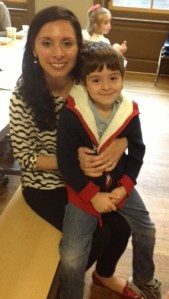
Mother and son

Having a great time together at the Pear Tree Mother’s Day breakfast!

Some classes even performed songs or handed out flowers to each Mom. This annual TNCS tradition is just about as nice a celebration as you could want. And the kids . . .  they were beaming from ear to ear, proudly introducing their moms to special friends (and handling the delay in getting outside to the playground with admirable restraint). Sundai Valcich, mother of two children in the primary program at TNCS says, “The Mother’s Day breakfast is one of my favorite events of the year. I love the excitement my children have leading up to the day, and the pride they have those mornings bringing me into their school. It’s so nice to share a meal with them there and is a wonderful way to celebrate being their Mom.”

Even though school will already be out for the semester by the time Father’s Day comes around, TNCS is making sure Dads get their turn, too. TNCS Services Manager Lindsay Duprey says, “the primary classes invite fathers (or significant other male figures or mothers) to join their child for breakfast at Thames Street Park.” Bulletins from class teachers will provide dates and times.

So to help keep the celebratory spirit going, let’s indulge in some more exploration of what it means to have children and to care for them. After all, parenting is at the heart of this blog as well as at the heart of why we care about the quality of our kids’ educations. Here is some empirical evidence with which to reassure ourselves that we’re raising happy, well-adjusted kids. Of course, none of us manages to do all of it right all of the time, but all of us get it right some of the time—cause enough to celebrate!

A Top 10 Evidence-Based Parenting Checklist 

1. Joke with your kids: Researcher Elena Hoicka at the Economic and Social Research Council believes parents who joke with their children are helping them develop social aplomb—no kidding! Though “joking around” certainly counts, click here for some kid-friendly quips to add to your personal stand-up routine.

2. Stay positive: Researcher Michael Lorber from the University of Minnesota originally reported in Child Development that negative parenting can result in aggressive kids. Even when it’s the last thing we feel like doing when confronted with bad behavior, correct with a smile and gentleness.

3. Foster self-compassion: Pioneering self-compassion researcher Kristin Neff suggests that accepting our imperfections is a very important life skill, helping people stay resilient in the face of challenges. Parents can use self-compassion when coping with difficult times with their kids, but even better, as we show ourselves compassion, we set a great example for our kids.

4. Let go: This is the hard one for many, but researcher Neil Montgomery found that so-called “helicopter” parents have neurotic kids who are more dependent on Mom and Dad throughout life.

5. Nurture your marriage (or partnership): Surprisingly, researcher Anne Mannering at Oregon State University discovered that marital instability caused sleep difficulties in young children—at ages when sleep is most critical for healthy development. The implied converse is that stability allows for healthy sleep with all of its concomitant developmental benefits.

6. Tend your mental health: Researcher Heidemarie Laurent showed that depressed parents display muted responses to their childrens’ distress and could also contribute to depression, stress, and other problems in their kids down the road. Getting help when you need it will help your child also make necessary adjustments for health.

7. Develop secure attachments: Researchers from the University of Maryland believe this is especially important between mothers and sons and leads to better interpersonal (including romantic) relationships in their adulthood.

8. A little sassing is okay: Kids are learning to stand up for themselves, say researchers, and this is especially important for withstanding peer pressure. Again, smile, smile, smile . . .

9. Abolish perfectionism: Researchers found that parents who believe society expects perfect parenting from them ironically become worse parents and could transfer that stress and self-doubt to their kids. Good enough is good enough!

10. Tailor your parenting to your kids. We know this on a really deep level, but somehow the other voices manage to creep in. No matter what other parents think and advise, we know our own kids’ personalities best. Researchers say to be flexible and adapt your parenting style to your particular kids for their lifelong emotional health.

So parents, pat yourselves on the back and celebrate the great work you’ve done!

Touch Screens and Your Child: To App or Not To App

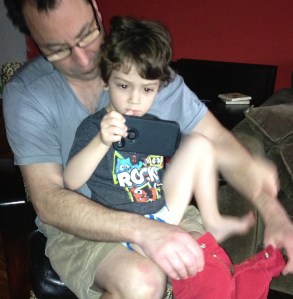
This child is so immersed in the iPhone screen that he can't even participate in getting dressed for school. Hope he's learning something!

This child is so immersed in the iPhone screen that he can’t even participate in getting dressed for school. Hope he’s learning something!

Digital Natives

Called “digital natives,” because they have never known an existence without the internet, our kids navigate touch screens almost instinctively, with the same ease that a tadpole learns to swim. (What does that make those of us born after 1993, you ask? “Digital immigrants,” evidently trying our best to adapt to this strange new world.)

Let’s start right off the bat by saying that this is neither a diatribe for nor against toddler technology usage. There is still so much to be learned about this issue, but opening the conversation certainly seems worthwhile. Because, for many parents, besieged daily by work, laundry, phone calls, bills to pay—those bazillion myriad demands on our time and energy—the personal table or smart phone becomes almost a temporary surrogate, immediately appeasing a whining or misbehaving child when our attention has already been commanded. Or, how about the alluring possibility of grabbing 15 minutes’ more sleep on Saturday morning . . . Sure, honey, you can play with Mommy’s iPad! But once the tasks are seen to, or the coffee has kicked in, the guilt floods in, right? Are we turning their brains to mush? Shouldn’t they be outside, enjoying an idyllic, tech-free childhood (like Heidi)?

According to a new article by Hanna Rosin featured in April’s The Atlantic, we may be beating ourselves up unecessarily. Sure, using apps to babysit our kids probably isn’t the ideal to aspire to, but a little screen time, it turns out, is probably not only fine, but is maybe even good for them in moderation. One key is that iPads and the apps that we download onto them are interactive, and interactivity fosters deeper engagement and thereby faster learning. The difference in brain scans of a child watching a passive television show versus playing Toca Tea Party (a toddler-sized app), for example, is startling.

In “The Touch Screen Generation,” Rosin argues that, “if parents ‘treat screen time like junk food, or ‘like a magazine at the hair salon’ — good for passing the time in a frivolous way but nothing more, then the child will fully absorb that attitude, and the neurosis will be passed to the next generation.” In other words, if we consider it contraband, they will too. Her response was to see what would happen if she gave her 4-year-old son free access to the iPad. She found that he played with it obsessively for a few days, after which it lost that “forbidden fruit” appeal and was relegated to the rotation the rest of his toys cycled through. Rosin’s article is a great read—you can find her story as well as a video on how kids use iPads here. She also includes a list of apps that are “cool in toddler world.”

But in “Parents of the Touch-Screen Generation,’ Don’t Free Your iPad Yet,” KJ Dell’Antonia counters that Rosin is missing a key use of iPads for young kids—“a middle way between ‘neurosis’ and full-blown iPad freedom.” In the United States, she writes, we tend to see apps as either educational or entertaining (or both, at their best). Quoting Lisa Guernsey, author of “Screen Time: How Electronic Media — From Baby Videos to Educational Software — Affects Your Young Child,” Dell’Antonia writes that in Europe, schools are “teaching the children to use the iPads to make them creators and documenters of their learning.” Instead of always drawing them in to that immersed, “zombie-like” state, the iPads are used to connect them to their world—surroundings, family, friends.

We started with the more positive perspective on this issue because the outcry against screen time for toddlers and kids is a bit more vociferous, and the point of view in favor of moderate, supervised usage can get drowned out. But let’s now take a look at the very real reasons we’re so emotional (guilty, afraid, angry, etc.) about our adorable little digital natives.

Well, for one thing, the screen’s going to get very sticky.

There’s one objection for you. On a more serious note, other objections range from zombie-ism to missing out on time spent outdoors to becoming socially dysfunctional. In a May 2012 broadcast of her NPR show, Diane Rehm asked, “What’s all this screen time doing to these young developing brains?” The jury is still very much out on that (the technology having existed for less time than it takes to conduct a viable study) although research is being done at a furious pace. (Even this becomes an objection for some—are we turning our kids into science experiments?) Nevertheless, the American Academy of Pediatrics (AAP), who in 1999 strongly advised against television for kids under age 2 years, issued a 2011 update with even more stringent warnings. Now they say to restrict access to any screen for this age group. Seems a bit draconian, given that these same babies likely see their parents interacting with screens of all sizes, all the time, and their instinct is to mimic what they see their parents doing.

Draconian measures notwithstanding, the AAP’s stance certainly gives parents of toddlers pause. We might do best, along with KJ Dell’Antonia, not going all the way to unrestricted iPad use. All things in moderation, right?

Some advice from an Application Usability Specialist . . .

“As an Application Usability Specialist with two young children,” writes one parent very intimate with this issue, “my children have been immersed in technology since birth.” He says that as his “testers,” his kids have learned “math, resource management, flexible thinking, situation analysis, information analysis, goal-setting and sharing, yes sharing.”

His advice? Parents should:

  • Make sure apps are age appropriate!
  • Read the app reviews first!
  • The parents have to do the homework and play the game first.
  • Don’t purchase so-called educational games based upon a “commercial toy property” (i.e., Dora the Explorer) and expect that education will come first. My personal exception to this rule is Sesame Street and PBS properties, because education always comes first with PBS.
  • Play the games with your children.
  • Some of the best games are from independent designers and developers.
  • Size does not equal quality. Some of the best apps are the simplest.
  • The best touch-screen interface is a book! It never runs out of power and is usable with any sufficient light source. (Note: Hanna Rosin takes issue with the notion that books are inherently better than screens: “My daughter, after all, often uses books as a way to avoid social interaction, while my son uses the Wii to bond with friends.”)

And in the above-mentioned book, Lisa Guernsey says much the same thing with her “3 Cs” of media consumption: Content, Context, and your Child. Triangulating the 3Cs can guide app selection and usage under almost any circumstance.

Just for fun?

As a final word, the App That Shall Not Be Named has not yet been mentioned here, and, given its entrenchment in the hearts and minds of little kids, it should be. Of course we control what we download on the iPad, but let’s face it, parents, it’s not always that simple. Once kids see Angry Birds, which is everywhere, they want to play Angry Birds, not Montessori Letter Sounds. “You know those shoot -em up games?” asked one mother. “They’re kinda fun,” she said smiling a little sheepishly.

Apps are fun!

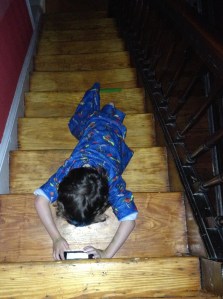
Enjoying the game he was playing so much, this child paused midway up the stairs, lost in the experience. Good? Bad? Probably here to stay.

For more on this issue: