Thoughts on the First Half of the Year from TNCS Head of School Shara Khon Duncan

Although it may be hard to believe, the first half of the 2018–2019 school year at The New Century School has just drawn to a close. Boy, did the last 3+ months fly by!

However, when we look back at everything that TNCS students have done since August 27th, the real surprise becomes, wow—how’d they squeeze so much active learning into such a short time span?! So, Immersed sat down with TNCS Head of School Shara Khon Duncan to get her perspective on how the school year is progressing so far as well as how she is settling in to her role.

The Skinny from Señora Duncan

SONY DSCIt’s clear right off the bat that Señora Duncan has embraced her position as TNCS Head of School. But that doesn’t mean it’s all smooth sailing all the time. “It seems like just when I feel like I’m starting to cruise a little bit, a new event pops up, or something new is about to happen, or I have to prepare for something coming up down the road. But that’s expected; it’s the first year,” she said smiling. So many things are happening, many simultaneously, that she’s pretty much on her toes all the time—“good thing I danced as a kid,” she joked. She ticks off a partial list of some of the events she either kept track of or oversaw in the preceding weeks, both during and outside of the school day, and each with its own particular set of needs: Observation Week and the Fall Festival for the Primary program, whole-school Book Character Dress-Up Day, Elementary and Middle School Information Night and Open Houses for prospective families, Winter Concerts . . . and the list goes on. “They come so fast, yet they seemed so far off back in June. Now June seems far away, and here we are in December,” she said. “So sometimes it feels like I’m just about to take a breath, but we have to keep moving to get ready for the next thing. It’s great because I either learn something new about the school, or I get to meet some more people, which is even better.” Speaking of new people, she recalls the Maryland Secretary of State’s visit, saying, “Important visitors to our campus brings even another level and layer of excitement and preparation, which makes it all so interesting.”

She means it when she says that she finds all the hubbub exciting:

I’m loving it. I’m really loving it. My friends and family ask, ‘how do you like it?’I tell them, ‘Don’t get me wrong, I’ve had some challenges. It’s not like it’s all sunshine and roses, but it’s so exhilarating to have a new challenge in my life at this stage of my career.’ To be able to do this is wonderful. All of these things that have been in me that I’ve been gathering in my career backpack for education over the last 25 years, I get to pull them out and really use them. It’s all coming to bear. At the same time, I’m still learning, which is just wonderful. I have not taught all of the subjects we teach here, so learning about those I was previously unfamiliar with and listening to our teachers and to our parents about how we can make them better really helps. It gives me an idea of where we need to go.

A Day in the Life

When asked for a description of a typical day as TNCS Head of School, Sra. Duncan laughed. “See, that’s another thing I like about education, there are no typical days!” She explains that some days she visits classrooms to keep track of what’s going on in those environments, whereas other days might find her confined to her office, conducting meetings, handling all of her communication, and the myriad other tasks her position demands of her. “I don’t like those days as much,” she admits. “Not that what goes on in there isn’t important, it is, but I’d rather see what’s going on in the classrooms. There are so many wonderful things going on during the day—I love to sit and listen and watch. I find it utterly amazing.”

Being a linguiphile (she grew up in a household where her mother encouraged all forms of language exposure), she finds Pei Ge‘s (“Ge Laoshi’s”) classroom particularly difficult to tear herself away from and is starting to pick up some Mandarin with Wei Li’s (“Li Laoshi’s”) help.

I want to sit there and be with the kids and go right along with them as they go through the daily routine in Mandarin or talk about fruits in Mandarin. It’s amazing to me that even students who just joined the program this year can become so proficient so fast. It’s magical to see live what happens with the students and their brains. You can talk about studies, you can see them online, you can read all the papers—but when you actually see children speaking the language and then turn around and start speaking English to me or speaking Spanish to Sra. Sanzana . . . it’s just amazing how their brains switch effortlessly to the very next thing.

Another interesting aspect of her role is that not only did she assume it this year, but it is itself new, or maybe refurbished, this year. The school administration expanded to include a Head of School as well as a Head of Lower School/Dean of Students, which position Alicia Danyali took over. Both roles are well defined and eliminate the guesswork that can plague an organization when chain of command is unclear. When asked how this new division of roles has worked out so far, Sra. Duncan wasted no breath: “I don’t know what I would have done without her, and I don’t know how she did it all these years by herself. I mean this is a big job, a really big job!” She also appreciates how well they work together, not just alongside each other: “We’re very like-minded in our philosophies about school, which is ideal. It’s great to be with her,” said Sra. Duncan. And, their strong suits complement each other:

Ms. Danyali has done wonders with handling preschool, which admittedly is not my bailiwick, so having her really cover that has been so wonderful. And having her experience and institutional knowledge has been invaluable. If I have a question about a situation, she can tell me how it was handled last year, 3 years ago, and so on. I feel so lucky to have that. How many people get to work with their predecessor? It should almost be required because it’s so helpful.

Work–Life Balance

Apart from enjoying a new position and being able to handle it, any big career change also has to fit into an individual’s broader life. Fortunately, that, too, is working well for Sra. Duncan. With her two daughters away at college, the daily demands of raising children have largely evaporated, leaving more time, space, energy, and nurturing that Sra. Duncan can direct elsewhere. Also, her husband has been very supportive. Even when she needs to stay late, such as for a school potluck, he will sometimes join her or make sure she has what she needs to get through a long day (“He packs fruit for me everyday”). “But, even though this job does fit into my life pretty well at this stage, I have learned long ago that I have to make a separation between home and work. So, I really try to make sure that I leave TNCS at TNCS, and, when I get home, I’m at home. That’s something I’ve really worked hard to do,” she said.

Her ability to achieve this work–life balance serves her well, but it also serves TNCS and the TNCS community of students, teachers, staff, and families. Sra. Duncan has already earned our love and respect for her unflagging composure, ready smiles, and judicious leadership. We can’t wait to see what the second half of the school year brings!

 

TNCS Middle School Students Learn Grant Writing!

At The New Century School, service to the community is a core value. Dean of School/Head of Lower School Alicia Danyali has integrated service learning throughout the school year in many ways (read last week’s “check-in” with her for more on specific initiatives).

Last month, she  took it to the next level when she invited 11th-grade McDonogh School student Laya Neelakandan to present on her impressive experience with grant writing to support several charitable projects. She learned of Ms. Neelakandan last June after having collaborated with one of Ms. Neelakandan’s teachers (Mary-Catherine Irving) on a service project for her son’s school. Ms. Irving told her about Ms. Neelakandan’s remarkable accomplishments in service initiatives, and they discussed the possibility of a visit to TNCS. “I am excited that the students will have this opportunity, which the 6th- to 8th-grade students can use as a ‘jumping off point’ to initiate their own grant writing to support and fund service,” said Ms. Danyali.

Grant-Writing Presentation

tncs-grant-writing-presentationEven this early in her sure-to-be illustrious career, Ms. Neelakandan has already received 11 grants from five different foundations—she has been awarded every grant she has ever applied for!
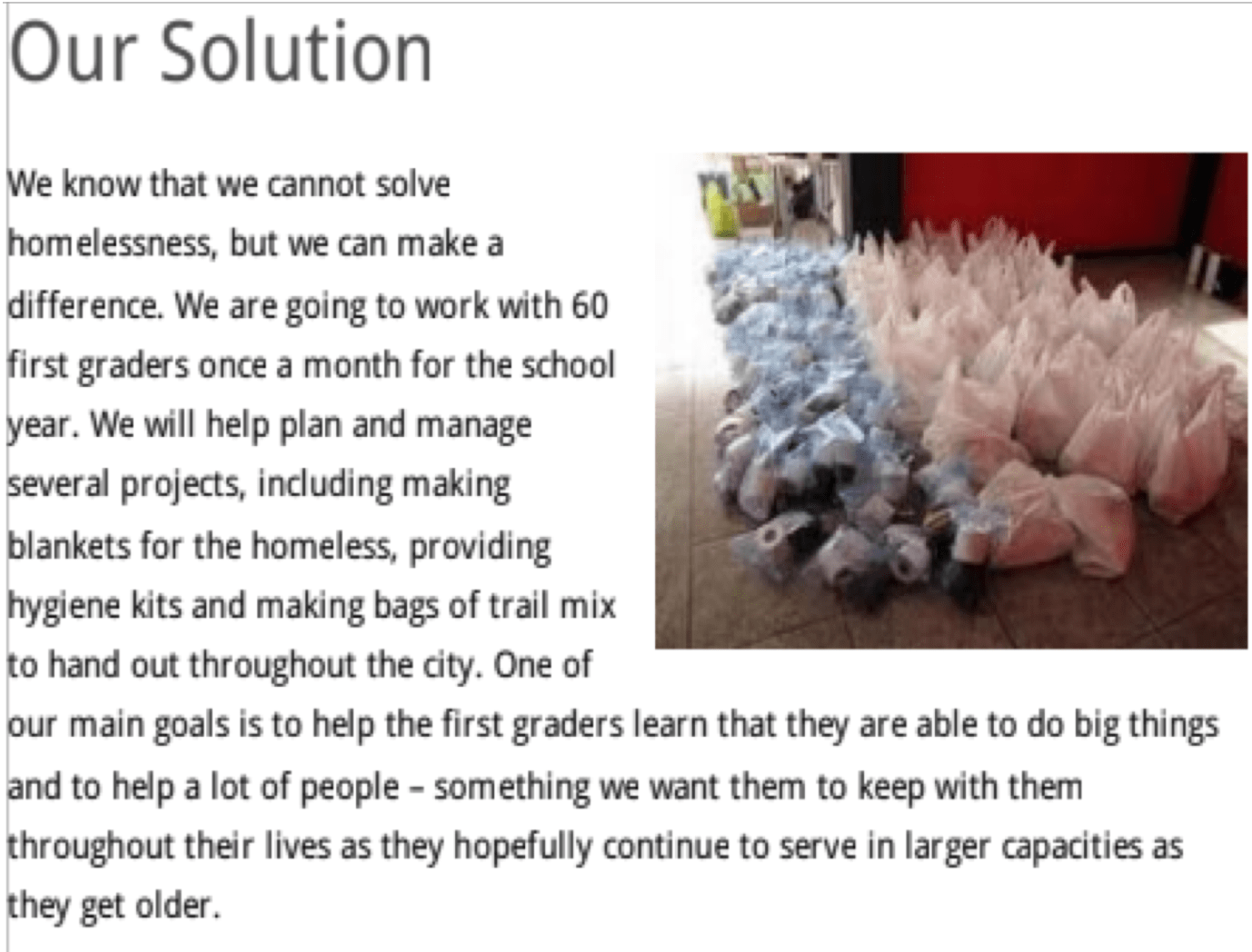
After introducing herself, she began her presentation by describing her first grant-writing experience for The World We Want Foundation (WWWF). This organization promoted philanthropy among youth all around the world and was introduced to Ms. Neelakandan by Ms. Irving. Her proposal was designed to teach the importance of giving back at a young age, so she recruited groups of 1st-graders to make blankets, hygiene kits, and bags of trail mix to distribute to Baltimore’s homeless citizens.

tncs-grant-writing-presentation

With her written grant proposal, she was first awarded enough to fund a couple of such projects. She next wrote a follow-up proposal to fund all of her projects and received three $1,000 grants over a 3-year period. This allowed her to expand her philanthropic efforts to include the India Project, which is a school supplies drive for Indian schools. She made and sold friendship pins to buy dictionaries and other supplies that she delivered in person in India.

tncs-grant-writing-presentationAfter a very successful run with WWWF, which closed down in 2015, Ms. Neelakandan went in search of a new project to support and came across Karma for Cara (K4C), which is based in Baltimore and is dedicated to “Empowering Youth to Repair Our World.” Following the online instructions, she applied for and won four $1,000 microgrants. With these, she was able to keep her already successful WWWF projects thriving as well as add a backpacks drive. She continues to support K4C.
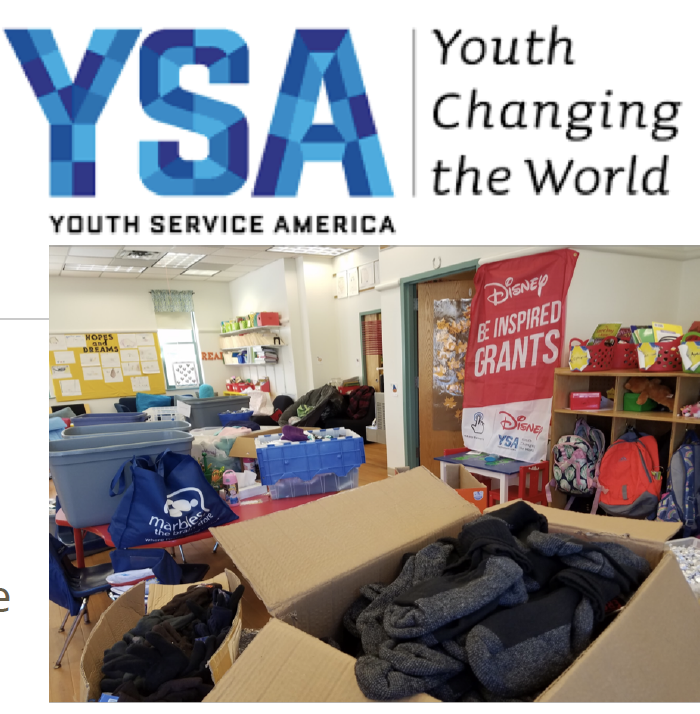
She then learned about Disney and Youth Service America (YSA)’s 2017 Summer of Service Organization Grant and, to her surprise, won the $500 grant 2 years in a row. She says the experience “proved that I should be confident in myself and that I can change the world (and you can too!) and showed me that there are people out there who believe in the power of youth.”

tncs-grant-writing-presentation

Ms. Neelakandan’s work has not gone unnoticed. Recently, the Orokawa Foundation (a grant-making organization in Towson, MD) approached her about funding her projects. She is using the money to establish a library at a domestic abuse shelter. TNCS students may be assisting her in this endeavor in the near future.

And—breaking news–in the days since she presented at TNCS, she has been awarded yet another grant in the amount of $150. Kindness Grows Here is a new foundation that awarded its first Annual Kid Kindness Grants this month! “[They] want kids with awesome ideas to submit applications for ways in which they can help spread kindness in their school, community, town, or neighborhood.”

Screen Shot 2018-12-02 at 10.23.10 AM.png

Ms. Neelakandan closed her TNCS presentation with some hard data (which has since been updated, given the new grant she just won):

  • She has raised $10,478 in the 6 years she has been doing these projects.
  • She has delivered over 150 handmade fleece blankets, 800 bags of trail mix, more than 1,200 sweet treats, 750 hygiene kits, and 300 backpacks.
  • She has directly helped over 1,250 less fortunate men, women, and children.

She has also been invited to speak at fundraisers, won awards, and influenced fellow students. With these mantras in mind, this is how she has done it:

  • There is no such thing as a small act of kindness.
  • Find your passion and use it to change the world.
  • Keep applying to different places and never get discouraged if it does not work out.
  • You have the power to change the world, and don’t ever let anyone tell you otherwise.
  • Ask questions, be a leader, be kind and empathetic.

Interview with Laya Neelakandan

Because the visionary Ms. Neelakandan had to return to school immediately following her presentation, she kindly agreed to an email interview for this piece, transcribed here.

How did you become interested in grant writing?

“When I was in 4th grade, my mentor, Mrs. Mary-Catherine Irving, asked me if I wanted to lead her class in service projects. She introduced me to the concept of microgrants, and, at the age of 10, I applied for and received my first grant. Since then, I have continued to immerse myself in grant writing to get support for the projects that I make for the homeless.”

Do you plan to go to college? What will you major in, if so?

“I do plan to go to college after I graduate high school. Though I’m not completely certain yet exactly what I want to major in, I’m very interested in English and writing and aspire to be a journalist.”

What future career do you plan to pursue?

“I want to pursue journalism as a future career and use the power of my words to make a difference in my community and highlight social justice causes.” [Ed. note: You go, girl!]

Can you describe your experience of presenting at The New Century School?

“Presenting at The New Century School was an amazing experience for me. I had never presented about my grant writing before, and I loved seeing the students’ earnest and engaged faces as I told them how they have the power to change the world. Their interest shone through especially during the Q&A, where they asked me some of the most intriguing and introspective questions I had ever received, including what inspired me to keep giving back and if my school supports my work.”

Will you be doing additional work with TNCS students?

“The TNCS students are going to be conducting a collection drive for gloves, mittens, scarves, and socks for families at a shelter that I have been working with this past year (this is the Family Crisis Center shelter where I built the library for the children). I am excited to see what other ideas the students come up with.”

What are your hobbies (or, what do you enjoy doing in your free time)?

“In my free time, I enjoy playing piano, classical Indian flute, practicing classical Indian dance, singing, reading, and writing.”

What do your parents think of your work?

“My parents are extremely supportive of my work. They help drive me when I go out to distribute the items to the men and women who need them. They have also instilled in me the importance of using this gift of life to help others.”


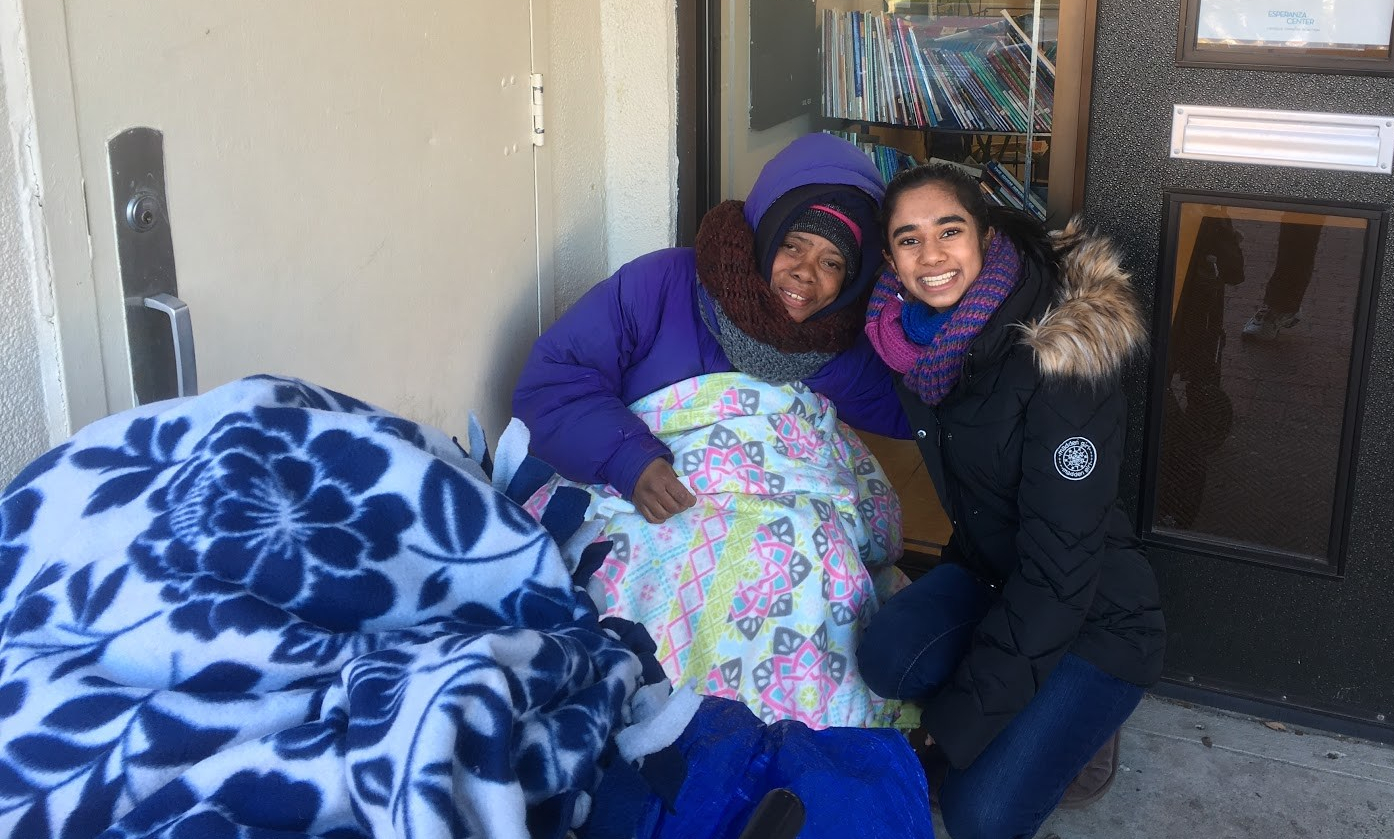
Ms. Neelakandan is pictured below right with a woman outside a homeless shelter last January. “I had just given her some handmade fleece blankets. It was below freezing outside,” she explained.
tncs-grant-writing-presentation

Ms. Neelakandan drove home two primary points for TNCS students: First, youth have the power to do good, and, second, write from the heart when seeking a grant—“If you really care about something, it will show through in your writing,” she said.

“She was inspiring and wonderful,” said Ms. Danyali. It certainly will be wonderful to see just how she inspires TNCS students and what great things they will make happen in the coming months!

Meet the Teacher: Taryn Biancaniello Gets in Key with TNCS 2nd- and 3rd-Graders!

For the 2018–2019 academic year, The New Century School has two classrooms of 2nd- and 3rd-graders, one of which is now taught by Taryn Biancaniello.

Meet Taryn Biancaniello

tncs-elementary-teacher-taryn-biancanielloMs. Biancaniello comes to TNCS by a rather circuitous route. Her extended family is originally from Reading, Pennsylvania, but her immediate family never stayed put for long owing to her father’s job in the government. “I grew up moving around,” she explains. “I was born in Germany and lived there until I was 5 years old. Then we moved to Glen Rock, PA and next to Glen Burnie, MD, where we lived until I was 10 years old.” From there, she lived in Australia until the age of 16, then returned to Pennsylvania for a couple of years. She also experienced several different kinds of schooling, from being home-schooled to attending a Waldorf School and a parochial school. Her family eventually wound up in Hawaii, where she attended the University of Hawaii. for about 5 years. “My dad would tell us what government positions were coming up and apply for them in places that seemed cool, so we kind of had a say as a family,” she said. In what might be a lifetime record stay, she has now been in Baltimore for almost 7 years now!
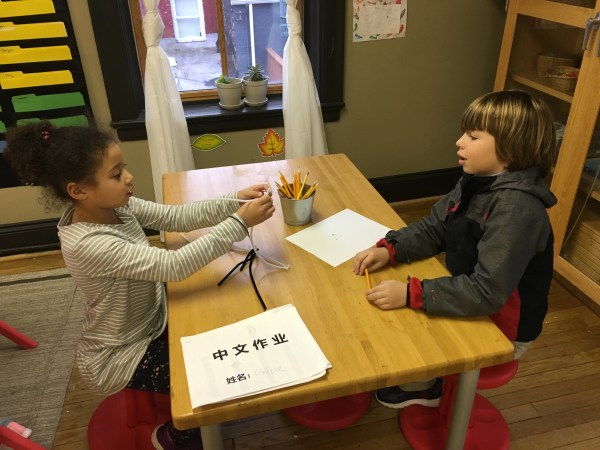
In college, Ms. Biancaniello studied music, so, again, her line to the classroom zigzagged a bit.

I’ve always loved music and performing. I went to school for piano performance but realized that I did not want to be a concert pianist. Instead, I discovered that I really enjoy teaching while I was still in school, so I started teaching piano. I still teach a couple days a week outside of school. So, I had been teaching piano for years and doing a little bit with voice, when, a few years ago, I decided that I wanted to take the next step—I want to do this full time. I began substitute teaching at Friends School and at Calvert School. After a few years, I felt ready to look for a full-time position, and that is how I arrived at TNCS.

In the Classroom

tncs-elementary-teacher-taryn-biancanielloMs. Biancaniello shares the 2nd- and 3rd-grade cohort with Barbara Sanchez, each having 13 homeroom students. Ms. Biancaniello teaches English Language Arts (ELA), Science, and Global Studies. Sra. Sanchez also teaches Global Studies, but in Spanish, as well as Math and Spanish Language Arts. Li Laoshi handles Mandarin Chinese in daily lessons lasting 45 minutes each.
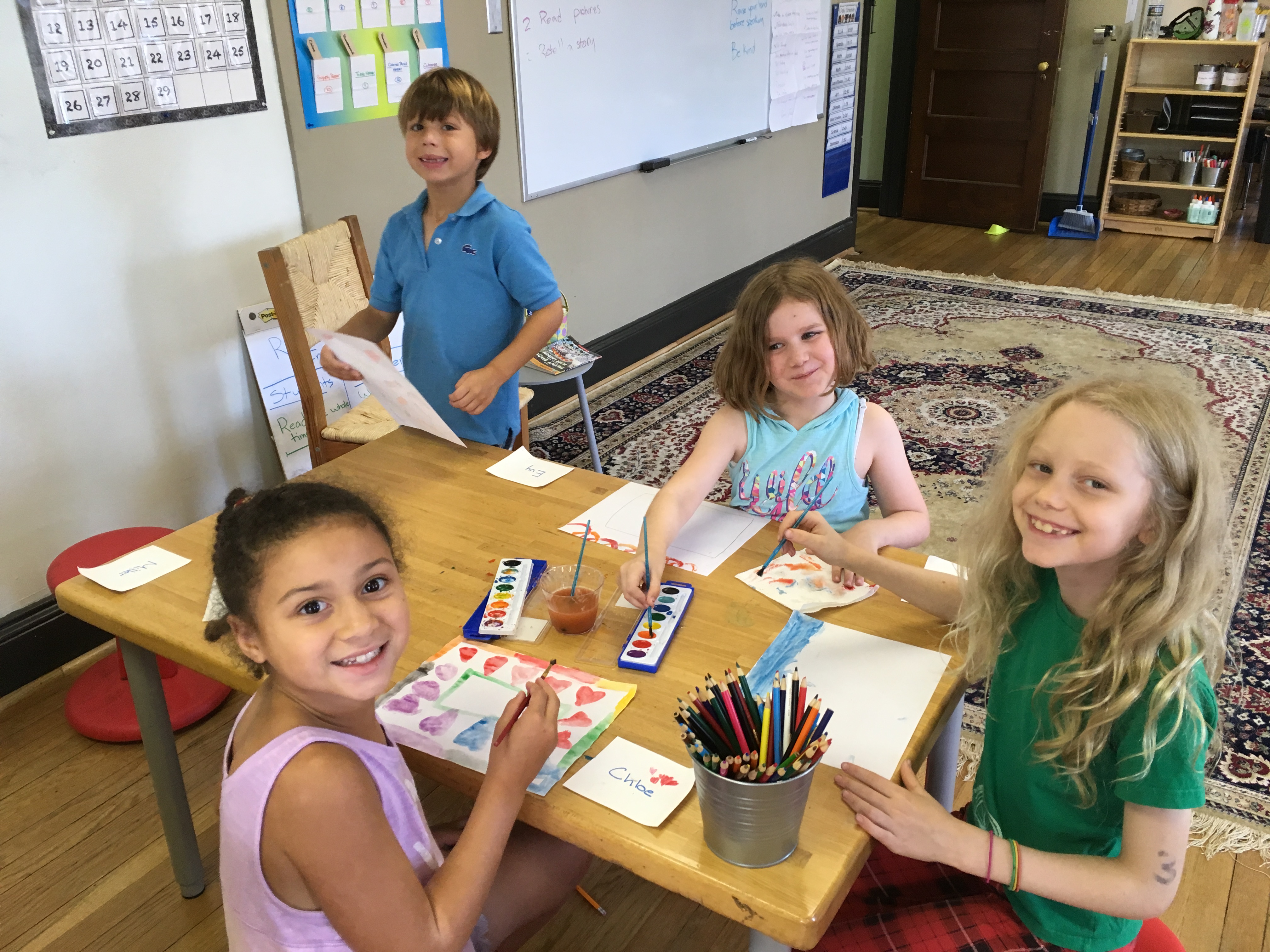
Ms. Biancaniello feels very much at home at TNCS, even as a first-year teacher. Working with multilevel age groups and acclimating to the differentiated learning classroom can be challenging, but she has found this challenge to be, above all, fun. “I really love teaching, and I feel this is a job that you have to be passionate about. It takes time to adjust to the learning curve, and I find myself getting caught up in planning and losing track of time that way, too. Yet, the more I do, the more I know this is the job for me. It doesn’t seem like work.”

tncs-elementary-teacher-taryn-biancaniello

She also dearly loves working with her students and appreciates TNCS’s approach to education. She attributes this good-fit feeling partly to her varied background: “It’s just so much fun, and, especially coming from a background where I really enjoy being creative, I think this is an awesome school, and I love the inquisitive learning.”

The inquisitive learning she alludes to is exemplified in science class, where students work with STEMscopes, a science curriculum. “It introduces an idea and gets the students thinking about that idea and drawing from information they know,” explained Ms. Biancaniello. “Then they do related exercises and experiments, as I give them more information to draw from.” From this hands-on experience and testing, they learn more deeply and certainly retain more than they would in a lecture format. On this basis, this year’s third quarter Science Fair should be better than ever!

In ELA, her main curricular foci are reading, writing, and spelling. “Because everyone is at different levels, we do the Daily 4 or 5 rotations,” she said. “We’re doing novel studies, leveled reading, different spelling and vocabulary work, and working in Successmaker.” At this level, when students are able to articulate ever more complex ideas, writing becomes particularly important. Thus, they are also working on cursive skills, journaling, and creative writing as well as participating in a whole-group writing workshop.

In Perfect Harmony

Reflecting on her experience at TNCS so far, Ms. Biancaniello credits much of her success to her fellow faculty.

For first-time teachers, it can be a bit overwhelming at times, but they say the successful ones have support. That has been such a huge thing for me because I feel like I’ve had such a good team of people, and I do feel very supported. Sra. Sanchez has been a blessing—she has been with me every step of the way—and Adriana DuPrau has been a fantastic mentor. I feel getting to know this group of people has been really amazing. I couldn’t have asked for a better staff to jump in with.

Circling back to an earlier theme, she reiterates the importance of being passionate about work.

I have had so much fun doing this and really do love so much what I’m doing. That’s really important because that’s what makes it fun for the students. The teachers who were most influential to me and had a big impact were the ones who really seemed to care about what they were doing. Those were the classes I was invested in. I particularly love working with these kids, and I hope that’s coming across so that the kids are feeling excited and being inspired to learn. Because, if the drive isn’t there, it doesn’t matter what subject you’re learning. I feel very strongly about bringing the challenge but keeping it really fun, too.

Well said, Ms. Biancaniello! Welcome to TNCS, and keep hitting those high notes!

tncs-elementary-teacher-taryn-biancaniello

Meet the Teacher: Leslie Shaffer Joins TNCS Lower Elementary!

This fall, The New Century School welcomed Leslie Shaffer to teach kindergarten/first-grade for the 2018–2019 school year. Immersed had the pleasure of interviewing her recently and brings you the highlights in this post.

Meet Leslie Shaffer

tncs-k-1st-teacher-leslie-shafferMs. Shaffer is originally from New York state and graduated from Hamilton College in upstate New York in 2015 with concentrations in Government and English. She went on to get a Master’s Degree in Early Childhood Education at Bank Street College of Education in New York City.

Once she was out of college, Ms. Shaffer moved to Connecticut to take a position teaching pre-K and kindergarten at Greenwich Country Day School, in what she says was similar to an apprenticeship program. After 2 years, she returned to New York City to teach kindergarten at the all-girls school Sacred Heart and reports that she thoroughly enjoyed that 1-year experience.

So far, she has not merged her undergraduate Government concentration into her teaching, because once she realized later in college that reading books for fun could be a major, she was hooked. “I took an English class by accident and wound up loving it. It’s now something I use a lot in the classroom, and I’m so excited that I get to do so,” she said.

This past summer, she moved to Annapolis to be closer to family, who have a business on the Eastern Shore. When asked what inspired her to apply to teach at TNCS, she says: “I think a lot of it was the neighborhood. I knew I didn’t want to teach in Annapolis, even though I would be living there. Having just come from New York, I wanted to be in more of a city environment, with more going on. I wanted a little bit of excitement. Annapolis is a lovely place, but it’s not a city.”

The 15 students in her homeroom class plus the 14 students she co-teaches from Pei Ge (“Ge Laoshi”)’s homeroom are contributing to that excitement Ms. Shaffer enjoys. “I love it here,” she said. “I really do. I think what I’ve liked most is that the parents are so interesting, and so the kids are, too. Everyone is traveling to different places, has family in different countries . . .  I think it’s fascinating.”

Ms. Shaffer’s primary subjects are Math and English Language Arts, and she does the Daily 3 or 4 rotation for both (including a snack rotation). Her homeroom students spend the first 1 1/2 hours of the day with her, and then they move to Ge Laoshi’s classroom for Global Studies and Science. The two classes also switch for part of the afternoon. Many of her first-grade students came up through the TNCS primary program, and many of her kindergarteners are new to the school, but everyone has adjusted beautifully, thanks to the built-in differentiation that rotations afford. Says Ms. Shaffer:

I think my favorite parts about being a teacher have always been the small group work and working one on one with a student. I think that the day lends itself so well to having rotations, and although I enjoy my time with them, I make sure they stop at a good amount of independent stations, too. But also there’s always one more, and that’s just with me. I love that part of it.

English Language Arts Class

“In ELA, differentiation is crucial,” explains Ms. Shaffer, “because some of the students coming in could not yet identify all of the letters of the alphabet, while many of the 1st-graders can completely read on their own.” Thus, her ELA class will typically have a rotation that includes her reading with a small group in the “library” (pictured below) and another with her listening to a student reading independently as well as various exercises involving more intensive focus on individual letters. “For those who are still working on letter recognition,” she said, “each week we focus on a letter. For those who can read on their own, this becomes more like coming up with a list of how many words they can spell with the letter of focus.” Most of the books in the K/1 classroom are “decodable,” meaning that there are no tricky sounds or silent letters, to give young learners the chance to gain some confidence before encountering the many exceptions to the rule that comprise the English language.

The best part of the day for Ms, Shaffer takes place in ELA class, with her students circled around her:

My favorite part of the day is always doing a read-a-loud, which, for the past 2 months, has been a Marcy Watson book. They are chapter books, which seems like a lot for kindergarteners to listen to, but because the books are so funny, the students are really, really attentive, even from the beginning of the year.  I think it’s been a good place as well for the kids who are very comfortable reading. Every once in a while, they’ll want to read the next chapter, and the other students still listen to them, which is so nice.

Math Class

The Math curriculum for all TNCS elementary students is Singapore Math. For K/1 students, many who are transitioning from preschool, math class includes manipulatives, but, albeit quite similar, these are from Singapore Math rather than Montessori materials the students would have used in primary.

“The students have mainly been using the base 10 block so far, explained Ms. Shaffer. The 1 is represented by a tiny cube, 10 is a stick, 100 is a block of 100, and 1,000 is a cube. “This system works really well, especially for the 1st-graders, who are doing addition and subtraction, but also for the kindergarteners who are just starting to figure out what the numbers represent.” She is also incorporating bead rings, another way to represent smaller numbers, as shown below.

“They’re doing very nicely,” said Ms. Shaffer, “and we had a professional development training in Singapore Math earlier this year that really helped us understand how to use the materials most effectively.” (More on that in a future post!)


Ms. Shaffer is very much at home at TNCS, and her fascination with people and culture—and learning—makes her an ideal fit for the school. There is one aspect of the day in which her students have the upper hand over her: “They love it when they come back from Chinese class, and they know all these words that I don’t,” she laughed. But even here, she is picking up vocabulary and enjoying the fun of learning right alongside her wonderful students.

Welcome, Ms. Shaffer! Huānyíng (欢迎)!

TNCS Elementary and Middle School Students Do Hands-On Field Research!

At The New Century School, field trips serve multiple purposes: They are valuable  learning and social opportunities, and they are fun—important respites from the classroom. Field trips at TNCS are thoughtfully crafted to effectively support student learning by exposing them to new experiences, increasing their interest and engagement in a topic, and being memorable and useful even long after the visit. They give students both cognitive and affective benefits.

Indeed, research shows that field trips work best when they provide support for students to explore in a personally meaningful way. This is especially true for the sciences. As a shared social experience that provides the opportunity for students to encounter and explore novel things in an authentic setting, a field trip can deepen and enhance classroom study. The National Research Council holds that a quality science curriculum “is one that extends beyond the walls of the classroom.”

Bird is the Word!

During Q1 at TNCS, science focused on two units, Macrobiology and Genetics. Accordingly, elementary and middle school science teacher Nameeta Sharma chose two field trips to align with those units. “The students visited Irvine Nature Center to understand more about the ecosystem and the organisms that live in it through hands-on field research experience,” she explained. “There was an emphasis on adaptation that supports survival.”

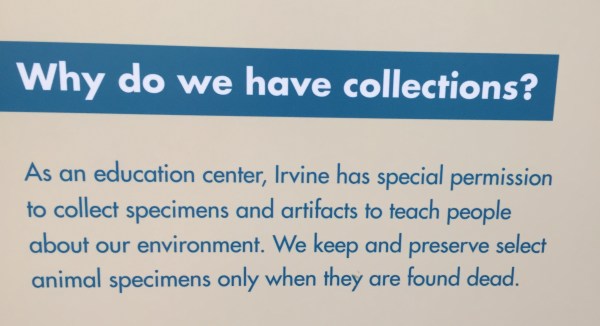
IMG_2007“[Irvine believes it is every child’s right, as an integral part of the natural community, to develop a foundation of academic skills through encounters in the natural world,” according to their website. While there, in two groups, students cycled through activities including hiking; attending a presentation on what makes owls such effective birds of prey (the adaption that Ms. Sharma mentioned); and exploring the interactive exhibits;

They also got the chance to discuss owl adaptations with Ms. Roman in an engaging question and answer session. Some of their contributions are positively brilliant!

IMG_1929
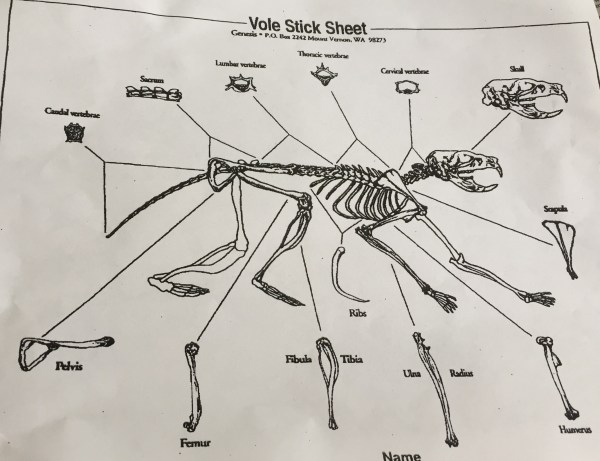
The culminating activity, though, was dissecting owl pellets. Owl pellets are the regurgitated remains of an owl’s meal, including all the bones of the animals it ate (usually small rodents, such as voles). Owls typically swallow their food whole, digest the edible parts, and then expel the indigestible parts through their mouth as a pellet. Owl pellet dissection is a great way to learn about owl eating habits. Naturally, some students were a bit leery of this “gross” activity at first, but curiosity gave way. (And, no worries, parents—the pellets are sterilized in an oven to kill bacteria, and students wore gloves during the dissection and washed their hands right after.) Irvine instructor Diana Roman facilitated.

This slideshow requires JavaScript.

Headed Squidward!

“The visit to the National Aquarium helped students understand biomes,” said Ms. Sharma. “They had a first-hand experience of visiting reefs and tropical rainforests and saw animals and sea organisms in their habitats. They had the opportunity to observe and touch (in some cases) and learn about unique adaptations that help them survive. The trip was also chosen to make students appreciate the bounty of the Chesapeake Bay.”

Here again, the research was “hands on,” as students dissected a squid.

Getting Some Space!

At least two more field trips will take place during the second semester of the 2018–2019 school year. Says Ms. Sharma: “I am happy to inform you that I have scheduled another field trip on January 16, 2019. That trip will take us to NASA Goddard Space Flight Center!”