

A few weeks ago, The New Century School Montessori teachers gave their bi-annual Primary Workshop to provide parents with a firsthand experience of the Montessori approach to pre-K education. But this time, they also added a new twist—how to support Montessori principles in the home.

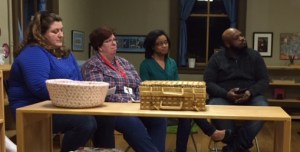
Our illustrious panel of Montessori teachers.
Joining teachers Catherine Lawson, Martellies Warren, Lisa Reynolds, and Maria Mosby, Head of School Alicia Danyali introduced the workshop and was quick to reassure parents that they needn’t run out and “remodel the home with Montessori materials”; rather, “this presentation is to show ways that Montessori can be connected naturally to what you already do in the home.”
Although previous workshops, including in the fall of this academic year, have demonstrated specifically what students are learning and doing during their daily class time, this one did not cover teacher and learning with Montessori materials per se. For those parents who did not attend Montessori school as kids, the materials are a marvel—both eye-opening and fun. For those who did grow up in a Montessori environment, the chance to reacquaint themselves with the materials must evoke the most delicious nostalgia. Maria Montessori developed the Montessori materials based on her extensive observation of children ages 2 1/2 through 6 years. Her goal was to put academic success within their reach by setting realizable achievement milestones, so to do that, she tailored materials to be used the way she saw children interacting with their world. Primary students use these materials nearly exclusively, and seeing how the materials are actually used and learning what each does for the child’s development was the focus of prior Primary Workshops.
As such, the Montessori classroom is a very deliberately “prepared environment.” Every nook and cranny is optimized for both the child’s size and the child’s development (accommodating a range of both, of course). Similar child-optimization can also be accomplished with a little careful tweaking of the existing environment, such as in the home, as the TNCS Montessori teachers went on to demonstrate.
To make the home–school connection, they covered the following four areas.
Part 1
Up first, Mrs. Lawson described how to prepare the interior and exterior of the home and the car, joking that “we aren’t going to force anyone to set up this way. No one is coming to your home to check on you! But we’re trying to teach independence, and here are some ways you can further this at home.”
Entryway
- Install low hooks for children to hang up their own coats or use child-sized hangers so they can hang their coats with everyone else’s (Mrs. Lawson showed an old, well-loved hanger one of her daughters had decorated for this use).
- Create a place to put wet boots and dirty shoes.
- Designate a place to keep lunch boxes, backpacks, and other regularly used gear.
Living Room and Family Room
- Make these areas child friendly so children feel welcome—said Mrs. Lawson: “Children like to be where their parents are, but they need their things handy also.”
- Make books available in every room, if possible, with a bookshelf or basket to hold them.
- Keep some toys available for use in an organized way, which encourages easy clean up:
- Use low bookshelves or the bottom shelf of a television cart to hold toys.
- Give each particular toy a place on the shelf. Place activities with many pieces in dedicated holders (e.g., shoe boxes, baskets, etc.).
- Offer limited choices of activities that fit on the shelves provided, and rotate the toys when interest wanes.
- Use a bathmat, throw rug, or bath towel for the child’s designated activity area, à la Montessori.
- Although these might be hard habits to break, try to avoid:
- Using a toy box or big basket that holds many toys because children can get overstimulated with too many choices.
- Allowing the child to play with many toys and then doing a big clean-up. Instead, encourage playing with one toy and putting it away before moving onto the next.
Bedroom
- Make books available in every room, if possible, with a bookshelf or basket to hold them.
- Use low shelves for children’s toys and activities:
- Each toy should have its own place, and rotate toys as necessary.
- Only have bedroom-appropriate toys in the bedroom because you will not always be present to supervise. Markers, for example, are not a good choice!
- Keep a laundry basket handy that allows the child to dispose of his or her own dirty clothes each night.
- If possible, install in the closet an easy-to-reach rod and child-sized hangers.
- In the dresser, place season-appropriate clothes in the lower drawers so the child can choose the clothing and dress him or herself.
- Install a bulletin board at the child’s eye level to display pictures of family members, artwork, postcards, etc.:
- When they are reading, post reminders about things or just love notes.
- Add a calendar to mark off days.
- Consider using a comforter instead of a bedspread on the bed. Let it be the child’s job or to help pull up the comforter each morning.
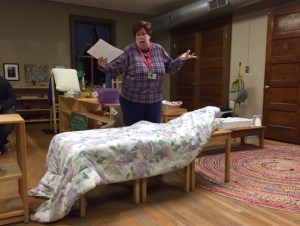
“It hides the wrinkles and looks tidy even if it isn’t perfect,” demonstrated Mrs. Lawson.

Outside
- Make a place for outdoor toys (not just a big plastic tub for everything), such as a laundry basket.
- Have opportunities for gardening (i.e., digging in the dirt) available.
Car
- The car is an extension of home for many commuting families. Make it a happy environment with car-appropriate activities:
- Books
- CD of music or stories
- DVDs
- Activity books (avoid crayons, which melt)
- Keep a supply of snacks and drinks on hand. Make a snack bag that allows the child to decide when and how much to eat (this encourages responsible decision making and avoids a power struggle).
- For longer trips, consider making a goodie bag filled with tissue paper–wrapped activities or toys (they can be new things or things from around the house, e.g., rubber ducks, trucks, sticker books).
Part 2
Mr. Warren spoke next. “My part of today’s presentation is on allowing for mistakes. A huge part of Montessori and overall development is making mistakes.” He read essential parts from “Mistakes and Freedom,” an article published by The Center for Guided Montessori Studies and starting with this famous quote by Dr. Maria Montessori:
“It is a commonplace that the child must be free. But what kind
of freedom has he been given? The only true freedom for an
individual is to have the opportunity to act independently. That
is the condition sine qua non of individuality. There is no such
thing as an individual until a person can act by himself. The
instinct guiding the child to seek his independence thus leads us
to realize what the whole of nature demonstrates – that any sort
of association is composed of separate individuals. Otherwise
there would be no such thing as societies, but only colonies.
Education must foster both the development of individuality
and that of society. Society cannot develop unless the
individual develops, as we learn from observing the child, who
immediately uses his newly won independence to act on a social
environment.”
Read the article in its entirety here: http://www.guidedstudies.com/2011/04/mistakes-and-freedom/.
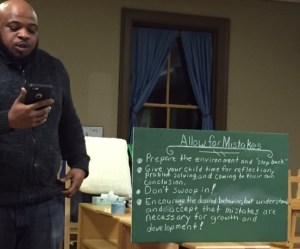

- Prepare the environment and step back.
- Give the child time for reflection, problem-solving, and coming to their own conclusions.
- Don’t swoop in!
- Encourage the desired behavior, but understand and accept that mistakes are necessary for growth and development!
Part 3
Next up, tying into Mr. Warren’s theme, Mrs. Reynolds discussed the difference between praise and encouragement and how to allow children to cultivate the courage to be imperfect. “I like praise,” she joked, “it’s like candy.” Audience laughter ensued. “But what is the long-term effect,” she asked? “Children who are praised choose less challenging work.” That might seem counterintuitive—it’s why we praise our kids, after all, to ostensibly build up their self-esteem—but studies are unequivocal in demonstrating that our good intentions are having deleterious effects.
Mrs. Reynolds brought up the example of kids’ art, which parents can tend to gush over, even when what is depicted is basically a scribble. Not only does this signal to the child on some level that he or she doesn’t need to really try hard to make something praiseworthy, but the praise itself also becomes less meaningful.
The upside is, said Mrs. Reynolds, “Children who are encouraged for their efforts are willing to choose more challenging tasks on their own.” Encourage the deed, rather than praising the outcome. “Show respect for and interest in the child’s point of view.” Also, make sure to provide opportunities for the child to develop his or her life skills, such as making the bed. (Recall from Part 1, though, that the idea is to set the child up for success by “preparing the environment.” See above.) This will help the child develop self-confidence and independence, as well as independence from the negative opinions of others.
“Who doesn’t want that for their children?” she concluded.
Part 4
Ms. Mosby then took up the thread of independence by presenting specific ways that parents can give children these opportunities at home. “Have you ever been approached by your children while your cleaning the house because they want to help?” she asked. Our tendency can be to brush aside these offers as sweet, but not really very helpful because we want an actually clean outcome for our efforts. But, this is exactly the time, explained Ms. Mosby, to tap into that natural excitement and teach them how to tackle some of these household tasks before they become too jaded to want to help. Sure, the results might not be perfect, but the ultimate reward of cultivating independence and a fundamental helpfulness in your child will outweigh this temporary downside.
She went on to tell parents how eager her students are to help clean the classroom and how she seizes those opportunities to both accept the help as well as teach the correct methods. “All of the materials I’m showing you are things you’ll already have around the house, such as dust cloths, dustpans, and plastic bins to wash dishes or other items ‘the old-fashioned way’.” (She gave parents the helpful tip that her students love polishing tables and will rub the polish practically off in their zeal for this task.)
Kids are also natural sous chefs—they love to help make their lunches, for example, such as by spreading ingredients on bread and peeling vegetables. Learning to use kitchen implements also helps them develop their fine motor skills. They can also be recruited to put dishes away. “Let them know you trust them,” said Ms. Mosby, ” and start with unbreakable pots and pans in a low cabinet, progressing as the child is ready to more fragile dishes.”
They can also help with pets. “They love to have another little someone to care for,” said Ms. Mosby. Let them brush the cat or dog and help put out the food and water. They can even help with younger siblings and get practice with gentle care in the classroom with babydoll models.
The garden or backyard is another area where kids can be a huge help, whether with cleaning up or actual gardening. A “pooper scooper,” she pointed out, makes a great child-sized leaf picker-upper.
Resources
Head of School Alicia Danyali offers the following resources “to support your family’s educational journey” with a young learner.
Books
- The Child in the Family, by Dr. Maria Montessori
- Positive Discipline for Preschoolers, by Jane Nelson
- Child of the World: Montessori, Global Education for Age 3-12+, by Susan Mayclin Stephenson
- How to Raise an Amazing Child the Montessori Way, by Tim Seldin
- The Whole-Brain Child, by Daniel J. Siegel and Tina Payne Bryson
- How to Talk So Kids Will Listen, and How to Listen So Kids Will Talk, by Adele Farber and Elaine Mazlish