

The New Century School cares about nothing so much as quality education, so when the “Kirwan Commission” was established in 2016, TNCS took note. In fact, just last week, Head of Lower School Alicia Danyali, who is involved in advocacy for this initiative, attended a presentation and was motivated to share her thoughts about what she witnessed.
“Dr. Kirwan worked with the National Center on Education and the Economy (NCEE). to identify building blocks of high performing schools around the world for 1 year,” said Ms. Danyali. “During his year with NCEE, he researched gaps in Maryland, which led to the Kirwan recommendations.”
What’s the Kirwan Commission?


Maryland Association of Boards of Education (MABE) puts it like this: “The Kirwan Commission on Innovation and Excellence in Education is a multi-year initiative to research and develop major funding and policy reforms to improve the quality of Maryland’s public education system to benefit all of the more than 790,000 students, which will in turn benefit the State’s economy and quality of life for all Marylanders.”

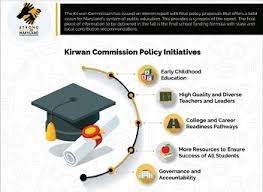
Key Policy Areas
The Kirwan Commission has a two-pronged goal: 1) Make policy recommendations that will improve Maryland schools performance overall, and 2) propose changes to current funding formulas for schools.


Interim Report

Benefits for All Marylanders
That price tag—sounds like a lot to ask? Not when you consider the potential return on investment (ROI) study done by Strong Schools Maryland and the Sage Policy Group. along with David Hornbeck, another Marylander with a stellar career in education. “Mr. Hornbeck is gathering facts and statistics to support getting this bill passed,” said Ms. Danyali. For example, 12% more moms would return to the workforce if preK were more widely available. With a well-educated population, prison expenses as well as Medicaid expenses drop, because individuals are employed. The bottom line is, by 2046 the ROI is projected to be $6.3 billion—that’s a lot more than the initial outlay.


Educating youth, starting at very young ages, and valuing educators has multiple advantages: individual empowerment; healthy, more sustainable communities; and a robust statewide economy. (Read the full Executive Summary.)
Kirwan’s Presentation
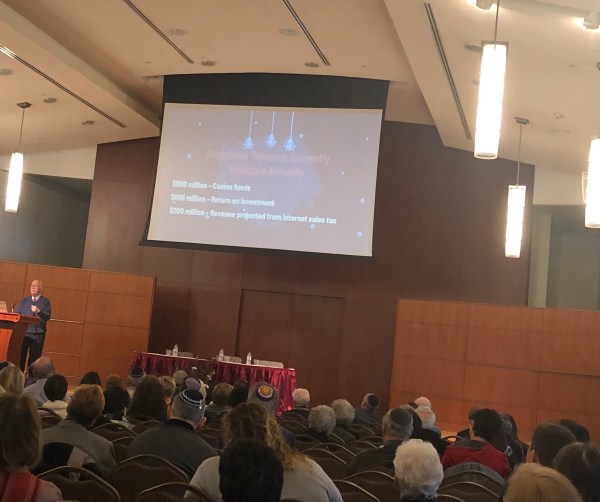

Some of Dr. Kirwan’s speech really resonated with Ms. Danyali:
This is the right vision and focus to match needs and prepare students for the current work world and for the future. We have to be as good as the best. There are many good schools and superb teachers, but not enough—47% of MD teachers leave the profession after 2 years due to lack of compensation and support. Students need to perform at a grade 10 ELA and have completed algebra 1 to graduate, but only 40% of MD students meet this criteria. We can’t allow this to stand. It’s unacceptable. We need to make education a high-status profession. If we do not shift this point, there is no point.
Want to Take Action?
The 2020 legislative began Wednesday, January 8th, and there will be multiple opportunities to make your voice heard. Here are a few:
Join StrongSchoolsMaryland in Annapolis: http://bit.ly/AnnapolisSignUp
Join the StrongSchoolsMaryland email list: http://bit.ly/ssmsignup
Get your voice counted for fixing the funding gap: https://www.strongschoolsmaryland.org/email-your-leaders
The legislation goes to vote on April 6th, and this is it. Another such commission will not be possible within this decade and maybe even the next. The time is now to stand for great education for all Marylanders. “It doesn’t matter if you’re public or private,” said Ms. Danyali. “This is going to affect every school in some way.”