

At The New Century School, Montessori instruction not only defines the primary classroom for students ages 3- to 5-years old, but Montessori principles are the bedrock on which TNCS was founded. Although only the primary classrooms are classically Montessori, its importance at TNCS cannot be overstated. Students who start at TNCS in their primary years and progress through the upper divisions find that their elementary and middle school classrooms retain much of the Montessori character in terms of mixed-age classes; an inquiry-driven, student-led approach, and an emphasis on courage, compassion, respect, and service to and for schoolmates and staff.
Because there’s a lot to the Montessori method, TNCS hosts two workshops annually to allow parents to get the full picture of how it works. Last fall, primary teachers Lisa Reynolds, Elizabeth Bowling, Maria Mosby, and Yanyang Li hosted the first of these annual workshops, covering many areas of the Montessori classroom, including the Work Cycle, Practical Life, the Montessori Skillset, and other broader concepts.


This current workshop focused on the tools and lessons that Montessori students use to learn Geography and Science, Math, and Language as well as their primary vehicle for learning—their five senses: “The senses, being explorers of our world, open the way to knowledge,” wrote Maria Montessori.
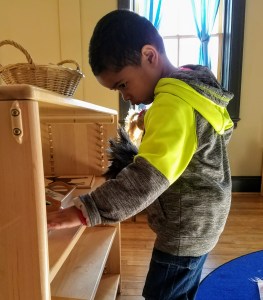


In a Science and Geography activity (known as a “work”), for example, a student might put together a globe puzzle, calling on his or her sensorial training to understand sequence, order, and beauty to successfully complete it (with complete absorption, no less), or match Ancient Egyptian names with figures. Cultural awareness also begins to develop here; in Montessori, concepts begin very concretely to enable to child to fully grasp them before being naturally drawn to extrapolate them to more abstract ideas.


This is nowhere more true than in Math: “Process is taught first, and facts come later. Order, coordination, concentration, and independence are experienced by the child using [Montessori math] materials.” The materials are organized into five groups:
- Group 1 introduces sets of 1 through 10, which prepares the child for counting and teaches the value of quantity. Children begin to associate numeral and quantity with number rods and number cards and will gain a growing understanding of sequence. To reinforce the 1 through 10 concept, a teacher may add spindle boxes, cards and counters, the short bead stair, and other 1-to-10 counting activities.
- Group 2 involves the decimal system using the golden bead material. Children become familiar with the names of the decimal categories: units of 10s, 100s, 1,000s, and so on. A concrete experience with each category is represented by beads, and quantity will be followed by symbol and association.
- Group 3 deals with the operations using the golden bead material. The concept and process of addition, subtraction, multiplication, and division are presented. Children work with each other and benefit from these exercises using the bank game. Progression then continues using operations with the stamp game.
- Group 4 consists of linear counting. Quantity is presented using the teen and 10 boards, followed by symbol and association. The 100 board and bead chains develop number concepts and recognition of numbers 1 through 100. The bead chains also introduce the child to skip-counting—5, 10, 15, 20, etc., for example.
- Group 5 contains activities such as strip boards, the snake game, and memorization of facts. Fractions are also a part of this group. Fraction skittles and insets serve this purpose.


The activities in the math area are not to be implemented at a set pace. Providing students with the materials at precisely the right challenge level will enable them to demonstrate their development to the teacher through their progress. A child who is able to grasp such math concepts as addition and subtraction demonstrates a successful use of the math materials.
“The only language men ever speak perfectly,” Maria Montessori wrote, “is the one they learned in babyhood, when no one can teach them anything!” Thus, language is possibly the area of the Montessori classroom accorded the most space, focusing first on oral language and vocabulary, then writing, and finally reading. From birth to age 6, children are in an exquisitely sensitive period for language development. They absorb multiple languages effortlessly and without direct instruction. The latter half of this plane of development is when they exhibit a strong interest in words.
- The oral language curriculum focuses on activities that enrich the child’s vocabulary and ability to isolate phonetic sounds, such as having conversations, telling and reading stories, playing sound games, and working with vocabulary cards.
- Children are typically interested in the practice of writing and often learn to write before they can read. The writing curriculum focuses on preparing the mind and the hand for writing activities through sensorial exercises and manipulatives.
- A child prepared to begin reading will demonstrate this by first blending phonetic sounds. After much work in this area, the child will begin to work with phonograms, digraphs, and finally puzzle words (sight words). All of this work is done using sensorial objects that the child can manipulate and relate to words.


