

Since its inception in 2007 (back then known as Patterson Park Montessori) as a preschool for kids ages 2–5 years, The New Century School has “grown up” right along with its student body. Adding a grade level each year to accommodate the earliest students and expand its scholastic reach, TNCS currently offers classes through 3rd grade. The 2013–2014 year will add 4th grade, and so on annually through grade 8. Watching this growth unfolding and the school really come into its own has been an exciting process for staff, students, and parents.
But what is elementary in a Montessori setting? Many find those concepts incompatible. In elementary school, after all, students are expected to achieve standardized goals, which, at its worst, can result in lecture after boring lecture masquerading as education. In the Montessori model, however, the classroom has much more relaxed parameters that allow room for voluntary exploration at an individual pace but that some say might not always be quite so academically rigorous. Let’s take a closer look at how TNCS has harmoniously merged these seemingly antithetical approaches to create an environment where real learning happens . . . and where kids want to be. They have choice, variety, and a say in their own education. Most importantly, they learn how to think.
First, it’s important to point out that for primary through elementary age groups, TNCS isn’t classically Montessori. Rather, they take the best of Montessori, such as fostering self-discipline and encouraging intellectual curiosity, and couple it with a profoundly progressive approach to education that includes a focus on foreign language acquisition, to forge something completely new. This unique blend grew out of a desire to provide the optimal learning environment. Alicia Cooper-Danyali, Head of School, says, “Our Lower Elementary program (grades 1–3) focuses on the strength of meeting individual needs of mixed-age abilities, development of both Spanish and Mandarin, and true community building.”
Above all, learning should be an active process in which students are engaging with intriguing material, not a passive one in which they absorb factoids. TNCS is not education by osmosis; it’s a fruitful collaboration between student and teacher and among students themselves.
Here are some ways TNCS seeks to achieve this goal:
- Small class size: The benefits to kids of individualized, differentiated instruction are innumerable. Kids are as different from one another as snowflakes, and their methods of learning are just as varied. Small class sizes allow teachers to customize each child’s education for the best, most effective fit.
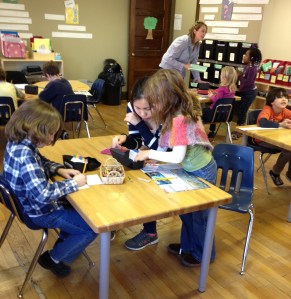
The smoothly functioning TNCS elementary classroom is a marvel of productive learning.
- Enhanced learning via technology: Students in Lower Elementary use SuccessMaker and other state-of-the-art educational software daily to hone math and reading skills. They not only love this work, but the software programs are carefully aligned with national education standards, so the students are getting the foundational knowledge that secondary schools will require. Upper Elementary students will additionally learn basic computer programming.
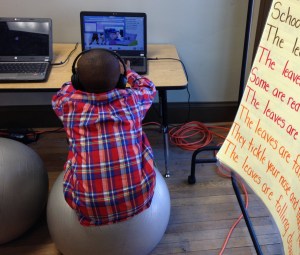
Strengthening his core curriculum skills on the computer while strengthening his core on a balance ball!
- Inquiry- and skill-based curriculum: A solid foundation in the core subjects allows teachers to develop science and global studies lessons based on student questions and interests. Being interested from the outset ensures students’ close attention and deepens their learning.
- Mixed-age classrooms: Grouping students of various ages allows children to work at their skill level, not just their grade level. If they need more time with a particular concept, they get it. Likewise, when something clicks right away, they don’t need to wait for the rest of the class to catch up to them before moving ahead to the next wondrous topic of exploration. Mixing ages also continues the Montessori tradition of mentor–mentee relationships, which are mutually beneficial for social, intellectual, and emotional development.
- Spanish and Mandarin classes: Where else are students given daily lessons in both of these languages critical to global citizenship? They learn conversation, reading, and writing at a time when their brains are elastic enough to achieve real fluency with relative ease.
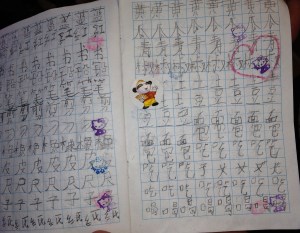
Chinese characters practice–Hello Kitty and friends signal a job well done!
- Music, art, and physical education classes: On staggered days, students get weekly or twice weekly instruction in these areas so important for encouraging creativity, self-expression, and overall physical and mental health. In an atmosphere of looming federal budget cuts—some of which will surely impact education—U.S. public schools may find that they lack the funds to keep the humanities in their curricula, sadly.
- Field trips: The on-site greenhouse established by Master Gardener Emma Novashinksi affords plenty of opportunity for scientific investigation of all stripes. Lower Fell’s Point, TNCS’s “extended campus” additionally provides community involvement opportunities to broaden students’ social and environmental awareness.
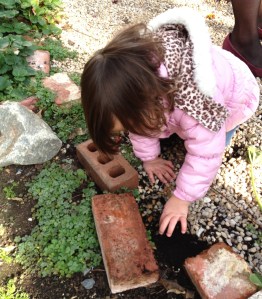
In hot pursuit of a particularly interesting caterpillar!
- Emphasis on values: Students at TNCS learn to treat themselves and others with respect. By the time they have reached the elementary level, this really shows. Peace, compassion, and kindness pervade the smoothly functioning elementary classroom.


Still have questions? Comments? Please let us know your thoughts in the comments section—we value your participation in this discourse! By the way, are any of your TNCS elementary kids among the original students from 2007? Let us know!
Also, did you know? TNCS is hosting an Elementary Information Night on Thursday, January 17, 2013 from 6:00–7:30 p.m. for current and prospective families. This will be the ideal opportunity to familiarize yourself with TNCS’s elementary programs, to ask questions, and to hear other families’ experiences.
TNCS cofounder Roberta Faux will offer a brief keynote talk, and free childcare is available. Click the above link to find out more and to RSVP. You don’t want to miss it!